Formosan Lady's Slipper Orchid
Cypripedium formosanum
The Gardening Year
Best months in UK gardens · full planting calendar →
🖨 Printable care card (PDF)At a Glance
| Botanical name | Cypripedium formosanum |
|---|---|
| Common name(s) | Formosan lady's slipper orchid |
| Family | Orchidaceae |
| Plant type | perennial (rhizomatous geophyte) |
| Height × Spread | 10–25 cm × 10–50 cm |
| Position | Partial shade |
| Soil | moist, fertile, leafy, humus-rich slightly alkaline soil |
| Flowering | April–August |
| Toxicity | Potentially harmful Skin allergen. Wear gloves and other protective equipment when handling |
| Native range | Taiwan |
Cypripedium formosanum, the Formosan lady's slipper orchid, is a hardy terrestrial orchid from the mountains of Taiwan. Among the slipper orchids it is unusually amenable to UK cultivation: compact, spring-flowering and well-behaved in a cool, shaded woodland bed, it has earned the Royal Horticultural Society's Award of Garden Merit and remains the most widely grown Asian member of its genus in British gardens.
Overview
Cypripedium formosanum is a diploid, deciduous orchid first described in 1916 by the Japanese botanist Bunzo Hayata, from material collected in the central mountains of Taiwan. The species is endemic to that island, where it grows in damp coniferous and broadleaf forest, mountain bogs and seepage slopes at 2,000–3,000 m altitude. In the wild it is now considered Endangered on the IUCN Red List, and all members of the genus are listed under CITES Appendix II, which controls international trade. Gardeners in Britain should only buy nursery-propagated stock and should never attempt to lift plants from the wild.
In UK gardens it behaves as a hardy, slow-growing perennial that emerges in early spring, flowers before the leaves of many deciduous trees have opened, and retreats underground by late summer. A position in dappled shade with humus-rich, free-draining woodland soil is the foundation of success. The plant is unglamorous for most of the year and spectacular for a brief fortnight in spring; gardeners who enjoy early snowdrops, hepaticas and hellebores tend to be the ones who appreciate it most.
Appearance
The plant grows from a short, shallow rhizome that pushes up a tightly furled bud in early spring. The bud opens to reveal two (sometimes three) opposite, broadly fan-shaped leaves that are bright, slightly glossy green and conspicuously pleated along their length. The leaf surface and the veins carry fine hairs, giving the foliage a softly downy appearance that is unusual among hardy slipper orchids. Mature leaves commonly span 8–15 cm across when fully expanded.
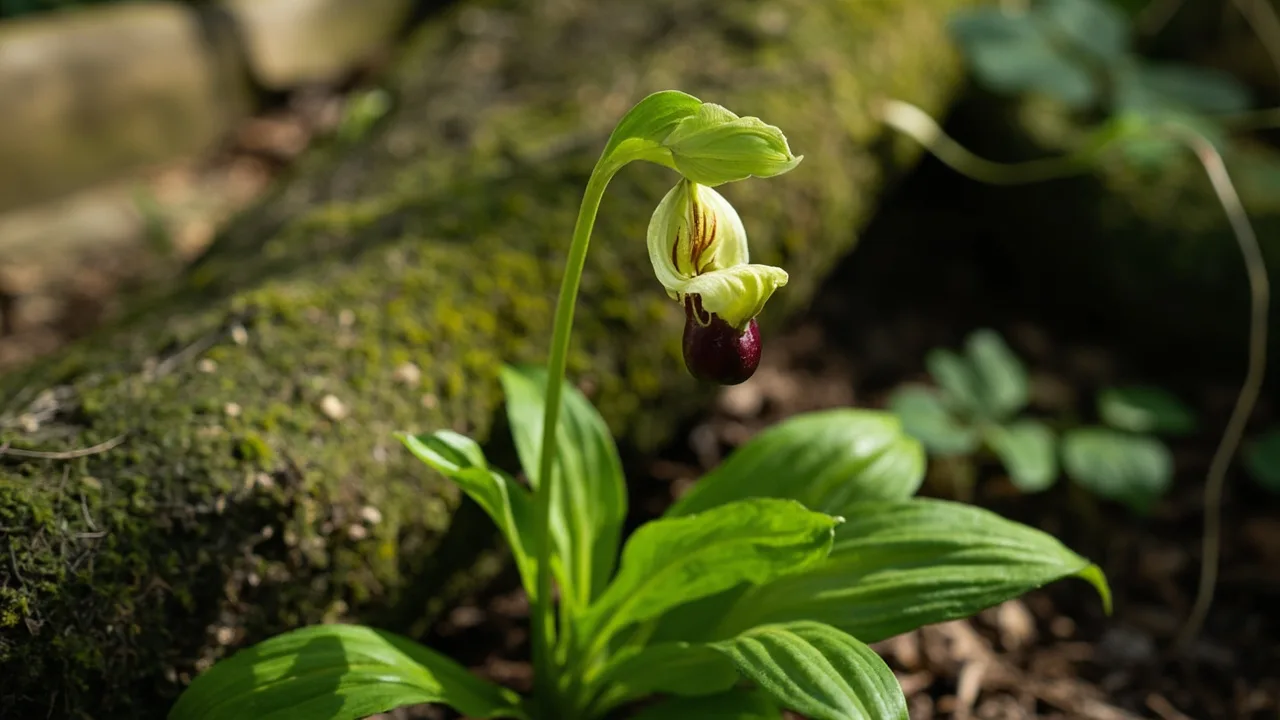
Flowering stems reach 10–30 cm in British cultivation, occasionally a little taller on richer soils. Each strong stem carries a single flower (occasionally two in well-established clumps), held clear of the leaves on a short, downy stem. The flower is the characteristic inflated pouch of the slipper orchids, 4–7 cm across, white to palest pink and finely speckled inside with maroon or deep-pink dots. Above and around the pouch, the dorsal sepal and the two twisted lateral petals are greenish-white, veined and lightly washed with maroon. Flowering in the UK is from late March into May; in a mild spring the first flowers can open alongside snowdrops and winter aconites, before many spring bulbs have finished.
The rhizome is shallow, brittle and fleshy. It resents disturbance, which is why established clumps are usually left in place for many years. Seedlings are slow: a young plant typically takes two to five years to reach flowering size, and the flowering clump only gradually increases thereafter.
Growing Conditions
Light is the first consideration. Cypripedium formosanum wants dappled shade or part shade and scorches quickly in strong midday sun, particularly on a south-facing border or against a hot wall. A north- or east-facing slope beneath deciduous trees, the cool side of a shrub border, or a shaded raised bed all work well. The canopy of light deciduous trees is ideal because winter rain soaks into dormant ground and the emerging shoots receive the brighter spring light before the leaves come out.
Soil should be humus-rich, moisture-retentive yet sharply drained, and slightly acidic to neutral (approximately pH 5.5–6.8). A mix of leaf-mould, loam, sharp grit and well-rotted bark closely replicates the Taiwanese forest floor. Heavy clay is unsuitable unless it is extensively remade into a raised, free-draining bed. Thin, dry chalk is also unsuitable because summer moisture cannot be held reliably. A mulch of leaf-mould or pine-needle litter applied annually in autumn maintains the humus content and helps to buffer moisture and temperature around the shallow rhizome.
Moisture must be steady through the growing season and the rhizome must never be waterlogged, especially in winter. Sites that hold standing water in the dormant months are fatal; cold exposed sites where late frosts penetrate are also unsuitable. Container culture in a deep terracotta or plastic pot, in a coarse bark / pumice / loam mix, is a sensible alternative where garden soil is wrong. Keep the pot shaded and cool, and protect it from prolonged winter wet under an open-sided canopy.
Planting and Care
Plant container-grown or bare-root stock in autumn (October–November), when the plant is fully dormant, or alternatively immediately after flowering in late spring while the plant is still in active growth. Specialist nurseries in the UK usually ship bare-root plants in early autumn. Soak the root ball before planting, tease the roots out gently and lay them horizontally in the top 10 cm of prepared soil. Set the rhizome 2–3 cm below the surface so that only the tip of the emerging bud is visible at planting time; deep planting is one of the most common causes of failure. Space plants 20–30 cm apart, water in well, and mulch with 2–3 cm of leaf-mould.
Watering during the first two growing seasons is the most demanding part of aftercare. Supplementary watering is needed during summer drought, particularly under trees that draw heavily on surface moisture. Once established, the plant is more self-sufficient but should never be allowed to dry out completely while in active growth. Reduce watering as foliage yellows in late summer and keep the rhizome only just moist through winter; saturation is more dangerous than dryness at this stage.
Feeding should be light. An annual top-dressing of leaf-mould in autumn, supplemented by a single weak dose of balanced fertiliser in spring, is sufficient on reasonable soil. Over-feeding produces lush, soft growth at the expense of flowering and can predispose the plant to rot. High-nitrogen feeds, fresh manure and rich garden compost placed against the crown should all be avoided.
No routine pruning is required. The flowering stem should never be cut for indoor display: it is the season's entire display and removing it weakens the rhizome. Allow the foliage to die back naturally in late summer and only then tidy the yellowed stems down to ground level with clean secateurs. The annual leaf-mould mulch is the main seasonal task, along with vigilance against slugs from late winter onwards.
Propagation is best left to the nursery. Commercial stock is almost entirely seed-raised or meristem-propagated. Home division is possible in early autumn on established clumps but each piece must carry a sound section of rhizome with at least one viable bud; divided plants sulk for one to two seasons afterwards and the technique is not recommended for beginners.
Common Problems
Slugs and snails are the principal UK pest. The new shoot emerges in early spring when slugs are at their most active, and they will graze the shoot tip and destroy the flower bud in a single night. Use ferric phosphate pellets, copper rings around the crown, or night-time hand-picking from late February onwards.
Aphids can colonise flower buds and the undersides of leaves in late spring. They are easily displaced with a jet of water or treated with insecticidal soap if the infestation is heavy. Vine weevil is uncommon but damaging in containers: tip the root ball of any plant that loses vigour without obvious cause and inspect for the white, C-shaped larvae against the root tips; treat affected pots with Steinernema kraussei nematodes.
Fungal rots caused by Pythium and Rhizoctonia are nearly always a soil problem rather than an airborne infection. They follow waterlogged or poorly drained conditions, deep planting, or heavy mulch piled over the crown. The cure is prevention: improve drainage, reduce watering and replant at the correct depth in fresh, open medium if a salvageable specimen can be lifted.
Virus diseases, including Cypripedium mosaic virus, have been recorded in cultivated stock. There is no cure and infected plants should be isolated to protect neighbouring orchids. Tools should be sterilised between plants and new stock bought only from reputable specialist nurseries.
Bud abortion, sometimes called "shepherd's crook", is a cultural problem: the new shoot emerges but fails to straighten and open. It usually follows late frost, irregular moisture or planting too deep. A non-flowering established plant is most often a young specimen or one growing in too much shade on too rich a feed. Patience is the main remedy; reducing shade and feed over several seasons will often restore flowering once the plant has matured.
Popular Varieties
There is essentially only one widely grown taxon in UK gardens: the species Cypripedium formosanum itself. No established subspecies, cultivars or named clones of C. formosanum are in mainstream cultivation. Gardeners seeking variation should look to inter-species hybrids, several of which are easier to obtain and easier to grow than the species itself. Cypripedium 'Formi' is a registered trade name occasionally listed by nurseries, but it is a hybrid selection rather than the true species and should not be confused with it.
Among inter-species hybrids that are widely available in the UK and that share the same woodland conditions, Cypripedium ×ventricosum (from C. calceolus × C. macranthos), Cypripedium Gisela gx and Cypripedium Ulla Silkens gx all offer similar early-spring flowering on plants that are generally more tolerant of garden soil than the parent species. These are separate grexes with their own parentage and should be recorded as such, not used as substitutes for C. formosanum.
When buying any slipper orchid, prioritise legally propagated nursery stock with a clear botanical name, a healthy root system and ideally a culture sheet. Avoid plants without a propagation record, plants offered without a botanical name, and any supplier who cannot confirm that the stock has been raised in cultivation. Accurate provenance is the foundation of both successful cultivation and the conservation of wild lady's slipper populations.
Pests and Diseases
| Problem | Symptoms | Management |
|---|---|---|
| Root rot | Leaves turn yellow and wilt while the crown or roots become soft, mushy, and discoloured. | Ensure excellent drainage with a gritty compost mix and avoid overwatering, especially in winter. |
| Slugs and snails | Irregular holes chewed into leaves or seedlings eaten entirely, often accompanied by slime trails. | Use physical barriers like copper tape or apply iron phosphate-based pellets around the base. |
| Vine weevil | Notched edges on leaves above ground and larvae feeding on roots underground, causing plant decline. | Apply nematodes to the soil in autumn or use systemic insecticides if infestation is severe. |
| Powdery mildew | A white, powdery fungal growth appears on the upper surfaces of leaves. | Improve air circulation and spray with a suitable fungicide or bicarbonate solution if necessary. |
| Leaf spot | Circular brown or black spots develop on leaves, sometimes surrounded by a yellow halo. | Remove affected foliage and avoid wetting the leaves when watering to reduce fungal spread. |
For step-by-step help, read Dealing with Slugs and Snails, Treating Powdery Mildew and Tackling Black Spot on Roses. Or browse the full plant problem solver to diagnose an issue by symptom.
Recommended Products
GardenWizz earns a commission from qualifying purchases made through affiliate links on this page (including links within the article) — as an Amazon Associate, and from Thompson & Morgan via the Awin network. This does not affect the price you pay. See our disclaimer for details.