Chenille Plant
Echeveria leucotricha
The Gardening Year
Best months in UK gardens · full planting calendar →
🖨 Printable care card (PDF)At a Glance
| Botanical name | Echeveria leucotricha |
|---|---|
| Common name(s) | Chenille plant |
| Family | Crassulaceae |
| Plant type | succulent (Evergreen perennial; polycarpic (flowers and sets seed many times over lifetime).) |
| Height × Spread | 10–50 cm × 10–50 cm |
| Position | Full sun |
| Soil | Well-drained; sandy, slightly acidic; peat-free cactus compost |
| Flowering | June–August |
| Toxicity | — |
| Native range | Mexico and central and southern America |
Overview
Echeveria leucotricha is a Mexican succulent in the stonecrop family (Crassulaceae), grown for its compact rosettes of fleshy green leaves densely covered in soft white hairs. It is closely related to Echeveria pulvinata and is treated by some authorities as Echeveria pulvinata var. leucotricha. The common name chenille plant refers to the downy, almost plush texture of the foliage. In the United Kingdom it is a tender houseplant or conservatory subject for most of the year, happiest under glass where light is bright and the air stays dry.
The plant's main appeal is textural: in a mixed succulent bowl or on a bright windowsill the white-haired rosettes provide a strong contrast to glossy, smooth-leaved neighbours. In summer, mature plants push out arching stems of bell-shaped orange-red flowers, which sit well above the foliage. Given a cool, frost-free winter rest, an established plant will flower freely year after year.
Because it is tender and slow-growing, E. leucotricha is best understood as a long-term container plant rather than a garden specimen. With careful watering, bright light and restraint in winter, it can be kept in good condition for many years, slowly branching into a short, shrubby clump.
Appearance
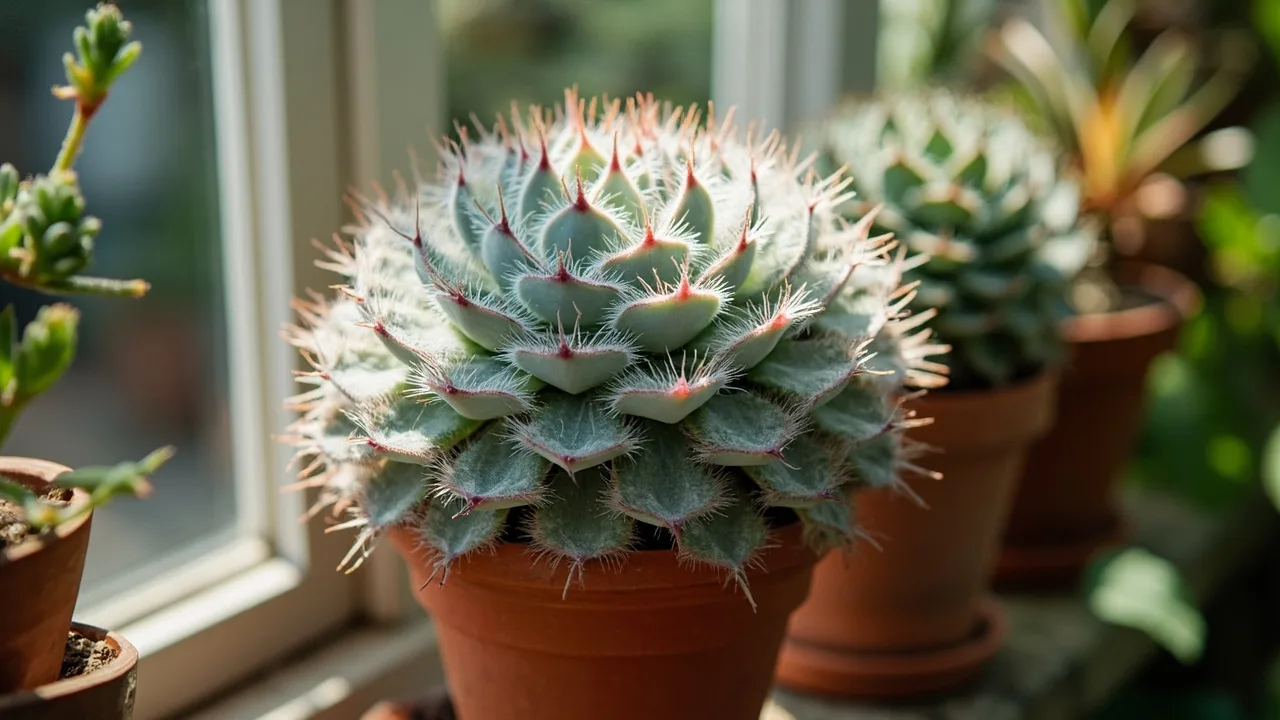
Echeveria leucotricha forms compact, slightly branching rosettes of thick, fleshy leaves, each rosette eventually reaching about 10–15 cm across. Well-grown plants offset slowly from the base and stem to build a small, shrubby clump, sometimes 20–30 cm across after several years. The overall habit is sculptural and softly rounded, which is the main reason the species is so widely used in contemporary succulent arrangements.
The leaves are spoon-shaped to obovate, ending in a softly pointed tip, and are densely clothed in soft white hairs (trichomes) that give the whole plant a felty, almost powdery appearance. This indumentum is the species' defining feature and is not found on most other commonly grown echeverias. The underlying leaf colour is a fresh, pale green, but in strong light the leaf tips and margins can flush reddish-brown, contrasting beautifully with the white hairs.
Flower spikes appear from late spring into autumn on mature, well-rested plants. Each spike is slender and slightly arching, rising 15–25 cm above the rosette and carrying a small cluster of bell-shaped flowers in shades of orange to red, often with yellow interior detail. A healthy clump can produce several spikes at once. Spent spikes dry back after flowering and can be removed at the base once they have withered.
Compared with smoother-leaved echeverias such as E. elegans or the hybrid E. 'Perle von Nürnberg', E. leucotricha reads as softer and paler, with the contrast between hairy white foliage and brightly coloured flowers as its main ornamental feature.
Growing Conditions
Light and position
Echeveria leucotricha needs bright light to keep its compact shape and to bring out the reddish leaf-tip colour. In UK homes, a south- or west-facing windowsill provides the steadiest results, with a few hours of direct sun each day; a bright east-facing sill also works, though the leaf flush will be less pronounced. In conservatories and greenhouses, bench the plants close to the glass where light is strongest.
Insufficient light produces etiolation: the rosette opens up, the central leaves elongate, and the dense hair coverage thins. Once a plant has stretched in this way it does not return to its original shape, so new offsets grown in better light are the usual remedy.
Temperature and humidity
The species is tender and must be kept frost-free. The RHS advises bright indirect light and a cool, dry winter rest for echeverias grown under glass, and Echeveria is generally listed as a tender glasshouse subject in UK horticultural references. A cooler winter rest in a bright, unheated room or frost-free greenhouse encourages flowering the following summer.
Dry air is preferable to the damp, stagnant conditions that encourage basal rot, and good ventilation around the rosette matters more than any specific humidity target. Avoid placing the plant in a steamy kitchen or bathroom, where persistent humidity can mark the hairy foliage and encourage fungal problems.
Soil and pot culture
Drainage is the single most important growing requirement. Use a sharply draining mix — a loam-based compost amended with at least 30% horticultural grit, perlite or pumice, or a proprietary peat-free cactus and succulent compost with extra grit added. The substrate should dry out quickly after watering and never remain soggy at the base. The RHS recommends rainwater over tap water for Echeveria where practical, particularly in hard-water areas.
Terracotta pots are ideal because they breathe and dry quickly, matching the plant's drought-tolerant nature. Whatever container is used, it must have reliable drainage holes. Top-dressing the surface with a thin layer of grit keeps the crown dry, deters basal rot, and discourages fungus gnats.
Watering rhythm
Water thoroughly only when the compost has dried through. In active growth — broadly March to September in UK conditions — this usually means a deep soak every one to two weeks, depending on pot size, temperature and light. In winter, water only enough to prevent the leaves from shrivelling, and keep water out of the dense hairy rosette where possible. The most reliable test is weight: a freshly watered pot feels noticeably heavier than a dry one.
Planting and Care
Potting and repotting
Repot every two to three years in spring, as new growth begins. Move the plant on only one pot size at a time; over-potting leaves compost wet for too long and encourages rot. After repotting, wait about a week before watering so any damaged roots heal in dry compost. Handle rosettes by their base, as the dense white hairs mark easily and do not fully regenerate.
Propagation
Echeveria leucotricha propagates readily from offsets and stem cuttings. Once a side shoot is at least 3–4 cm across with small root initials, tease it from the mother plant with a clean, sharp knife and allow the cut surface to callus for two to three days in a dry, shaded place before potting into dry, gritty compost. Stem cuttings taken from a leggy plant root in the same way and are the usual remedy for plants that have stretched in low light.
Leaf cuttings also work: a healthy leaf pulled cleanly from the rosette, base intact, can be left to callus and laid on the surface of dry compost where it will root and form a tiny new plant over several weeks.
Feeding
A weak, half-strength cactus or succulent fertiliser applied once a month during active growth is sufficient. Feed only between spring and late summer; hold off in autumn and winter. Over-feeding produces soft, pale growth that is more prone to rot and pest damage.
Summer outdoors and seasonal care
Once night conditions are reliably mild — usually from late May or early June in much of the UK — E. leucotricha can be moved outdoors to a bright, sheltered patio spot. Acclimatise gradually over seven to ten days, starting in light shade, and bring plants back indoors well before the first frost.
Through the cooler months the aim is a cool, bright and largely dry rest. A bright porch, unheated conservatory, or the lightest windowsill in a frost-free spare room all work well. Resume normal watering and feeding only when clear new growth appears in spring.
Common Problems
Etiolation
Stretching rosettes with pale, widely-spaced leaves are the result of insufficient light. Move the plant to a brighter position; affected rosettes will not shrink back, so new offsets or stem cuttings grown in better light are the usual recovery.
Basal and crown rot
Rot at the base or centre of the rosette is almost always caused by overwatering or compost that stays wet too long. The first sign is usually a soft, discoloured area near the base, often with leaves dropping at a touch. Stop watering immediately, unpot the plant, cut away any soft or blackened tissue back to firm healthy growth, allow the cut surfaces to callus, and repot into dry, gritty compost. Severely affected rosettes rarely recover, but healthy offsets can often be saved and rooted as new plants.
Mealybugs
Mealybugs are the principal pest, hiding in the crown and at leaf axils as small tufts of white, cottony material — easy to mistake for the plant's own hairs. Light infestations can be controlled by dabbing individual insects with a cotton bud dipped in 70% isopropyl alcohol, taking care not to soak the rosette. Heavy infestations may need a treatment labelled for ornamental houseplants, applied as the manufacturer directs. Because the foliage is densely hairy, avoid sprays that could mark or clog the indumentum.
Leaf drop and shrivelling
Individual lower leaves naturally wither and drop as the plant grows, which is normal. Sudden loss of plump, healthy-looking leaves usually points to over- or under-watering. Check compost moisture before adjusting the watering routine, and confirm drainage holes are clear.
Popular Varieties
Named cultivars of Echeveria leucotricha are uncommon in UK trade; the plant is most often sold simply under its botanical name, and provenance matters more than any cultivar label. The species is also treated by some authorities as Echeveria pulvinata var. leucotricha, and a small number of closely related echeverias are routinely sold alongside it and share its compact habit and downy look.
- Echeveria pulvinata — the parent species of E. leucotricha in many classifications; similar rosette form with slightly less dense white indumentum and orange flowers, widely available in the UK.
- Echeveria setosa — fine white hairs along the leaf margins give a softly dewy appearance; equally tolerant of UK indoor conditions and a useful companion plant.
- Echeveria harmsii — a slightly larger, shrubbier relative with red-tipped green leaves and orange flowers, also grown as a UK houseplant.
- Echeveria elegans — a smoother-leaved companion often grown in mixed succulent bowls alongside E. leucotricha for contrast.
- 'Perle von Nürnberg' — a well-known hybrid echeveria with a powdery bloom but a distinctly pinkish-purple overall colour, useful for adding a different hue to a grouping.
A healthy, well-grown plant of Echeveria leucotricha under consistent light, gritty free-draining compost and a cool winter rest will out-perform any poorly grown named label.
Sources & Further Reading
- Royal Horticultural Society — Echeveria plant profile and growing advice: https://www.rhs.org.uk/plants/echeveria, accessed 2026-07-22
- BBC Gardeners' World — succulent care guidance: https://www.gardenersworld.com/how-to/grow-plants/how-to-grow-succulents/, accessed 2026-07-22
- World of Succulents — Echeveria leucotricha (chenille plant) species profile: https://worldofsucculents.com/echeveria-leucotricha-chenille-plant/, accessed 2026-07-22
- Succulents and Sunshine — mealybug identification and treatment on succulents: https://succulentsandsunshine.com/kill-mealybugs-on-succulents/, accessed 2026-07-22
- Royal Botanic Gardens Kew — Crassulaceae taxonomic reference: https://powo.science.kew.org/taxon/urn:lsid:ipni.org:names:102102-2, accessed 2026-07-22
Pests and Diseases
| Problem | Symptoms | Management |
|---|---|---|
| Root rot | Leaves become soft, mushy and discoloured while the stem base may blacken. | Ensure sharp drainage with gritty compost and water only when the soil is completely dry. |
| Mealybugs | White, cottony fluff appears in leaf axils and on stems, often accompanied by sticky residue. | Isolate the plant and treat infested areas with a cotton bud dipped in methylated spirits. |
| Vine weevil | Semi-circular notches appear on leaf edges while roots are chewed away underground. | Use biological nematodes or systemic insecticides in the compost during active growth periods. |
| Aphids | Small green or black insects cluster on new growth and flower stalks, secreting honeydew. | Spray off with a strong jet of water or apply insecticidal soap to affected areas. |
| Leaf burn | Leaf tips or edges turn brown and crispy due to chemical damage from tap water. | Water exclusively with rainwater or filtered water to avoid fluoride and salt buildup. |
For step-by-step help, read Controlling Aphids Naturally. Or browse the full plant problem solver to diagnose an issue by symptom.
Recommended Products
GardenWizz earns a commission from qualifying purchases made through affiliate links on this page (including links within the article) — as an Amazon Associate, and from Thompson & Morgan via the Awin network. This does not affect the price you pay. See our disclaimer for details.