Spanish Heath
Erica australis
The Gardening Year
Best months in UK gardens · full planting calendar →
🖨 Printable care card (PDF)At a Glance
| Botanical name | Erica australis |
|---|---|
| Common name(s) | Spanish heath |
| Family | Ericaceae |
| Plant type | shrub |
| Height × Spread | 1.5–2.5 m × 0.5–2 m |
| Position | Full sun |
| Soil | well-drained acidic soil |
| Flowering | April–May |
| Toxicity | — |
| Native range | southern Europe, including the western Iberian Peninsula (Portugal and Western Spain) as well as Northwest Africa (in Morocco) |
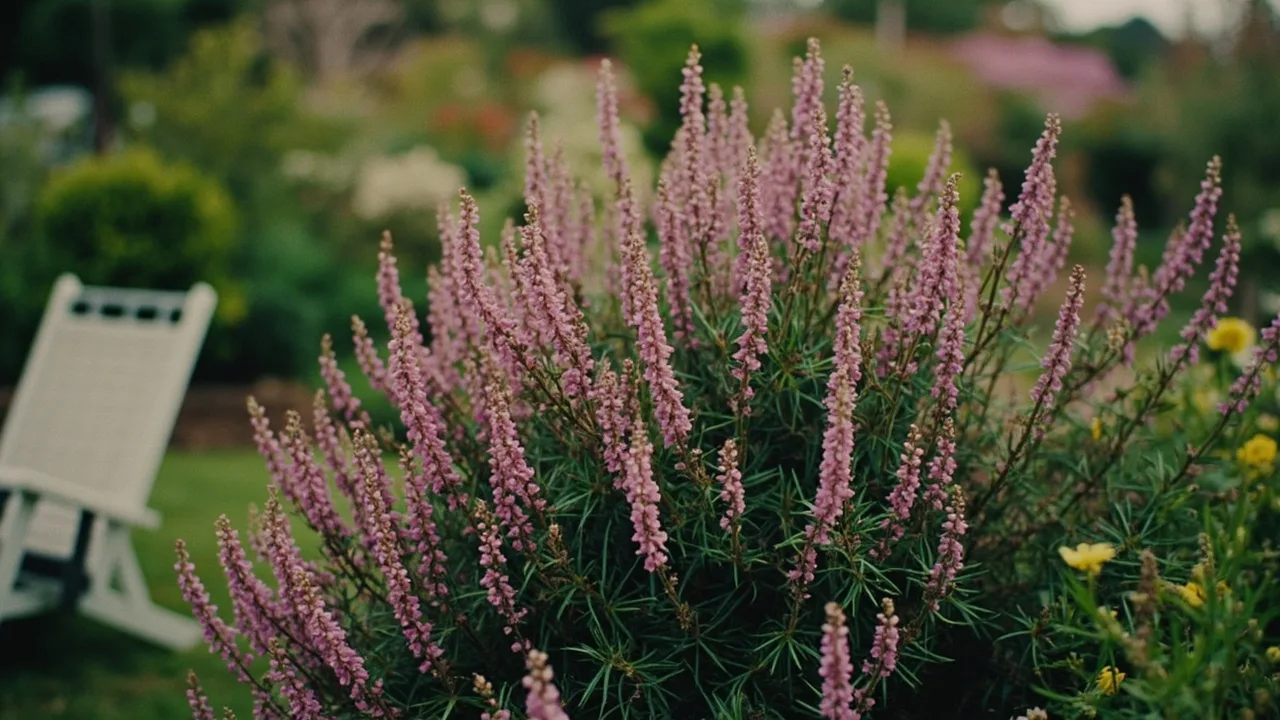
Erica australis, widely known as Spanish heath, is a compact evergreen shrub grown in the UK for its spring display of small, bell-shaped flowers. It is one of the "tree heathers" — a group within the genus that makes larger, more upright plants than the winter-flowering heaths more familiar from British heather beds. In a mild British garden, on sharply drained acid soil, Spanish heath settles into a rounded, textural shrub that brings soft colour through April and May when much of the garden is still finding its stride.
Native to the western Mediterranean basin, E. australis has earned a firm place in UK horticulture thanks to its tidy habit, its reliability on acid soils and the RHS Award of Garden Merit, which recognises its consistent garden performance in British conditions.
Overview
Erica australis belongs to the heather family, Ericaceae, a group that includes rhododendrons, blueberries and the winter- and summer-flowering heaths commonly used in British gardens. It is one of the larger, shrubbier species within the genus, distinct from the low, carpet-forming heaths more often planted on acid moorland edges. The species was described from material collected in the western Iberian Peninsula and Northwest Africa, and remains associated in the wild with the dry, sun-baked hillsides and rocky slopes of southern Portugal, western Spain and parts of Morocco.
In UK cultivation it behaves as a hardy evergreen shrub in milder regions and as a slightly tender one in colder inland and northern districts. The RHS Award of Garden Merit, awarded in 1993, signals its long record as a reliable garden plant in British conditions. Gardeners value it for the dense clouds of small flowers that smother the plant in mid-spring, and for the fine, needle-like evergreen foliage that gives it a soft, almost feathery texture through the rest of the year.
It is closely related to Erica lusitanica, the Portuguese heath, with which it is sometimes confused in older references and in some garden centres. The two share a similar upright habit and bell-shaped flowers, but E. lusitanica flowers slightly later, in winter into early spring, with paler pink and white blooms. E. australis flowers distinctly in April and May, has slightly larger, deeper pink flowers and a more compact overall habit — differences that matter for flowering season, hardiness and pruning.
Appearance
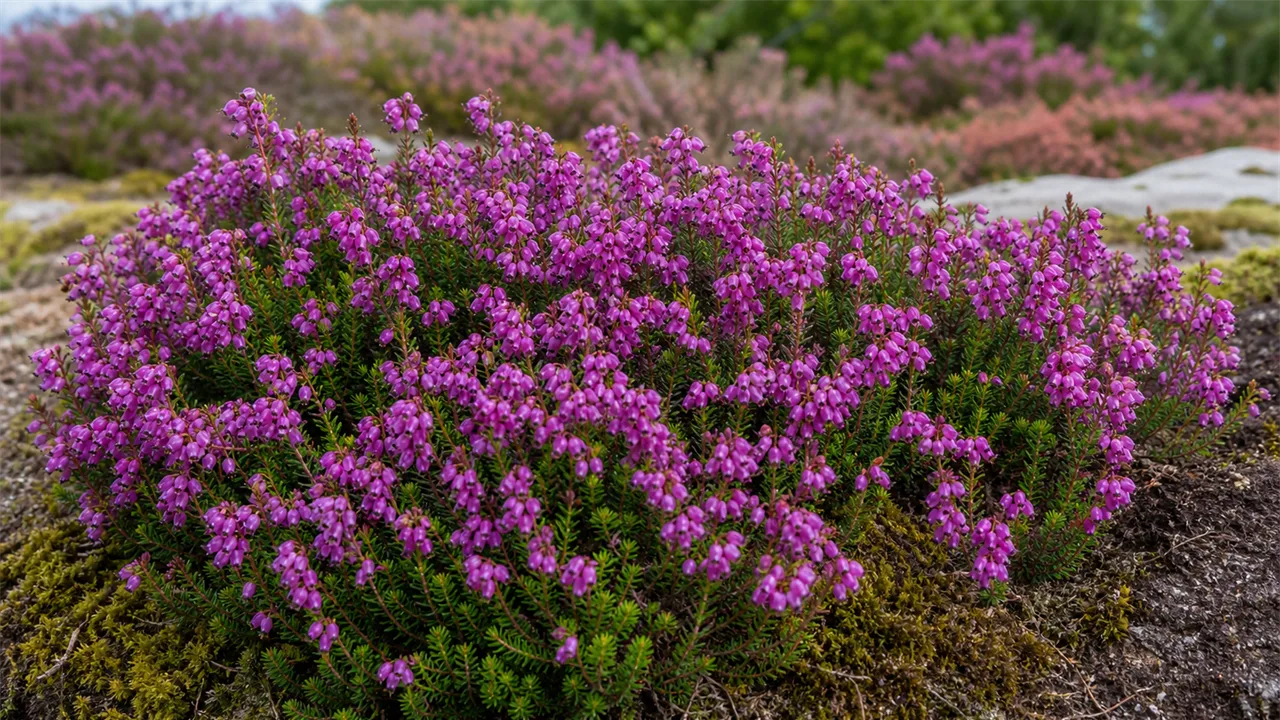
Spanish heath makes a dense, rounded evergreen shrub with an upright to slightly arching habit. The stems are wiry and woody at the base, branching freely from low down to build a well-furnished plant without bare legs. Mature specimens reach about 1.5–2.5 m in height and spread roughly 0.5–2 m across depending on soil and exposure. Growth is moderately fast in the first few years, then settles into a steady rhythm.
The leaves are the most distinctive vegetative feature. They are needle-like — narrow, short and arranged in whorls of three or four along the stems — and a soft, slightly grey-green rather than the darker green of some winter-flowering heaths. The foliage has a fine, almost mossy texture that is the foundation of the plant's year-round appeal. When crushed it carries the faint, resinous scent typical of Mediterranean heathers.
Flowers appear from April into May. They are small, bell-shaped and tubular, hanging in loose clusters along the previous year's stems, with a narrow mouth that barely opens. The colour is typically a soft to mid pink, sometimes with a slightly lilac tint in bud, ageing paler as the flowers mature. The display is heavy enough to clothe the entire plant in colour, giving the rounded mound the appearance of being dusted in pink for several weeks. The root system is fine and fibrous, sitting in the upper layers of the soil, which is why sharp drainage is essential.
Growing Conditions
Spanish heath wants full sun in well-drained, acidic to neutral soil. In shade it becomes leggy, flowers sparsely and the dense, rounded habit collapses into a more open shape. A south-, west- or east-facing aspect suits it well, ideally with some shelter from the coldest winter winds inland and further north.
Soil texture and pH are the two conditions to get right. Sharp drainage is essential — the plant dislikes sitting wet at the roots through any season — and the soil must be acidic to neutral. In alkaline conditions the foliage yellows with chlorosis and the plant slowly declines, even with otherwise good cultivation. Where the garden soil is alkaline, grow Spanish heath in a container of ericaceous compost, or build a raised bed with imported acidic loam and grit. Patio containers of ericaceous compost against a sunny house wall give both an acid root run and a few degrees of frost protection.
Across the UK the plant performs best in the south, south-west and along the western seaboard, where mild winters and free-draining soils mimic its Mediterranean homeland. It suits Cornish, Devon and Welsh coastal gardens, and does well in the London microclimate. In colder inland and northern districts, particularly across the Midlands and into Scotland, it grows successfully in a sheltered, free-draining site with protection from the worst of the winter wet; in the very coldest parts of the UK it is best treated as a container plant.
Planting and Care
Planting
Container-grown E. australis can be planted at any time the ground is workable, but autumn and early spring give the best establishment. Dig a hole a little wider than the rootball and to the same depth, set the plant so the soil mark on the stem sits level with the surrounding ground, and backfill with the excavated soil. A handful of ericaceous compost or leafmould forked into the backfill helps in borderline soils. Water thoroughly and apply a 5–8 cm mulch of bark or leafmould, kept clear of the stems.
In alkaline gardens, container growing is usually the simplest path. Choose a pot at least 40 cm across, use a peat-free ericaceous compost mixed with about a third by volume of sharp sand or perlite, and raise the container on pot feet so excess water can drain freely. Refresh the top 5 cm of compost each spring and repot every two to three years.
Watering and feeding
Water newly planted specimens through their first growing season during dry spells; once established, Spanish heath is reasonably drought-tolerant and needs little supplementary watering except in prolonged summer droughts, particularly on sandy soils. Container plants need more regular watering — keep the compost just moist through the growing season but allow the surface to dry slightly between waterings to discourage root rot.
Feeding should be modest and acid-friendly. A single annual application of an ericaceous or acid-loving plant feed in spring is enough. Avoid general-purpose feeds that raise soil pH, and avoid lime or mushroom compost anywhere near the plant. A light top-dressing of pine needles or ericaceous compost each spring keeps the root run cool and slowly acidifies the surrounding soil.
Pruning
Spanish heath flowers on wood produced the previous year, so pruning is timed to avoid cutting off the coming season's display. The standard UK method is to trim the plant lightly with shears immediately after flowering, in late May or early June, removing the spent flower heads and a little of the current season's growth. This keeps the shrub dense and mounding, and prevents the rather straggly habit that develops on plants left unpruned for years. Avoid cutting back into old wood that has no green growth low down; Spanish heath does not reliably regenerate from bare stems, so a light annual trim is far better than occasional hard pruning.
Propagation
Semi-ripe cuttings taken in mid to late summer root readily in a 50:50 mix of ericaceous compost and sharp sand or perlite, kept under a clear cover in a shaded cold frame. Cuttings of 5–8 cm of healthy current-season growth, trimmed just below a leaf node and dipped in a rooting hormone, typically root in six to ten weeks. Pot on individually once rooted and overwinter in a cold frame before planting out the following spring. Seed germinates readily without special treatment but does not come true for named cultivars.
Seasonal care
The main seasonal tasks are a tidy trim after flowering in late spring, a mulch refresh in early spring, and a check on protection in midwinter in colder gardens. In exposed inland and northern sites, a layer of frost protection fleece thrown over the plant during the worst of the winter wind and frost can make the difference between losing a plant and keeping it through to another flowering season. Watch for waterlogging at the roots during wet winters — Spanish heath is far more often killed by wet feet than by cold.
Common Problems
Spanish heath is generally trouble-free in well-drained, acidic soil in full sun. Most problems arise when one of those conditions is not met, and most are prevented by choosing the right site rather than treated once they appear.
Phytophthora root rot. Foliage turns brown and wilts rapidly, often after wet weather or in poorly drained soil. The causal organism thrives in cold, wet ground, so the cure is preventive: plant in sharply drained, acidic soil and avoid waterlogging at any time of year. Plants showing advanced symptoms rarely recover and are best removed.
Honey fungus. General decline with browning shoots and leaves, sometimes accompanied by white fungal growth at the base of the plant or bootlaces of black fungal strands running through the soil. Improve air circulation and drainage and remove badly infected specimens. There is no cure for honey fungus in the soil, so a new planting site should be chosen carefully.
Winter wet damage. Leaves turn yellow or brown and drop off during damp, cold winter months, particularly on heavy or compacted soils. Plant in a well-drained position, ideally on a slope or in a raised bed, so winter rain runs away from the root zone. Container plants should be raised on pot feet and ideally moved under the eaves of a house wall through the worst of the winter.
Alkaline soil stress. Foliage becomes chlorotic — yellowed with the veins remaining green — as iron and other micronutrients become unavailable. The long-term solution is to plant only in acidic to neutral soil, or to amend alkaline soils generously with ericaceous compost at planting and as an annual top-dressing. Container growing in ericaceous compost is the simplest answer in chalky districts.
Vine weevil. Notches appear on leaf margins where adult weevils feed at night, and container-grown plants may wilt as the creamy-white larvae chew through the roots. The standard UK approach is biological: apply pathogenic nematodes to the compost in late summer and early autumn when larvae are active. Adult weevils can be collected by torchlight on mild evenings.
Popular Varieties
The species Erica australis itself is the most widely grown form in the UK and the form most often awarded the AGM. A small number of documented variants and cultivars are available from specialist UK nurseries, and a closely related species is sometimes offered alongside.
Erica australis f. albiflora 'Polar Express'. The white-flowered form of Spanish heath, sold in the UK trade under the cultivar name 'Polar Express'. The flowers are a clean, slightly creamy white rather than the usual pink, set off well against the grey-green foliage. It grows to a similar size as the type and flowers in the same April–May window, and is a popular choice for white garden schemes. Available from UK heather specialists including Crocus.
Erica australis 'Riverslea'. A selected pink-flowered cultivar with deeper, slightly larger flowers than the typical species, originating from the Riverslea Nursery in south-west England. The growth habit is compact and rounded, similar to the type, and it flowers at the same time. A reliable alternative for gardeners who want a richer pink than the species provides.
Erica lusitanica (Portuguese heath). Strictly a different species rather than a variety of E. australis, but routinely grouped with it in UK trade literature and in the "tree heathers" category because the two are closely related and visually similar. Portuguese heath flowers earlier, carrying white to palest pink blooms from late winter into early spring, and is generally slightly less hardy. Useful in mild western gardens for extending the heather display earlier in the year.
Pests and Diseases
| Problem | Symptoms | Management |
|---|---|---|
| Phytophthora root rot | Foliage turns brown and wilts rapidly, often following periods of wet weather or poor drainage. | Ensure excellent drainage by planting in sandy, acidic soil and avoid waterlogging the roots. |
| Honey fungus | General decline with browning shoots and leaves, sometimes accompanied by white fungal growth at the base. | Improve air circulation and drainage; remove infected plants if severe to prevent spread. |
| Winter wet damage | Leaves turn yellow or brown and drop off during damp, cold winter months. | Plant in a well-drained position, preferably on a slope or raised bed, to prevent waterlogging. |
| Alkaline soil stress | Foliage becomes chlorotic (yellowing) with green veins due to iron deficiency. | Plant only in acidic to neutral soils; amend alkaline soils with ericaceous compost. |
| Vine weevil | Notches on leaf margins and wilting caused by larvae feeding on roots in containers. | Use non-chemical controls like nematodes or biological controls available in the UK. |
Or browse the full plant problem solver to diagnose an issue by symptom.
Recommended Products
GardenWizz earns a commission from qualifying purchases made through affiliate links on this page (including links within the article) — as an Amazon Associate, and from Thompson & Morgan via the Awin network. This does not affect the price you pay. See our disclaimer for details.