Winter Heath
Erica carnea · Alpine heath · Winter-flowering heather
The Gardening Year
Best months in UK gardens · full planting calendar →
🖨 Printable care card (PDF)At a Glance
| Botanical name | Erica carnea |
|---|---|
| Common name(s) | Winter heath, Alpine heath, Winter-flowering heather |
| Family | Ericaceae |
| Plant type | shrub |
| Height × Spread | 10–25 cm × 50–100 cm |
| Position | Full sun, Partial shade |
| Soil | free-draining, neutral to acidic soil; tolerates mildly alkaline soils |
| Flowering | February–March |
| Toxicity | — |
| Native range | mountainous areas of central, eastern and southern Europe |
Overview
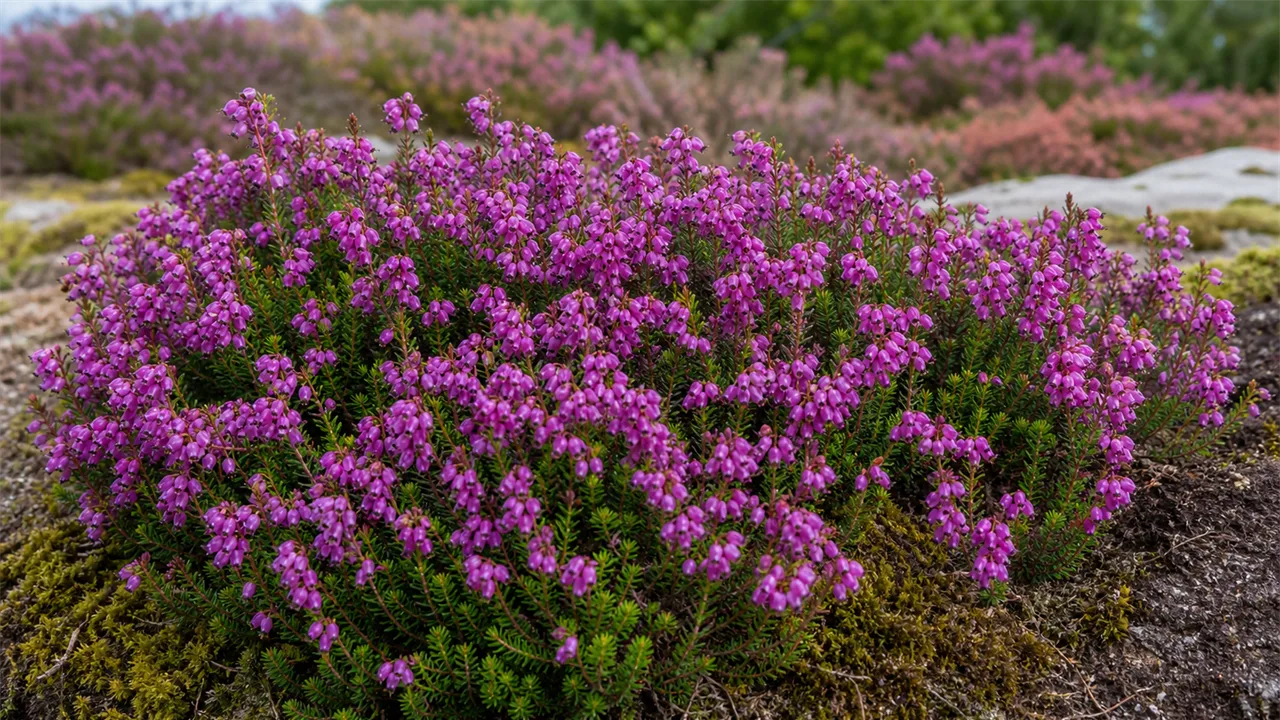
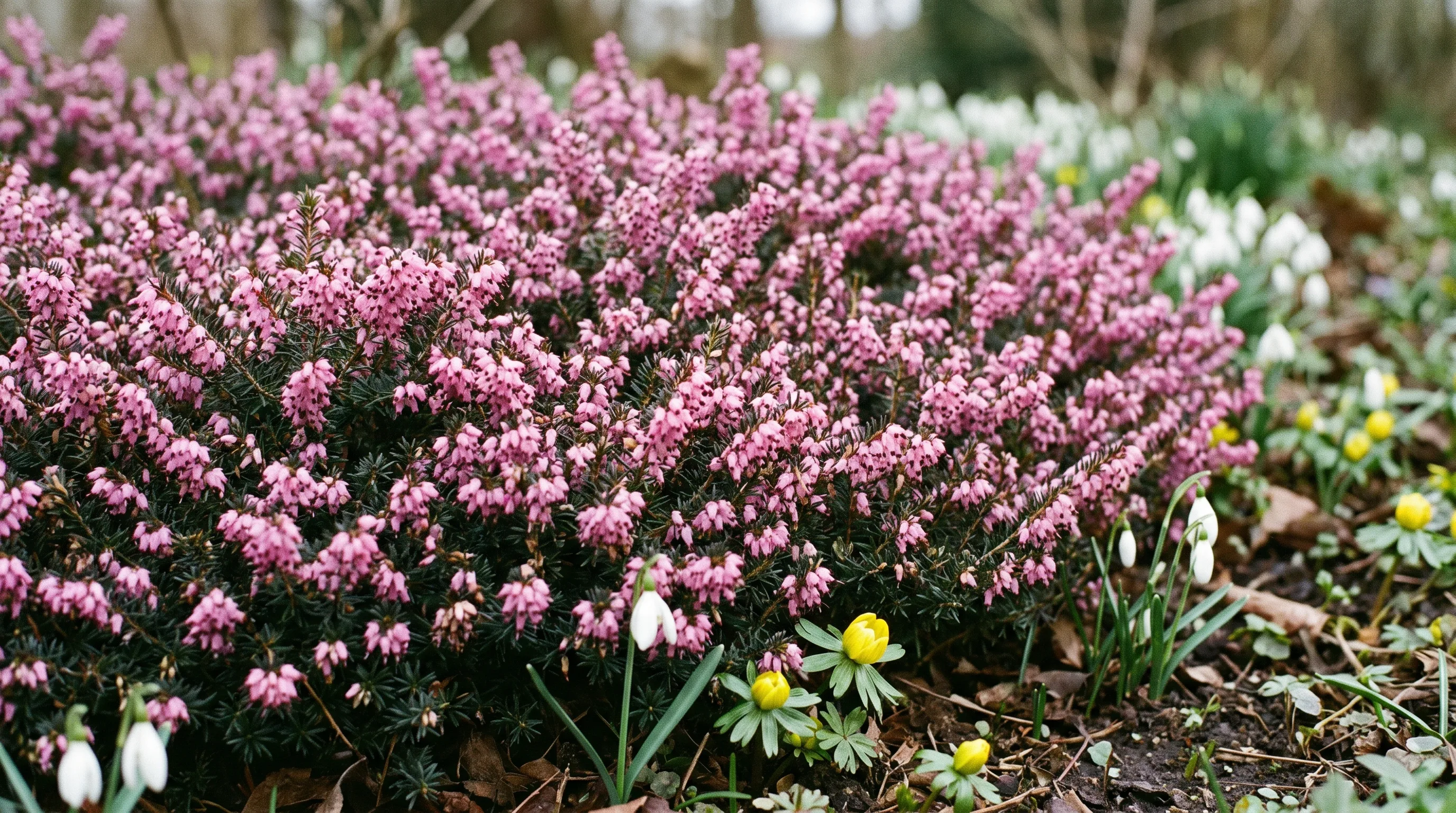
Erica carnea (winter heath, sometimes sold as alpine heath or simply as winter-flowering heather) is a low, mat-forming evergreen shrub in the family Ericaceae. It is native mainly to the mountains of central and southern Europe, where it grows in stony, well-drained ground above the tree line, and it has been cultivated in British gardens for well over a century. In the United Kingdom it is valued chiefly for its willingness to flower through the colder months, bringing colour to beds, containers and rock gardens when little else is in bloom.
The plant forms a dense, slowly spreading mound of slender, needle-like evergreen leaves. Mature specimens reach about 15–25 cm tall with a spread of 30–50 cm or more, gradually knitting together to make an effective, year-round ground cover. Flowers are small, urn-shaped and borne in dense, one-sided spikes along the previous year's shoots, opening from late autumn through to late spring depending on the cultivar. Colours range from pure white through pale pink, rose and carmine to a deep magenta-red, and the contrast with the surrounding dark green or golden foliage is part of the plant's appeal.
Erica carnea is one of the easiest heathers to place in UK gardens because, unlike most other Erica species, it tolerates mildly alkaline soil and a touch of shade. It is reliably hardy across the whole of the British Isles and asks for very little routine attention once established, which makes it a strong choice for low-maintenance plantings.
Appearance
Erica carnea is a dwarf, evergreen shrub with a creeping, suckering rootstock that allows it to spread slowly into a low mat. Each shoot is clothed in whorls of short, narrow, mid- to dark-green leaves arranged in fours; in some cultivars the foliage turns bronze or red-tinted in cold winter weather, while golden-leaved forms hold a buttery yellow throughout the year. New growth emerges in spring and the previous year's shoots remain clothed year-round, which is why the plant looks presentable even in the depths of winter.
Flowers appear in short, dense, one-sided racemes near the tips of the previous year's stems. Each individual bloom is a small, cylindrical or urn-shaped corolla, roughly 5–8 mm long, with the four sepals and corolla fused into the characteristic heather bell. In the species type the colour is a clear rose-pink, but cultivated varieties range through pale pink ('Springwood Pink'), carmine ('Myretoun Ruby'), pure white ('Springwood White', 'Snow Queen') and a near-magenta red ('Vivellii', 'Kramer's Rote'). The flowers are rich in nectar and on mild winter days attract early bumblebees and other pollinators.
Unlike the taller, more upright tree heaths (Erica arborea, Erica australis), E. carnea stays close to the ground and rarely exceeds 25 cm in height. Its arching, rooting stems mean a single plant can extend steadily across a bed over several years, eventually colonising a square metre or more given time and a suitable substrate.
Growing Conditions
Light and position
Erica carnea flowers most freely in full sun, where the low winter light is enough to open the buds reliably. It also grows well in light, dappled shade beneath deciduous shrubs or at the front of a border, but flowering will be sparser and growth more open. Deep, dry shade under evergreen trees is unsuitable: the plant slowly declines, fails to flower and eventually rots out at the crown.
A south- or west-facing slope is ideal because it gives sharp drainage and the maximum winter sun. Cold, exposed east-facing sites can scorch open blooms in hard frosts, although the buds usually shrug off temperatures that would blacken other winter shrubs.
Soil and pH
The single most important requirement is sharp drainage. Erica carnea will tolerate a wide pH range — from clearly acidic through neutral to mildly alkaline — but it absolutely will not tolerate waterlogged ground. On heavy clay, plant on a raised bed, a low mound or into a rockery pocket so the roots stay above the wet zone; on light sandy soil, incorporate plenty of organic matter to hold moisture during the first growing season.
In neutral to alkaline soils use leaf mould, well-rotted garden compost or bark as the main soil amendment rather than peat, which is unsustainable and adds little that home-made compost cannot provide. For acid-soil gardens with established beds of rhododendrons and camellias, E. carnea sits comfortably alongside them and asks for the same ericaceous, humus-rich compost and the same acid mulch of bark or chopped leaves.
Moisture and feeding
Once established, winter heath is notably drought-tolerant, particularly on soils that have been improved with organic matter. Water newly planted specimens through their first summer and during prolonged dry spells in subsequent years; mature plantings seldom need supplementary watering in the UK climate. A light annual mulch of leaf mould or composted bark in early spring is the only routine feeding the plant really requires — supplementary fertiliser is rarely needed and can scorch the low foliage if applied in dry weather.
UK climate suitability
Erica carnea thrives throughout the British Isles, from the drier south-east to the wetter north and west. It is one of the few heathers that performs reliably on chalk and limestone soils, provided the surface layer of organic matter is replenished every few years. Coastal sites are tolerated as long as salt spray is not directly onto the foliage; the plant's hardiness rating for UK gardens is displayed on the structured hardiness badge accompanying this entry.
Planting and Care
When and how to plant
Container-grown plants can go in at any time of year when the ground is workable, but autumn and early spring are best. Autumn planting lets the roots establish in mild, damp conditions before the following summer, while spring planting avoids the worst of the winter wet on heavier soils. Dig a hole roughly twice the width of the pot and the same depth, fork in a generous bucketful of leaf mould or well-rotted compost, and set the plant so the crown sits flush with the surrounding soil.
Space plants about 25–30 cm apart for a quick ground-cover effect, increasing to 40 cm where a more natural, open look is wanted. Water in well and top-dress with a further 2–3 cm of bark or leaf mould, keeping the mulch a finger's width away from the stems themselves.
Watering
Water regularly during the first growing season, especially on light or chalky soils. After the first year, supplementary watering is only needed during extended summer drought. Container-grown plants dry out faster and need checking every few days in summer; plunge the pot into a bucket of water until bubbles stop rising, then allow it to drain freely.
Feeding and mulching
An annual mulch of ericaceous or neutral organic matter in early spring is usually sufficient. If growth looks thin or foliage yellows on alkaline soils, apply a granular ericaceous fertiliser in late spring at the manufacturer's recommended rate, watering it in well. Avoid high-nitrogen lawn fertilisers, which produce soft, leafy growth that is more prone to die-back and fungal disease.
Pruning and trimming
Erica carnea is treated as a minimal-prune, deadhead-only shrub in the calendar manifest: it does not require a scheduled annual woody prune, and is maintained by trimming off the spent flower spikes once flowering finishes. This is best done with shears or hand shears in late spring, as the new growth begins to push, taking the old flowers and about 1–2 cm of the leafy stem beneath them. Avoid cutting back into old, leafless wood, which seldom regrows; the regular light trim keeps plants dense and flowering freely for many years.
If a plant has become leggy or open with age, take cuttings rather than trying to renovate it by hard pruning — old, bare centres rarely recover.
Propagation
Take short, non-flowering shoot-tip cuttings of about 3–4 cm in mid- to late summer. Strip the lower leaves, dip the cut end in a little rooting hormone, and insert into a small pot of moist, gritty, ericaceous compost. Cover with a clear propagator lid or a small plastic bag, place in a cool, bright position out of direct sun, and roots should form within six to ten weeks. Pot on individually once rooted and overwinter in a cold frame before planting out the following spring.
Layering is also straightforward: peg a low, flexible shoot into the surrounding soil in spring, sever it from the parent plant once it has rooted (usually by the following autumn), and transplant to its final position.
Seasonal care
In late autumn, clear fallen leaves from the top of the plants so they do not smother the low foliage and trap winter moisture against the stems. In cold gardens, a loose handful of bracken or straw over the crowns in severe weather helps protect opening buds from wind scorch, but it should be removed as soon as the weather moderates. Container plants benefit from being moved to a sheltered corner from January to March if late frosts coincide with peak flowering.
Common Problems
Die-back and bare centres
The most common complaint is a plant that develops a bare, woody centre with healthy growth only around the edges. This usually reflects a missing annual trim: without it, flowering wood creeps outwards and the centre becomes shaded out. The remedy is to start a regular light trim each spring once the existing plants have been replaced with new, propagated stock.
Heather beetle
The heather beetle (Lochmaea suturalis) can defoliate plants in late summer, leaving sparse, brown shoots. Pick off adults where practical and apply a proprietary insecticide labelled for ornamental heathers if damage is severe. Healthy, well-grown plants recover quickly from a single attack.
Root rot in wet soils
Persistent yellowing and collapse in winter or early spring usually points to waterlogging rather than cold. Lift the plant, improve drainage with grit and organic matter, and replant on a slight mound. In severe cases the affected plant will not recover and replacement is the cleanest answer.
Fungal spotting
Grey mould (Botrytis) can affect flowers during mild, damp winters. Improve air circulation by thinning surrounding growth, remove affected shoots promptly, and avoid overhead watering. Most healthy heathers outgrow minor infections as the weather dries.
Failure to flower
Sparse flowering is most often caused by too much shade, hungry or waterlogged soil, or pruning at the wrong time. Move young plants to a brighter spot, top-dress with organic matter, and trim only after flowering. Plants cut back into old wood take several years to recover, if they recover at all.
Popular Varieties
- Erica carnea 'Springwood White' — vigorous trailing form with bright green foliage and abundant large white flowers from January to March; excellent for covering banks and tumbling over walls.
- Erica carnea 'Vivellii' — one of the most popular carmine-red cultivars, with deep green foliage that bronzes in winter; reliable, neat habit and a long flowering season from late winter into spring.
- Erica carnea 'Springwood Pink' — pale shell-pink flowers over fresh green foliage; particularly good for naturalising in drifts beneath shrubs or in gravel gardens.
- Erica carnea 'Golden Starlet' — a modern cultivar with bright golden-yellow foliage all year and pure white flowers from late winter; needs sun to keep its colour.
- Erica carnea 'Myretoun Ruby' — intense magenta-pink flowers and dark green foliage; widely considered one of the strongest-coloured cultivars for UK gardens.
- Erica carnea 'December Red' — earlier-flowering form with rose-pink blooms from December onwards; useful for extending the season at the early end.
- Erica carnea 'Snow Queen' — compact, tidy habit with large pure-white flowers from February to April; pairs well with dark-foliaged cultivars for contrast.
Group plantings of two or three cultivars with contrasting flower colours and a clear golden-leaved form give the longest and most reliable display through the darkest months of the year.
Pests and Diseases
| Problem | Symptoms | Management |
|---|---|---|
| Phytophthora root rot | Foliage turns brown and wilts rapidly, often following periods of wet weather or waterlogged soil. | Ensure excellent drainage by planting in gritty compost and avoid overwatering during winter. |
| Honey fungus | General decline with yellowing leaves and eventual death, sometimes with white fungal growth at the base. | Improve soil drainage and remove infected plants completely to prevent spread to neighbours. |
| Slugs and snails | Irregular holes in new shoots and flowers, often accompanied by silky trails and slime. | Use physical barriers like copper tape or apply iron phosphate pellets around the base. |
| Vine weevil | Notched edges on leaves above ground and root damage causing wilting below ground. | Apply nematodes to the soil in autumn or use systemic insecticides for potted specimens. |
| Bud blast | Flower buds turn black and die before opening, typically after late spring frosts. | Plant in a sheltered position to protect developing buds from sudden temperature drops. |
For step-by-step help, read Dealing with Slugs and Snails. Or browse the full plant problem solver to diagnose an issue by symptom.
Recommended Products
GardenWizz earns a commission from qualifying purchases made through affiliate links on this page (including links within the article) — as an Amazon Associate, and from Thompson & Morgan via the Awin network. This does not affect the price you pay. See our disclaimer for details.