Hypericum Dummeri
Hypericum × dummeri
The Gardening Year
Best months in UK gardens · full planting calendar →
🖨 Printable care card (PDF)At a Glance
| Botanical name | Hypericum × dummeri |
|---|---|
| Common name(s) | Hypericum dummeri |
| Family | Hypericaceae |
| Plant type | shrub |
| Height × Spread | 50–100 cm × 100–150 cm |
| Position | Full sun, Partial shade |
| Soil | moderately fertile to poor, moist but well-drained |
| Flowering | June–August |
| Toxicity | Potentially harmful. Fruit are ornamental - not to be eaten. |
| Native range | — |
Overview
Hypericum × dummeri is a low, spreading, semi-evergreen shrub belonging to the family Hypericaceae. The multiplication sign in the name is not decorative: it denotes a hybrid of garden origin, formally named by Norman Robson and recorded as an accepted name on Kew's Plants of the World Online. Horticulturally it is treated as a compact St John's wort, and in the UK trade it is overwhelmingly represented by a single named selection, 'Peter Dummer', raised at Hillier Nurseries by the propagator after whom it is named.
The hybrid is useful in British gardens where a small, mounding, late-flowering woody plant is wanted at the front of a border, on a sunny bank, or as low informal ground cover. It is not a show plant in the way that a hybrid tea rose or a paeony is, but it is reliable, long-lived once established, and tolerant of the kind of dry, freedraining soil that defeats fussier ornamentals.
Appearance
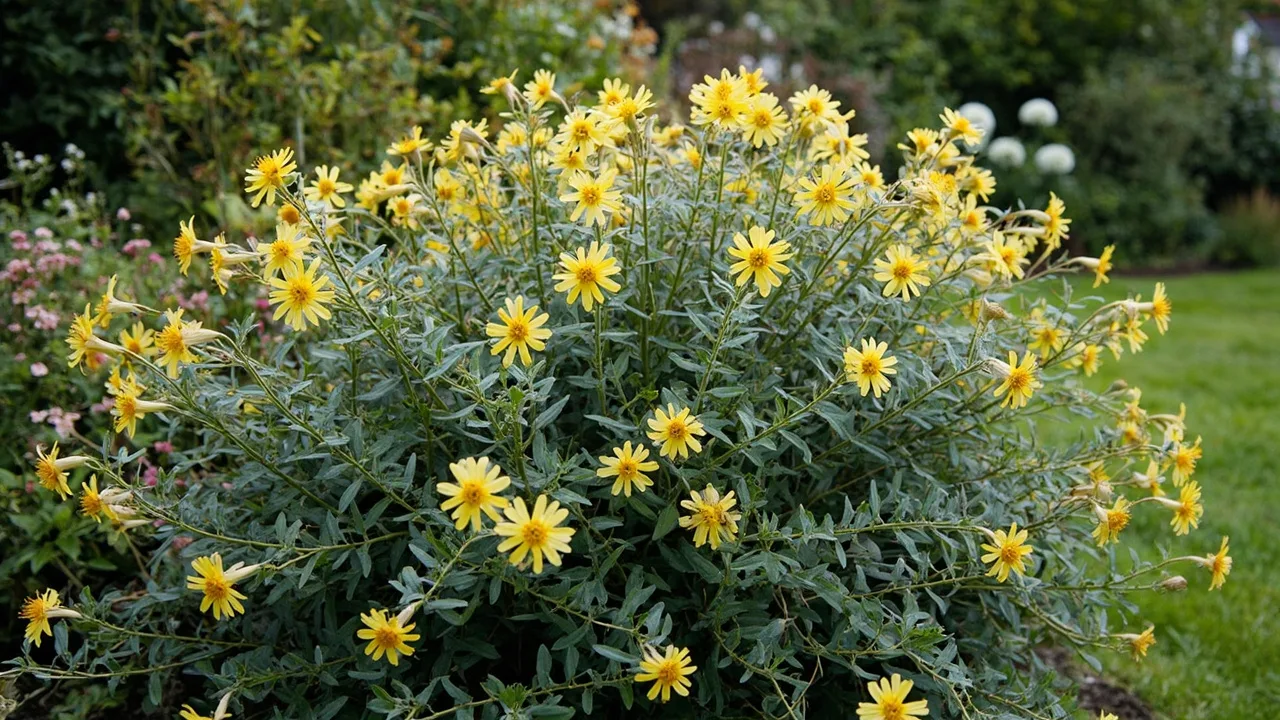
The best-documented form of the hybrid, 'Peter Dummer', forms a compact, bushy, rounded shrub reaching roughly 60 cm in both height and spread after a few seasons. The leaves are ovate, opposite, and a distinctive blue-green to dark blue-green, which sets the plant apart from the brighter mid-green foliage of Hypericum 'Hidcote'. They are classed as semi-evergreen, which in a UK context means a mild winter will leave the plant clothed; a harder winter, especially in cold inland districts or in pots, may see some or most of the leaves dropped.
The flowers are large for a Hypericum — distinctly saucer-shaped, golden yellow, with a prominent central boss of stamens. On a happy plant individual blooms can reach 5–6 cm across, carried in small clusters at the shoot tips. Flowering begins in mid- to late summer (typically July in southern England, slightly later further north) and can continue intermittently into early autumn. If pollinated, the flowers are followed by small, oval, red-tinged berries, although berry set on H. × dummeri is generally modest compared with showier Hypericum hybrids such as 'Hidcote' or H. × inodorum selections.
Bare stems are slender, reddish when young, and arching rather than rigid. The overall habit is a low mound wider than it is tall on young plants, gradually filling out into a more even dome with age.
Growing Conditions
Hypericum × dummeri grows best in full sun, where flowering is most profuse, though it tolerates light partial shade for part of the day. Soil should be well-drained; the hybrid dislikes sitting in cold, wet ground through winter, and on heavy clay a raised planting position or generous incorporation of grit and well-rotted organic matter at planting time is worth the effort. Once established the plant is moderately drought tolerant and copes well with the freedraining conditions found on chalk and sandy soils.
It is hardy across most of the UK, with the RHS assigning the cultivar a hardiness rating that is displayed in the structured plant badge on this page. Plants in exposed northern or east-facing sites, in containers, or in poorly drained ground are at the colder, wetter end of its comfort zone and may suffer some shoot die-back after a hard winter. Mulching in late autumn with bark or leaf mould helps, but mulch should be kept clear of the woody stems at the base.
The plant tolerates a wide pH range, from roughly neutral down to mildly alkaline, mirroring its tolerance of chalk-derived soils in southern England.
Planting and Care
Plant container-grown stock in spring (March–May) or early autumn (September–October), avoiding frozen or waterlogged ground. Water in well and keep the soil evenly moist through the first growing season; once the plant is established, supplementary watering is rarely needed except on very free-draining or sandy soils in prolonged dry spells. Feed in spring with a balanced general-purpose fertiliser, or top-dress with a 5 cm layer of well-rotted garden compost, which serves both as a feed and a moisture-conserving mulch.
Pruning is light. The hybrid flowers on wood produced in the current and previous season, so hard cutting back costs flowers. The standard treatment is to remove any dead, damaged or crossing shoots in mid-spring, then lightly shape the plant after the main summer flush has finished if it is outgrowing its space. On older plants that have become leggy, up to a third of the oldest stems can be cut back to near ground level in spring to encourage fresh basal growth; this is best done in stages over two or three years rather than all at once. Avoid the close "hedge-clip" approach used on H. × inodorum, which sacrifices the natural arching habit of × dummeri.
Propagation is straightforward from semi-ripe cuttings taken in mid- to late summer. Trim 8–10 cm cuttings just below a leaf joint, strip the lower leaves, and insert into a 50:50 mix of peat-free compost and perlite. Cover with a propagator lid or clear plastic bag, keep in bright but indirect light, and roots usually form within six to eight weeks. Pot on individually once rooted and overwinter in a cold frame before planting out the following spring. Seed propagation is possible but, because this is a hybrid, seedlings will not come true to the parent and named cultivars must be propagated vegetatively.
Seasonal care is minimal. In late autumn clear fallen leaves from around the base to reduce the places where rust spores can overwinter. In spring, watch for new growth emerging from the base — a sign that the plant has come through winter successfully.
Common Problems
Hypericum rust, caused by the fungus Melampsora hypericorum, is the most frequently reported disease across the genus and can affect H. × dummeri. Symptoms begin as small yellow or orange spots on the upper leaf surface, with corresponding rust-coloured pustules on the underside. In heavy attacks leaves yellow and drop early, weakening the plant. Management is cultural: remove and dispose of badly affected shoots, clear and destroy fallen leaves in autumn (do not compost them), maintain good airflow around the plant by avoiding crowding, and water at the base rather than over the foliage. Rust is worse in damp, still conditions, so a sunny, open site is itself a partial defence.
Poor drainage is a separate, non-infectious cause of decline. In heavy clay or compacted soil, waterlogging over winter can cause root loss, leading to die-back, sparse foliage and reduced flowering the following summer. The fix is cultural: improve drainage, replant on a slight mound, or relocate the plant to a freedraining part of the garden.
Pests are not generally a serious issue for H. × dummeri in UK gardens. Thrips and various leaf beetles are recorded on Hypericum in the wider horticultural literature but are not specifically documented as routine problems on this hybrid, and healthy plants in the right site shrug them off.
Popular Varieties
The hybrid is effectively represented in UK cultivation by a single widely available selection. Other named forms are not consistently listed by mainstream British nurseries, so the list below reflects what UK gardeners can reasonably buy rather than the full theoretical range of the hybrid.
- 'Peter Dummer' — the dominant form in British nurseries. Compact, bushy, roughly 60 cm tall and wide, with blue-green semi-evergreen leaves and large, saucer-shaped golden-yellow flowers in summer. Raised by Peter Dummer at Hillier Nurseries, Winchester, and listed by the RHS. Currently the safest choice for UK gardeners wanting this hybrid.
- Hypericum × dummeri (unselected seedling forms) — occasionally offered by specialist shrub nurseries as the straight species. These are typically taller and looser in habit than 'Peter Dummer' and may vary noticeably in flower size, leaf colour and hardiness, so they are best bought in flower from a specialist who can vouch for the form on offer.
- Hypericum × dummeri 'Norman' — reported in older Hillier and RHS lists as a sibling seedling of 'Peter Dummer' from the same Hillier cross. It is not widely listed by current UK mail-order nurseries and may be difficult to source; if a particular reader is offered it, treat it as collector material rather than a high-street shrub.
Gardeners wanting a reliably available, larger Hypericum with similar yellow flowers and stronger berry display should consider Hypericum 'Hidcote' or Hypericum × inodorum 'Elstead' as practical alternatives, recognising that those are different hybrids with their own habits.
---
Sources & Further Reading
- Royal Horticultural Society — Hypericum × dummeri 'Peter Dummer' plant profile, accessed 2026-07-22: https://www.rhs.org.uk/plants/98462/hypericum-x-dummeri-peter-dummer/details
- Royal Botanic Gardens, Kew — Plants of the World Online, Hypericum × dummeri N.Robson, accessed 2026-07-22: https://powo.science.kew.org/taxon/906355-1
- Thompson & Morgan — Hypericum × dummeri 'Peter Dummer' product page, accessed 2026-07-22: https://www.thompson-morgan.com/p/hypericum-x-dummeri-peter-dummer/t66260TM
- BBC Gardeners' World — How to grow St John's wort, accessed 2026-07-22: https://www.gardenersworld.com/how-to/grow-plants/how-to-grow-st-johns-wort/
- PlantenPlagen encyclopaedia — Hypericum rust (Melampsora hypericorum), accessed 2026-07-22: https://www.plantenplagen.nl/en/plantenplagen/hypericum-rust/
- University of California IPM — Hypericum pest and disease management, accessed 2026-07-22: https://ipm.ucanr.edu/PMG/GARDEN/PLANTS/hypericum.html
Pests and Diseases
| Problem | Symptoms | Management |
|---|---|---|
| Slugs and snails | Irregular holes chewed in leaves and stems, often accompanied by silky trails. | Use physical barriers like copper tape or apply iron phosphate-based pellets. |
| Vine weevil | Notched leaf margins on young growth and root damage causing plant collapse. | Apply systemic insecticides to the soil in autumn to target larvae. |
| Powdery mildew | White, dusty fungal growth on leaves and stems, potentially causing distortion. | Improve air circulation and spray with a fungicide if infection is severe. |
| Aphids | Clusters of small soft-bodied insects on new shoots, often leaving sticky honeydew. | Squash by hand or use a strong jet of water to dislodge them. |
| Root rot | General decline, yellowing leaves, and wilting despite adequate moisture. | Ensure well-drained soil and avoid overwatering, especially in winter. |
For step-by-step help, read Controlling Aphids Naturally, Dealing with Slugs and Snails and Treating Powdery Mildew. Or browse the full plant problem solver to diagnose an issue by symptom.
Recommended Products
GardenWizz earns a commission from qualifying purchases made through affiliate links on this page (including links within the article) — as an Amazon Associate, and from Thompson & Morgan via the Awin network. This does not affect the price you pay. See our disclaimer for details.