St. John's Worts
Hypericum
The Gardening Year
Best months in UK gardens · full planting calendar →
🖨 Printable care card (PDF)At a Glance
| Botanical name | Hypericum |
|---|---|
| Common name(s) | St. John's worts |
| Family | Hypericaceae |
| Plant type | shrub (Species occur as trees, shrubs, annuals, and perennials.) |
| Height × Spread | 0.1–2 m × 100–150 cm |
| Position | Full sun, Partial shade |
| Soil | moist but well-drained soil |
| Flowering | June–November |
| Toxicity | — |
| Native range | nearly worldwide distribution, missing only from tropical lowlands, deserts and polar regions |
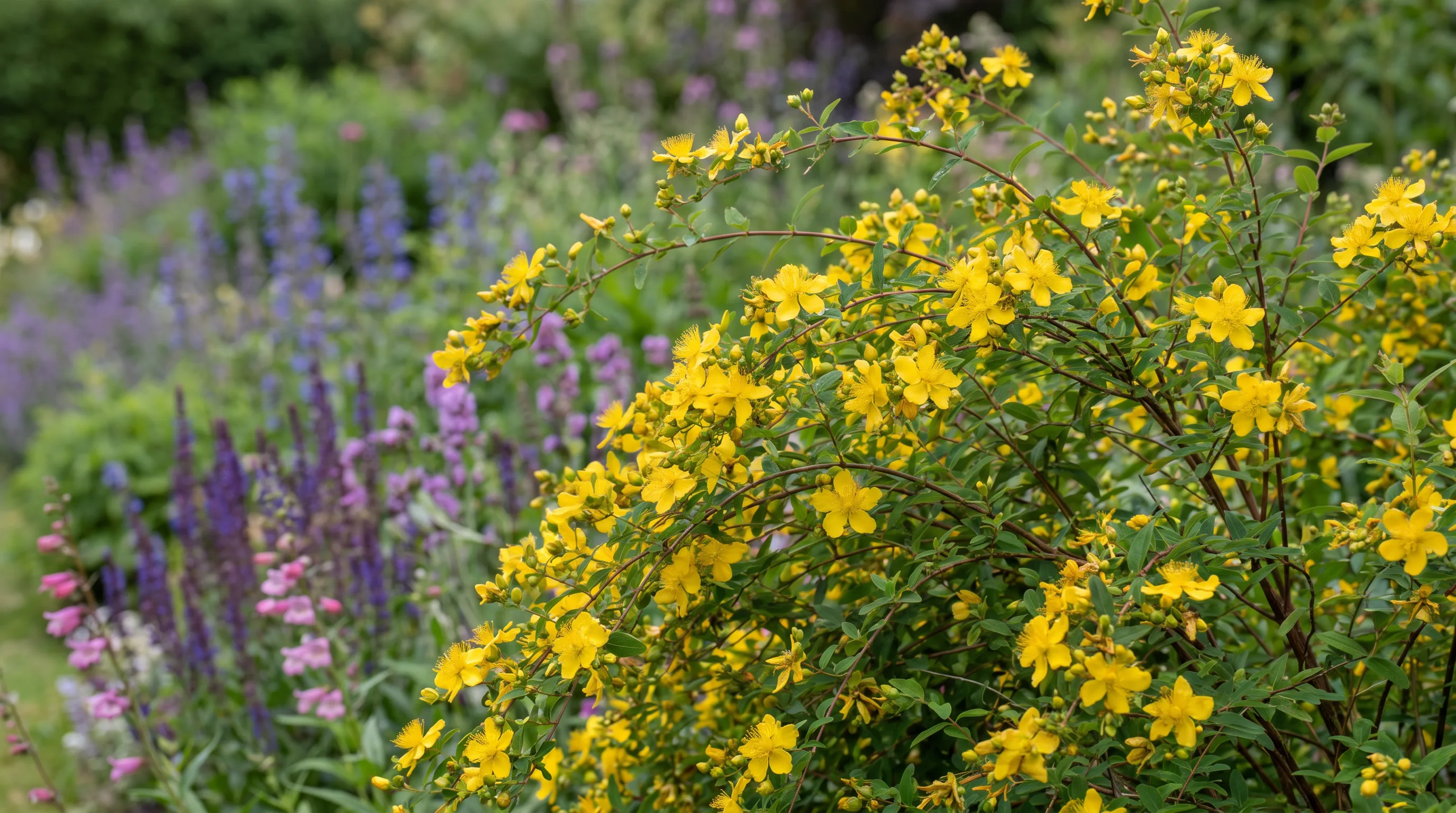
Hypericum, often called St John's Wort, is a large genus of shrubs, sub-shrubs and herbaceous perennials widely grown across UK gardens for their bright yellow flowers, attractive berries and reliable performance in mixed borders.
Overview
Hypericum is a cosmopolitan genus in the family Hypericaceae, with several hundred species distributed across temperate and subtropical regions. In the UK, the most familiar garden plants are the larger-flowered hybrids descended from Hypericum calycinum and Hypericum hidcoteense, alongside the wild native Hypericum perforatum and the berry-bearing Hypericum androsaemum (Tutsan).
The genus is valued in British gardens for several reasons. Flowering shrubs such as Hypericum × hidcoteense 'Hidcote' give a long, reliable display of golden blooms from early summer through to autumn. Ground-cover forms such as Hypericum calycinum thrive in difficult dry shade beneath trees, where many other flowering plants struggle. Berry-producing cultivars extend visual interest well into autumn, producing fruits that range from pale ivory through pink and red to deep purple-black. Several species also have a long traditional association with midsummer, having given their name to the St John's Wort used historically for its herbal properties.
For UK gardeners the genus sits comfortably in mixed borders, low-maintenance shrub plantings, informal hedging, woodland edges and ground-cover schemes. Most cultivated forms are tolerant of average garden soil, periods of summer drought once established, and the relatively cool, damp winters typical of British lowland districts.
Appearance
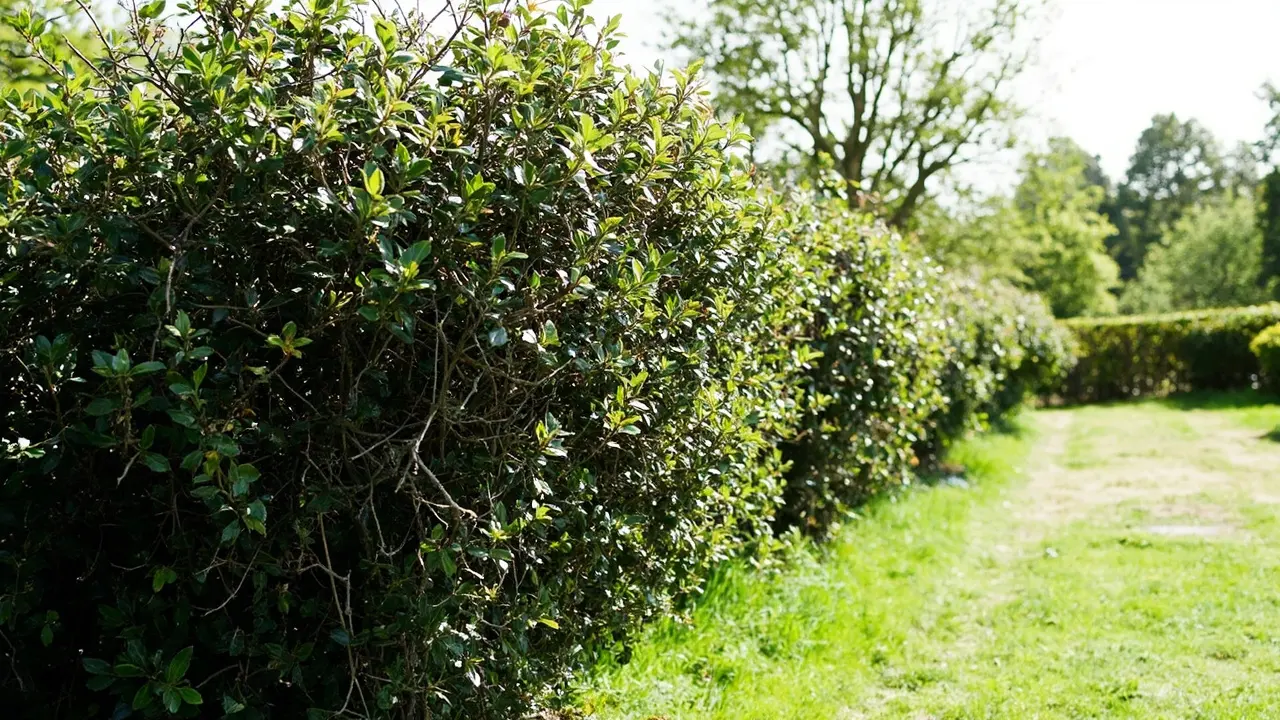
The growth habit of cultivated Hypericum in the UK is usually that of a dense, mound- or dome-shaped shrub with arching branches. Evergreen and semi-evergreen forms retain a substantial proportion of their leaves through winter, particularly in milder regions, while deciduous species shed their foliage after the first hard frosts. Stems are typically slender, woody at the base when mature, and carry opposite pairs of oval to oblong leaves. Foliage colour ranges from soft blue-green through mid-green to golden-yellow in variegated cultivars.
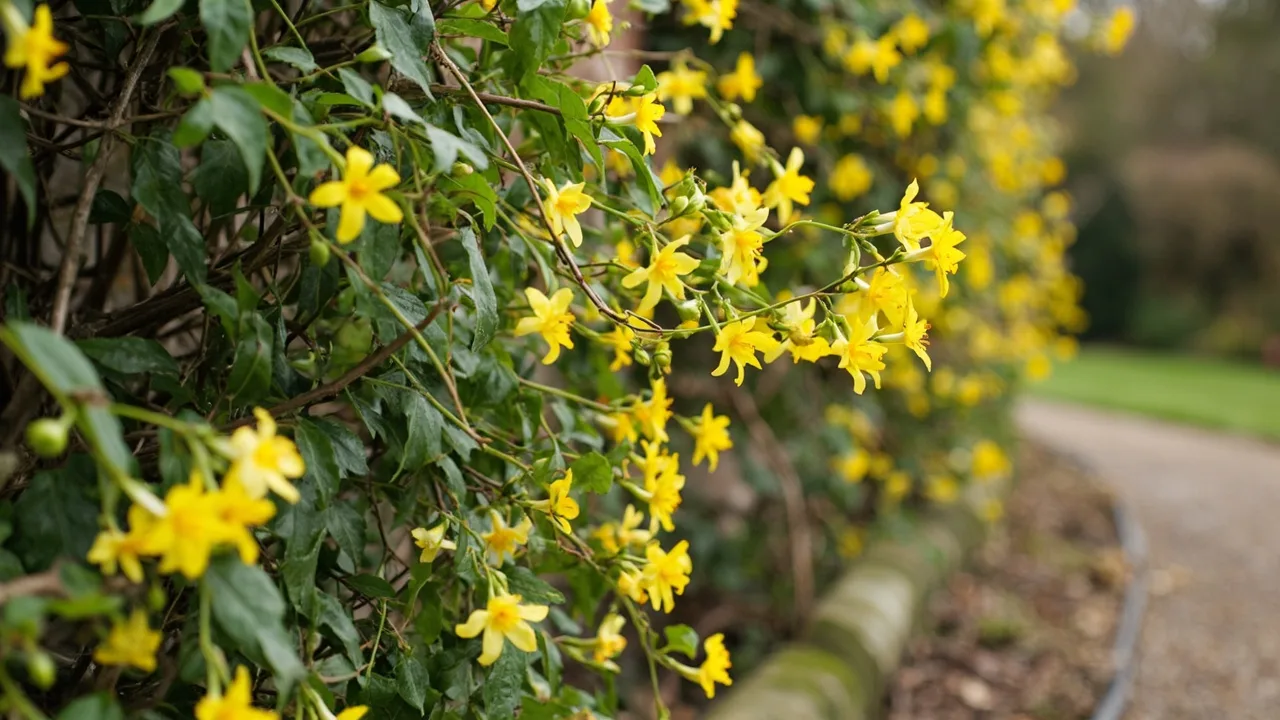
Flowers are the genus's signature feature. Individual blooms are typically 3–6 cm across, with five broad, rounded petals arranged around a prominent central boss of stamens. The dominant colour is a clear, warm yellow, occasionally tinged with orange or copper in certain hybrids. In a typical UK summer, flowering begins in June and continues intermittently into September on species such as Hypericum × hidcoteense, while Hypericum perforatum produces a more concentrated display in late June and July.
Following flowering, many cultivated forms develop ornamental berries. Hypericum androsaemum and its hybrids produce fleshy, capsule-like fruits that ripen from green through red to almost black as autumn progresses, providing a useful contrast against later flowers. Foliage on berry-bearing cultivars often takes on warm bronze or plum tones in cooler weather, adding a second season of interest.
Across the genus, mature sizes vary considerably. Hypericum calycinum rarely exceeds 30 cm in height but spreads aggressively by suckers. Hypericum × hidcoteense 'Hidcote' typically reaches 1.2–1.5 m with a similar spread. Larger species such as Hypericum × inodorum can reach 1.5–1.8 m in good conditions.
Growing Conditions
Light and position
Most cultivated Hypericum perform best in full sun to partial shade. In the UK, full sun encourages the heaviest flowering and the strongest autumn berry colour, particularly in northern and western districts where summer light levels are lower. Light dappled shade beneath deciduous trees suits ground-cover forms such as Hypericum calycinum very well, and is often the only realistic planting option beneath established beech, sycamore or conifer canopies.
Soil and moisture
The genus tolerates a wide range of soils provided drainage is reasonable and summer moisture is not entirely absent. A loam-based garden soil with reasonable organic content is ideal, but Hypericum also accepts sandy, chalky and lightly clay-based ground. Soil that remains saturated through winter can damage roots and should be avoided, particularly for the larger shrub forms. Ground-cover species tolerate drier conditions more readily once their root systems are established.
UK climate suitability
Hypericum is generally well suited to UK conditions, with most cultivated forms growing reliably across lowland Britain. Coastal, urban and exposed inland gardens all support the genus well. In colder inland districts of northern England and Scotland, hardier species such as Hypericum perforatum and Hypericum androsaemum are the safest choices, while evergreen hybrids may shed more foliage in harsh winters.
Sheltered sites help preserve both foliage and early berries on evergreen cultivars. Avoid frost pockets where late-spring frosts can scorch fresh growth.
Planting and Care
Buying and planting
Healthy container-grown Hypericum can be planted at almost any time the ground is workable, though autumn and spring are the most reliable seasons in the UK. Dig a hole comfortably wider than the rootball, tease out any circling roots, and plant so the top of the rootball sits level with the surrounding soil. Backfill with the excavated soil, firm gently, and water thoroughly. A 5–8 cm mulch of composted bark or well-rotted leaf mould helps conserve moisture and suppress weeds during establishment.
For ground-cover plantings of Hypericum calycinum, space plants about 45–60 cm apart; for shrub forms such as 'Hidcote', 60–90 cm apart is typical.
Watering and feeding
Water new plantings regularly through their first growing season, particularly during dry spells in late spring and summer. Established Hypericum is notably drought-tolerant and only needs supplementary watering during prolonged dry periods. A single balanced feed in spring, such as a general-purpose slow-release fertiliser, supports healthy growth and abundant flowering without producing excessive soft growth that would be vulnerable to wind damage.
Pruning
Hypericum × hidcoteense and similar evergreen hybrids benefit from a light annual prune in early to mid spring, just as new growth begins. Cut back the previous season's flowered stems by roughly a third, removing weak, crossing or damaged wood at the base. This keeps shrubs dense, floriferous and well-shaped without compromising the coming season's display.
Deciduous species such as Hypericum androsaemum can be cut back harder in late winter to maintain a compact framework. Avoid cutting into very old, bare wood where new shoots are unlikely to regenerate.
Ground-cover Hypericum calycinum is best sheared over in early spring with shears or a strimmer set high, removing winter-damaged foliage and encouraging fresh basal growth.
Propagation
Semi-ripe cuttings taken in mid to late summer root reliably under a simple propagator cover. Softwood cuttings in late spring also work for many species. Division is practical for Hypericum calycinum and other suckering forms in autumn or early spring. Seed can be sown in autumn for species such as Hypericum perforatum, though cultivars will not come true from seed.
Practical seasonal guide for the UK
- March–April: prune evergreen hybrids, feed established plants, plant new container-grown stock.
- May–June: water new plantings during dry spells; mulch if not already done.
- July–August: deadhead lightly to extend flowering on repeat-blooming hybrids.
- September–October: harvest and sow seed of Hypericum perforatum; plant new stock in mild districts.
- November–February: clear fallen leaves from around evergreen specimens; protect borderline-hardy forms in exposed gardens.
Common Problems
Hypericum is generally trouble-free, but several issues are worth anticipating.
Rust can appear as small orange-brown pustules on the undersides of leaves during humid summers, particularly on Hypericum calycinum. Improve airflow by thinning congested growth, avoid overhead watering, and remove badly affected leaves.
Hypericum leaf spot, caused by the fungus Septoria hyperici, produces dark brown blotches with paler centres. Tidy up fallen leaves in autumn and avoid replanting into the same ground where infection has been heavy.
Powdery mildew can affect drought-stressed plants in late summer, particularly in sheltered urban gardens. Mulching, consistent watering and good spacing reduce the risk.
Aphids occasionally colonise soft new growth in late spring. Encourage natural predators such as ladybirds and hoverflies; only treat with insecticidal soap if colonies are large.
Hypericum perforatum and certain other species can become invasive in some sites, particularly on light or disturbed soils. Choose less vigorous hybrids such as 'Hidcote' where containment matters.
Popular Varieties
Real, widely available cultivars and species suitable for UK gardens include:
- Hypericum × hidcoteense 'Hidcote' — the classic mid-sized evergreen shrub, with large bright-yellow blooms over a long season and a dense, dome-shaped habit.
- Hypericum calycinum — an excellent evergreen ground-cover shrub for dry shade, with large flowers and a spreading suckering habit.
- Hypericum × moserianum 'Tricolor' — a compact sub-shrub with variegated green, cream and pink-tinged foliage and small golden flowers.
- Hypericum androsaemum 'Albury Purple' — a deciduous berry-bearing form with reddish-purple young foliage and fruits that ripen from red to black.
- Hypericum × inodorum 'Magical Universe' — a modern hybrid bred for heavy crops of large ornamental berries in shades from ivory through pink to deep red.
- Hypericum perforatum — the native wild St John's Wort, a hardy herbaceous perennial with characteristic translucent-dotted leaves and clusters of small yellow flowers.
Choose cultivars by intended use: 'Hidcote' for mixed borders, Hypericum calycinum for ground cover in shade, berry-bearing forms for autumn interest, and Hypericum perforatum for wildlife-friendly naturalistic plantings. Local nursery availability varies, so check with a reputable UK supplier before ordering specialist cultivars.
Pests and Diseases
| Problem | Symptoms | Management |
|---|---|---|
| Rust | Pale leaf spots develop into orange, jelly-like spore clusters on the lower leaf surfaces. | Remove affected leaves promptly and avoid excess nitrogen fertiliser to prevent soft growth. |
| Honey fungus | Plant decline with white fungal mats under bark or at the base, though rare in Hypericum. | Ensure well-drained soil and remove infected plants entirely if identified. |
| Slugs and snails | Irregular holes chewed in young leaves and shoots, often with slimy trails visible. | Use physical barriers like copper tape or apply iron phosphate pellets around the base. |
| Vine weevil | Notched edges on leaves above ground and root damage causing wilting below ground. | Apply nematodes to the soil in autumn or use systemic insecticides for potted plants. |
| Powdery mildew | White, dusty fungal growth appears on leaves and stems during humid weather. | Improve air circulation and spray with a sulphur-based fungicide if severe. |
For step-by-step help, read Dealing with Slugs and Snails and Treating Powdery Mildew. Or browse the full plant problem solver to diagnose an issue by symptom.
Recommended Products
GardenWizz earns a commission from qualifying purchases made through affiliate links on this page (including links within the article) — as an Amazon Associate, and from Thompson & Morgan via the Awin network. This does not affect the price you pay. See our disclaimer for details.