Cemetery Iris
Iris albicans
The Gardening Year
Best months in UK gardens · full planting calendar →
🖨 Printable care card (PDF)At a Glance
| Botanical name | Iris albicans |
|---|---|
| Common name(s) | Cemetery Iris |
| Family | Iridaceae |
| Plant type | perennial (semi-evergreen or evergreen (in mild winters)) |
| Height × Spread | 30–121 cm × 10–50 cm |
| Position | Full sun |
| Soil | well-drained, fertile, neutral to slightly acidic |
| Flowering | March–June |
| Toxicity | Harmful if eaten |
| Native range | Middle East and northern Africa; southern Europe (mainly Italy and France) |
Iris albicans is a compact, rhizomatous perennial iris native to the Middle East and North Africa, widely naturalised across southern Europe and grown in the UK for its early-spring flowers and tidy, evergreen presence. Sometimes sold under the common name Arabian iris, it sits within the bearded-iris group (section Iris, bearded subsection) and shares the architectural foliage and six-tepalled flower form familiar from larger bearded cultivars. It is one of the earliest iris species to flower in British gardens and is valued for tolerating poor, dry soils where many border perennials struggle.
Overview
Iris albicans is a low-maintenance, drought-tolerant iris prized in UK gardens for its reliability and early flower power. It is a sterile hybrid clone, propagated only by division of the rhizome, which means cultivated plants are genetically uniform and the species does not self-seed or become invasive in British conditions. Its tolerance of thin, stony soils and dry summer weather makes it a useful candidate for gravel gardens, Mediterranean-style plantings, and the sun-baked front of herbaceous borders. Although it is happiest in full sun and free-draining ground, it accepts a wide range of garden soils as long as the rhizomes are not waterlogged through the dormant season.
In the UK the species is reliably hardy through most regional climates, and established clumps pass through ordinary British winters without lifting or protection. The main horticultural requirements are simple: a sunny position, sharp drainage, and division every few years to keep clumps vigorous. Because it flowers ahead of most border perennials, it pairs naturally with late-spring bulbs, euphorbias, and the early foliage of herbaceous plants that come into growth later in the season.
Appearance
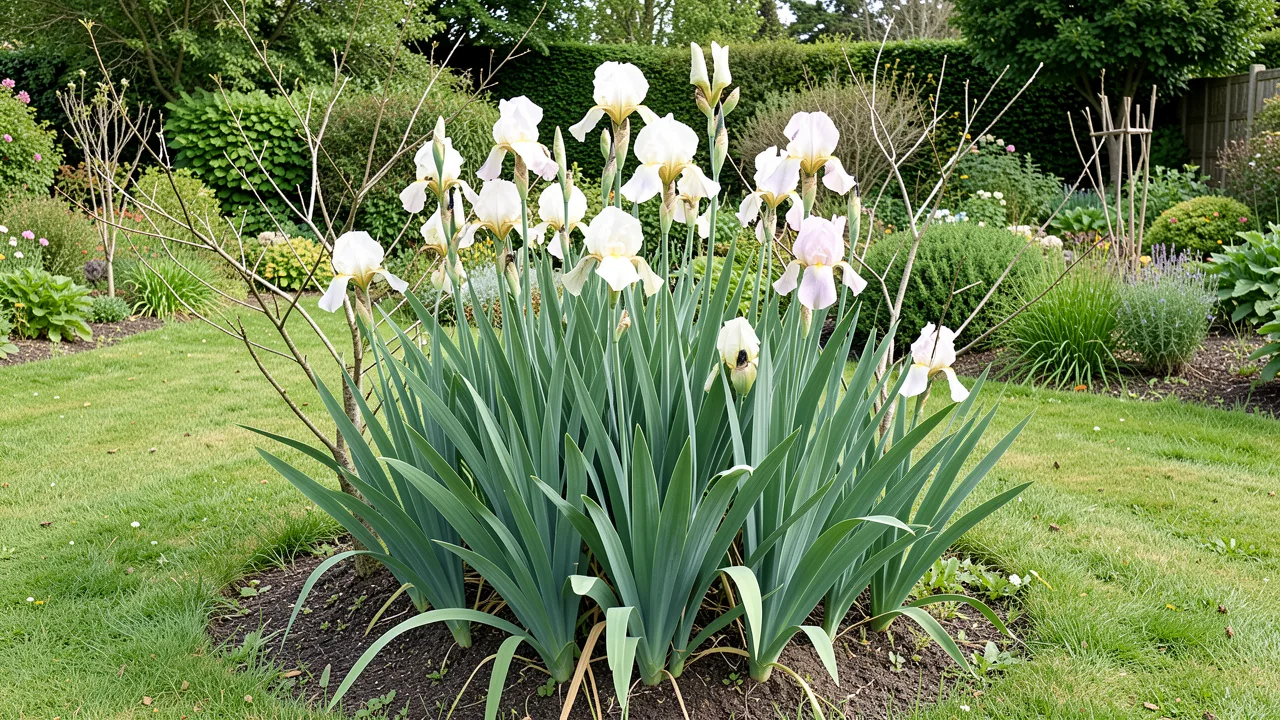
Iris albicans forms a tight, slowly expanding clump of upright, sword-shaped leaves that are grey-green to glaucous and slightly broader at the base. Foliage typically reaches 30–60 cm in height in UK cultivation, with the leaves arching gracefully at their tips. The foliage is largely evergreen through mild winters, though leaf quality can deteriorate in colder districts, where some browning at the tips is normal after hard frost.
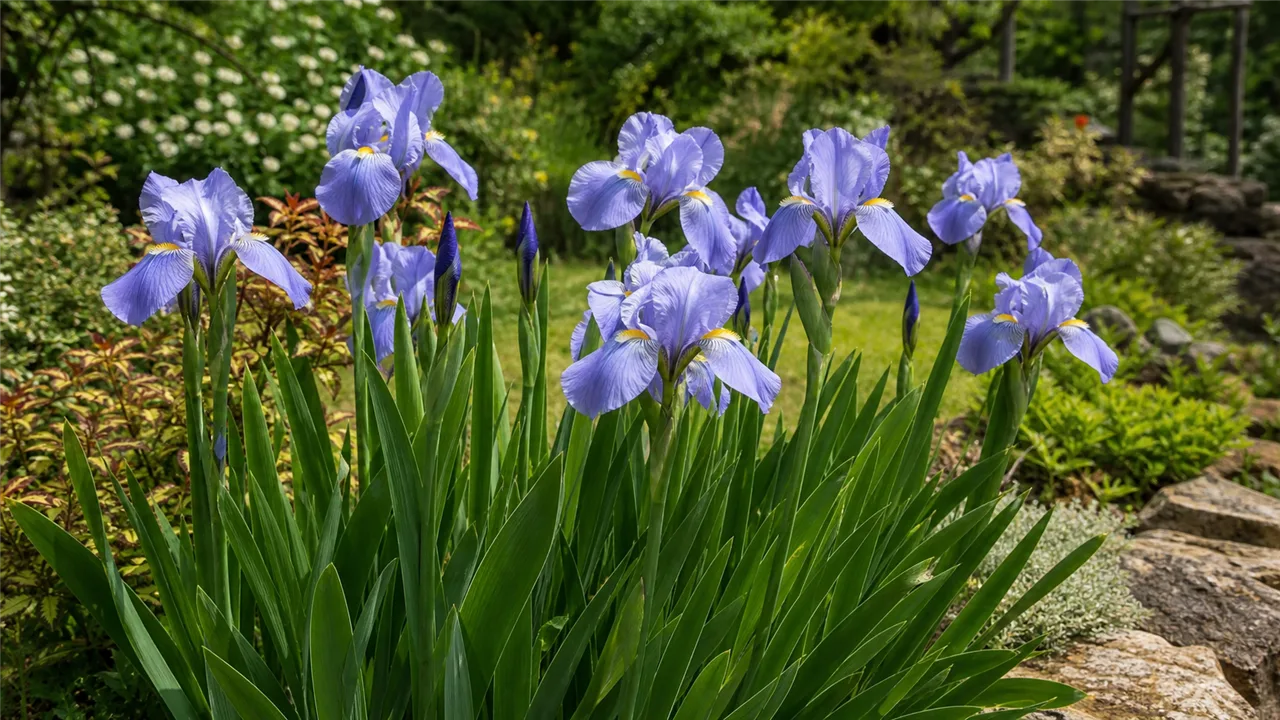
In a typical British season, flower stems emerge in March and rise just above the foliage, each carrying one or two blooms. The flowers follow the classic bearded-iris structure: three upright inner segments called standards and three outer segments called falls, which in I. albicans are white with a faint blue or lilac flush along the margins and a conspicuous yellow beard running down the centre of each fall. Individual flowers last a few days, but a well-established clump produces a succession of stems over several weeks from March into May. The overall colour impression at a distance is of cool, luminous white — a useful counterpoint to the deeper purples and blues of many later-flowering bearded iris cultivars.
The rhizome is a stout, fleshy, near-surface structure typical of bearded iris, sitting horizontally at or just below soil level. With age, clumps form a dense mat of rhizomes that gradually creep outwards; this is the basis for division, the principal method of propagation.
Growing Conditions
Iris albicans performs best in full sun, where the rhizomes can bake during summer and the foliage stays dry enough to reduce the risk of rot. It will tolerate light dappled shade for part of the day, but flowering becomes noticeably sparser as shade increases, and the clump tends to become leggy. A south- or west-facing border, raised bed, or rock garden pocket suits it well.
Soil should be free-draining and not too rich. The species tolerates loam, gritty clay-amended ground, and poor stony substrates, but it resents winter wet. Heavy clay that holds water around the rhizomes for prolonged periods is the most common cause of failure, as the rhizomes are prone to rotting in cold, saturated soil. If planting in heavier ground, work in generous grit or composted bark to improve drainage, or site the plant on a low mound so the rhizome sits above the surrounding level. A neutral to slightly alkaline pH is ideal, mirroring the calcareous soils of much of its native range.
Iris albicans is hardy across most of the UK and tolerates typical British winters without protection in well-drained soil; in colder inland or northern districts, the foliage may be partially scorched but the rhizomes survive. Its tolerance of summer drought once established makes it a good fit for dry gardens and exposed coastal positions, where its leathery leaves shrug off salt-laden wind.
Planting and Care
The most important principle when planting bearded iris of any kind is to set the rhizome at or just below the soil surface, with the top exposed to the sun. Burying the rhizome deeply is the single most common cause of rot. Plant rhizomes with their roots spread out beneath them, firm the soil, and water in to settle the ground. Space plants 30–45 cm apart to give each clump room to expand.
Watering
Water regularly during the first growing season to help the new roots establish. After that, I. albicans is notably drought-tolerant and prefers to dry out between waterings. In ordinary UK summers, established clumps need no supplementary watering. Avoid watering in winter; the dormant rhizome should remain on the dry side.
Feeding
A light application of a balanced slow-release fertiliser in early spring, as new growth emerges, is sufficient. Avoid heavy nitrogen feeds, which produce lush foliage at the expense of flowers and can encourage soft growth that is more susceptible to rot. A top-dressing of bonemeal or a low-nitrogen fertiliser worked into the soil around the clump in March will sustain flowering for several weeks.
Tidying and cutting back
Iris albicans requires no routine cutting back beyond seasonal tidying. Remove dead or damaged leaves in autumn (September to November) by pulling them cleanly away from the base of the plant; do not shear the clump, as this can trap moisture in the crown. Leave healthy foliage in place through winter, as it continues to photosynthesise on mild days and feeds the rhizome for the following spring's flowers.
Propagation
Propagation is by division of established clumps. Lift and separate congested clumps in July or August, immediately after flowering, when the rhizomes are entering their summer dormancy. Cut the foliage back by two-thirds to reduce water loss, tease the clump apart into individual rhizome fans with attached roots, and replant at once. Discard any old, spent rhizome material from the centre of the clump and replant only vigorous outer pieces. Division every three to four years keeps clumps flowering well and prevents the centres from becoming exhausted.
Seasonal care
In spring, top-dress and tidy the clump, removing any winter-damaged leaves. Through summer, allow the soil to dry between waterings and avoid mulching over the rhizome. In autumn, clear away fallen leaves from around the base to reduce overwintering slug and rot problems, but leave the iris's own foliage in place. In winter, the plant needs no protection in most UK gardens.
Common Problems
Iris albicans is generally robust in UK cultivation where drainage is adequate, but a handful of problems can occur.
Rhizome rot. Bacterial soft rot (Erwinia carotovora) and grey mould (Botrytis cinerea) are the most common causes of collapse. Both are associated with waterlogged soil or rhizomes buried too deeply. Improve drainage, lift affected plants, cut back to sound tissue, and replant the rhizomes at the surface. Destroy severely affected material rather than composting it.
Iris borer. The caterpillar of Macronoctua onusta tunnels into rhizomes, causing leaves to yellow and stems to collapse. Although this pest is less common in the UK than in North America, it does occur. The standard control is to lift and destroy affected rhizomes in late summer, breaking the life cycle, and to clear away old debris where eggs overwinter.
Leaf spot. Fungal leaf spotting caused by Alternaria and Heterosporium species produces brown lesions on the foliage, particularly in damp, crowded plantings. Remove and destroy affected leaves, improve air circulation by division if clumps have become congested, and avoid overhead watering.
Slugs and snails. Young spring growth and emerging flower stems are vulnerable to slug and snail damage, particularly in damp seasons. Use ferric-phosphate slug pellets, beer traps, or physical barriers according to preference.
Halo blight. Bacterial leaf scorch (Pseudomonas syringae pv. iris) produces water-soaked streaks and yellow halos on foliage. Remove and destroy affected plants, disinfect tools between cuts, and avoid working with the plants when they are wet.
Toxicity. All parts of Iris albicans are mildly toxic if eaten, containing irritant compounds in the rhizome and foliage. The sap can also irritate sensitive skin, so wear gloves when dividing clumps. The plant is not normally browsed by livestock or pets.
Popular Varieties
Iris albicans is itself a sterile, vegetatively propagated clone, and named cultivars within the species are scarce in British horticulture. Most plants sold in UK nurseries are the species itself, often labelled simply as Iris albicans or under older trade names such as the Madonna iris. Gardeners seeking named forms will find that genuine, distinct cultivars of I. albicans are not widely listed; most named bearded irises sold in the UK belong to other species and hybrid groups.
A handful of related bearded irises that share I. albicans's early-flowering, drought-tolerant character are sometimes grown alongside it and are widely available in UK trade:
- Iris germanica cultivars — the traditional bearded irises of cottage borders. Cultivars such as 'Jane Phillips' (soft sky-blue), 'Sable' (deep violet-black), and 'Immortality' (pure white, repeat-flowering in some seasons) offer a wider colour range while sharing similar cultivation needs.
- Iris florentina — closely related to I. albicans and historically used as a source of orris root. Its flowers are predominantly white with a blue tinge, and it tolerates the same dry, sunny conditions.
- Iris pallida — a taller bearded iris with glaucous foliage and lilac-blue flowers, valued for its scented blooms and variegated leaf forms such as 'Variegata' (cream-striped leaves) and 'Argentea Variegata' (silver-striped leaves).
Where specific named forms of I. albicans are sought, specialist bulb and iris nurseries are the most reliable source; many garden-centre plants offered as cultivars turn out to be the standard species on closer inspection.
Pests and Diseases
| Problem | Symptoms | Management |
|---|---|---|
| Bacterial rhizome rot | The base of the leaves and rhizome collapse, becoming soft, slimy, and foul-smelling. | Ensure excellent drainage and plant rhizomes partially exposed to prevent waterlogging. |
| Iris leaf spot | Small, circular brown or purple spots appear on the leaves, often merging into larger blotches. | Remove and dispose of infected foliage at the end of the season to reduce overwintering spores. |
| Iris rust | Orange or brown pustules develop on the leaves, causing them to yellow and wither. | Pick off lightly infected leaves early in the season to slow the spread of the fungus. |
| Ink disease | Leaves turn black and shrivel, often starting from the base and moving upwards. | Dig up and destroy severely affected plants immediately to prevent soil contamination. |
| Viral infection | Young leaves show distorted growth, mottling, or streaking patterns. | Remove and burn infected plants as there is no cure for viral infections. |
Or browse the full plant problem solver to diagnose an issue by symptom.
Recommended Products
GardenWizz earns a commission from qualifying purchases made through affiliate links on this page (including links within the article) — as an Amazon Associate, and from Thompson & Morgan via the Awin network. This does not affect the price you pay. See our disclaimer for details.