Kerner Iris
Iris kerneriana
The Gardening Year
Best months in UK gardens · full planting calendar →
🖨 Printable care card (PDF)At a Glance
| Botanical name | Iris kerneriana |
|---|---|
| Common name(s) | Kerner iris |
| Family | Iridaceae |
| Plant type | perennial |
| Height × Spread | 20–55 cm × — |
| Position | Full sun, Partial shade |
| Soil | well-drained, neutral to slightly acid loam |
| Flowering | May–July |
| Toxicity | Harmful if eaten |
| Native range | Northern Turkey |
Iris kerneriana, the Kerner iris, is a compact rhizomatous iris from northern Turkey, valued for its narrow foliage and softly coloured yellow flowers. It suits sunny, freely drained UK borders where a small, distinctive species iris is more useful than a large, heavily bred cultivar.
Overview
Kerner iris is a relatively uncommon member of the iris family, Iridaceae. It is a beardless species associated with the spuria group, rather than one of the familiar tall bearded irises. Its restrained proportions, fine leaves and clear, pale flowers give it a lighter appearance than many border irises. In a garden it forms a slowly expanding clump rather than a bulky mass, making it suitable for the front or middle of a sunny border, a gravel garden or a specialist iris collection.
The accepted botanical treatment is not entirely uniform. The Royal Horticultural Society maintains Iris kerneriana as a plant name, while Plants of the World Online treats it as a synonym of Iris haussknechtii. These names should therefore not be assumed to represent two distinct garden plants when comparing catalogues. The older synonym Iris graminifolia may also occur in references, although that name can cause confusion because it has been applied elsewhere in the genus.
The species is native to northern Turkey, not Britain or Ireland. It is suited to outdoor cultivation in much of the UK when given free drainage. Winter wet is a significant practical risk, so improve heavy, compacted ground and avoid low-lying sites that remain saturated.
Kerner iris works well in cottage-style borders, sunny beds and naturalistic plantings. Its narrow leaves contrast with rounded foliage, while the pale yellow flowers combine easily with blue, violet and white.
Appearance
The plant grows from slender rhizomes and develops into a neat tuft, generally reaching no more than about 45 cm in height and a similar spread. Its leaves are narrow, upright, dark green and grass-like. They create a fine vertical texture from spring onwards without occupying the visual space of the broad, sword-shaped fans found on some larger irises. As a deciduous herbaceous perennial, the foliage declines and dies back at the end of the growing season.
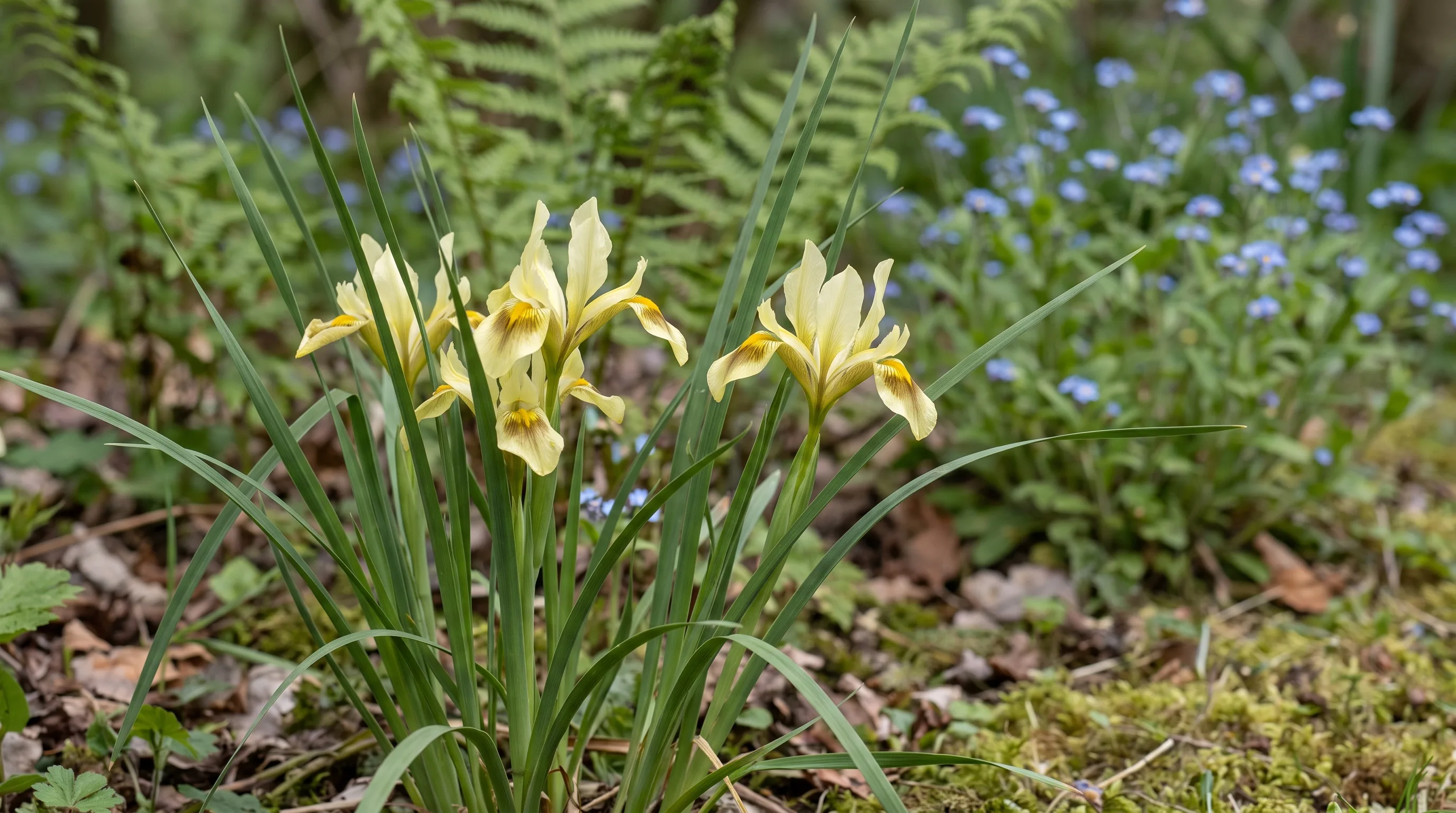
Erect flower stems rise through the leaves and usually carry a small number of blooms. Individual flowers can be up to about 10 cm across. Their principal colour is cream to pale straw-yellow, with a richer golden-yellow signal patch on the falls. The falls are the lower, outward-facing parts of an iris flower; the standards are the upright inner segments. Their subtle contrast gives each flower definition.
Flowers appear in late spring or early summer, commonly around May and June. They may be lightly scented. Strong winds can bruise the petals or shorten the display, so an open yet sheltered position is preferable.
Growing Conditions
Choose full sun for the strongest flowering and firm growth. Light partial shade is tolerated, particularly where the plant still receives several hours of direct light, but deep shade is likely to reduce flowering and leave the clump less vigorous. Shelter from persistent strong winds is useful, although the site should not be enclosed so tightly that air remains stagnant around wet foliage.
The best soil is a fertile, humus-rich loam that drains freely. A neutral to slightly acidic reaction is suitable. Before planting into heavy clay, incorporate well-rotted organic matter through a broad area and add grit where this genuinely improves the soil structure. Simply placing grit in a small planting hole can create a sump, so drainage must be addressed across the bed. Raised beds or a gentle slope can provide a safer setting in gardens with wet winters.
Very sandy soil may lose moisture and nutrients too rapidly. Improve it with mature garden compost, then mulch lightly in spring without burying the rhizomes or crown. Avoid fresh manure and thick mulches pressed against the plant.
Kerner iris is suitable for UK gardens provided the position matches these requirements. In wetter western districts, winter drainage deserves particular attention. In drier eastern and south-eastern areas, newly planted clumps may need more regular watering. Containers are possible using a loam-based, peat-free compost with added grit and generous drainage holes.
Planting and Care
Prepare the ground deeply enough to remove perennial weeds and relieve compaction. Plant a pot-grown specimen at the same level it occupied in its container. When planting a bare rhizome or a freshly divided piece, spread the roots into prepared soil and keep the rhizome close to the surface rather than burying it deeply. Allow roughly 30–45 cm between plants so air can move around the foliage and the clump has room to develop.
Water thoroughly after planting and maintain even moisture while new roots establish. Thereafter, established plants should need supplementary water mainly during prolonged dry spells. Water the soil at the base rather than repeatedly wetting the leaves, and allow the surface to begin drying between applications. Container-grown plants dry faster, but their compost must not remain constantly sodden.
Feeding should be moderate. Apply a thin mulch of well-rotted garden compost around, but not over, the crown in early spring. On poor ground, a light application of a balanced general fertiliser at the start of growth is sufficient. Excess nitrogen can encourage soft foliage at the expense of flowers and may make growth more vulnerable to disease.
Kerner iris does not require scheduled woody pruning. Cut spent flower stems down after flowering unless seed is wanted, taking care not to damage the leaves. Leave healthy foliage in place while it is green because it supports the rhizomes. Cut back dead or dying leaves in autumn and remove the debris from the bed. This distinction matters for a herbaceous perennial: the appropriate task is seasonal cutting back, not pruning.
Divide congested clumps after flowering, from midsummer into early autumn, broadly July to September. Lift the clump carefully, separate healthy outer rhizomes with sound roots and discard any soft, hollow or badly damaged material. Replant divisions promptly in prepared soil and water them until established. Iris material is harmful if eaten, including to pets, so keep it away from children and animals likely to ingest it. Because the material is potentially harmful when handled, wear gloves when working with the plant, and clean tools after working on diseased plants.
Seed provides an alternative means of propagation but is slower and does not give an immediate mature clump. Sow fresh or stored seed in pots of free-draining seed compost and keep them in a cold frame in autumn or spring. Germination may be irregular, and seedlings can take several years to reach flowering size. Do not include a sowing event in the outdoor care calendar for this herbaceous perennial; seed propagation is a specialist nursery technique rather than its routine garden schedule.
Inspect new growth in spring and keep competing weeds away. After the May–June display, remove old flower stems. Divide only when the clump becomes congested or flowering declines. In autumn, cut back dying foliage and clear it from the bed; in winter, keep drainage channels and container holes open.
Common Problems
Slugs and snails may chew emerging leaves and scar young shoots, especially during damp spring weather. Regular inspection after dusk, removal of hiding places and wildlife-friendly barriers can reduce damage. Thrips are tiny sap-feeding insects that may cause silvery streaks, distorted growth or marked flowers. Good plant health and removal of badly affected material help limit their impact; severe or repeated damage should be identified accurately before treatment.
Aphid-borne viruses can produce streaked, mottled or distorted foliage and impaired flowering. There is no curative treatment for a virus-infected iris. Remove badly affected plants, control heavy aphid infestations by appropriate garden methods, and avoid transferring sap between clumps on dirty tools. Not every mark is viral, so compare symptoms across new growth and rule out feeding damage or physical injury before removing a valued specimen.
Bacterial soft rot is a serious risk where rhizomes are injured or soil remains wet. Affected tissue becomes soft, discoloured and often unpleasant-smelling. Lift the plant, cut away compromised material with a clean tool and discard it rather than composting it. Improve drainage before replanting healthy sections. Grey mould can develop on damaged or dying tissue in cool, humid conditions; prompt clearing, adequate spacing and air movement reduce the conditions it favours.
Failure to flower is often cultural. Too much shade, excessive nitrogen, deeply buried rhizomes or overcrowding can all contribute. Correct the site or feeding regime and divide a congested plant at the appropriate time. Browning foliage late in the season is normal dormancy.
Popular Varieties
Named cultivars of Iris kerneriana are not well documented in mainstream UK horticultural references, and no reliable set of three distinct cultivars can be given without inventing names. Plants are usually offered simply as the species, Iris kerneriana, or occasionally under a taxonomic synonym.
When buying, note that Iris haussknechtii may be used under a current taxonomic treatment for the same species, while Iris graminifolia may appear as an older synonym. Neither is a cultivar name. Species-raised seedlings may vary modestly, but that does not create a recognised cultivar. Choose a healthy, correctly labelled plant from a specialist iris nursery and retain its provenance.
Pests and Diseases
| Problem | Symptoms | Management |
|---|---|---|
| Slugs and snails | Irregular holes chewed in leaves, flowers, or young shoots, often accompanied by slimy trails. | Use physical barriers like copper tape, hand-pick at night, or apply iron phosphate pellets. |
| Bacterial soft rot | Rhizomes become soft, mushy, and emit a foul odor, causing the plant to collapse. | Remove and destroy affected plants; ensure well-drained soil and avoid overwatering. |
| Iris leaf spot | Small purple or brown spots with yellow halos appear on leaves, potentially causing them to yellow. | Remove and dispose of infected foliage in autumn to reduce spore carryover. |
| Iris rust | Orange or brown pustules form on the undersides of leaves, leading to yellowing and distortion. | Improve air circulation and remove heavily infected leaves; avoid wetting foliage when watering. |
| Thrips | Flowers appear crumpled, discolored, or distorted with silvery patches on petals and leaves. | Monitor closely during flowering; use blue sticky traps or insecticidal soap if infestations are severe. |
For step-by-step help, read Dealing with Slugs and Snails. Or browse the full plant problem solver to diagnose an issue by symptom.
Recommended Products
GardenWizz earns a commission from qualifying purchases made through affiliate links on this page (including links within the article) — as an Amazon Associate, and from Thompson & Morgan via the Awin network. This does not affect the price you pay. See our disclaimer for details.