Lazistan Iris
Iris lazica
The Gardening Year
Best months in UK gardens · full planting calendar →
🖨 Printable care card (PDF)At a Glance
| Botanical name | Iris lazica |
|---|---|
| Common name(s) | Lazistan Iris |
| Family | Iridaceae |
| Plant type | perennial |
| Height × Spread | 10–50 cm × 10–50 cm |
| Position | Full sun, Partial shade |
| Soil | sharply-drained, neutral to alkaline soil; moist but well-drained |
| Flowering | February–March |
| Toxicity | Harmful if eaten |
| Native range | Black Sea coast of Turkey and Georgia; Turkey to Transcauc |
Iris lazica, sometimes sold as the Turkish iris or Lazica iris, is a low, evergreen, beardless perennial grown chiefly for its late-winter and early-spring flowers. Closely related to the better-known Algerian iris (Iris unguicularis), it shares that plant's habit of pushing up bloom from a dense evergreen tuft of strap-shaped leaves in the depths of the season, but it tolerates a wider range of British conditions and is generally easier to keep in good heart across most of the UK. It is a useful front-of-border subject for mild and coastal gardens, where it can be in flower from February well into April.
Overview
Iris lazica belongs to the large and varied genus Iris in the family Iridaceae. It sits within the beardless group of irises and is closely allied to Iris unguicularis, the Algerian or winter-flowering iris that is more widely grown in British gardens. Where I. unguicularis comes from stony Mediterranean hillsides, however, I. lazica originates much further east, on the damp, mild coasts of the eastern Black Sea. Its native range is restricted to the Colchis region of north-eastern Turkey — the historic Lazistan from which the species takes its name — and adjacent parts of western Georgia, including Adjara and Abkhazia. There it grows in scrub, rocky slopes and light woodland near the coast, in soils that are reliably moist through the growing season but never waterlogged.
The species was introduced to wider British horticulture largely through the Beth Chatto Gardens in Essex, which championed it after plantsman and writer Dr John Grimshaw drew attention to its garden value in the 1990s. Since then it has settled into UK cultivation as a useful alternative to I. unguicularis for gardens that are too cold, too damp or too shady to keep the Algerian iris happy. It is fully hardy in most lowland and coastal parts of Britain, evergreen, and — unlike its better-known cousin — tolerant of soils that stay slightly moist through the year.
In a UK context, I. lazica is valued for late-winter interest at the front of a border, at the base of a warm wall, or in a rock garden or raised bed where its low tuft of glossy leaves and early blooms can be seen at close quarters. It is also a useful nectar source for emerging bumblebee queens and solitary bees on mild February and March days. Like other winter-flowering irises it carries a light, sweet scent, most noticeable when the flowers open in sunshine.
Appearance
The plant forms a low, clump-forming evergreen tuft. The leaves are glossy, deep green, strap-shaped and arching, typically 30–45 cm long and 1–2 cm wide. They are narrower and rather more refined than those of I. unguicularis, giving the clump a tidier outline through the year. Established plants make a dense mat of rhizomes just at or just below the soil surface, slowly expanding outwards to form a generous evergreen patch.
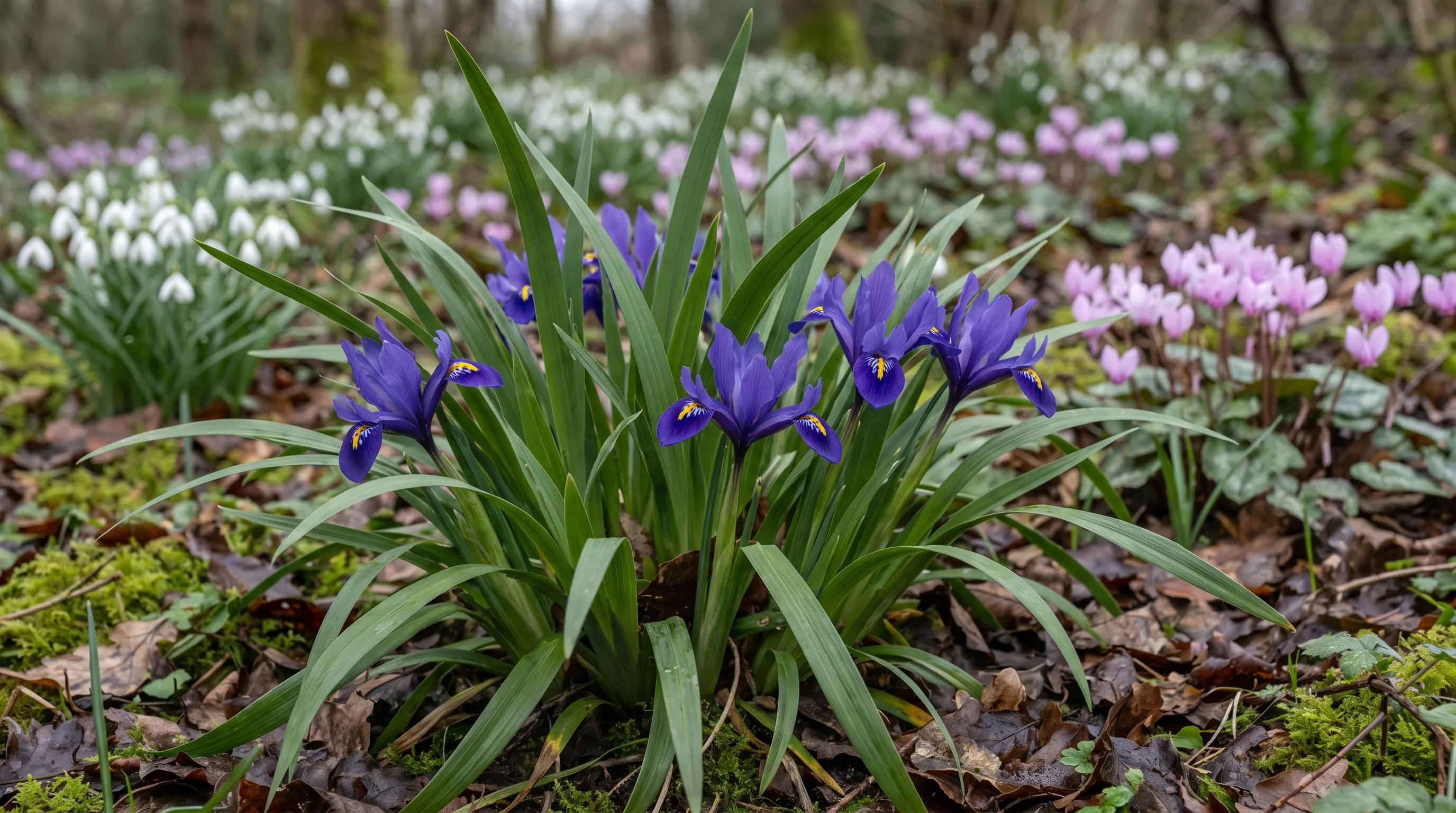
Flowers appear from late winter into early spring, generally February to April in the UK and sometimes earlier in mild seasons. Each bloom is 6–8 cm across, beardless, and in shades of lilac to lavender-blue, occasionally paler or faintly veined on the falls. The falls (outer tepals) are broader than the standards (inner tepals) and carry a small yellow or whitish signal patch at the throat that helps guide early pollinators in. Flower stems are short — usually 15–25 cm — so the blooms sit among or just above the leaves rather than rising well clear of them.
The scent is light and sweet, most pronounced on sunny days when the flowers warm through. Seed capsules do form in long, warm summers but rarely set in the British climate, and almost all plants in cultivation are propagated vegetatively by division.
Growing Conditions
Iris lazica is happiest in a spot that mimics its native damp, mild coastal woodland edge. In practice this means a position in full sun or very light dappled shade, in a humus-rich soil that holds moisture through the growing season yet drains freely in winter. It is notably more tolerant of moisture at the roots than most other rhizomatous irises, and it copes well with the heavier and slightly damp soils that defeat I. unguicularis.
The ideal soil pH is slightly acidic to neutral, but the species is tolerant and will perform well on neutral-to-mildly-alkaline ground. The one soil condition it cannot abide is winter waterlogging around the rhizome, which quickly leads to rot. On heavy clay, planting into a slightly raised bed or a slope, or working grit and well-rotted organic matter into the planting area, makes a real difference.
In the UK, I. lazica is generally grown outdoors without protection in coastal and lowland gardens, and its evergreen foliage holds well through the winter. In cold inland sites, particularly in frost pockets and exposed northern gardens, the foliage may be scorched or damaged during hard spells, but the rhizome itself usually survives and re-flushes in spring. Shelter from the worst of the winter wind — for example at the base of a south- or west-facing wall — both protects the leaves and brings the flowers forward by a few weeks.
Planting and Care
Planting is best done in spring or early autumn, giving the rhizome a full growing season to establish before it has to face its first winter. Set the rhizomes shallowly, with the top of the rhizome at or just below the soil surface, and space them about 20–30 cm apart. Burying the rhizome too deeply is the most common cause of failure with this genus, and shallow planting is more important than for many other border perennials.
Watering needs are modest. Water newly planted rhizomes in during dry spells in their first summer, but established clumps generally look after themselves in the British climate, even through the dry periods that are increasingly common in late spring and summer. There is no need for routine supplementary watering once the plant has settled in.
Feeding should be light. A mulch of garden compost or leaf mould in autumn is sufficient and reflects the species' preference for a humus-rich, slowly fed soil. High-nitrogen fertilisers encourage lush leafy growth at the expense of flower and should be avoided.
Pruning is minimal. The species is evergreen, and the foliage continues to photosynthesise through the winter, feeding the rhizome. The only routine tidy is to remove any battered, scorched or torn leaves in early spring, just as the flower buds are emerging, taking care not to shear the whole clump. Old flower stems can be cut back to the base once the blooms have faded.
Propagation is by division of established clumps every four to five years, carried out in late summer after flowering has finished. Lift the clump, tease apart the rhizomes, replant the youngest, most vigorous sections at the same shallow depth, and discard the old woody centres. Late-summer division suits I. lazica because it continues rooting into autumn and resents being disturbed during the cold months.
A gravel or stone mulch suits the species well, both reflecting winter light up into the flowers and keeping the rhizome crown dry, but a thin organic mulch is equally acceptable on heavier soils.
Common Problems
The main disease risk is rhizome rot, sometimes called ink disease in irises. It is caused by a complex of fungi (Bipolaris iridis / Drechslera iridis-type pathogens) and bacteria (Erwinia species) that turn the rhizome and leaf bases black and soft. It is most prevalent in poorly drained soil and after cold, wet winters. Prevention — by improving drainage and avoiding deep planting — is far more effective than cure. Affected plants should be lifted, cut back to clean white rhizome tissue and replanted in improved conditions.
Slugs and snails are a recurring nuisance in damp British springs, grazing emerging flower buds and new leaf tips. Standard UK controls — night hand-picking, wildlife-friendly pellets, beer traps and copper rings — are all effective.
Leaf spot, caused by Didymellina and Mycosphaerella species, can produce small brown spots on the foliage, particularly in wet summers. It is rarely serious and is mostly cosmetic; removing affected leaves and avoiding overhead watering is usually enough to keep it in check. Aphids occasionally colonise flower stems but rarely cause meaningful damage.
Iris mosaic virus and related viruses produce streaked or mottled foliage and reduced flowering. There is no cure; affected plants should be lifted and destroyed, and tools should be sterilised between clumps to avoid spreading infection.
In cold exposed inland sites the evergreen foliage may scorch at the leaf tips during hard frosts. The damage is cosmetic and the plant will replace the affected leaves in spring; trimmed tips are best removed with secateurs rather than shears.
Popular Varieties
Iris lazica is sold in British gardens almost exclusively as the species, and no named cultivars have become established in mainstream UK horticulture. Specialist alpine and woodland plant nurseries occasionally offer seedling-raised plants under collection numbers (for example forms collected in Adjara or near Artvin), but these are not formally named varieties and are not widely available.
Where gardeners want a slightly different effect, the natural comparison is with the closely related Iris unguicularis, which has a wider range of named forms including 'Walter Butt' and the white-flowered 'Alba', and tolerates drier and sunnier conditions than I. lazica. I. lazica itself is best treated as a single, variable species: plants raised from seed may differ modestly in flower colour from pale lilac to a slightly deeper lavender-blue, but none of these variants has been formally named or widely tested in UK cultivation.
If a particular form proves reliably better in a given garden — for example, one that flowers particularly early, or one that holds its foliage better in cold inland sites — it is worth dividing and sharing that clone locally, but it should not be sold or written up under a cultivar name without proper trialling and registration.
Pests and Diseases
| Problem | Symptoms | Management |
|---|---|---|
| Bacterial soft rot | The rhizome base becomes mushy, blackened and emits a foul odour. | Cut away affected tissue with a disinfected knife and allow wounds to dry before replanting. |
| Slugs and snails | Irregular holes are chewed in young leaves and emerging flower buds. | Use physical barriers, hand-pick at night, or apply iron phosphate-based pellets. |
| Iris leaf spot | Small brown or purple spots appear on the foliage, often merging into larger lesions. | Remove and dispose of infected leaves and clear all debris at the end of the season. |
| Grey mould (Botrytis) | A fuzzy grey fungal growth covers flowers and foliage, causing them to rot. | Ensure good air circulation and avoid wetting foliage when watering. |
| Thrips | Tiny insects cause silvering or bronzing of leaves and distortion of flower petals. | Monitor closely and use blue sticky traps or insecticidal soap if infestations are severe. |
For step-by-step help, read Dealing with Slugs and Snails. Or browse the full plant problem solver to diagnose an issue by symptom.
Recommended Products
GardenWizz earns a commission from qualifying purchases made through affiliate links on this page (including links within the article) — as an Amazon Associate, and from Thompson & Morgan via the Awin network. This does not affect the price you pay. See our disclaimer for details.