
European Larch
Larix decidua
The Gardening Year
Best months in UK gardens · full planting calendar →
🖨 Printable care card (PDF)At a Glance
| Botanical name | Larix decidua |
|---|---|
| Common name(s) | European Larch |
| Family | Pinaceae |
| Plant type | tree (deciduous coniferous tree) |
| Height × Spread | 25–45 m × 5–8 m |
| Position | Full sun |
| Soil | well-drained soils |
| Flowering | — |
| Toxicity | — |
| Native range | mountains of central Europe, in the Alps and Carpathian Mountains, with small disjunct lowland populations in northern Poland |
European larch is one of the few conifers that drops its needles every autumn, and that single quirk makes it instantly recognisable in UK gardens and parklands. From spring through summer it carries the soft, fresh green of any other conifer; from late October it burns a clear, warm gold before shedding, leaving bare winter branches studded with woody cones. Native to the mountains of central Europe, it is fully at home in British conditions and is widely planted as a specimen tree, as shelter on exposed sites, and as a forestry crop. It is also a long-lived tree: well-grown specimens commonly reach two hundred years, and very old individuals can approach a thousand.
Quick-Care Table
Overview
European larch belongs to the pine family (Pinaceae) and is the most widely planted of the world's ten or so larch species. It was introduced to British cultivation in the early seventeenth century and has since become a mainstay of forestry, estate planting, and ornamental landscapes. Its value lies in a rare combination of traits: a strongly architectural conical form when young, brilliant autumn colour, useful timber, and an ability to thrive on poor, exposed ground where many other conifers struggle.
It is fully hardy throughout the UK and tolerates wind, cold, and altitude well, which is why it features so heavily in upland shelterbelts from the Welsh borders to the Scottish Highlands. Although deciduous, it behaves in cultivation as a robust, undemanding tree provided it is given sun and a well-drained soil. In a garden setting it is best treated as a long-term specimen rather than a quick fix: even a young vigorous tree will outgrow most domestic plots within a couple of decades, so it is better suited to large gardens, parkland, and estates.
Appearance
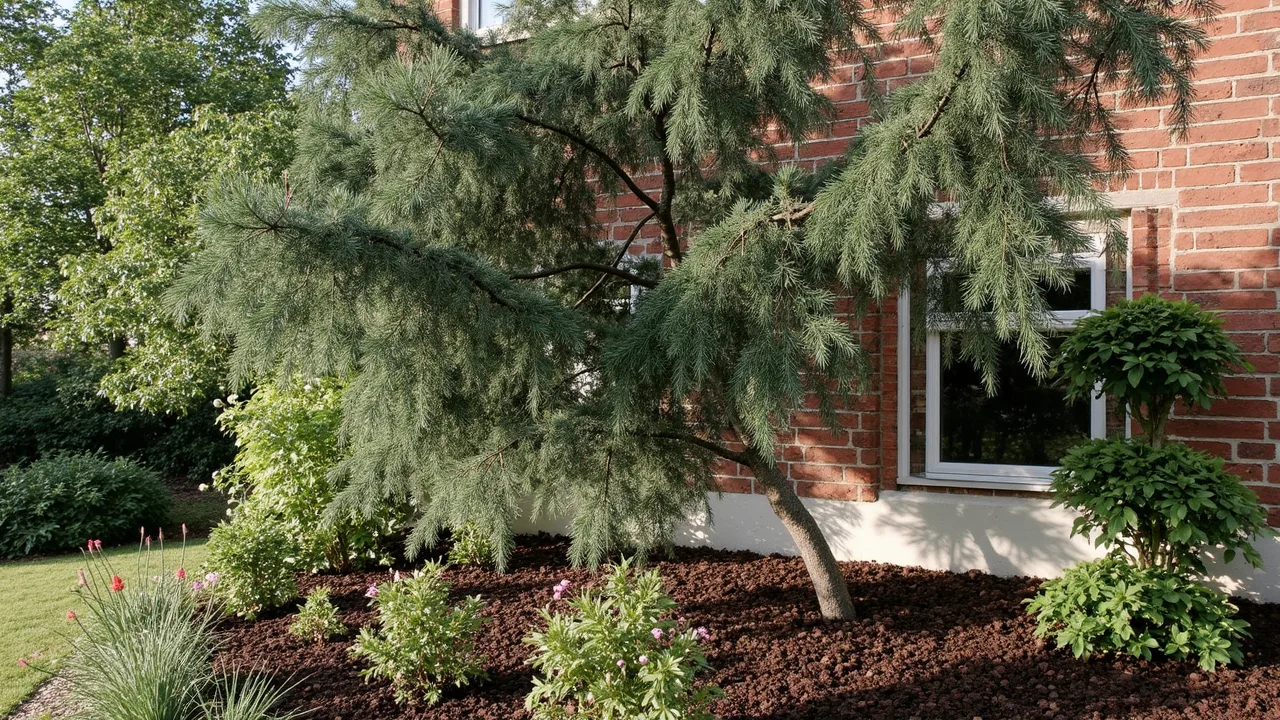
European larch forms a medium to large tree, typically 25 to 45 m tall at maturity, with a straight, clean trunk and a broadly conical or pyramidal crown. With age the crown tends to broaden and flatten slightly, and the lower branches often layer themselves where they touch the ground, producing distinctive natural grafts.
The bark is smooth and grey-green on young trees, becoming reddish-brown and fissured into scaly vertical plates as the tree matures. Twigs are slender and pale yellow-buff, hanging with a characteristic gentle droop.
The foliage is the tree's signature. Needles are soft and bright green, 2 to 4 cm long, and arranged in two distinct ways: singly along the long shoots of the current year's growth, and in tight rosette-like clusters of 20 to 40 on short woody spurs along older wood. New needles emerge in spring with a fresh, almost luminous green and darken only slightly through summer. From late September the whole crown turns a uniform clear gold, usually over a two- to three-week window, before the needles drop.
Flowers appear with the new needles in spring. The species is monoecious: small, rounded, yellowish male catkins and erect, reddish to greenish female cones sit on the same branches. Once pollinated, the female cones ripen into small ovoid woody cones 2 to 4 cm long, pale brown when mature. The cones persist on the tree for several years and provide useful winter interest, as well as a food source for seed-eating birds such as siskins and redpolls.
Growing Conditions
European larch is a tree of cool mountains, and British conditions suit it very well. It prefers a site in full sun, where the crown will develop symmetrically and the autumn colour will be at its best; in shade the tree becomes thin, leggy, and prone to dieback.
The ideal soil is deep, well-drained loam or sandy loam with a slightly acidic to neutral pH (roughly 5.5 to 7.0). Larch tolerates a range of textures from clay-loam to stony glacial soils, but it dislikes two things above all: waterlogged ground and shallow chalk. On compacted, wet, or highly alkaline sites growth will be poor and canker is more likely. It is, however, tolerant of exposure and thin soils, which is why it has been a first choice for upland forestry and shelter planting since the nineteenth century.
The tree is exceptionally wind-firm once established, thanks to a deep, wide-spreading root system, and tolerates coastal and hill sites where many other trees struggle. Growth is rapid when young — typically 30 to 60 cm of new extension per year for the first two decades — slowing to 20 to 30 cm per year as the crown broadens with age. UK hardiness is RHS H7, meaning it will tolerate temperatures below −20 °C with no protection, and it grows successfully from Cornwall to the far north of Scotland.
Planting and Care
When to plant. Bare-root or rootballed stock is best planted from late October through to early March, while the tree is dormant. Container-grown plants can go in at any time of year, but late autumn and winter are still preferable, as this lets the roots establish before the spring flush of growth.
Spacing. As a single specimen, allow 6 to 10 m of clearance from buildings, fences, or other large trees. In shelterbelts and forestry rows, plant at 2 to 4 m apart depending on how quickly a screen is needed.
Watering. Consistent watering through the first two or three growing seasons is the single most important input. Keep the rootball moist through any dry spell until the tree has put on clear new extension for two consecutive years; thereafter larch is reliably drought-tolerant. Container-grown specimens on patios will need regular watering throughout their life.
Feeding. Trees grown in the ground rarely need supplementary feeding on reasonable soils. A single mulch of well-rotted garden compost or bark chips in early spring is usually enough. Larch grown in containers benefits from a slow-release balanced fertiliser applied in spring.
Mulching. A 5 to 8 cm layer of organic mulch — composted bark, wood chips, or leaf mould — over the rooting area helps retain moisture and keeps grass and weeds down while the tree establishes. Keep the mulch clear of the trunk itself.
Pruning. European larch needs very little routine pruning. Allow the tree to develop its natural conical form and remove only dead, damaged, or crossing branches. If shaping is needed, work in late summer once growth has slowed; pruning in late winter or early spring can cause sap bleed from cut surfaces. Always make clean cuts just outside the branch collar and avoid leaving stubs.
Propagation. The species is raised from seed, which needs a period of cold stratification before sowing in spring. Named varieties are grafted onto seedling larch understock in late winter, a job for a specialist nursery. Semi-ripe cuttings can be rooted in summer with bottom heat, but success rates are variable.
Seasonal care. From November to February little is required; check stakes and ties on young trees after winter gales. In March and April, watch for aphid activity on the new shoots and treat early if numbers are high. Autumn is the time to enjoy the foliage colour and to clear any leaves that have dropped onto lawns or paths.
Common Problems
Larch canker (Lachnellula willkommii, formerly L. suecica). The most serious disease of European larch. Small amber resinous patches appear on the bark, followed by dieback of shoots and branches above the canker. There is no curative treatment: prune out affected branches promptly in dry weather, sterilise tools between cuts, and avoid wounding the bark. Choose open, well-ventilated sites and avoid planting in damp hollows where humidity lingers.
Needle-cast fungi. Several fungal species cause browning and premature shedding of needles, often in wet seasons. Improve airflow around the crown where possible, clear up fallen needles in autumn, and avoid overhead watering of young trees in the evening.
Adelgids and aphids. The larch adelgid (Adelges laricis) and related species suck sap from young shoots in spring, causing distorted growth and a sticky honeydew that may blacken with sooty mould. Numbers are usually kept in check by natural predators, but heavy infestations on specimen trees can be treated with horticultural oil or insecticidal soap applied at bud-burst.
Phytophthora ramorum. A notifiable pathogen that can infect larch as well as other hosts. Symptoms include bleeding bark lesions, needle browning, and rapid dieback. If suspected, the tree should be reported to the relevant plant health authority rather than removed privately.
Honey fungus. Armillaria species can attack weakened or drought-stressed larch, producing white mycelial fans under the bark and honey-coloured toadstools at the base in autumn. There is no effective chemical control once a tree is infected; improving vigour through watering and mulching is the main defence.
Squirrel damage. Grey squirrels will strip bark from young trees in some areas, which can girdle and kill them. A plastic or wire tree guard around the lower trunk for the first decade is worthwhile where squirrel pressure is known.
Popular Varieties
The species itself is the most widely grown form, and most British stock is raised from selected continental seed sources. Three botanical varieties are recognised and are the varieties most commonly listed by UK nurseries:
Larix decidua var. decidua — the nominate European or Alpine larch. This is the typical form found across the Alps and most of the natural range, with cones 2.5 to 6 cm long and yellow-buff shoots. It is the parent of almost all forestry planting in the UK.
Larix decidua var. carpatica — the Carpathian larch. From the Carpathian Mountains of eastern Europe, it differs little from the nominate variety in cultivation but is sometimes listed by specialist conifer nurseries for collection purposes.
Larix decidua var. polonica — the Polish larch. A disjunct lowland variety from northern and central Poland, with smaller cones (2 to 3 cm) and very pale, almost white shoots. It has a more slender habit than the Alpine form and is occasionally offered as a collector's plant.
Among ornamental cultivars, slow-growing weeping and shrubby forms such as 'Pendula' and the dwarf 'Kornik' have been in and out of UK nursery lists over the decades, though availability is variable; check current RHS Plant Finder listings before ordering. None of the forms or varieties currently in widespread cultivation holds an Award of Garden Merit from the RHS.
Pests and Diseases
| Problem | Symptoms | Management |
|---|---|---|
| Phytophthora ramorum | Brown lesions on needles and bark cankers causing dieback of shoots. | Report suspected cases to the plant health authority; remove infected material. |
| Honey fungus | General decline, yellowing foliage, and white fungal growth at the base. | Improve drainage and avoid planting in soil known to be infected. |
| Larch canker | Resin-soaked lesions on branches leading to dieback of affected limbs. | Prune out infected branches during dry weather to prevent spread. |
| Larch casebearer moth | Needles turn brown and drop prematurely due to larval feeding damage. | Monitor for silk cases on foliage; severe infestations may require insecticide. |
| Root rot (Phytophthora spp.) | Wilting, stunted growth, and eventual collapse of the tree. | Ensure well-drained soil conditions to prevent waterlogging at the roots. |
Or browse the full plant problem solver to diagnose an issue by symptom.
As an Amazon Associate, GardenWizz earns from qualifying purchases made through links on this page (including links within the article). This does not affect the price you pay. See our disclaimer for details.