Horse Chestnut
Aesculus hippocastanum
The Gardening Year
Best months in UK gardens · full planting calendar →
🖨 Printable care card (PDF)At a Glance
| Botanical name | Aesculus hippocastanum |
|---|---|
| Common name(s) | Horse Chestnut |
| Family | Sapindaceae |
| Plant type | tree (deciduous, synoecious (hermaphroditic-flowered)) |
| Height × Spread | 39 m × — |
| Position | Full sun, Partial shade |
| Soil | Moist but well–drained, Well–drained pH Acid, Alkaline, Neutral |
| Flowering | March–May |
| Toxicity | Humans/Pets (dogs): harmful if eaten. Wear gloves and other protective equipment when handling |
| Native range | Balkans (Albania, Bulgaria, Greece and former Yugoslavia), Turkey and Turkmenistan |
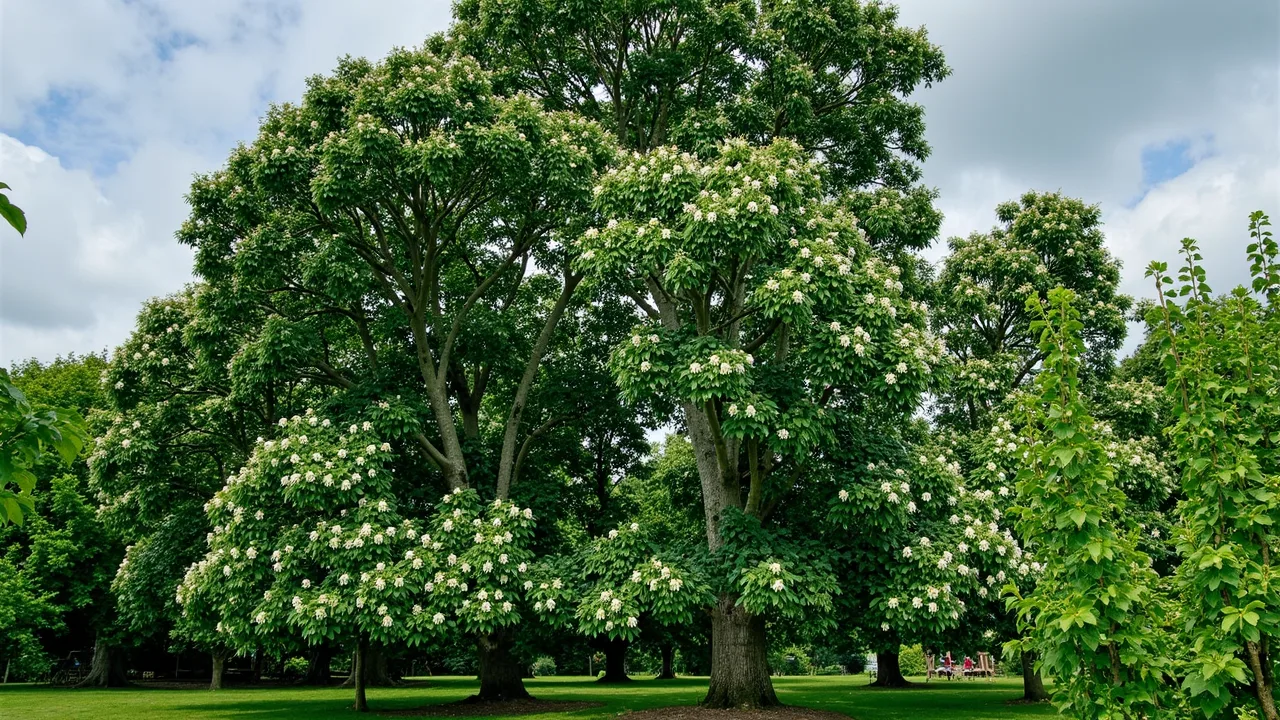
A mature Horse Chestnut in full May bloom is one of the most recognisable sights in the British landscape — a broad, dome-shaped crown ablaze with upright white "candles" that can be seen from some distance. Long a feature of parkland, village greens and urban streets, the species was introduced to the UK in the early seventeenth century and is now thoroughly naturalised. Its bold palmate leaves, showy spring flowers and autumn crop of glossy brown conkers make it a familiar part of British life, but it is a large tree with particular site requirements and a growing list of pests and diseases worth understanding before planting.
Overview
Horse Chestnut is a large, fast-growing deciduous tree native to a small area of the Balkans but widely planted across northern Europe, including the whole of the British Isles. It belongs to the family Sapindaceae (formerly placed in Hippocastanaceae), and is the species most associated with the familiar "conker" — the seed of its spiny green fruit. The tree is long-lived, often surviving 150–200 years, and individual parkland specimens can reach truly imposing sizes.
In the UK it is most often seen in parkland, on village greens, in larger gardens, along avenues, and as a street tree in wider streets. Because of its eventual size, it is rarely a sensible choice for a small domestic garden. Its ornamental value is concentrated in two short seasons — the upright panicles of white, pink-blotched flowers in May, and the russet leaf colour in autumn.
Ecologically, the flowers are valuable to bumblebees and other long-tongued pollinators, and the seeds are eaten by squirrels and deer, although the nuts are toxic to horses and to most livestock if consumed in quantity. Children across the UK have played the traditional game of conkers with the seeds for well over a century.
Appearance
Horse Chestnut makes a large tree with a domed, broadly rounded crown on a sturdy bole. In good conditions it reaches 30–40 m in height, with a crown often nearly as wide. The bark is smooth and greyish-brown on young trees, becoming darker, scaly and fissured with age. Twigs are stout and pale, ending in large sticky buds in winter.
The leaves are one of its most distinctive features. They are palmately compound, meaning several leaflets radiate from a single point like the fingers of a hand, with typically five to seven leaflets per leaf. Each leaflet is obovate (broadest towards the tip), up to about 25 cm long, with a coarsely serrated margin and a short stalk. The foliage is a fresh, bright green through summer, turning a buttery yellow-brown in autumn.
Flowers appear in April and May, carried in conspicuous upright panicles (sometimes called "candles") 20–30 cm tall. Each individual flower is white with a yellow spot that ages to pink or red at the base of the petals. The display lasts two to three weeks in good weather.
The fruits that follow are green, leathery capsules covered in short flexible spines, splitting in autumn to release one to three large, glossy mahogany-brown seeds — the conkers — typically 2–4 cm across. These fall to the ground in September and October.
Growing Conditions
Horse Chestnut is fully hardy across the UK. The RHS lists it as H6, indicating tolerance of lows around –20 °C, and it grows successfully from the south coast of England to central Scotland. It is not, however, a tree for every site, and getting the conditions right from the start is the single biggest factor in long-term performance.
Soil. The species prefers a deep, well-drained, moderately fertile soil. It tolerates clay, loam and sandy soils provided they are not waterlogged, and will grow well on neutral to slightly alkaline ground. It dislikes shallow chalk, compacted ground, and sites that waterlog in winter, where its roots quickly suffer and the tree becomes prone to bleeding canker.
Aspect and light. Full sun produces the most prolific flowering and the densest crown; partial shade is acceptable but leads to a thinner canopy and fewer flowers. The species is moderately tolerant of exposure once established but is best sited away from cold, desiccating east winds in northern areas, which can scorch emerging spring foliage.
Space. This is a tree for parkland, paddocks, large gardens and wide streets. The crown spreads broadly with age, and surface roots can lift paving and interfere with drains, drives and foundations. Allow at least 15–20 m of clear space from buildings, and more if used as a street tree.
Planting and Care
Planting. Container-grown trees can be planted at any time of year when the ground is workable — not frozen, waterlogged or parched. Bare-root stock is best planted between November and March, when the tree is dormant. Dig a hole at least twice the width of the rootball and the same depth, loosening the base and sides. Backfill with the excavated soil improved with a generous forkful of well-rotted garden compost or leafmould. Plant at the same depth the tree was growing in the nursery — the dark "soil mark" on the trunk is a useful guide. Stake young trees with a low stake and a wide, flexible tie, and leave the stake in place for two to three growing seasons. Water in thoroughly.
Watering. Water young trees regularly through their first two to three summers, particularly during any prolonged dry spell. Once established, Horse Chestnut is reasonably drought-tolerant and will not normally need supplementary watering except on the very lightest soils in extended drought.
Mulching. Each spring, apply a 5–8 cm layer of organic mulch — garden compost, well-rotted bark or leafmould — over the rooting area to suppress weeds and conserve moisture. Keep the mulch clear of the trunk to prevent collar rot.
Feeding. On reasonable garden soils, established trees rarely need routine feeding. On thin or hungry soils, an annual top-dressing of general-purpose fertiliser in early spring will support strong growth and flowering in young trees.
Pruning. Horse Chestnut needs only minimal pruning. Remove dead, damaged or crossing branches in late summer to mid-autumn, when the tree is in full leaf and sap pressure is reduced — this minimises the bleeding that can follow winter or spring pruning. Never hard-prune a Horse Chestnut: it responds poorly to large cuts, and major work should be left to an arborist.
Propagation. The species is straightforwardly raised from seed: sow ripe conkers outdoors in autumn in a deep pot of loam-based compost, and protect from mice. Seedlings grow quickly but typically take two to three years to reach a plantable size. Named cultivars are propagated by grafting onto seedling rootstocks; this is a job for a specialist nursery rather than the home gardener.
Seasonal care. The principal seasonal jobs are a spring mulch, occasional deep watering in summer droughts for the first few years, autumn clearance of fallen leaves to interrupt the life cycle of leaf miner and leaf blotch, and a once-over check for deadwood after leaf fall in late autumn.
Common Problems
Horse Chestnut is host to a longer list of pests and diseases than most garden trees, and several have become significantly more common in the UK over recent decades.
Horse chestnut leaf miner (Cameraria ohridella). The larvae of this small moth mine within the leaves, producing brown blotches and causing early leaf drop from mid-summer onwards. Mature trees usually survive repeated infestations but can look unsightly. Raking up and disposing of fallen leaves in autumn reduces the overwintering population.
Leaf blotch (Guignardia aesculi). A fungal disease that produces irregular brown blotches, often spreading inwards from the leaf margins. Usually cosmetic rather than fatal, but in wet summers it can cause extensive browning. Good garden hygiene — clearing fallen leaves — is the main practical control.
Bleeding canker (Pseudomonas syringae pv. aesculi). A bacterial infection causing bark to crack and bleed amber-coloured fluid, often associated with crown dieback. There is no effective chemical cure; severely affected trees should be removed to prevent spread to neighbouring Horse Chestnuts.
Aesculus scale. A sap-sucking insect that can colonise bark and foliage, producing sticky honeydew and sooty mould. Generally a problem only on stressed or mature trees; horticultural oil or a systemic treatment can be used where the infestation is severe.
Powdery mildew and leaf scorch. Both tend to appear in hot, dry summers or on trees under drought stress. Watering during prolonged dry spells and mulching in spring are the best preventions.
Popular Varieties
Named cultivars of Aesculus hippocastanum are less widely grown than the species itself, partly because the species is so distinctive and partly because cultivars are usually grafted and therefore more expensive. Three forms occasionally available in the UK include:
- 'Baumannii' — a vigorous, reliably sterile double-flowered form that produces no conkers, which makes it a useful choice for streets and parks where fallen fruit would be a nuisance. The white double flowers last longer than those of the species.
- 'Pyramidalis' — a narrowly conical selection, useful where a more upright silhouette is needed. Less commonly stocked but worth seeking out for avenues and restricted sites.
- 'Laciniata' — a curious cut-leaved form with deeply and finely divided leaflets, giving a distinctly lacy texture. Slower-growing and smaller than the species, though still ultimately a sizeable tree.
The closely related red-flowered hybrid Aesculus × carnea (Red Horse Chestnut), particularly the cultivar 'Briotii', is often grown as a partner or alternative where a smaller, more compact tree with deep pink flowers is wanted. Like the Horse Chestnut, it produces spiny fruits, but it is generally less prone to leaf miner than A. hippocastanum.
Pests and Diseases
| Problem | Symptoms | Management |
|---|---|---|
| Horse chestnut leaf-mining moth | Leaves develop large, irregular brown blotches as larvae mine between the veins. | Tolerate minor infestations as they rarely harm tree health; remove and dispose of fallen leaves to reduce overwintering larvae. |
| Horse chestnut leaf blotch | Irregular brown blotches with yellow margins appear on leaves during summer. | Rake up and compost or burn fallen leaves in autumn to reduce fungal spores for the following year. |
| Horse chestnut bleeding canker | Dark, sticky fluid oozes from cracks in the bark, drying to a rusty-brown deposit. | Avoid wounding the bark and maintain tree vigour through proper watering and soil care; no chemical cure exists. |
| Powdery mildew | A white, dusty fungal growth appears on young leaves and shoots in warm, dry weather. | Ensure good air circulation around the tree and avoid overhead watering to keep foliage dry. |
| Vine weevil | Notched edges on leaves of potted specimens and root damage causing wilting in containers. | Apply nematodes or insecticidal drenches to the soil in early autumn to control larvae. |
For step-by-step help, read Treating Powdery Mildew. Or browse the full plant problem solver to diagnose an issue by symptom.
As an Amazon Associate, GardenWizz earns from qualifying purchases made through links on this page (including links within the article). This does not affect the price you pay. See our disclaimer for details.