Cherry Plum
Prunus cerasifera
The Gardening Year
Best months in UK gardens · full planting calendar →
🖨 Printable care card (PDF)At a Glance
| Botanical name | Prunus cerasifera |
|---|---|
| Common name(s) | Cherry plum |
| Family | Rosaceae |
| Plant type | tree |
| Height × Spread | 8–12 m × 6–8 m |
| Position | Full sun |
| Soil | Chalk, Clay, Loam, Sand; Moist but well–drained or Well–drained; Acid or Alkaline or Neutral |
| Flowering | February–April |
| Toxicity | — |
| Native range | Southeast Europe and Western Asia |
Overview
Prunus cerasifera — commonly called the cherry plum or myrobalan plum — is a small deciduous flowering tree native to south-eastern Europe and western Asia, from the Balkans across to the Caucasus and Iran. Long naturalised in the British Isles, it is one of the earliest flowering members of the rose family to come into bloom each year, often covered in white blossom in February or March while most other trees are still bare. It plays several roles in UK horticulture: a popular ornamental specimen for small gardens, a vigorous hedging plant sold by the metre, and — less visibly but commercially crucial — the rootstock on which most garden plums and damsons are grafted. This last role is why seedlings of the species appear so freely in hedgerows near old orchards.
In British cultivation the green-leaved species is largely a workhorse, valued for hedges and for the fruit it carries; the ornamental showpieces are its purple-leaved cultivars, especially 'Nigra' and 'Pissardii', which combine early pale-pink blossom with bronze-purple foliage that holds its colour from spring through autumn. The species tolerates the UK climate well once established and is suitable for gardens across England, Wales, and most of lowland Scotland; its precise hardiness is shown in the badge and not restated here.
Appearance
As a specimen, Prunus cerasifera makes a small tree of 4–8 m, often multi-stemmed from the base with a rounded to slightly spreading crown. Left unpruned it is broadly upright in youth and broadens with age; with formative pruning it can equally be kept as a large shrub. In hedgerow situations it is usually cut back hard to a dense twiggy framework.
The leaves are ovate to elliptical, 4–7 cm long, finely serrated and glossy mid-green on the type. In the purple-leaved cultivars the emerging foliage is deep red, ageing through the season to a dark bronze-purple that holds well into autumn. Green- and purple-leaved plants are easily distinguished from a distance once the leaves have expanded in April.
Bark is dark brown to purplish-brown, smooth on young specimens and shallowly fissured on older trunks. Twigs are slender and often carry a few thorny side-shoots, particularly on hedgerow seedlings.
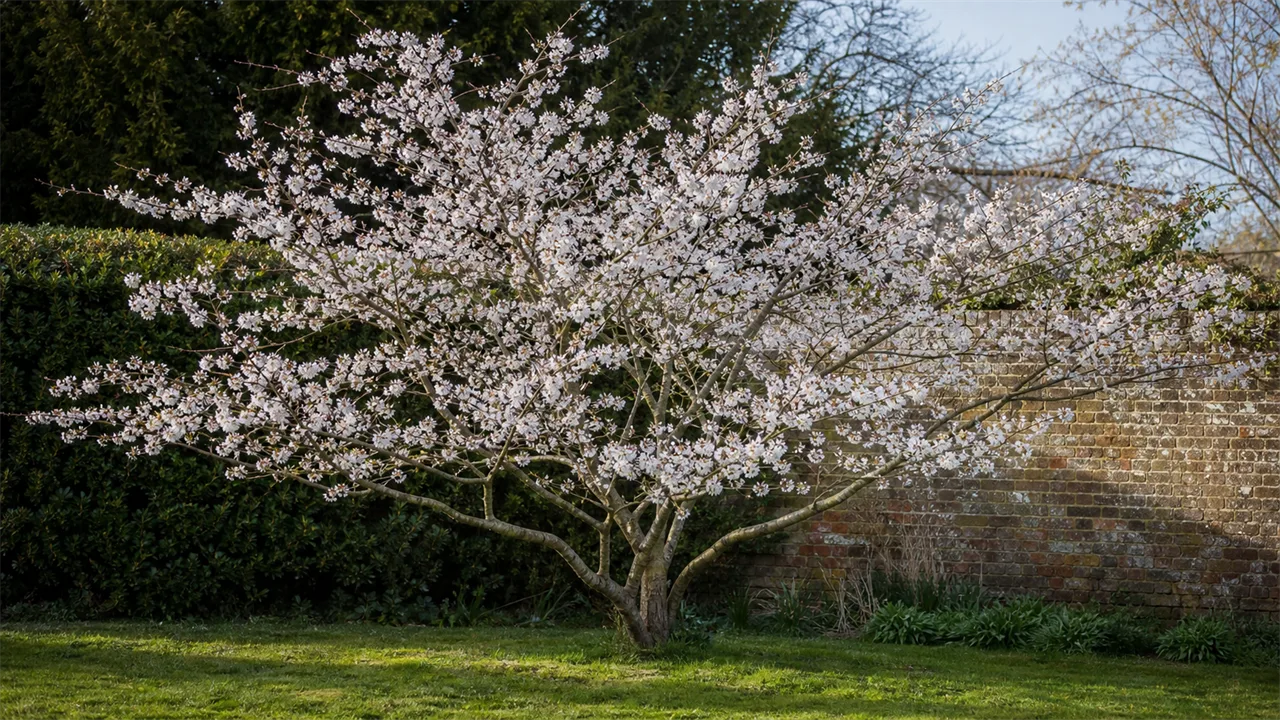
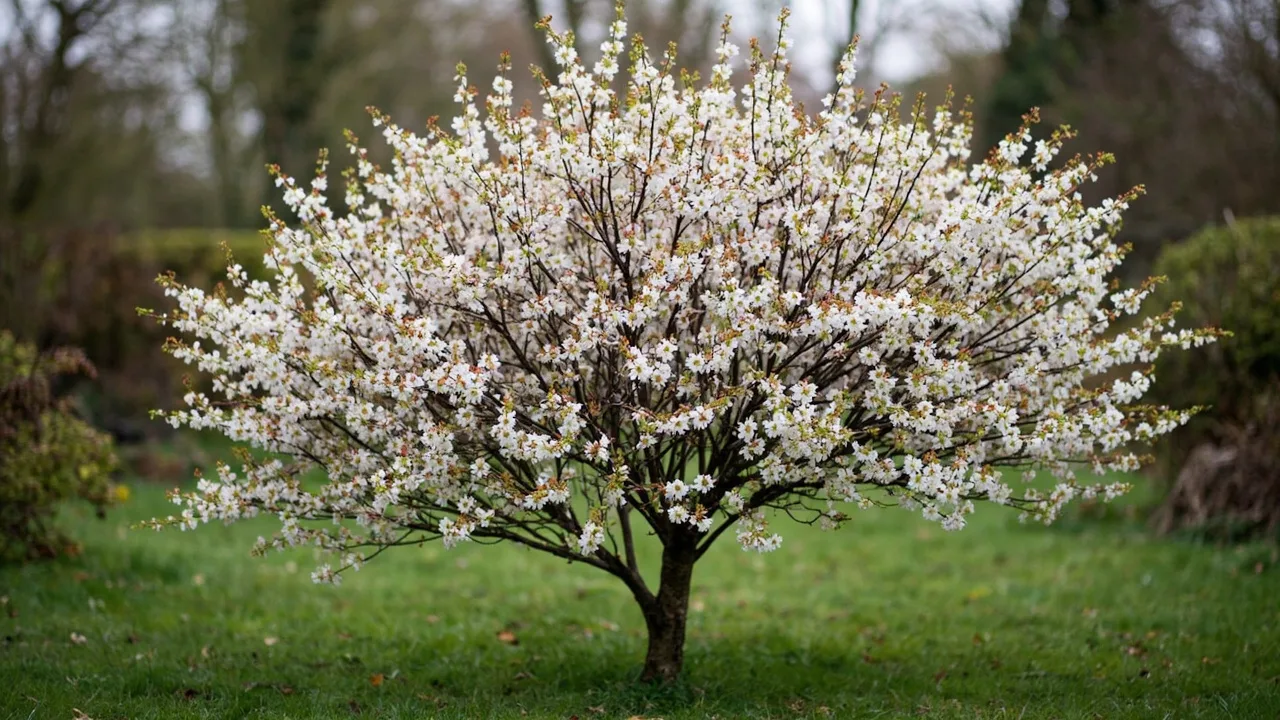
Flowers are pure white, occasionally pinkish-tinged, 2–2.5 cm across, borne singly or in small clusters directly along the bare branches in February or March. The display on a mature specimen in a mild year can be spectacular, covering the bare branches in white before any other tree in the neighbourhood has stirred.
Fruits follow in mid to late summer: small round plums 2–3 cm across, ripening from yellow-green through to glossy red. They are edible but usually too tart to eat raw; in country kitchens they are more often cooked into jams, jellies, and country wines, or left for the birds. Thrushes, blackbirds, and small mammals take them freely from late July onwards.
Growing Conditions
Cherry plum grows best in full sun. A sheltered south- or west-facing position gives the densest flower display and, in the purple cultivars, the richest foliage colour; light partial shade is tolerated but flowering is noticeably sparser and the bronze-purple tones are duller. The species is reasonably tolerant of exposed sites once established and is widely used in street and park planting, where it copes well with urban pollution and compacted soils.
Soil requirements are modest. A reasonably fertile, well-drained loam is ideal, but the species tolerates a wide pH range including chalky and mildly alkaline ground — one of its advantages over many ornamental cherries, which are fussier about lime. Wet, poorly drained ground should be avoided; waterlogging in winter is the most reliable way to lose a newly planted tree.
Late frosts can damage open flowers in cold inland districts in March, occasionally stripping a display before it has properly begun. Coastal and urban gardens, where winters are slightly milder, generally escape this. The plant has a hardiness rating shown only in the badge; the precise value is held in the structured field and is not stated here.
In the UK, the practical growing calendar runs from a late-winter flower display through a summer fruit crop, with the best planting window for bare-root stock between November and March, while the soil is workable but the tree is dormant.
Planting and Care
Planting. Bare-root specimens are best planted between November and March and establish quickly; container-grown plants can go in at any time the soil is workable, though autumn and early spring are preferred so the root system gets a chance to settle before the first summer. As a specimen tree, allow 4–6 m of clear spread on all sides. For a hedge, plant 60–90 cm apart in a single row, slightly less for a denser stock-proof barrier. Stake young trees for the first two or three years and keep the ground clear of grass in a 50 cm radius around the trunk for the same period.
Watering. Water newly planted trees through their first growing season, particularly during dry spells from late May onwards. Once established the species is drought-tolerant and needs no routine irrigation.
Feeding. A mulch of well-rotted organic matter applied in early spring is usually sufficient. On very poor or sandy soils an occasional general-purpose fertiliser in March helps, but most garden soils do not need it.
Pruning. Prune immediately after flowering if shaping is needed; the flower buds for the following spring are formed on wood produced the previous summer, so late-summer or autumn pruning sacrifices the next year's display. Remove any dead, diseased, or crossing wood, plus any suckers from the base or from below a graft union, at the same time. Hedges can be cut more formally once flowering has finished; the species responds well to coppicing or laying on a long rotation, in the traditional country manner.
Propagation. Seed-raised plants are vigorous but variable and tend to revert to plain green leaves; they are fine for hedging and wildlife planting, but the coloured cultivars must be propagated by budding or grafting onto Prunus rootstock to keep their leaf colour. Semi-ripe cuttings taken in mid to late summer will strike, though success is uneven and grafting remains the standard nursery practice.
Seasonal care. Little is required beyond the spring mulch, the post-flowering prune, and an occasional check for aphids on the young shoots. Established specimens need no winter protection in the UK.
Common Problems
Cherry plum is generally robust but shares the typical Prunus susceptibility to a handful of fungal and bacterial problems.
Silver leaf (Chondrostereum purpureum) is the most familiar. Spores enter through pruning wounds and the fungus spreads through the wood, producing a characteristic silver sheen on the foliage as the affected branches die back. The standard control is to prune only in dry summer weather when the spores are least active, disinfect tools between cuts, and remove badly affected wood promptly.
Bacterial canker (Pseudomonas syringae) causes sunken lesions on bark and a shot-hole effect on leaves, particularly in wet springs. Avoid overhead watering, prune out affected shoots back to clean wood, and clear fallen leaves in autumn to reduce overwintering inoculum.
Black knot (Apiosporina morbosa) is rare in the UK but has been reported. It causes elongated black, swollen galls on branches, which should be cut out and disposed of well before they release spores.
Aphids — particularly the cherry-plum aphid and the mealy plum aphid — form early-season colonies on young shoots, causing leaf curl and sticky honeydew. They are usually checked by natural predators (ladybirds, hoverflies, lacewings) within a few weeks; if numbers build badly a strong jet of water or a winter wash against the overwintering eggs is usually enough.
Plum moth (Cydia funebrana) and plum sawfly (Hoplocampa flava) attack the developing fruits rather than the tree itself, and are mainly a concern where fruits are being harvested for culinary use; for ornamental plantings they can be tolerated. Pheromone traps are available for plum moth and reduce damage significantly if hung from late May.
Popular Varieties
Three forms cover most British plantings of cherry plum:
- Prunus cerasifera 'Nigra' — by far the most widely planted cultivar in UK gardens. A small, rounded tree to about 5–7 m, with deep purple foliage that holds its colour from spring leaf-out to autumn leaf-fall and pale pink flowers in early spring. It holds the Royal Horticultural Society's Award of Garden Merit and is the default choice where a single ornamental specimen is wanted.
- Prunus cerasifera 'Pissardii' — the original purple-leaved selection, introduced from Persia in the late nineteenth century and still widely sold. Slightly larger-growing than 'Nigra', with paler pink flowers and bronze-purple foliage that can green a little in the hottest part of summer.
- Prunus cerasifera (green-leaved species form) — the type itself, used mainly as a hedging plant, for wildlife planting, and as orchard rootstock. The flower display is pure white and prolific, and the small red plums are useful for cooking or for the birds.
Pests and Diseases
| Problem | Symptoms | Management |
|---|---|---|
| Cherry leaf scorch | Leaves turn brown, shrivel and remain attached to the tree throughout winter. | Rake up fallen leaves in autumn to reduce fungal spores for the following year. |
| Bacterial canker | Sunken dead patches of bark with gummy ooze and small holes in leaves. | Prune out infected branches in dry weather, disinfecting tools between cuts. |
| Cherry leaf spot | Leaves develop purple or yellow spots, sometimes with shotholes, and drop prematurely. | Collect and destroy fallen leaves to minimize overwintering fungal spores. |
| Cherry blackfly | New growth becomes tightly curled and distorted by clusters of small black aphids. | Encourage natural predators like ladybirds or use a strong jet of water to dislodge them. |
| Powdery mildew | A white, dusty fungal growth appears on young leaves and shoots in spring. | Improve air circulation by thinning the canopy and avoid overhead watering. |
For step-by-step help, read Controlling Aphids Naturally and Treating Powdery Mildew. Or browse the full plant problem solver to diagnose an issue by symptom.
Recommended Products
GardenWizz earns a commission from qualifying purchases made through affiliate links on this page (including links within the article) — as an Amazon Associate, and from Thompson & Morgan via the Awin network. This does not affect the price you pay. See our disclaimer for details.