Red Currant
Ribes rubrum
The Gardening Year
Best months in UK gardens · full planting calendar →
🖨 Printable care card (PDF)At a Glance
| Botanical name | Ribes rubrum |
|---|---|
| Common name(s) | Red Currant |
| Family | Grossulariaceae |
| Plant type | shrub (deciduous) |
| Height × Spread | 1–2 m × 100–150 cm |
| Position | Full sun, Partial shade |
| Soil | moist but well-drained; tolerates most soils not waterlogged; benefits from organic matter |
| Flowering | March–May |
| Toxicity | — |
| Native range | western Europe |
Overview
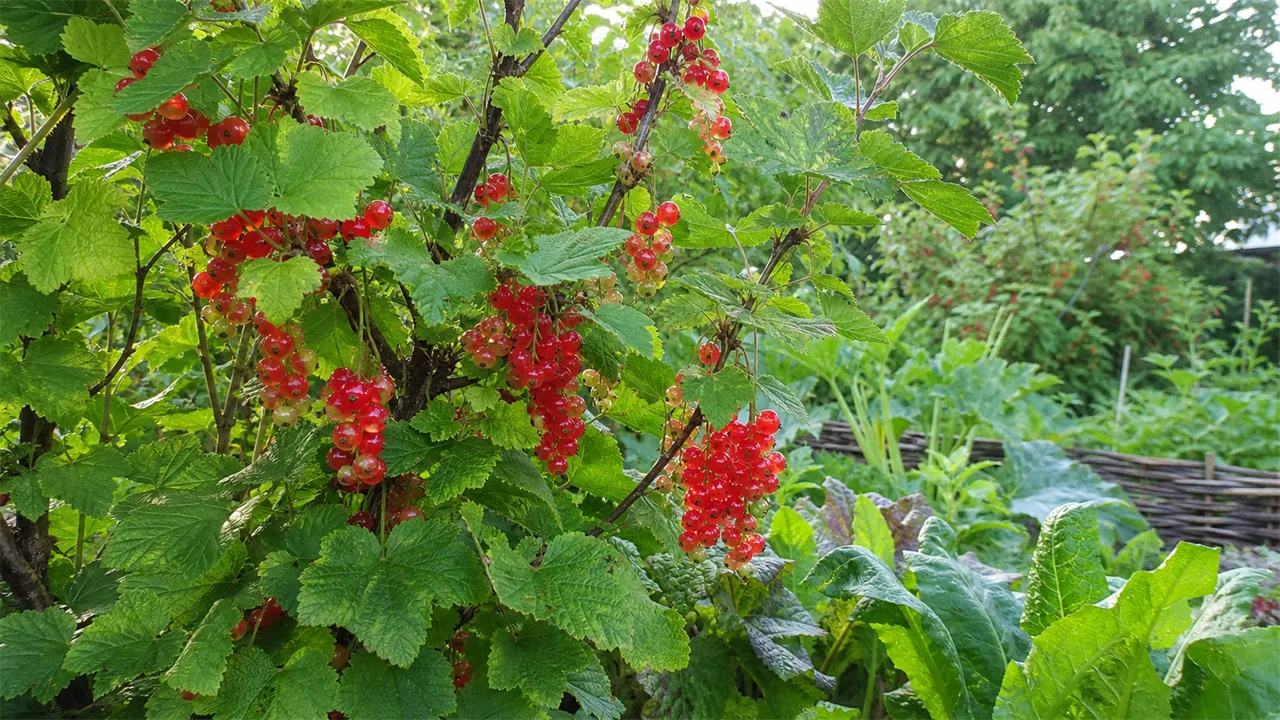
Red currant, Ribes rubrum, is a deciduous shrub of the family Grossulariaceae, grown across the UK for its translucent, jewel-bright berries that ripen in high summer. Botanically distinct from blackcurrant (R. nigrum) and gooseberry (R. uva-crispa), the cultivated red currant is the same species as the white currant (a pale-fruited colour sport) and produces long, drooping strigs of small, tart, vividly coloured fruit. Plants are hardy across virtually the whole of the British Isles, and once established they crop reliably for 15–20 years with relatively little attention.
Red currants deserve a place in the kitchen garden for reasons that go beyond nostalgia. The fruit is high in pectin, vitamin C and antioxidants, holds its shape and colour when cooked, and turns the classic British summer fruits into something more interesting than a bowl of raspberries on its own. The strigs are ornamental enough that the plant pulls double duty in a mixed border or trained against a north-facing wall where little else will fruit well — red currants tolerate more shade and cooler sites than most soft fruit.
For UK growers, the plant offers one of the easiest entries into fruit growing: cheap to buy, simple to prune, unfussy about soil, and productive from the second or third year after planting. A single mature bush can yield 4–5 kg of fruit per season, and a row of three or four bushes will keep a household in red currants for fresh eating, jam, jelly, cordials and the rest of the year through the freezer.
Sowing
Red currants are propagated by hardwood cuttings, not from seed — seedlings do not come true to type, and named cultivars would be lost. In practice, every UK gardener buys a bare-root or container-grown bush from a fruit nursery, planted during the dormant season.
When to plant. Bare-root red currants are planted from late October through to mid-March, while the plant is dormant, provided the ground is neither frozen nor waterlogged. In mild southern England, the south-west and the south coast, November planting is ideal — roots establish through winter and the bush breaks strongly in spring. In colder regions (the north, upland Wales, most of Scotland), wait until late January or February so the young plant does not sit in cold, wet soil through the worst of the winter. Container-grown bushes can be planted at any time of year, but autumn and spring are still preferable because summer watering is then less critical.
Planting method. Plant to the same depth as the bush stood in the nursery — the soil mark on the stem should sit flush with the surrounding soil. Red currants are grown on a short "leg" (trunk) of 10–15 cm, which keeps the fruiting branches off the ground and helps airflow; do not bury the leg deeper than this or the buried portion will rot. Spread the roots out in a wide planting hole, backfill with the original soil, firm gently with your heel, water in well, and mulch with a 5 cm layer of well-rotted compost or manure over a 1 m radius, keeping it clear of the stems.
Spacing. Bushes: 1.2–1.5 m apart in the row, with 1.8–2 m between rows. Cordons (single-stemmed plants trained vertically against wires): 30–40 cm apart on the support wire. Fan-trained red currants against a wall: 1.5–2 m of wall space per plant.
Site and soil. Red currants prefer a sunny position but tolerate light dappled shade better than most fruit — a north- or east-facing wall will produce a useful crop, though ripening will be a week or two later than on a south-facing site. The key soil requirement is moisture-retentive but free-draining; on thin, sandy soils work in plenty of organic matter, and on heavy clay plant on a shallow mound or in a raised bed to keep roots out of winter wet. The ideal pH is slightly acidic to neutral (6.0–7.0); red currants are more lime-tolerant than blueberries but suffer on strongly alkaline soils. Avoid frost pockets — early flowers in April are reasonably frost-tolerant but a hard frost at full bloom will damage the crop.
Sowing (planting) windows by UK region.
- South-west England, south coast, London, East Anglia: November to early March, with November–December ideal.
- Midlands, south Wales, central southern England: late November to late February.
- Northern England, north Wales, Yorkshire, Lancashire: December to late February, avoiding the coldest spells.
- Scotland (lowland and central belt): late January to mid-March.
- Scotland (upland, north-east, Caithness): wait until February to early March; site selection (shelter, drainage) becomes critical.
- Northern Ireland: December to mid-March.
Buying plants. Buy from a specialist fruit nursery rather than a general garden centre. Two-year-old bushes are the standard purchase and will begin cropping meaningfully in their third year. Certified stock is virus-tested; older garden bushes often carry reversion virus or suffer reduced vigour, which is why replacement every 15–20 years is sensible.
Growing
Pruning at planting. Cut all shoots of a newly planted bare-root bush back to two buds above the soil. This sounds severe but it forces strong new growth from the base and establishes the short leg on which the bush will be trained. Container-grown plants need a lighter prune — just remove weak or damaged growth.
Formative pruning, years 1–3. In each dormant winter (December to early February), build up an open-centred goblet shape of six to eight main branches rising from the short leg. Remove any suckers growing from below the soil or from the leg, any weak or crossing shoots, and any branches drooping to the ground. Tip back the chosen framework branches by a third to an outward-facing bud to encourage branching.
Annual pruning from year 4 onward. Red currants fruit on spurs carried on two-year-old and older wood, plus at the base of the previous season's growth. In late winter, remove roughly a third of the oldest, darkest stems to ground level or to a strong replacement shoot, leaving the strongest mix of one-, two- and three-year-old wood. Shorten the previous summer's growth on the framework branches to about 5 cm — this is where the next summer's fruit will hang. Keep the centre of the bush open to light and air. In summer, after fruiting, cut back the fruited laterals to a strong new shoot.
Watering. Red currants are more drought-tolerant than most soft fruit, but they crop better with consistent moisture through May and June, when fruit is sizing up. Water deeply once a week during dry spells rather than sprinkling daily; a 5 cm layer of organic mulch will cut watering needs in half. Container-grown cordons need watering from May to September — do not let the compost dry out.
Feeding. Apply a balanced general fertiliser (such as blood, fish and bone, or a granular 7-7-7) in late winter at 70 g per square metre around the drip line. Top-dress in spring with a 5 cm mulch of well-rotted manure or garden compost. Avoid high-nitrogen feeds in summer — soft leafy growth is susceptible to mildew and aphids. If leaves yellow between the veins in summer, an application of sequestered iron or a feed containing magnesium will correct the deficiency.
Weeding and mulching. Keep a 1 m weed- and grass-free circle around each bush; grass competition is the single biggest cause of slow growth in newly planted red currants. Renew the mulch each spring.
Pests and diseases. The main UK issues are:
- Aphids (especially the redcurrant blister aphid) — cause puckered, red-brown blisters on leaves in late spring; usually tolerable, but a severe attack weakens young bushes. Treat with a winter wash and encourage natural predators.
- Gooseberry sawfly — pale green caterpillar-like larvae that can strip a bush in days in late spring; inspect from late April and pick off colonies by hand or use a contact insecticide if heavy.
- Birds — blackbirds and thrushes take ripening fruit; net the bushes two or three weeks before harvest.
- Powdery mildew — white powdery coating on leaves in dry summers, worse on drought-stressed plants and on crowded bushes with poor airflow. Improve pruning, water consistently, and avoid overhead watering.
- Reversion virus — causes leaves to become narrower and fewer-lobed; no cure. Buy certified stock and replace infected bushes.
- Botrytis (grey mould) — affects ripening fruit in wet summers; improve airflow through pruning and pick promptly.
Conditions through the year. Red currants are hardy to about −25 °C when fully dormant, more than sufficient for the whole of the UK. They dislike waterlogged soil in winter and bone-dry soil in summer; get those two right and the plant largely looks after itself. Container-grown bushes need their pots insulated (bubble wrap around the pot) in exposed northern gardens to prevent the rootball freezing solid.
Recommended cultivars for UK growers (planted inline, not as an ornamental table):
- `Red Lake` — the standard garden cultivar; long strigs of large, bright berries, heavy cropping, good disease resistance. The default choice for new growers.
- `Jonkheer van Tets` — early-ripening, large fruit, good flavour; the first to crop, useful in the north where season length matters.
- `Stanza' — mid-season, very heavy cropping, good for jam and juice; slightly more compact habit.
- `Rovada` — late-ripening, very long strigs of large berries, excellent flavour; the best choice for extending the season.
- `White Versailles` (or `White Grape`) — a white currant, same species, sweeter and milder; useful for fresh eating and decorative use.
- `Junifer` — early and heavy cropping, good resistance to mildew, widely planted commercially; reliable in cooler summers.
A row of `Jonkheer van Tets` and `Rovada` will crop from late June through to early August in the south, slightly later further north — a useful spread for a small garden.
Harvesting
When to pick. Red currants ripen in high summer and are ready when the berries are fully coloured, plump, and pull easily from the strig without resistance. Unlike blackcurrants, red currants are almost always picked as whole strigs, not individual berries — the fruit is small and the strigs keep the fruit intact and look striking in the kitchen. Pick on a dry day if possible; wet fruit rots quickly once picked.
UK harvest windows by region and cultivar.
- Early cultivars (`Jonkheer van Tets', `Junifer'): late June to mid-July in the south; mid-July to early August in the Midlands and the north; often late July to mid-August in Scotland and the north.
- Mid-season (`Red Lake', `Stanza'): mid-July to early August in the south; late July to mid-August in the Midlands and the north; early to late August in Scotland.
- Late cultivars (`Rovada'): late July to mid-August in the south; early to late August in the Midlands and the north; mid- to late August in Scotland, occasionally into early September in a good year.
Northern and upland gardens should favour early and mid-season cultivars to ensure a reliable crop before autumn damp sets in.
How to pick. Hold the strig at its base and snap it cleanly from the spur, or use snips for the largest strigs. Lay the strigs in shallow trays, no more than three or four deep, to avoid crushing the fruit at the bottom of the pile. Pick over each bush two or three times across two to three weeks — not all strigs ripen at once.
Yield. A well-grown mature bush yields 4–5 kg of fruit per season in good conditions; a single cordon yields 0.5–1 kg. Pick promptly — ripe red currants will keep on the bush for a week or so but quality and keeping both decline fast after full ripeness.
Eating
Red currants are intensely tart when raw and need sugar to bring them into balance. Cooked with sugar, they make one of the great British preserves — redcurrant jelly is the traditional accompaniment to lamb, roast pork, game and duck, and a jar of homemade redcurrant jelly in the larder is one of the more underrated pleasures of the kitchen garden. The fruit is also high in pectin, so it sets a jelly reliably without added pectin.
In the kitchen, red currants shine in:
- Jelly and jam — the classic use; the high pectin content makes a clear, jewel-bright jelly. A 1:1 fruit-to-sugar ratio by weight is a reliable starting point.
- Cordial and syrup — simmer 500 g strigs with 250 g sugar and 250 ml water for ten minutes, strain, and bottle; dilute to taste with cold or sparkling water for a long, refreshing summer drink.
- Summer pudding — essential; red currants give the pudding its sharp edge and hold their shape better than raspberries, which collapse.
- Tarts and tarts aux fruits rouges — paired with raspberries, strawberries and a vanilla crème pâtissière.
- Sauces for game and mackerel — fresh red currant sauce with a splash of red wine and a knob of butter is excellent with mackerel, duck breast or venison.
- Champagne or sparkling wine — a small sprig of red currants in the bottom of each flute is the classic garnish for a kir-style cocktail.
Red currants also freeze well (see Storing below), so a single mid-July glut can be spread across the year.
Storing
Red currants store better than most soft fruit because they are picked on the strig and have a tough skin. Fresh, the fruit keeps for one to two weeks in a single layer in a cool, dark place (a fridge at 2–4 °C is ideal), provided it is picked dry and sound.
For longer storage, the simplest method is to freeze whole strigs on a tray, then transfer to a bag once solid — frozen strigs keep their shape and can be tipped straight from the freezer into a pan for jam or jelly later in the year. Whole berries also freeze well and can be used straight from frozen in muffins, crumbles and fools.
For traditional preserving, red currants bottle well in light syrup, make an excellent wine, and combine with raspberries or strawberries for a mixed summer jam that captures both flavours in one jar. Red currants can also be dried in a dehydrator at 55 °C for six to eight hours to produce tart, chewy dried currants for winter baking — closer to the dried Zante currants of commerce than to the fresh fruit, and useful in biscuits, scones and dense fruit cakes.
Supporting
Red currants grown as cordons need a permanent post-and-wire framework. Fix horizontal galvanised wires at 60 cm and 1.2 m above the ground between sturdy posts at 2 m spacings, then tie the single stem of each cordon to a bamboo cane attached to the wires. As the cordon grows, prune back all side shoots in summer to five leaves (to encourage fruiting spurs) and shorten the leader in winter by a third until it reaches the top wire, then tip it back each year.
Fan-trained red currants against a wall need a similar wire framework: fix wires at 30 cm vertical intervals, starting 30 cm above the ground, and train eight to ten main branches out in a fan shape, tying in new summer growth in July and shortening fruited laterals after picking.
Bushes on their own roots do not need staking, though a single short stake at planting can help stabilise a tall bush on an exposed site until the root system establishes.
Pests and Diseases
| Problem | Symptoms | Management |
|---|---|---|
| Currant leaf spot | Small purple or brown spots appear on leaves, causing them to yellow and drop prematurely. | Rake up and dispose of fallen leaves in autumn to reduce overwintering spores. |
| Powdery mildew | A white, dusty fungal growth covers leaves, shoots, and developing fruit. | Prune for good air circulation and choose resistant varieties where possible. |
| Currant blister aphid | Leaves at shoot tips become puckered, blistered, and discoloured yellow or red. | Encourage natural predators like ladybirds; chemical control is rarely needed. |
| Coral spot | Small, bright orange fungal fruiting bodies appear on dead wood and stems. | Prune out affected branches during the dormant season to improve hygiene. |
| Gall midge | Shoot tips curl and distort due to larvae feeding within the growing points. | Cut off and destroy affected shoot tips as soon as symptoms are noticed. |
For step-by-step help, read Controlling Aphids Naturally and Treating Powdery Mildew. Or browse the full plant problem solver to diagnose an issue by symptom.
Recommended Products
GardenWizz earns a commission from qualifying purchases made through affiliate links on this page (including links within the article) — as an Amazon Associate, and from Thompson & Morgan via the Awin network. This does not affect the price you pay. See our disclaimer for details.