Raspberry
Rubus idaeus · red raspberry · European red raspberry
The Gardening Year
Best months in UK gardens · full planting calendar →
🖨 Printable care card (PDF)At a Glance
| Botanical name | Rubus idaeus |
|---|---|
| Common name(s) | raspberry, red raspberry, European red raspberry |
| Family | Rosaceae |
| Plant type | perennial (Perennial root system with biennial stems (canes); primocanes grow in first year, floricanes fruit in second year.) |
| Height × Spread | 1.5–2.5 m × 50–100 cm |
| Position | Full sun, Partial shade |
| Soil | well-drained soil with a pH between 6 and 7 with ample organic matter |
| Flowering | May |
| Toxicity | No specific toxicity is listed by the RHS. This is not a guarantee of safety — check with a vet or the ASPCA before pets or children eat any plant. |
| Native range | Eurasia |
Overview
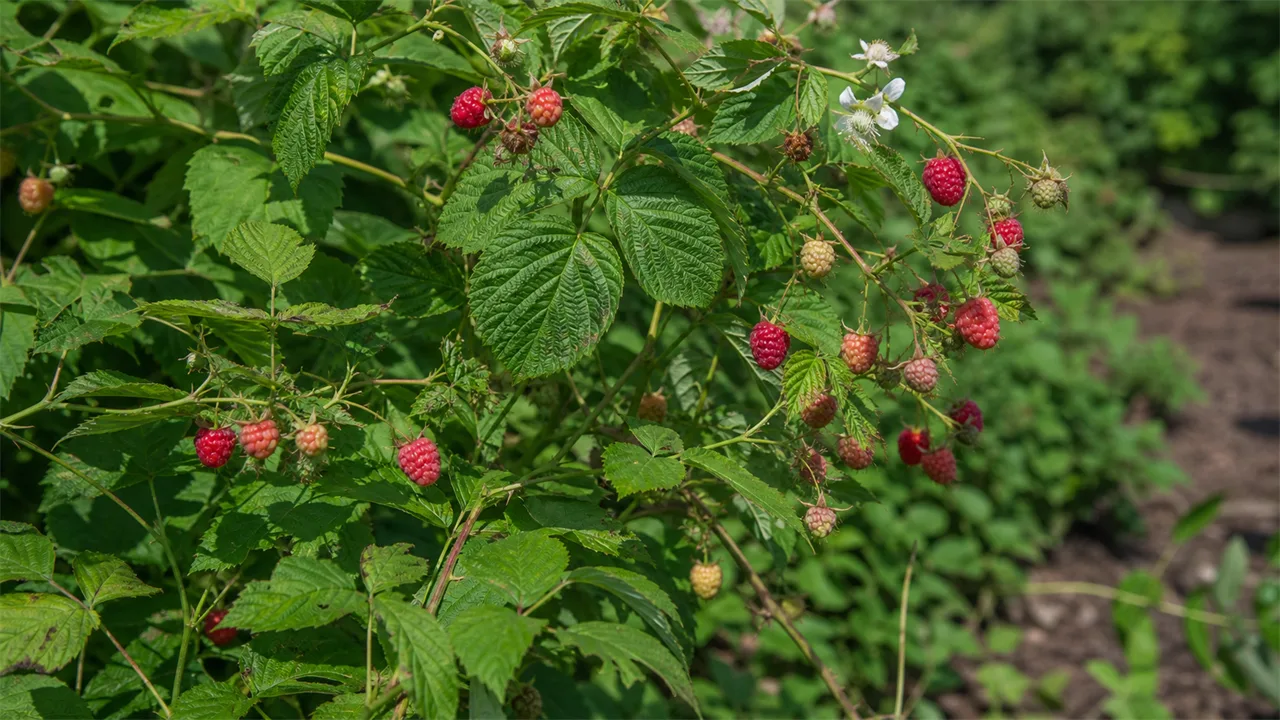
Raspberry (Rubus idaeus) is the cultivated cane fruit most British gardeners will grow at some point. It belongs to the rose family (Rosaceae) and produces its crop on perennial roots that throw up new canes each year, making it one of the most rewarding fruit crops for the allotment or back garden. Raspberries crop reliably across most of the UK, ask for relatively little space, and a well-managed row will give heavy pickings for ten years or more before it needs replacing.
The cultivated raspberry is a hybrid of the wild European Rubus idaeus and the North American Rubus idaeus var. strigosus, and almost all garden varieties descend from this cross. It is deciduous, hardy everywhere in the UK, and self-fertile, so a single plant will fruit on its own, though yields improve with two or three for pollination. Two main types are grown: summer-fruiting raspberries, which crop heavily in early to mid summer on last year's canes, and autumn-fruiting (primocane) raspberries, which crop from late summer into autumn on the current season's growth. Both suit the British climate, and most UK growers plant one of each to extend the picking season.
Raspberries are worth growing because shop-bought fruit is fragile and loses flavour fast, while a raspberry picked warm from the cane is one of the great treats of the kitchen garden. They freeze well, jam well, and a well-tended row also looks handsome trained against a post-and-wire fence.
Sowing
Raspberries are not raised from seed in the garden — they are propagated vegetatively, either as bare-root canes sold dormant from late autumn to early spring, or as pot-grown plants available year-round. The cheapest and most traditional way to start a row is bare-root canes, planted from November to March while the plants are fully dormant. Pot-grown stock is more flexible and can go in at almost any time the soil is workable, though autumn and spring plantings still establish best.
Choose a site in full sun or light dappled shade, sheltered from the strongest winds which can snap fruiting canes and scorch the fruit. Raspberries dislike waterlogged ground, so a free-draining loam is ideal, but they are tolerant of most soils as long as drainage is reasonable and the ground is not bone-dry sand. Work the bed over before planting, removing all perennial weeds (especially couch grass and bindweed, which are hard to clear once they get into a raspberry row), and dig in a generous barrow-load of well-rotted manure or garden compost per square metre. A dusting of bonemeal or blood, fish and bone at planting time helps the roots establish.
UK region-aware planting windows:
- Mild south-west, Wales, southern England (roughly south of the M4/M40 corridor): plant bare-root canes from November through to early March. Autumn planting in late October or November is often the best of all because the roots settle over winter and the canes romp away the following spring. Pot-grown plants can also go in from September to April.
- Midlands, north of England, lowland Scotland: plant bare-root canes from late November to late February, once hard frosts are not imminent but the plants are still dormant. Avoid planting in a frozen or waterlogged hole — wait for a dry, mild spell. Pot-grown stock is safer here than in the far north and is best planted in early spring (March) or early autumn (September).
- Upland Scotland, the Pennines, the Lake District, late-frost pockets: aim for late February to mid-March planting only, so young canes do not get caught by late hard frosts. Spring planting once the worst of the winter has passed is the safer default for these colder areas.
Spacing depends on type. Summer-fruiting raspberries are best planted about 45–60 cm apart within the row, with 1.5–1.8 m between rows. Autumn-fruiting raspberries are a little more vigorous and are usually given a slightly wider spacing of about 60 cm within the row. Plant each cane so the old soil mark on the stem sits roughly 5 cm below the new soil level, spread the roots out, firm in well, and cut the cane back to about 25 cm above the ground to encourage strong new basal shoots.
After planting, mulch thickly with composted bark or well-rotted manure to keep the roots cool and moist, and water in thoroughly. Most new plantings will not need a support structure in their first year, but it should be in place by the second summer.
Growing
Raspberries are shallow-rooted and thirsty. The biggest single mistake UK gardeners make is to let the row dry out in late spring and early summer, which leads to small, crumbly fruit and weak cane growth. Water deeply once a week during dry spells from blossom time until harvest, and continue watering new plantings through their first summer. A thick organic mulch renewed each spring suppresses weeds, keeps the soil cool, and locks in moisture.
Feeding is straightforward. Each February or early March, top-dress the row with a general-purpose fertiliser such as blood, fish and bone or a slow-release organic fruit feed at the maker's rate, followed by a mulch of well-rotted manure or garden compost. Avoid high-nitrogen feeds in late summer on summer-fruiting varieties, as soft lush growth is more prone to winter damage and disease.
Weed control matters: raspberries do not compete well with grass or deep-rooted perennial weeds. Hand-weeding, hoeing, and mulching are the main tools. Do not cultivate deeply near the row, as raspberry roots run close to the surface and are easily damaged.
Support is essential by the second year. The traditional UK system is a post-and-wire fence: drive 2.4 m posts into the ground at each end of the row and at 3–4 m intervals, with horizontal wires at about 60 cm and 1.5 m above ground. Tie canes loosely to the wires with soft twine or purpose-made raspberry ties. Single-post systems with a central post and cross-arms also work well for smaller rows.
Pruning is what most new growers get wrong, and it differs by type:
- Summer-fruiting raspberries: after fruiting in July, cut out the canes that have just fruited at ground level and tie in the strongest new green canes for next year's crop, removing weak or overcrowded shoots.
- Autumn-fruiting raspberries: the easy option is to cut every cane down to ground level in late winter (February). This gives a single, later crop on the new canes. For two smaller crops, instead tip the canes and leave the strongest to crop again lower down the following summer.
Raspberries suffer from a handful of common problems in the UK. Raspberry cane blight and spur blight are fungal diseases that show as dark patches on canes; remove and burn affected canes, avoid overhead watering, and keep the row open and airy. Raspberry beetle is widespread — the small white grubs appear in the fruit — and is controlled by spraying or trapping the adult beetles at flowering time, or by simply picking promptly and not leaving overripe fruit on the canes. Aphids, particularly the large raspberry aphid, should be watched for as they spread virus diseases. Buying virus-tested stock from a reputable nursery and replacing the row every 10–12 years is the best long-term defence.
Harvesting
Summer-fruiting raspberries in the UK are typically ready from late June through July in the south, with mid-July to early August more typical further north and in Scotland. Autumn-fruiting varieties begin cropping in early August in mild areas and continue in flushes through to the first proper frosts in October or, in a mild autumn, into November.
Pick on a dry day, ideally in the morning once the dew has lifted but before the fruit warms up in the sun. Ripe raspberries slip off the receptacle (the white central plug) almost without a pull — if you have to tug, the fruit is not quite ready. Handle them as little as possible; they bruise very easily and will not keep once picked.
Pick over the row every two or three days during peak season. Any fruit showing raspberry beetle grubs, mould, or damage should go straight onto the compost heap rather than back into the picking basket. A healthy summer row of, say, ten metres will easily yield 5–10 kg in a good year once established.
Netting is almost always needed before the fruit colours up, otherwise blackbirds will strip the row in days. A simple fruit cage or a length of soft bird netting draped over the wire supports works well — ensure the netting is taut and lifted off the canes so birds cannot reach through.
After the last autumn pick, leave the canes (for summer-fruiting types) until pruning in the dormant season. Cut out any dead, damaged, or very thin canes and dispose of them; do not compost old fruited canes as they can carry disease.
Eating
Raspberries from the garden need almost nothing done to them. A bowl of fresh-picked fruit with a little double cream, or spooned over meringue with a splash of elderflower cordial, is the classic British summer pudding. They pair particularly well with other garden fruit: gooseberries, redcurrants, and strawberries all ripen around the same time as summer raspberries, and a mixed-bowl pudding is well worth the trouble.
In the kitchen, raspberries hold their shape better than many soft fruits, so they are ideal for folding into yogurt, panna cotta, or a simple fools-style cream. A quick raspberry coulis — fruit warmed gently with a little sugar and a squeeze of lemon, then pushed through a sieve — is excellent spooned over pavlova, ice cream, or pancakes.
Raspberries are also one of the best British fruits for preserving. Raspberry jam is a kitchen staple: a 1:1 fruit-to-sugar ratio with the juice of half a lemon and a brief boil sets reliably and keeps for a year. For longer storage, raspberries freeze well — spread them on a tray to freeze individually, then tip into a bag, so they don't clump into one solid block. They also make a sharp, fragrant raspberry vinegar, and a classic raspberry liqueur (steeped in vodka with sugar for a few months) is straightforward to make at home.
Storing
Raspberries are best eaten within a day or two of picking. Keep them unwashed in a single layer in the fridge and eat promptly — they do not keep like apples or pears. For anything beyond a couple of days, preservation is the answer: freezing, jam, coulis frozen in ice-cube trays, fruit leather, or bottling in light syrup. Frozen raspberries are excellent for baking and for turning into jam in winter when there is time to stand over the pan.
Pests and Diseases
| Problem | Symptoms | Management |
|---|---|---|
| raspberry beetle | eats the fruit | — |
Or browse the full plant problem solver to diagnose an issue by symptom.
Raspberry in our guides
- How to Grow Raspberries: Planting, Pruning and Picking
- Gardening Jobs for August in the UK
- Gardening Jobs for October in the UK
- Honey Fungus: The UK's Most Destructive Garden Disease
Recommended Products
GardenWizz earns a commission from qualifying purchases made through affiliate links on this page (including links within the article) — as an Amazon Associate, and from Thompson & Morgan via the Awin network. This does not affect the price you pay. See our disclaimer for details.