Notable Rhododendron
Rhododendron insigne
The Gardening Year
Best months in UK gardens · full planting calendar →
🖨 Printable care card (PDF)At a Glance
| Botanical name | Rhododendron insigne |
|---|---|
| Common name(s) | Notable Rhododendron |
| Family | Ericaceae |
| Plant type | shrub (evergreen) |
| Height × Spread | 1.5–6 m × 2.5–4 m |
| Position | Full sun, Partial shade |
| Soil | moist but well-drained, humus rich, acidic soil |
| Flowering | March–May |
| Toxicity | Harmful if eaten |
| Native range | southern Sichuan in China |
Overview
Rhododendron insigne is an evergreen shrub in the family Ericaceae, native to western Sichuan and northern Yunnan in southwestern China, where it grows in montane scrub and coniferous woodland at elevations of roughly 1,800 to 3,000 metres. It was introduced to British cultivation by the plant hunter Ernest Henry Wilson in 1908, from seed collected during his second expedition for the Veitch Nurseries, and a plant from this original sending still survives in the Rhododendron Collection at Wakehurst Place in West Sussex. The species is valued in the United Kingdom for its bold, glossy dark green foliage, its rounded trusses of pink, shell-pink or pale rose, bell-shaped flowers in late spring, and its reliable evergreen presence in woodland-edge plantings and larger shrub borders. Mature plants form a broad, dome-shaped shrub some 2 to 4 m tall and rather wider at maturity, with conspicuously recurved, narrow, lance-shaped leaves that are silvery and scaly on the underside. It belongs to subsection Thomsonia, a group of Asiatic elepidote rhododendrons that includes several other species grown in British gardens. Plants are slow-growing but long-lived, and a well-sited specimen will outgrow its allotted space only after several decades. Like almost all rhododendrons cultivated in Britain, it requires an acid soil and a sheltered position, and is best regarded as a collector's or large-garden plant rather than a shrub for a small border. The species is fully hardy in all but the most exposed UK sites and is well established in the rhododendron collections of Cornwall, Devon, Scotland and Northern Ireland.
Appearance
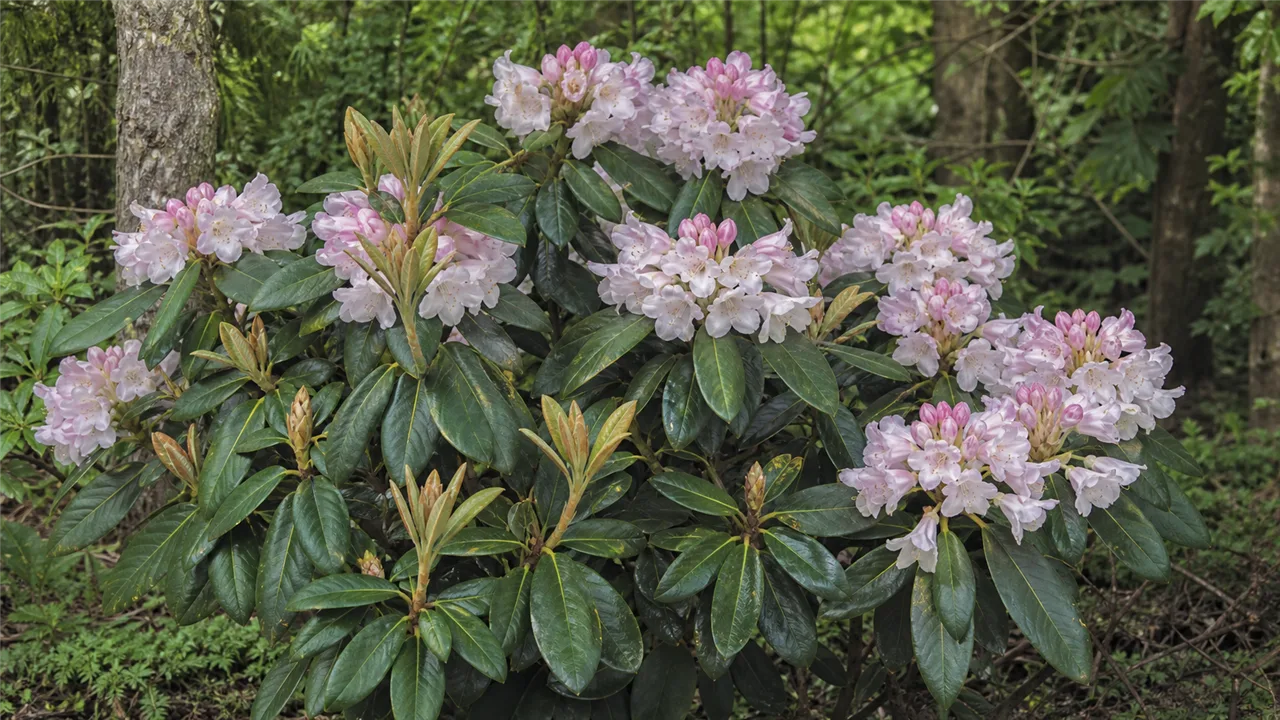
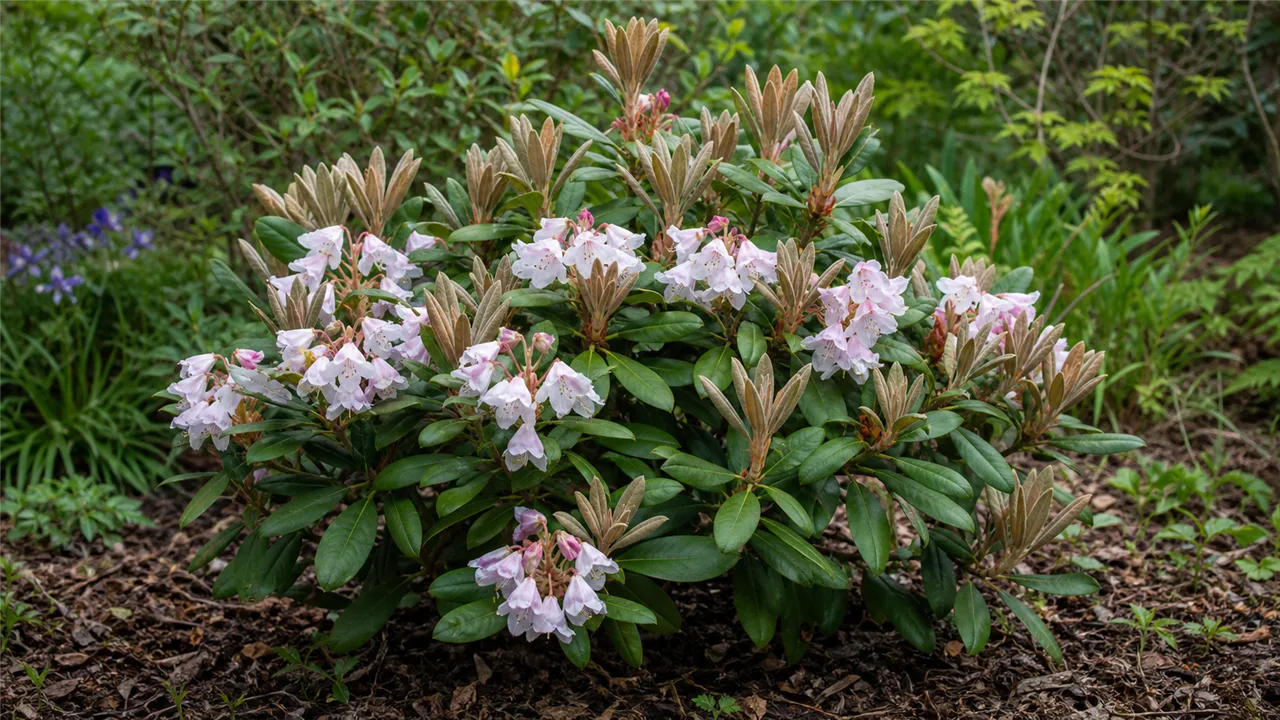
Rhododendron insigne is a stiffly branched, dome-shaped evergreen shrub with a strongly horizontal branch architecture in old specimens. The bark on young shoots is pale grey-brown and slightly downy, becoming smooth and reddish-brown with maturity. The leaves are one of the species' most distinctive features: narrowly elliptic to lance-shaped, 7 to 14 cm long and 2 to 4 cm wide, with a leathery texture, a glossy dark green upper surface, and a markedly recurved margin. The underside of the leaf is densely covered in a continuous layer of silvery to pale fawn scales, which gives the foliage a distinctive pale, almost metallic bloom when the plant is viewed from below, and which is the source of the species' specific epithet — insigne meaning "notable" or "distinguished" in Latin, referring to this striking foliage.
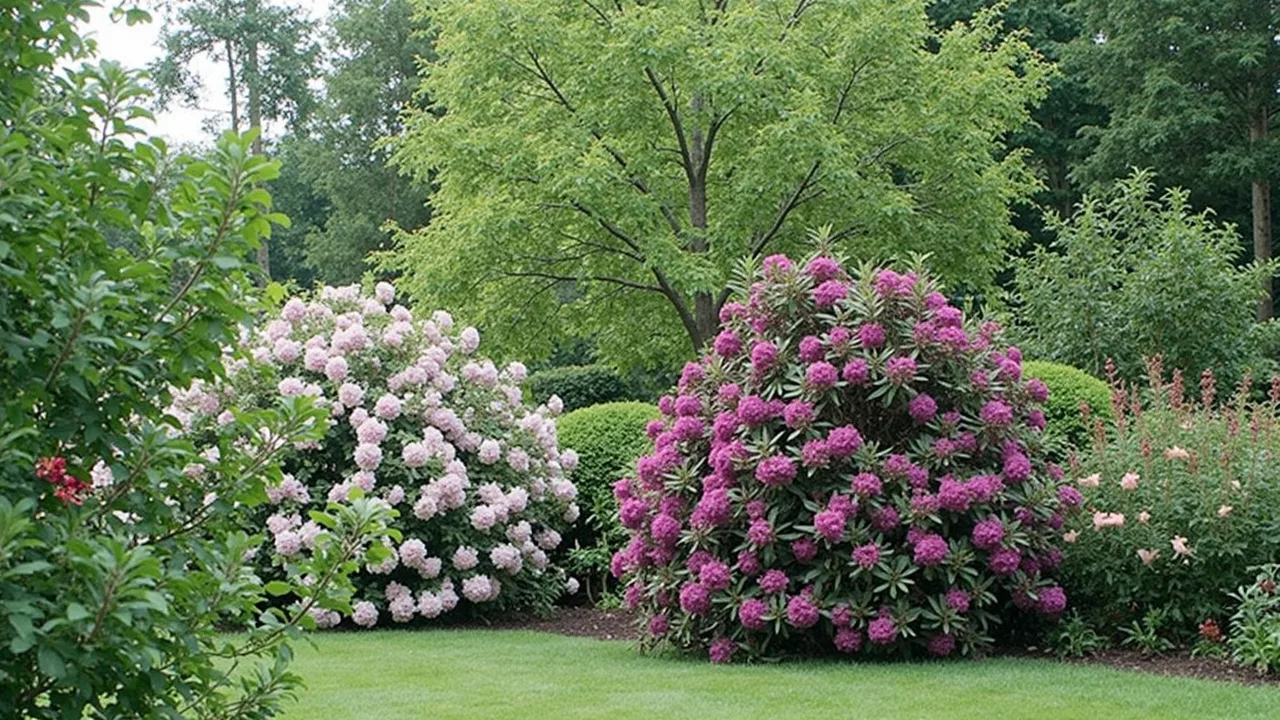
The flowers are borne in rounded, many-flowered trusses at the ends of the previous year's shoots, typically opening in late April in the south-west of England and in late May further north and at higher altitudes. Each truss carries 8 to 14 widely funnel-shaped to openly bell-shaped flowers, 4 to 6 cm across, in colour ranging from pale blush-pink through shell-pink to a clear, slightly translucent rose-pink, often paler in the throat and with a few faint deeper spots or flecks on the upper lobe. The stamens number ten and are noticeably shorter than the corolla, with pale filaments and dark anthers. The calyx is small and scaley, the pedicels and ovary are likewise scaly, and the style is slender and glabrous. Flowering lasts two to three weeks under typical UK conditions, with individual trusses holding their colour well in cool weather. The fruit is a small, dry, scaly capsule about 1.5 to 2 cm long, ripening brown in late summer and shedding fine seed. The overall habit of an old plant is broad, mounded, and slightly tiered, with the lower branches often sweeping the ground and the upper surface a flat-topped dome of dark, glossy foliage.
Growing Conditions
Rhododendron insigne performs best in the United Kingdom in light dappled shade, ideally in the high shade of deciduous or well-spaced coniferous trees where the plant receives broken sunlight for much of the day. It tolerates full sun in the cooler, moister west and north of the country, provided the soil is reliably moist and the root zone is mulched, but in the drier south and east it should be given some afternoon shade to prevent leaf scorch. The plant is not suitable for shallow chalky or limestone soils: it is a calcifuge and will become chlorotic, stunted and eventually die in alkaline ground. It requires an acid, humus-rich, moisture-retentive but freely drained soil with a pH between roughly 4.5 and 6.0; the typical recipe is an open woodland loam enriched with leaf mould, well-rotted coniferous bark or peat-free ericaceous compost, and a surface mulch of the same material maintained year-round.
The species is hardy across virtually all of lowland and lowland-upland Britain, including the south-west, the Welsh borders, the Pennines and central Scotland, in the sense that it tolerates the cold winter temperatures of these regions without injury. The hardiness rating itself is held in the structured field for the plant and is displayed by the badge rather than being stated in the article body. Gardeners in cold inland or upland sites should nevertheless avoid frost-pocket locations: the foliage is evergreen and will be scorched by hard late frost following a mild spell, particularly in early spring when the leaves are soft. Shelter from cold east and north winds is important, and a site with overhanging trees to the north and east, and open to the south or south-west, is ideal. The plant is well established in the great rhododendron collections of Cornwall, Devon, Argyll, Perthshire, County Wicklow and County Antrim, where the combination of high rainfall, mild summers, acid soil and shelter allows it to reach its full mature size and to flower freely in late spring.
Planting and Care
Container-grown plants can be planted at any time from autumn to mid-spring, provided the ground is not frozen or waterlogged; autumn planting is generally preferable because it allows the root system to establish before the spring growth flush. Bare-root plants are rarely offered because rhododendrons transplant badly when lifted bare-root, and almost all stock sold in the UK is container-grown. Before planting, dig a hole at least twice the width of the rootball and the same depth, and improve the backfill with leaf mould, well-rotted coniferous bark, or a proprietary peat-free ericaceous compost. Plant so that the top of the rootball sits flush with the surrounding soil — rhododendrons are shallow-rooted and must not be buried deep — and water in thoroughly with rainwater rather than tap water if the local mains supply is hard.
Watering through the first two growing seasons is the most important establishment task. The plant requires a soil that remains evenly moist but not waterlogged through the growing season; a 5 to 7 cm mulch of leaf mould, composted bark or pine needles, kept clear of the main stem, will conserve moisture, suppress weeds, and slowly acidify the surface soil. Feeding is light: a single application in early spring of a slow-release ericaceous fertiliser, or a top-dressing of well-rotted manure or leaf mould, is sufficient, and overfeeding produces soft leafy growth that is more vulnerable to frost and wind scorch. Irrigation with tap water in hard-water areas is a common cause of decline, as the alkalinity accumulates around the roots; where rainwater cannot be collected, a small drip line fed from a water butt is the most reliable answer.
Pruning is minimal. Like most elepidote rhododendrons, R. insigne is a deadhead-only plant: spent trusses should be snapped off carefully just behind the flower head as soon as the petals have faded, taking care not to damage the small cluster of new shoots immediately below. Deadheading prevents the plant from wasting energy on seed production and improves flowering the following year. Any necessary shaping or removal of damaged, crossing or frost-affected wood is done immediately after flowering in late May or June, and the cuts are made to a sideshoot or to the base of the offending branch. Hard renovation pruning into old wood is tolerated by healthy plants but may take two or three years to recover, and is best staged over several seasons.
Propagation is by semi-ripe cuttings taken in mid- to late summer from healthy non-flowering shoots; 8 to 12 cm cuttings with a heel root in a 50:50 mix of peat-free ericaceous compost and sharp grit under a closed propagator with bottom heat of around 18 to 20 °C. Layering of low shoots in autumn is reliable but slow, and grafted plants on Rhododendron ponticum or a selected clonal rootstock are the norm for large commercial material, particularly in areas where R. ponticum is itself unsuitable. Seed is viable but produces variable offspring, and named forms are propagated vegetatively only.
Seasonal care through the year in the UK follows a simple pattern: a light ericaceous feed and a top-up of mulch in late February or early March, deadheading in late May as the last flowers fade, renewal of the mulch in autumn after the autumn rains have soaked the ground, and a check on staking and ties in late winter on older specimens. Plants in exposed positions benefit from a temporary windbreak of hessian or bracken in hard late-winter spells.
Common Problems
Rhododendron insigne is generally a healthy, low-maintenance shrub when given the right soil, but several problems are common on unsuitable sites. The most frequent are physiological rather than infectious: leaf chlorosis (yellowing between the veins with the veins themselves remaining green) is almost always a sign of alkaline soil or hard irrigation water, and the only reliable long-term remedy is to lift and replant into genuine ericaceous conditions, or to use rainwater exclusively. Leaf scorch — browning of the leaf margins in winter and early spring — is usually a combination of cold wind and frozen soil, where the foliage loses water it cannot replace; shelter and a moist rootzone are the answer. Bud blast and browning of the developing flower buds in late winter is occasionally a sign of the rhododendron bud blast fungus (Pycnostysanus azaleae) spread by the rhododendron leafhopper, and is more common on stressed or drought-stressed plants.
Of the invertebrate pests, the rhododendron leafhopper (Graphocephala fennahi) is the most conspicuous: a small, bright turquoise-and-red leafhopper that appears from late summer and lays eggs in the flower buds, providing an entry point for the bud blast fungus. Control is rarely necessary in a garden setting, but sticky traps and autumn spraying of the lower foliage with a contact insecticide can reduce populations on valuable specimens. The rhododendron whitefly, lace bug (specifically the rhododendron lace bug, Stephanitis rhododendri, which produces a characteristic pale stippling on the upper leaf surface and tarry black spots of frass on the underside), and various scale insects are occasional pests, more troublesome in warm, dry summers and on stressed plants. Vine weevil grubs can be devastating in container-grown stock but are rarely a problem in open ground.
Fungal diseases recorded on the species include rhododendron powdery mildew (a white felted coating on the leaf surface in late summer, more common in dry seasons and on stressed plants), various leaf spots, and honey fungus (Armillaria spp.) on old or wounded specimens. Phytophthora root rot is the most serious soil-borne disease, causing sudden wilting, leaf rolling and collapse, particularly on poorly drained sites or where plants have been buried too deep. There is no effective cure, and affected plants should be removed with as much of the root system as possible and the site rested before replanting with non-ericaceous material.
Like all rhododendrons, the foliage and flowers of R. insigne are toxic if eaten, owing to grayanotoxins in the tissues, and the plant is considered harmful to grazing animals; the honey from rhododendrons can also be toxic in significant quantity, though this is not a practical problem in the United Kingdom. Gardeners with toddlers or browsing pets should site the plant accordingly.
Popular Varieties
Rhododendron insigne is itself a species of garden merit and is widely grown as the type form, but several selections and hybrids are offered by UK specialist nurseries. Rhododendron insigne 'King George' is a vigorous selection with particularly large trusses of clear pink flowers and broader, more heavily silvered foliage than the type, and is the most commonly planted clone in the older British collections. Rhododendron insigne 'Rogers' is a more compact form with deeper rose-pink flowers and a slightly narrower habit, useful in smaller gardens or for foreground woodland planting. A pale form sometimes sold as R. insigne album or under clonal names such as 'Bodnant White' is grown in the great Welsh collections and provides a useful contrast to the pink-flowered forms; its flowers are flushed very pale pink in bud, opening to a translucent creamy white.
The species has also been used in hybridising within subsection Thomsonia. Rhododendron 'Unique' (a hybrid of R. insigne and R. campylocarpum ssp. caloxanthum raised in the early twentieth century) is one of the more widely grown of these hybrids, valued for its pale apricot-yellow flowers and neat rounded habit. Rhododendron 'Sunte Nectarine' and several similar clones derive in part from R. insigne and inherit its glossy foliage and bell-shaped flowers in shades of apricot, peach and pink. Specialist nurseries in Cornwall, Devon, Scotland and Northern Ireland stock a wider range of R. insigne seedlings and selected clones, many of which remain un-named; named cultivars of the species itself are limited, and most garden plants are raised from controlled seed lots of the type.
Pests and Diseases
| Problem | Symptoms | Management |
|---|---|---|
| Lime-induced chlorosis | Leaves turn yellow between green veins due to iron deficiency in alkaline soil. | Plant only in lime-free ericaceous compost or well-drained acidic soil beds. |
| Powdery mildew | White, dusty fungal growth appears on leaves and shoots, often causing distortion. | Improve air circulation and apply a suitable fungicide if infection is severe. |
| Bud blast | Flower buds turn brown and die before opening, usually after late spring frosts. | Site plants in sheltered positions to protect against cold winds and frost damage. |
| Root rot (Phytophthora) | Plant wilts and declines rapidly with dark, water-soaked lesions on roots. | Ensure excellent drainage and avoid waterlogging by using raised beds or containers. |
| Vine weevil | Notched edges on leaves above ground and root damage causing plant collapse below. | Use biological nematodes in soil or systemic insecticides for potted plants. |
For step-by-step help, read Treating Powdery Mildew. Or browse the full plant problem solver to diagnose an issue by symptom.
Recommended Products
GardenWizz earns a commission from qualifying purchases made through affiliate links on this page (including links within the article) — as an Amazon Associate, and from Thompson & Morgan via the Awin network. This does not affect the price you pay. See our disclaimer for details.