Violet Willow
Salix acutifolia
The Gardening Year
Best months in UK gardens · full planting calendar →
🖨 Printable care card (PDF)At a Glance
| Botanical name | Salix acutifolia |
|---|---|
| Common name(s) | Violet willow |
| Family | Salicaceae |
| Plant type | shrub (deciduous, dioecious) |
| Height × Spread | 10 m × 12 m |
| Position | Full sun |
| Soil | well-drained but moisture-retentive (or even wet) |
| Flowering | March–May |
| Toxicity | — |
| Native range | Russia and eastern Asia |
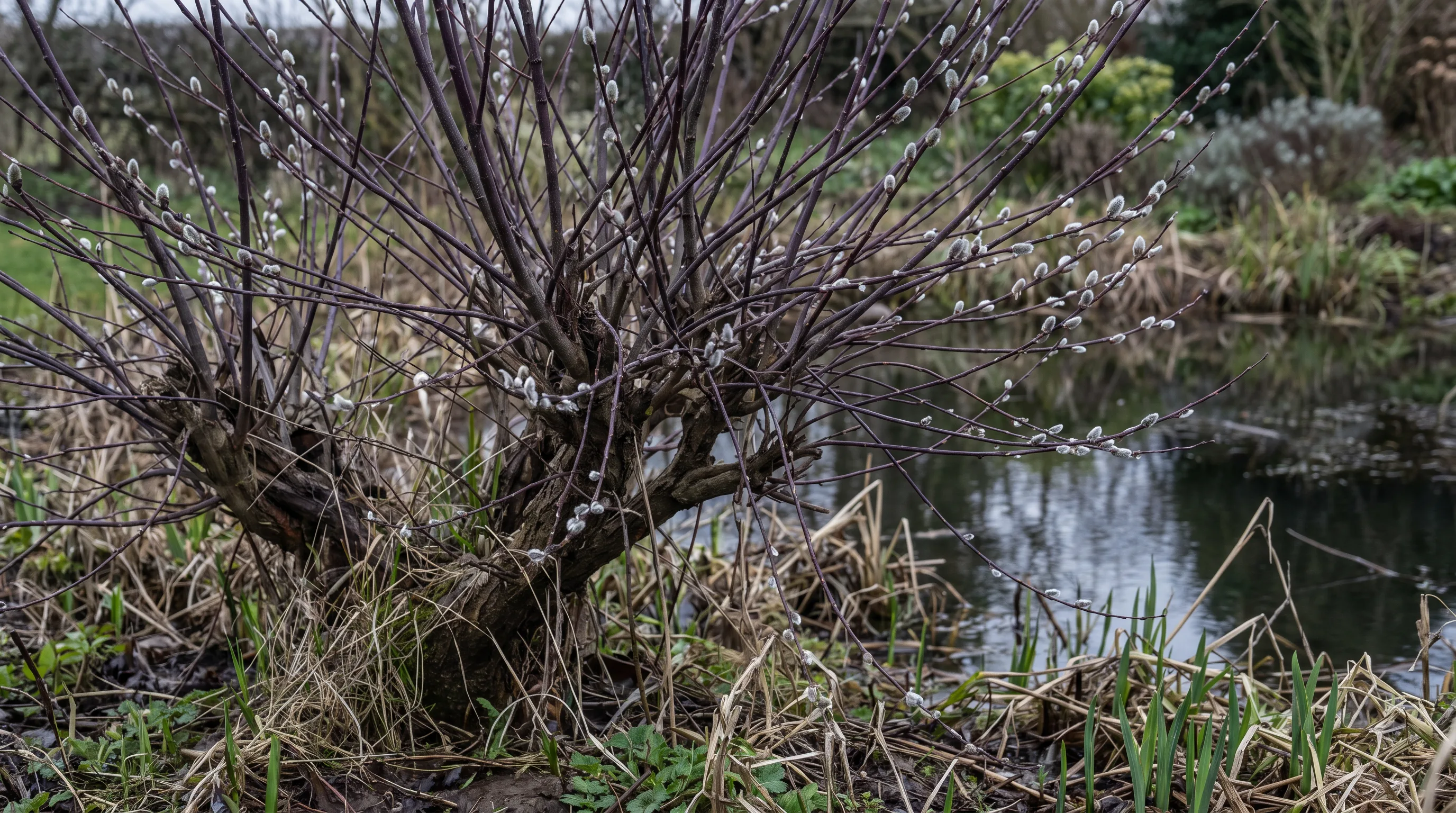
Violet willow (Salix acutifolia) is a vigorous deciduous willow valued for its glossy purple-black young shoots, often covered with a striking blue-white bloom. Silky early catkins extend its season of interest, but its eventual size and vigorous roots make careful siting essential in UK gardens.
Overview
Salix acutifolia belongs to the willow family, Salicaceae, and is native from eastern Europe into western Asia. It is most often grown in Britain as an ornamental large shrub or small tree. Its principal distinction is not summer flower colour but the sheen and bloom of its young bark: slender new stems mature to deep purple or almost black and may appear dusted with blue-white wax. This makes violet willow particularly effective in winter, when its leaves have fallen and the coloured framework is fully exposed.
The species is dioecious, meaning that male and female flowers are carried on separate plants. Both occur in catkins, although male catkins generally become more conspicuous when their yellow anthers open. A plant bought without a known sex should not be assumed to produce a particular type of catkin. Flowers appear on bare wood in late winter or early spring, before or around the time the new leaves unfold.
This is a landscape plant rather than a routine choice for a small border. An unpruned specimen may eventually approach 10 m in height and form a broad, multi-stemmed crown. Its roots seek moisture and can spread well beyond the branch canopy. A spacious lawn, large wildlife garden, informal boundary or broad waterside site is more suitable than a narrow bed beside a wall, drain or small lined pond.
Appearance
Young shoots provide the most recognisable feature. They are slender, smooth and lustrous, ranging from rich violet-purple to purple-black. A pale waxy bloom may create a blue or silvery cast, particularly on vigorous recent growth. The contrast is clearest after leaf fall and can remain decorative through winter. Older branches lose some of this intensity, which is why managed plants grown for stem colour are periodically renewed.
The leaves are narrow and taper to a long point, with finely toothed margins. They are dark green above and paler beneath, producing a lighter flicker when moved by wind. The overall summer outline is leafy and informal rather than dense and clipped. Autumn colour is generally secondary to the winter stems, and fallen leaves should be allowed for if the tree overhangs a path or pond.
Soft, silky catkins emerge on the bare shoots in late winter or early spring. Male catkins become yellow as the anthers develop, while female catkins are usually quieter in appearance. Their early timing gives the plant value when relatively few woody plants are flowering. The catkins can provide pollen for active insects during mild spells, while the mature crown supplies shelter and nesting structure.
Growing Conditions
Choose a position in full sun. Strong light encourages sturdy growth, shows the stem bloom clearly and helps the crown dry after rain. Light shade may be tolerated, but it can reduce the impact of the winter colour and encourage a looser shape. An open position with reasonable air movement is useful where foliar disease has previously affected willows.
The ideal soil is moisture-retentive and reasonably fertile. Loam and clay-based soils can suit the species, including ground near a stream or on the outer edge of a large natural pond, provided the roots are not trapped in permanently stagnant, airless conditions. Consistently dry, shallow soil is unsuitable. The combination of drought and reflected heat beside paving or a south-facing wall places avoidable stress on a moisture-loving tree.
Good siting depends as much on space as on soil. Keep violet willow well away from buildings, retaining walls, drains, septic systems and other underground services. Do not use it beside a small artificial pond where roots could reach a liner or where the crown would overwhelm the feature. Check the likely mature spread against boundaries, overhead cables and neighbouring gardens before planting.
Most suitable UK sites provide the seasonal conditions needed for healthy growth, but exposure, drainage and summer moisture remain important. Shelter young shoots from severe coastal wind, and allow for fallen foliage and catkin debris as well as the eventual crown.
Planting and Care
Plant container-grown violet willow from November to March when the plant is dormant and the ground is neither frozen nor waterlogged. Container plants can be set out at other times, but spring and summer planting demand much closer attention to watering. Bare-root plants should be planted during dormancy. Dig a broad hole no deeper than the root system, loosen compacted sides, spread the roots naturally and return the excavated soil without burying the root flare.
Water thoroughly after planting. A stake may be needed for a tree-form specimen on an exposed site; place it so that the root ball is stabilised while the upper stem can move slightly. Apply a broad layer of organic mulch over moist soil, leaving a clear collar around the stems. Mulch suppresses competition and slows moisture loss, but material piled against bark can hold excessive dampness and conceal damage.
Maintain even moisture through the first two or three growing seasons. Check the root area during dry spells rather than relying on light showers, and water deeply enough to wet the full root zone. Established willows on suitable moisture-retentive soil usually need less intervention, although prolonged drought can still cause leaf loss and shoot dieback. Avoid frequent shallow watering, which encourages roots near the surface.
Feeding is seldom necessary in fertile garden soil. A spring mulch supplies organic matter gradually. If a soil test or persistently weak growth indicates low fertility, apply a modest balanced feed in spring according to the product directions. Heavy feeding is counterproductive: it may promote soft, crowded shoots that are more vulnerable to pests, disease and wind.
Pruning depends on the intended form. For a natural tree or large shrub, remove dead, damaged, diseased and badly crossing branches, retaining the characteristic open outline. Carry out structural work during dormancy, generally in February or early March before vigorous growth begins. Use clean, sharp tools and cut back to a suitable branch collar or healthy outward-facing growth; do not leave long stubs.
For intense winter stem colour, establish the plant before beginning severe renewal. Coppice by cutting selected established stems back to a low framework in late winter, or pollard back to the previously formed heads. Do not alternate casually between tree, coppice and pollard management, as large irregular wounds and weakly attached regrowth can create future problems. Where major limbs are involved, seek advice from a qualified arborist.
Propagation is most reliable from hardwood cuttings. After leaf fall, take straight sections of healthy dormant shoot, make a clean basal cut and insert most of each cutting into a prepared outdoor bed or deep container of free-draining propagation medium. Keep the bed moist but not stagnant. Rooted cuttings can be lifted and moved during the following dormant season once they have developed a useful root system. Seed propagation is rarely needed in gardens and does not preserve the characteristics of a selected clone.
Seasonal care is straightforward but regular. In February or March, inspect the framework and complete planned dormant pruning. Mulch in spring while the soil is moist. From April through September, watch newly planted specimens during dry weather and water before severe wilting occurs. In autumn, clear heavily diseased fallen foliage and check stakes and ties, loosening or removing them before they constrict the stem.
Common Problems
Aphids may cluster on tender shoots and distort young leaves, while caterpillars, sawfly larvae and willow leaf beetles can chew or skeletonise foliage. A healthy established tree usually tolerates some feeding. Encourage predators, inspect young or recently coppiced plants regularly and remove small, accessible colonies or larvae by hand where practical. Broad, routine insecticide use can harm the insects that visit early catkins and is rarely justified for cosmetic leaf damage.
Willow anthracnose and scab can produce spotted, blackened or distorted leaves and shoot dieback. Rust may appear as orange or yellow pustules, while cankers can kill patches of bark and branches. Reduce stress by maintaining moisture, avoiding excessive nitrogen and preserving airflow through sensible spacing. Prune badly affected shoots back to healthy wood in suitable dry weather, disinfecting tools when moving between suspect material and healthy branches. Remove heavily infected debris rather than adding it to a cool home compost heap.
Honey fungus is a possible root and collar disease, particularly on stressed woody plants. Symptoms such as progressive crown thinning, dieback, decay at the base or sheets of pale fungal growth beneath bark require careful diagnosis because drought, waterlogging and root damage can look similar. There is no useful curative feed or spray; confirm the cause before deciding whether removal is necessary.
Environmental and siting problems are at least as important as pests. Recently planted trees can wilt rapidly in dry weather, whereas roots in stagnant, compacted soil may suffer from poor aeration. Vigorous roots and an expanding crown can become structural or boundary problems when the original planting space was too small. Correct placement at the outset is considerably safer than repeated drastic pruning later.
Popular Varieties
Named selections of Salix acutifolia are less widely offered than common cultivars of some other willows, and availability and descriptions can vary between specialist nurseries. The following names are documented in horticultural plant catalogues, but buyers should confirm the supplied plant's mature habit, sex and intended pruning regime with the nursery.
Salix acutifolia 'Blue Streak' is a named selection associated with the species' characteristic bloom-covered young stems. It may appeal where blue-toned winter shoots are the principal design feature.
Salix acutifolia 'Harry' is a documented named cultivar. Published descriptive information is limited, so it should not be chosen on the assumption of a particular ultimate size, catkin type or stem colour without checking the supplier's current stock description.
Salix acutifolia 'Lady Aldenham No. 2' is another recorded selection. As with other uncommon willow clones, its identity is best protected by buying labelled, vegetatively propagated material from a reputable specialist nursery.
Salix acutifolia 'Pendulifolia' is a documented named form whose epithet indicates a pendulous association. Its precise habit in commerce should be verified before planting rather than assuming it will remain compact or form a fully weeping tree.
Where a named selection cannot be sourced reliably, the straight species remains valuable for dark winter stems and early catkins. Regardless of name, allow for the dimensions of a substantial willow and decide whether it will be grown naturally, coppiced or pollarded before purchase.
Pests and Diseases
| Problem | Symptoms | Management |
|---|---|---|
| Willow anthracnose | Leaves develop irregular brown patches and may curl or drop prematurely. | Improve air circulation by thinning the canopy and remove fallen leaves to reduce spores. |
| Aphids | Clusters of small soft-bodied insects on new growth causing sticky honeydew and distorted leaves. | Encourage natural predators like ladybirds or use a strong jet of water to dislodge them. |
| Willow scale | Small white waxy bumps on stems and leaves leading to yellowing foliage and weak growth. | Prune out heavily infested branches in winter or apply horticultural oil during dormancy. |
| Canker | Sunken, discoloured lesions on stems causing dieback of branches above the wound. | Cut back to healthy wood with clean tools and avoid wounding stems during pruning. |
| Sawflies | Larvae resembling caterpillars skeletonise leaves, leaving only veins intact. | Hand-pick larvae or apply insecticidal soap if infestations are severe. |
For step-by-step help, read Controlling Aphids Naturally. Or browse the full plant problem solver to diagnose an issue by symptom.
Recommended Products
GardenWizz earns a commission from qualifying purchases made through affiliate links on this page (including links within the article) — as an Amazon Associate, and from Thompson & Morgan via the Awin network. This does not affect the price you pay. See our disclaimer for details.