Altai Tulip
Tulipa altaica
The Gardening Year
Best months in UK gardens · full planting calendar →
🖨 Printable care card (PDF)At a Glance
| Botanical name | Tulipa altaica |
|---|---|
| Common name(s) | Altai Tulip |
| Family | Liliaceae |
| Plant type | bulb |
| Height × Spread | 10–35 cm × 0–10 cm |
| Position | Full sun |
| Soil | fertile, well-drained |
| Flowering | May |
| Toxicity | Harmful if eaten; skin allergen |
| Native range | Russia, Kazakhstan, China |
Overview
Tulipa altaica is a small, true species tulip native to the dry, rocky mountain slopes and steppe of Central Asia, where it ranges across Kazakhstan, parts of western China's Xinjiang, Kyrgyzstan and the broader Altai and Dzungarian ranges. First described by Pallas and formally published by Sprengel, it sits within subgenus Tulipa alongside close relatives such as T. patens and T. kolpakowskiana, and has long been of interest to botanists tracing the wild ancestry of garden tulips. In the UK it is grown less for impact than for refinement: a compact spring bulb with clear yellow flowers, dark filaments and a marked preference for sharply drained, sun-baked sites that mimic its native habitat.
For British gardeners it is best treated as a connoisseur's bulb — a small species for the rock garden, raised bed or alpine trough, rather than a substitute for hybrid border tulips. It persists year to year only where summers are dry and drainage is sharp; in heavier or wetter gardens it is usually a "replace every few years" plant, lifted and replanted annually. Its UK hardiness has not yet been established by the RHS, so gardeners should rely on local experience and site preparation rather than a published rating.
Appearance
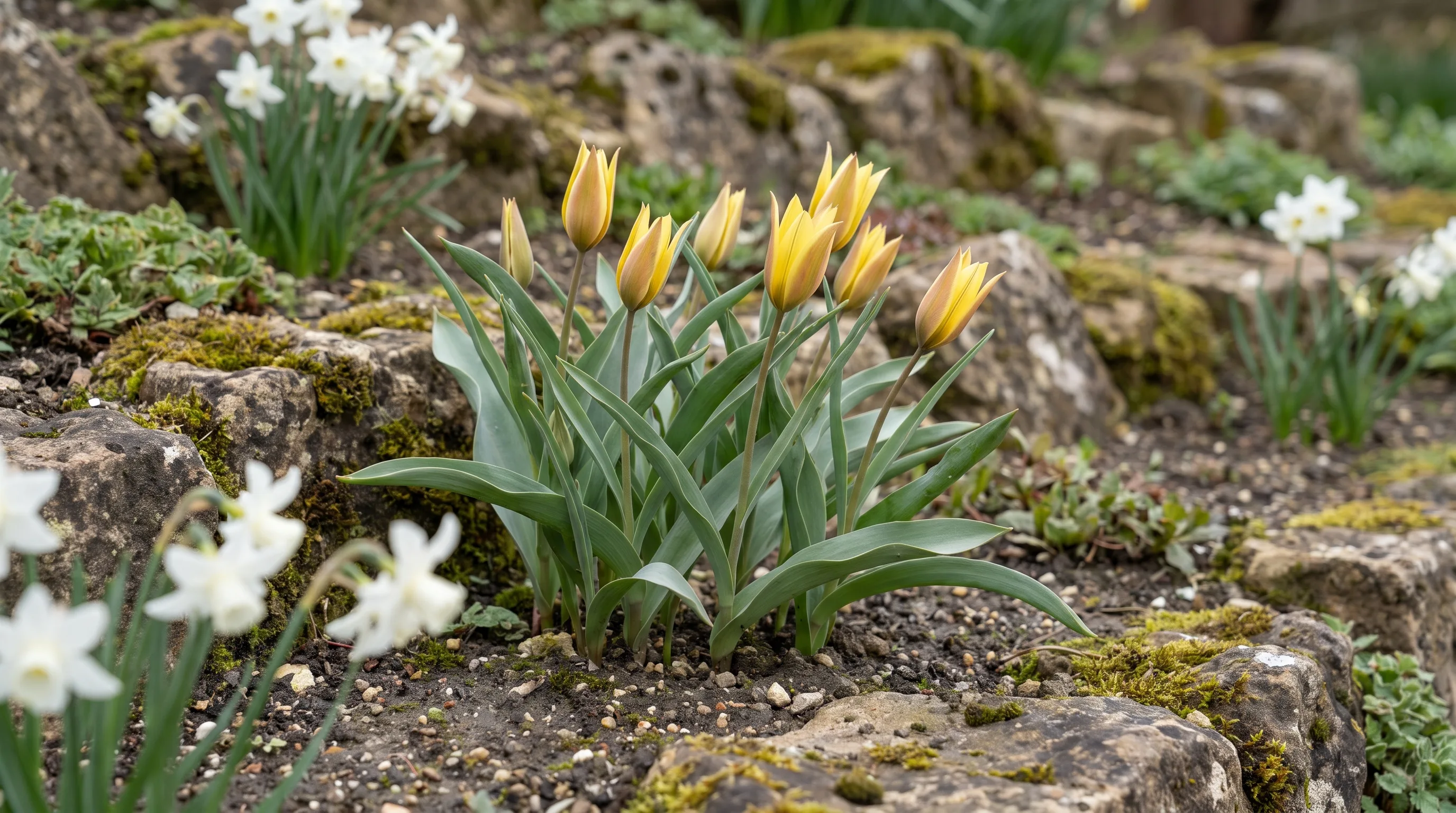
Tulipa altaica is a modest, wiry plant rather than a showpiece. Mature flowering stems reach 15 – 35 cm in cultivation, often shorter in the wild, with the bulb itself a typical tunicate type enclosed in a brown papery tunic and finished at the apex with a thin collar of woolly hairs — a useful diagnostic when separating true stock from confused commercial substitutes.
Three to five leaves are carried per stem. They are grey-green to distinctly glaucous, narrowly lanceolate, and characteristically undulate, with gently wavy edges that catch the light. Young leaves carry a fine, sparse pubescence; basal leaves sit low against the ground while stem leaves are smaller and narrower.
The flowers are the plant's chief ornament. Typically one per stem, occasionally two on well-grown clumps, they open from upright buds into cup-shaped blooms 4 – 7 cm across, with six tepals in two whorls. Colour ranges from clear lemon to deep golden yellow, sometimes flushed orange or bronze on the outside as the flowers age. At the base of each tepal sits a dark olive-green to purple-brown blotch. The six stamens are unusually showy: filaments deep purple-brown, almost black, with yellow to dark purple anthers — the contrast against the yellow perianth is what distinguishes a well-grown clump at a glance.
Seed is carried in a narrow elliptical capsule that dries and splits to release flat, papery, wind-dispersed seeds. In cultivation, allowing seed to set diverts strength from the bulb, so deadheading is usual unless seed is wanted.
Growing Conditions
Tulipa altaica needs full sun and, above all, sharp drainage. In the wild it grows on rocky, gritty slopes between roughly 1,500 and 2,500 m elevation, where winter is cold, summer is hot and dry, and the bulb spends most of June to September baked and dormant. Replicating those conditions in the UK is the entire game.
Soil should be a free-draining gritty or sandy loam. Heavy clay is the most common reason for failure: the bulb simply rots in a wet British summer. Where clay is unavoidable, plant in raised beds, large deep containers, or replace the planting medium with a 50/50 loam-and-grit mix to a depth of at least 25 cm. pH is forgiving — roughly neutral to mildly alkaline suits it, mirroring its native substrates. Fertility is unimportant; rich, organic-rich soil encourages rot rather than growth.
Aspect should be south- or west-facing and open to the sky, ideally with a gravel or stone mulch that radiates heat in spring and sheds rain in summer. Rock gardens, sunny gravel borders, the top of a drystone wall, alpine troughs and unglazed terracotta pots are all appropriate. The species is well suited to alpine houses, where the bulb can be kept dry in summer under the plunging glass.
In the UK, climate matters more than aspect. In drier eastern and south-eastern counties T. altaica tends to persist for many years; in the mild, wetter west it usually deteriorates after two or three seasons unless bulbs are lifted each summer and stored dry. Cold winters are not a problem — frost is in fact needed to break dormancy and trigger a strong flowering display the following spring.
Planting and Care
Plant bulbs in autumn, as soon as they become available in October or November. Set them 10 – 15 cm deep — roughly two to three times the bulb's own height — with the pointed tip uppermost, and space them 8 – 10 cm apart. In clay soils, dig a little deeper and put a small handful of sharp grit beneath each bulb before backfilling. A low-nitrogen, high-potash feed (the same tomato fertiliser used for tomatoes) at planting and again as shoots emerge in spring suits them; fresh manure and rich garden compost should be kept away from the bulb itself.
Watering is rarely needed once the bulbs are established. Autumn-planted bulbs root into moist ground; in subsequent years the natural rainfall of a British spring is usually sufficient. In containers, water only when the compost is clearly drying during the active season, and withhold water entirely once the foliage begins to yellow in late May or June.
After flowering, deadhead spent blooms before significant seed set to keep the bulb strong. Leave the foliage to die back naturally — do not tie, braid, or cut it while still green, as the leaves refill the bulb for the following year. A thin gravel mulch suits the plant's native habitat and helps surface drainage; bark or compost mulches hold too much moisture and should be avoided.
Lifting is optional. In heavy or damp gardens, lift bulbs once the foliage has yellowed, dry them in a cool shaded place, and store in paper bags or nets in a cool dry shed until autumn replanting. Many UK growers treat T. altaica as a "refresh every three to five years" bulb simply because British summers are wetter than it would like.
Propagation is either from seed, sown fresh in autumn and germinating the following spring (typically flowering in three to four years), or by offsets carefully detached from lifted bulbs. Offset increase is slow compared with hybrid garden tulips, so do not expect a clump to bulk up quickly.
Common Problems
Tulip fire (Botrytis tulipana) is the most serious disease. Symptoms are distorted shoots, fuzzy grey mould on leaves and flowers, and dark spotting. Promptly remove and destroy affected plants, and do not replant tulips in the same spot for at least three years.
Bulb rot, caused by Fusarium and Pythium fungi, follows poor drainage or summer wet. Prevention is purely cultural: improve drainage, avoid fresh organic matter at planting depth, and lift in problem sites.
Squirrels, mice and voles find the bulbs palatable. In gardens with a known rodent population, plant in wire cages or top-dress with a coarse gravel mulch that discourages digging.
Slugs damage emerging shoots and flowers in damp springs, particularly in sheltered gardens. Standard controls — night picking, ferric phosphate pellets, or copper barriers around vulnerable pots — are effective.
Viral decline is rarer in T. altaica than in hybrid tulips, but streaked or distorted foliage indicates infection. Lift and destroy affected plants; do not compost them.
Failure to flower in subsequent years usually reflects one of three things: a wet summer that exhausted the bulb, too-shallow planting that left the bulb vulnerable to summer warmth and winter wet, or bulb exhaustion after a particularly heavy flowering year. Lift, dry, and replant deeper in autumn.
Popular Varieties
True Tulipa altaica has no widely marketed cultivars, and named selections should be treated with caution — much of what is sold under this name in the bulb trade is mixed stock or close relatives. Where a named form is offered, buy from a specialist bulb nursery that propagates from known wild-collected seed and labels clearly.
For variation, grow seed-raised plants from a reputable source: a single sowing typically produces a slight range of heights and tepal colours, from paler lemon to deeper gold, with the occasional plant carrying a stronger bronze flush on the outside of the outer tepals. Selecting and dividing the best of these over several years is the conventional way to develop a strain.
Several close relatives are often grown alongside T. altaica and are worth considering for similar dry, sunny sites:
- Tulipa patens — a smaller species with white to pale lilac-pink flowers, also from Central Asia, with the same drainage needs.
- Tulipa kolpakowskiana — a dwarf with bright yellow flowers striped red on the outside, suited to rock gardens and troughs.
- Tulipa tarda — a clump-former with yellow-tipped white flowers, more tolerant of summer moisture but still happiest with sharp drainage.
Used together, these species extend the spring display from early March into late May and provide a useful cross-reference for any genuine T. altaica seedlings raised from seed.
Pests and Diseases
| Problem | Symptoms | Management |
|---|---|---|
| Tulip fire (Botrytis tulipae) | Brown spots appear on leaves which become twisted, withered and distorted. | Remove infected material immediately and avoid replanting in the same spot for at least three years. |
| Bulb rot | Bulbs decay and collapse due to waterlogged soil or poor drainage conditions. | Plant bulbs in well-drained soil and ensure they do not sit in standing water during winter. |
| Slugs and snails | Irregular holes are eaten into emerging shoots, leaves and flower petals. | Use slug pellets, beer traps or copper tape barriers to protect young growth. |
| Vine weevil | Notched edges on leaves above ground and root damage causing wilting below. | Apply nematode-based biological controls to the soil in autumn and spring. |
| Tulip viruses (e.g. TBV) | Flowers show irregular colour breaks or streaks and plant vigour declines over time. | Destroy infected bulbs promptly and control aphid vectors to prevent spread. |
For step-by-step help, read Dealing with Slugs and Snails. Or browse the full plant problem solver to diagnose an issue by symptom.
Recommended Products
GardenWizz earns a commission from qualifying purchases made through affiliate links on this page (including links within the article) — as an Amazon Associate, and from Thompson & Morgan via the Awin network. This does not affect the price you pay. See our disclaimer for details.