Crocus Tulip
Tulipa aucheriana
The Gardening Year
Best months in UK gardens · full planting calendar →
🖨 Printable care card (PDF)At a Glance
| Botanical name | Tulipa aucheriana |
|---|---|
| Common name(s) | crocus tulip |
| Family | Liliaceae |
| Plant type | bulb |
| Height × Spread | 10–50 cm × 10–50 cm |
| Position | Full sun |
| Soil | Chalk Loam Sand |
| Flowering | March–May |
| Toxicity | Harmful if eaten skin allergen |
| Native range | SW Asia |
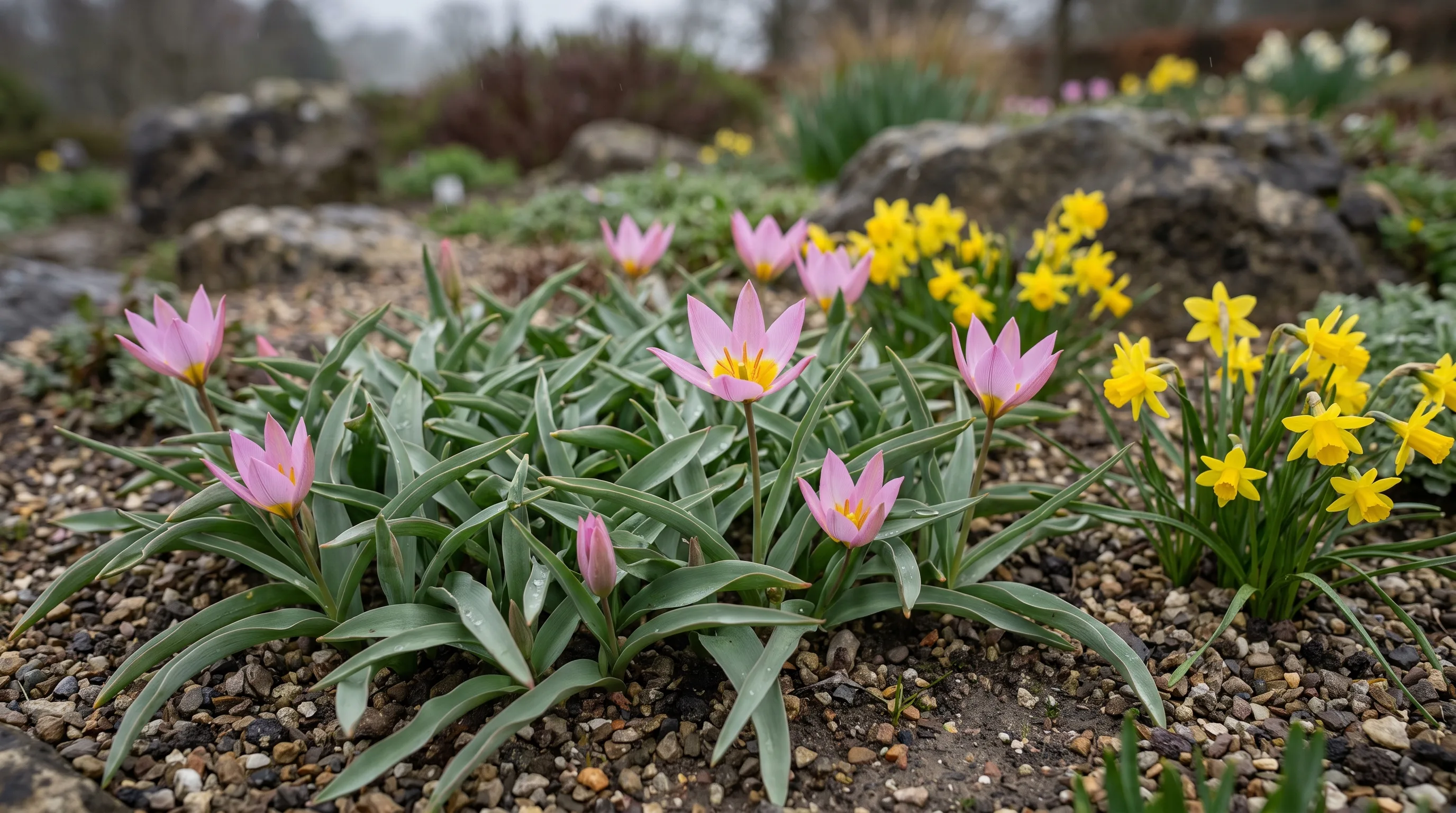
Tulipa aucheriana, or Aucher's tulip, is a diminutive botanical tulip valued for its pink to mauve spring flowers and compact habit. Native to mountainous parts of western Asia, it suits sunny rock gardens, alpine troughs, gravel gardens and other sharply drained positions in the UK.
Overview
Tulipa aucheriana is a wild species rather than one of the large-flowered hybrid tulips commonly used for formal bedding. Its modest scale and relatively understated flowers give it a different garden role: it is best placed where the plant can be viewed closely and where neighbouring plants will not overwhelm it. A rock garden ledge, raised gravel bed, alpine trough or sunny border edge provides both visibility and the free drainage it needs.
The species originates in western Iran, eastern Turkey and the Caucasus region, where bulbs experience cold winters, moisture during active spring growth and a comparatively dry summer dormancy. British winter cold is not normally the principal difficulty. Persistent wet around the dormant bulb is much more damaging, particularly in compacted clay or containers with blocked drainage holes. A sheltered, sunny site with gritty soil gives the most dependable long-term results.
Growth begins in late winter or early spring. Leaves and flowering stems develop rapidly, flowers open in April or May, and the foliage then yellows as stored energy returns to the bulb. By summer the plant has disappeared below ground. This short visible season makes accurate marking of the planting position useful, especially in mixed borders where later cultivation could damage dormant bulbs.
Aucher's tulip is named for Pierre Martin Rémi Aucher-Éloy, the nineteenth-century French botanist and plant collector. It remains chiefly a collector's and alpine gardener's plant in Britain, although its small size also makes it practical for limited spaces. When the site is suitable, established groups may remain undisturbed for several years and increase gradually by offsets.
Appearance
The plant rises from a small tunicate bulb enclosed by a brown, papery outer covering. Internal silky hairs are characteristic of many tulip bulbs, although they are rarely visible unless bulbs are being handled during dormancy. Each bulb generally produces two, sometimes three, narrow leaves. These are linear to narrowly lance-shaped, grey-green or glaucous, and may have gently undulating margins.
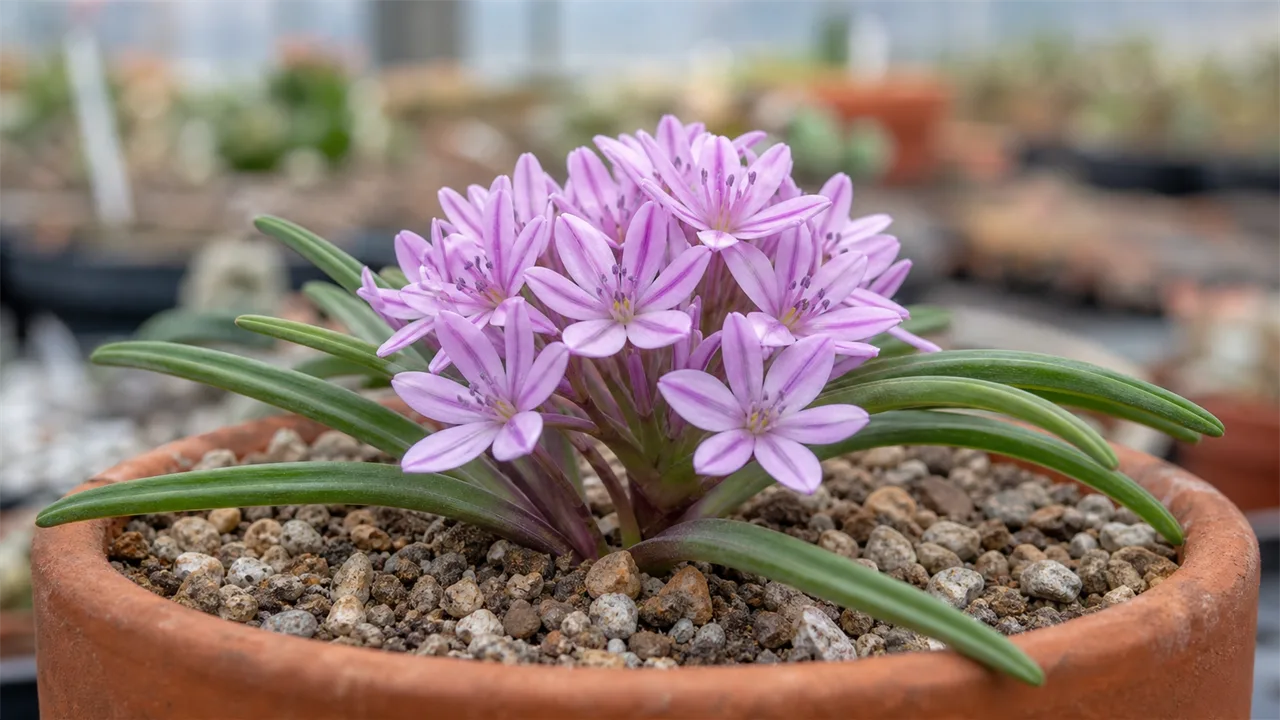
Flowering stems are usually 8–15 cm tall, though strong plants in cultivation can approach 20 cm. Their short stature allows the flowers to sit just above the leaves. Each stem normally bears one flower composed of six tepals. The bloom is initially cupped, opening more broadly in warm sunshine to produce a star-like outline. It may close partially in dull or cool weather, a useful adaptation that protects the reproductive parts.
Flower colour varies naturally from pale rose-pink through lilac-mauve to stronger pink. Darker colouring or a basal blotch may be visible near the base of the tepals, while dark anthers provide contrast at the centre. Variation between seed-raised plants should be expected because this is a species population, not a uniform named bedding cultivar.
In a sunny British garden, the principal display falls in April and May. The exact timing depends on region, altitude, aspect and the course of spring weather. Plants in warm southern or sheltered urban sites may open ahead of those in exposed northern gardens. After flowering, a seed capsule can develop if blooms are pollinated and not deadheaded. The flat seeds mature as the foliage declines.
The dying foliage is part of the bulb's normal annual cycle, not a sign of neglect. It should be allowed to turn yellow and detach naturally. Interplanting with restrained alpines can soften this brief untidy stage, but vigorous ground-cover plants should be avoided because they can shade the leaves and compete for moisture during active growth.
Growing Conditions
Full sun produces compact growth, good flower colour and the dry summer conditions that Tulipa aucheriana prefers. A lightly dappled position may be tolerated, particularly where deciduous branches admit spring light, but persistent shade tends to weaken flowering. Avoid low spots where cold rain collects or where melting snow and winter runoff remain around the bulbs.
Drainage is the decisive soil requirement. A gritty loam with relatively low fertility closely matches the plant's natural setting. Neutral to slightly alkaline conditions are suitable, but soil reaction matters less than an open structure that drains rapidly. On heavy clay, improve a whole raised area with coarse mineral material rather than placing each bulb in a small grit-filled pocket. A pocket surrounded by impermeable clay can behave like a sump and hold water around the bulb.
Raised beds and rock gardens are particularly effective because excess water can escape laterally as well as downwards. In an alpine trough, use a free-draining compost containing loam and coarse grit, and ensure drainage holes remain clear. A surface mulch of horticultural grit keeps the bulb neck relatively dry, reduces splash onto foliage and makes emerging shoots easier to see. Containers should stand where prolonged winter rain cannot saturate the compost, but should not be moved into warm indoor conditions.
Water is required while roots, leaves and flowers are developing, yet the soil should never remain sodden. Outdoor plants often receive sufficient rain between autumn planting and spring flowering. Water troughs and pots when the upper compost begins to dry during active growth. Reduce watering as leaves yellow, then keep bulbs substantially drier through summer dormancy. Do not place the planting beneath moisture-loving summer plants that require frequent irrigation.
The species is suitable for much of the UK when grown in an appropriate microclimate. In wet western districts, a raised bed, rain-shadow position or trough may be safer than open ground. In colder and drier districts, winter cold is less concerning than freeze-thaw cycles in waterlogged compost. A south- or east-facing position often provides useful spring warmth, while shelter limits wind damage to the short flowering stems.
Good companions include other small species tulips, dwarf narcissi, compact saxifrages and low, non-invasive thymes. Their requirements broadly overlap, but sufficient open ground should remain around each tulip so that its foliage receives light. Avoid rich perennial borders, dense lawns and sites beneath thirsty evergreen shrubs.
Planting and Care
Plant dormant bulbs from September to November, before the ground becomes persistently cold and wet. Set them about 8–10 cm deep, measured from the soil surface to the bulb base, and 5–8 cm apart. In containers, groups create a stronger display, but bulbs should not touch. Handle them carefully and discard any that are soft, mouldy or badly damaged. Wear gloves when handling tulip bulbs if skin is sensitive, and wash hands afterwards.
Water once after planting if the compost or soil is dry, then let seasonal rainfall maintain moisture. Emerging plants need even moisture in spring, especially in pots, but routine watering should always be judged against drainage. Water at soil level rather than repeatedly wetting the foliage. Once flowering ends and leaves begin to yellow, reduce irrigation so the bulbs enter dormancy in dry conditions.
Feeding should be restrained. Apply a modest dressing of balanced or high-potassium fertiliser when leaves emerge, following the product rate, and water it into container compost if necessary. Excess nitrogen encourages soft foliage at the expense of durable bulbs and can increase vulnerability to disease. Fresh manure and rich, moisture-retentive compost are unsuitable around the bulbs.
No pruning is required. Remove spent flowers if seed is not wanted, cutting only the flower head and retaining the stem and leaves. Leave all green foliage in place for at least six weeks after flowering, or until it has yellowed naturally. Tying leaves into knots, mowing them early or hiding them under thick mulch reduces photosynthesis and may prevent flowering in the following year.
Offsets provide the simplest means of propagation. Lift a congested group only after the foliage has died down in June or July, separate firm daughter bulbs, and replant them promptly or store them dry, cool and well ventilated until autumn. Small offsets may need more than one growing season to reach flowering size. Division every three or four years is useful where flower numbers decline through crowding, but thriving groups need not be disturbed on a fixed schedule.
Propagation from seed preserves natural variation and may produce useful numbers of plants, but it requires patience. Collect ripe seed before the capsule sheds it and sow it in a pot of gritty seed compost. Leave the pot outdoors in a sheltered place so seed receives natural seasonal temperature changes. Keep it labelled and prevent complete desiccation during germination, while avoiding saturation. Seedlings should be allowed to complete each growth cycle without disturbance; flowering commonly takes several years, and exact timing varies with cultivation.
In summer, dormant bulbs can remain in sharply drained ground. Lift them only where soil becomes wet during dormancy, where rodents are troublesome or where offsets are being separated. Store lifted bulbs in a dry, airy place away from direct heat and inspect them periodically. Replant in autumn rather than keeping them out of the ground indefinitely.
Common Problems
Bulb rot is the most serious cultivation problem. Shoots may fail to appear, or foliage may yellow and collapse prematurely while the bulb becomes soft and discoloured. Poor drainage, damaged bulbs and prolonged wet conditions favour fungal and water-mould pathogens. Remove affected material, improve drainage across the planting area and avoid replacing healthy bulbs immediately in badly contaminated soil.
Tulip fire, caused by Botrytis tulipae, produces distorted shoots, scorched-looking patches and spots on leaves or flowers, especially during cool, damp springs. Remove badly affected plants and bulbs, clear fallen debris and do not compost diseased material. Improve spacing and air circulation, avoid splashing water over leaves, and rotate tulips away from an affected site where practical.
Aphids may cluster on tender emerging growth. Their feeding distorts leaves, and they can spread tulip viruses. Small colonies can be removed by hand or with a gentle water jet where drainage permits. Plants showing persistent streaking, mottling or abnormal colour-breaking should be removed rather than propagated, because viral infection is not curable and offsets can carry it forward.
Grey squirrels, mice and voles may excavate or eat bulbs. Firm soil after planting, remove obvious bulb debris from the surface and use a buried wire basket or secured mesh over containers in gardens with repeated damage. The barrier must allow shoots to emerge and should not trap them as they grow. Rabbits or deer may browse foliage and flowers where pressure is high, so temporary mesh protection may be needed.
Failure to flower is usually cultural rather than pathological. Common causes include insufficient sun, foliage removed too early, overcrowding, rich nitrogenous feeding, immature offsets and bulbs sitting wet during dormancy. Review the full annual cycle before lifting plants. A bulb that produced healthy foliage should be allowed another season after light levels, feeding and summer dryness have been corrected.
Container bulbs can also suffer from vine weevil larvae, which feed below the compost surface, although this is less frequent than wet-related loss. Check declining pots for cream-coloured, brown-headed grubs and replace infested compost. Slugs and snails may graze emerging leaves but are rarely the main cause of disappearance; inspect at night and use integrated controls appropriate to the garden.
Popular Varieties
Tulipa aucheriana is principally grown as a botanical species, and reliably documented named cultivars are not generally available in UK horticulture. Plants sold under the species name may show genuine variation in flower shade, stature and basal markings, particularly when raised from seed. Such variation should not be presented as named cultivars unless a supplier provides a traceable cultivar identity.
For gardeners seeking a broader collection of small botanical tulips, several distinct species offer complementary colours and flowering forms. Tulipa tarda forms low clusters of white, yellow-centred starry flowers and is useful in sunny gravel. Tulipa turkestanica carries several small cream flowers on branching stems. Tulipa clusiana has slender red-and-white flowers and a more upright habit, while Tulipa humilis offers compact magenta to purple forms. These are alternatives or companions, not varieties of T. aucheriana, and labels should preserve the correct species names.
Buying bulbs from a specialist alpine or bulb nursery is preferable where accurate identity matters. Check that bulbs are firm and dry and that the supplier distinguishes the species from similarly coloured dwarf tulips. In a collection, label seed batches separately from parent plants because seedlings cannot be assumed to reproduce an individual flower colour exactly.
Pests and Diseases
| Problem | Symptoms | Management |
|---|---|---|
| Bulb rot | Bulbs become soft, mushy, and may emit a foul odour due to waterlogged soil. | Ensure sharp drainage by planting in gritty compost or well-drained gravel beds. |
| Slugs and snails | Irregular holes chewed into emerging leaves, flower buds, and young shoots. | Use slug pellets, beer traps, or copper tape barriers around planting areas. |
| Vine weevil | Notched edges on foliage above ground and larvae feeding on roots underground. | Apply nematodes to the soil in autumn or use systemic insecticides as a preventative measure. |
| Tulip fire | Yellow streaks on leaves that turn brown, and flowers may become distorted or fail to open. | Remove and destroy infected bulbs immediately; avoid reusing contaminated soil. |
| Squirrel damage | Bulbs are dug up from the soil and eaten, leaving empty holes in the garden. | Plant bulbs in wire mesh baskets or use netting to protect them during autumn planting. |
For step-by-step help, read Dealing with Slugs and Snails. Or browse the full plant problem solver to diagnose an issue by symptom.
Recommended Products
GardenWizz earns a commission from qualifying purchases made through affiliate links on this page (including links within the article) — as an Amazon Associate, and from Thompson & Morgan via the Awin network. This does not affect the price you pay. See our disclaimer for details.