Wall Speedwell
Veronica albicans
The Gardening Year
Best months in UK gardens · full planting calendar →
🖨 Printable care card (PDF)At a Glance
| Botanical name | Veronica albicans |
|---|---|
| Common name(s) | Wall Speedwell |
| Family | Plantaginaceae |
| Plant type | shrub |
| Height × Spread | 10–60 cm × 50–90 cm |
| Position | Full sun, Partial shade |
| Soil | well-drained soil; poor to moderately fertile; chalk, clay, loam, sand; moist but well-drained or well-drained; alkaline or neutral pH |
| Flowering | June |
| Toxicity | — |
| Native range | New Zealand |
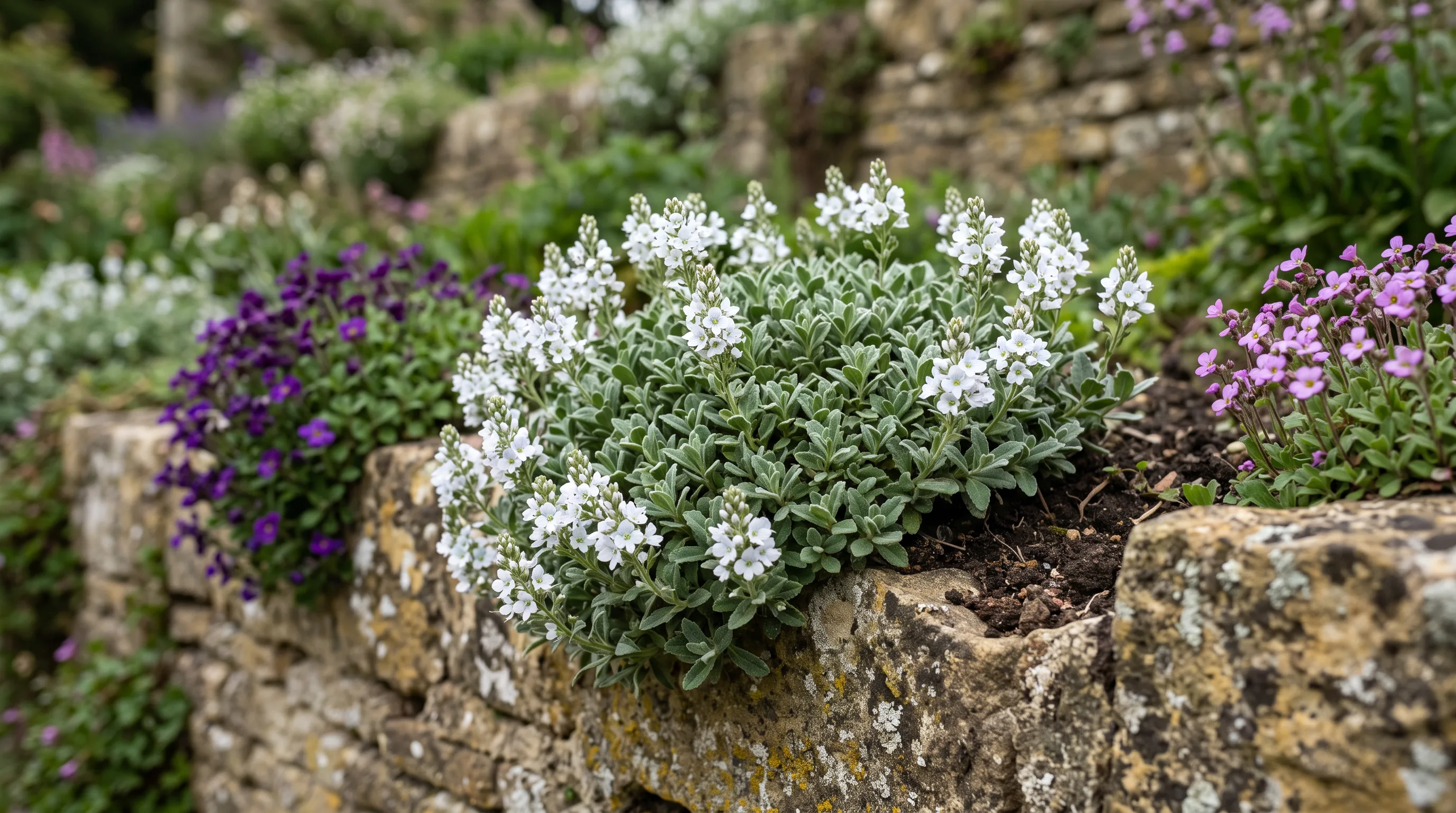
Veronica albicans, still widely sold under its former name Hebe albicans, is a compact evergreen shrub from New Zealand. Its dense mound of silvery grey-green foliage and short white flower spikes suit sunny rock gardens, gravel planting, raised beds and containers, provided the roots are protected from persistent winter wet.
Overview
Veronica albicans is a low, spreading member of the plantain family, Plantaginaceae. The accepted botanical name reflects the modern placement of the New Zealand hebes within Veronica, although the synonym Hebe albicans remains common in British nurseries, plant catalogues and older reference books. It should not be confused with herbaceous speedwells: this species keeps a woody framework and evergreen leaves throughout the year.
The species is native to the north-west of New Zealand's South Island, where it occurs in open, rocky places. That origin helps explain both its preference for light and drainage and its dislike of cold, saturated ground. In a British garden it is most dependable in a sunny, sheltered position with freely draining soil. Coastal and mild southern or western districts often provide favourable conditions, while colder, wetter gardens require more careful siting.
Its main ornamental feature is the neat, pale foliage, which creates a useful contrast with dark leaves, purple flowers and weathered stone. White flowers add summer interest and attract visiting pollinating insects. The compact habit makes the shrub suitable for the front of a border, a rock or gravel garden, a raised bed, low informal edging or a large alpine trough. It also grows well in a pot that can be moved away from the wettest or most exposed winter conditions.
Appearance
The shrub develops numerous short, closely branched stems, producing a rounded to spreading outline. Mature height is usually between 30 and 60 cm, with the spread often equalling or exceeding the height. Older specimens in exceptionally favourable sites can become wider, but Veronica albicans remains modest compared with many larger shrubby veronicas.
Leaves are arranged in opposite pairs along the stems. They are small, oval to narrowly oblong, smooth and often slightly waxy, with a glaucous grey-green or silvery surface. Their pale colour is suggested by the specific name albicans, meaning whitish or becoming white. The foliage is evergreen, giving structure through winter, although exposure to harsh wind or prolonged cold may cause bronzing, browning or tip damage.
Short, unbranched flower clusters rise just above the foliage in summer. The small individual flowers are usually white, sometimes opening from faintly tinted buds; named selections may show pale lilac colouring that fades towards white. Flowering commonly falls between June and August in the UK, but timing varies with locality, weather and clone. The restrained flower spikes complement rather than hide the foliage.
Growing Conditions
Full sun produces the densest growth, clearest silver foliage and best flowering. Light partial shade is acceptable, particularly where midday sun is intense, but deep shade encourages a looser habit and reduces bloom. A south- or west-facing site is useful in much of the UK. In an exposed garden, place the shrub near a wall, bank or larger open-branched plant that reduces drying wind without casting heavy shade.
Drainage is the central requirement. Sandy or gritty loam, gravelly soil and chalk are suitable when water passes through readily. Neutral to alkaline soil is generally well tolerated; mildly acidic soil can also be used if its structure is open. Heavy clay should be improved over a broad area rather than by filling a small planting hole with grit, which can create a sump. A raised bed or container is often the safer solution where clay remains wet in winter.
The soil should not be permanently dry. Newly planted shrubs need even moisture while their roots establish, and mature plants benefit from watering during prolonged summer drought. The aim is moist but well-drained ground during active growth, followed by conditions that do not remain saturated in the colder months. Good air movement helps the leaves dry after rain and reduces the risk of spotting.
UK suitability depends as much on winter moisture and exposure as on region. A sheltered gravel garden in a colder district may be more successful than a waterlogged border in a mild one. In high-rainfall areas, slope the soil surface away from the crown and keep mulch from the lower stems.
For pots, use a container with generous drainage holes and a peat-free loam-based compost opened with horticultural grit. Raise the pot on feet so water can escape. A broad, stable container suits the spreading habit and is less likely to blow over. Do not leave a saucer full of water beneath the pot during autumn or winter.
Planting and Care
Plant in April or May after severe weather has eased, or in September where autumns are mild and the soil drains quickly. Spring is safer in cold or wet districts because roots have a full growing season to establish. Water the plant in its nursery pot, tease out tightly circling roots and set the root ball at the same depth as before. Firm gently, water thoroughly and leave the crown uncovered.
Water regularly through the first growing season whenever the upper soil begins to dry. Once established, plants in open ground usually need additional water only through extended dry spells. Pots require closer attention from spring to early autumn because their compost dries rapidly, especially in wind. Water deeply, then allow surplus water to drain; repeated light sprinkling encourages shallow rooting.
Feeding should be restrained. In ordinary garden soil, a modest application of balanced fertiliser in April is sufficient, and very poor soil may benefit from a thin spring mulch of well-rotted organic matter kept away from the stems. Rich feeding produces soft, open shoots that are more vulnerable to weather and may spoil the compact outline. Container plants can receive a low-strength balanced liquid feed during active growth, stopping by late summer.
Prune lightly after flowering, normally in August, removing spent flower spikes and shortening vigorous new shoots just enough to restore an even mound. Cut back to leafy growth and avoid hard pruning into old, bare wood, from which regrowth may be slow or absent. In April, remove only clearly dead, broken or weather-damaged tips. Sterilise secateurs if disease is suspected and never shear plants while the foliage is wet.
Propagation is most reliable from semi-ripe cuttings taken from healthy, non-flowering shoots between July and September. Remove the soft tip, trim each cutting below a node, strip the lower leaves and insert it around the edge of a pot of moist, free-draining propagation compost. Keep the pot in bright indirect light under a ventilated cover until roots form. Seed can be used for the species, but seedlings vary and named cultivars must be propagated vegetatively to retain their characteristics.
Seasonal care centres on drainage and shelter. Check pots and drainage channels before autumn rain, reduce watering as growth slows and remove fallen leaves trapped within the mound. Do not wrap the plant in impermeable plastic. Where protection is needed, move a container to a bright, sheltered position or use a breathable windbreak. In spring, wait until new growth is visible before deciding whether browned shoots are dead.
Common Problems
Root and stem decay are the most serious risks. Affected plants may wilt despite wet soil, lose colour or develop darkened tissue at the base. There is no useful pruning cure for extensively rotted roots. Improve drainage, reduce irrigation and remove severely affected plants and contaminated compost. Prevention through correct siting is much more effective than treatment.
Leaf spots and shoot dieback are encouraged by damp foliage, overcrowding and poor air circulation. Remove badly marked leaves and dead tips, clear debris from beneath the shrub and water the soil rather than the foliage. Space nearby plants to improve ventilation. A few cosmetic spots late in the season do not necessarily threaten the plant, but rapid spread or blackening stems warrants prompt action.
Aphids may gather on tender shoot tips and flower stems, causing curled growth and sticky honeydew. Small colonies can be rubbed off or washed away with water while protecting beneficial insects. Scale insects appear as fixed brown or pale bumps on stems and leaf undersides; check sheltered inner branches and remove light infestations by hand. Healthy plants are seldom seriously damaged by either pest.
Popular Varieties
Named forms are often still catalogued under Hebe albicans, and their modern botanical placement is not always presented consistently by nurseries. The following selections are documented in cultivation, but availability in the UK varies:
- 'Aoira' is the historical name proposed for an early cultivated clone associated with the Aorere locality. It represents the familiar low, grey-leaved, white-flowered form long grown in gardens.
- 'Sussex Carpet' is a prostrate garden selection, formerly circulated as 'Prostrate Form'. It makes a particularly low, spreading mat with white summer flowers and is useful at the front of a rock garden.
- 'Snow Cover' is another low-growing, white-flowered selection described as similar to 'Sussex Carpet'. It may be difficult to obtain and should be bought from a specialist nursery with accurate labelling.
- 'Pewter Dome' is associated in cultivation with V. albicans and is valued for a compact dome of pewter-grey foliage. Taxonomic naming in the nursery trade should be checked when purchasing.
- 'Red Edge' is commonly sold as Hebe albicans 'Red Edge' and has blue-grey leaves with red margins, especially conspicuous in cool weather, plus pale lilac flowers fading to white. It is also treated as a probable hybrid rather than a pure selection of the species, so the unqualified cultivar name Hebe 'Red Edge' is the most cautious label.
Where a true species plant is wanted, check both current and former botanical names on nursery lists and ask whether the stock is seed-raised or clonal. The plain species remains worthwhile for its restrained silver foliage and white flowers even when named selections are unavailable.
Pests and Diseases
| Problem | Symptoms | Management |
|---|---|---|
| Downy mildew | Purple-red blotches on upper leaf surfaces with white spore production underneath. | Ensure good air circulation, water at the base in the morning, and remove infected debris. |
| Leaf spot fungi | Distinct spots on leaves causing yellowing and premature leaf drop. | Improve airflow, avoid wetting foliage, and clear fallen leaves to reduce reinfection. |
| Powdery mildew | White powdery fungal growth on leaves and shoots, often in humid conditions. | Plant in sunny positions with good ventilation and avoid overcrowding. |
| Grey mould | Soft, grey fuzzy rot affecting flowers, buds, or stems in damp weather. | Remove affected parts promptly and ensure plants are not waterlogged. |
| Slugs and snails | Irregular holes chewed in leaves and silky trails on foliage or soil. | Use physical barriers, hand-pick at night, or apply iron phosphate pellets. |
For step-by-step help, read Dealing with Slugs and Snails and Treating Powdery Mildew. Or browse the full plant problem solver to diagnose an issue by symptom.
Recommended Products
GardenWizz earns a commission from qualifying purchases made through affiliate links on this page (including links within the article) — as an Amazon Associate, and from Thompson & Morgan via the Awin network. This does not affect the price you pay. See our disclaimer for details.