Large Speedwell
Veronica austriaca
The Gardening Year
Best months in UK gardens · full planting calendar →
🖨 Printable care card (PDF)At a Glance
| Botanical name | Veronica austriaca |
|---|---|
| Common name(s) | Large Speedwell |
| Family | Plantaginaceae |
| Plant type | perennial |
| Height × Spread | 90 cm × 60 cm |
| Position | Full sun, Partial shade |
| Soil | loamy, moderately fertile, moist but well-drained; tolerates chalk, clay, loam, sand; pH acid, alkaline or neutral |
| Flowering | June–September |
| Toxicity | — |
| Native range | northern temperate Europe |
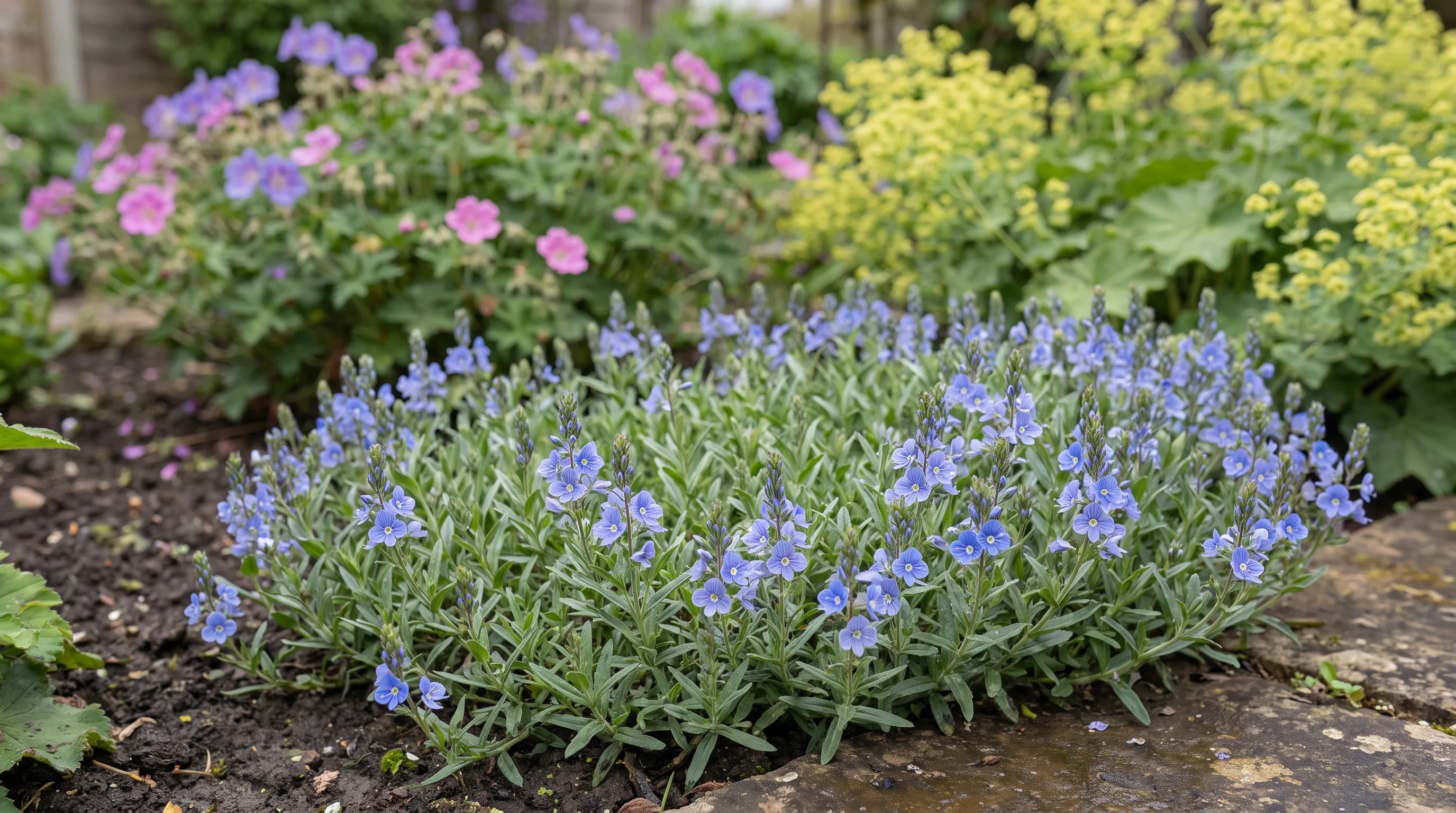
Veronica austriaca is a compact, clump-forming speedwell valued for its clear blue flowers and finely toothed foliage. Native to parts of continental Europe and western Asia, it suits sunny UK borders, gravel gardens and wildlife-friendly planting, where its late-spring and early-summer flowers provide colour without demanding intensive care.
Overview
Veronica austriaca belongs to the plantain family, Plantaginaceae, although older books may place it in Scrophulariaceae. It is a herbaceous perennial that makes a low mound of leafy stems and spreads slowly through short rhizomes. Its manageable habit and strong flower colour make it useful at the front of a mixed border, beside a path, in a rock garden or among drought-tolerant plants in gravel.
The species occurs naturally across central and eastern Europe, through the Caucasus and into western Asia. It is not native to Britain, although it has occasionally become naturalised in dry grassy places. In gardens it is best regarded as a sun-loving continental perennial adapted to open ground and free drainage. Once established, it tolerates short dry periods better than persistent winter wet.
Naming can cause confusion. Plants sold in Britain as Veronica austriaca are often V. austriaca subsp. teucrium, also encountered under the older name Veronica teucrium. This group is generally taller and more vigorous than the smaller typical species. Labels should therefore be checked when mature height matters, especially in a rock garden or at the very front of a border. Older botanical references may also use names such as Veronica dentata or V. multifida for related or previously separated material.
The flowers are accessible to bees, hoverflies and small butterflies, making this speedwell a useful component of a pollinator border. Its upright flowering stems also associate effectively with the rounded foliage of lady’s mantle, hardy geraniums and geums, or with salvias and fine ornamental grasses. Cut stems can be used in loose, cottage-style arrangements, although the plant is primarily grown as a garden perennial.
Appearance
The plant develops a neat, spreading clump of erect to slightly ascending stems. Typical forms stand around 20–40 cm high, while plants belonging to the subsp. teucrium group may reach 45–60 cm. The stems often branch towards their tips and may carry a covering of fine hairs. Short creeping rhizomes enlarge the clump gradually, but the plant is not normally invasive in a UK garden.
Leaves are arranged in opposite pairs. They are usually sessile or carried on very short stalks, with oblong to lance-shaped blades about 2–4 cm long. Their margins are irregularly and deeply toothed, sometimes approaching narrow lobes. This distinctive, saw-like outline explains the common name saw-leaved speedwell and the older epithet “dentata”. The foliage is mid-green and may feel slightly hairy.
From May to July, racemes emerge from the upper leaf axils and create a loose, spike-like display. Individual flowers are approximately 8–12 mm across, with four lobes: three relatively broad upper and side lobes and a narrower lower one. Their usual colour is bright to deep gentian blue, enhanced by darker veins radiating across the petals. Paler blue and occasionally pinkish forms occur, but blue is characteristic of garden plants.
After pollination, each flower can form a small, flattened, heart-shaped capsule. Removing fading flower stems prevents this stage from distracting from the clump and may encourage a modest second display. Where seed is wanted for propagation, selected stems can instead be left until the capsules mature and dry.
Growing Conditions
Full sun produces the strongest stems, densest growth and most generous flowering. The plant can tolerate very light dappled shade, particularly where summers are dry, but increasing shade tends to make its stems lean or flop and reduces the number of flowers. An open position is suitable, as the plant copes with ordinary wind exposure provided its roots are established.
Drainage is the central soil requirement. A moderately fertile loam with a neutral to slightly alkaline reaction is ideal, but the species adapts to a wider range of soils, approximately pH 6.0–8.0. Chalky, stony and relatively poor ground can all be suitable if plants do not dry out severely during establishment. Heavy clay should be improved over a broad area with grit and organic matter, or the plant should be placed in a raised bed where surplus winter water can escape.
Established clumps are reasonably drought tolerant, but this does not mean they should be planted and neglected during their first season. Watering while roots spread encourages resilient growth. Later, occasional deep watering during prolonged dry spells is preferable to frequent light sprinkling. Constantly wet ground, particularly during winter dormancy, can damage the crown and roots.
In the UK, plant in March or April as growth begins, or in September while the soil remains warm. Spring planting is generally preferable on cold, heavy ground; early autumn planting works well in free-draining southern or sheltered gardens. Avoid planting during frozen conditions or at the height of a hot, dry spell. Its natural-looking blue display suits cottage borders, wildlife gardens, sunny banks and gravel schemes, while compact true-species material can be accommodated in larger rock gardens.
Planting and Care
Prepare a hole as deep as the root ball and somewhat wider, loosening compacted soil around it rather than creating a pocket filled solely with rich compost. Set the crown level with the surrounding surface, firm gently and water thoroughly. Space plants 30–40 cm apart so that air can circulate between mature clumps. In heavy soil, planting slightly proud of the surface can help prevent water settling around the crown.
Keep newly planted specimens evenly moist through their first growing season, checking them during dry weather rather than watering to a rigid schedule. Once established, water deeply only when the soil has become dry for an extended period. Direct water towards the base and avoid repeatedly wetting the leaves, especially in humid weather. A thin spring mulch of well-rotted compost helps retain moisture, but it should not be heaped against the crown.
Feeding is rarely necessary in normal border soil. A light application of compost in spring is usually sufficient. Excessive fertiliser, especially a nitrogen-rich feed, encourages lush stems that are more likely to flop and may flower poorly. Plants in exceptionally lean container or gravel-garden soil can receive a modest balanced feed as growth resumes, but repeated feeding is unnecessary.
After the main flowers fade in July, cut the whole plant back by roughly one third. This removes untidy stems, encourages compact fresh foliage and can produce a lighter second flush. Remove remaining spent stems at ground level in late autumn after they decline, or leave them briefly for structure and cut them back before new shoots extend in early spring. Although this treatment is sometimes loosely called pruning, it is the seasonal cutback appropriate to a herbaceous perennial. Staking is not usually required in full sun, but taller forms grown in rich or partly shaded ground may benefit from discreet support placed early.
Divide mature clumps every three or four years to maintain vigour. Lift them in March or April, or in September on well-drained soil, separate healthy outer sections with roots and shoots attached, discard any weak woody centre, and replant promptly. Water divisions until they resume growth. Soft basal shoots can also be taken as cuttings in late spring and rooted in a free-draining medium.
The species may be raised from seed, although named cultivars do not reliably come true. Sow ripe or stored seed in trays and maintain gentle moisture without waterlogging; germination can be variable. Division or cuttings are better where an exact named plant must be retained. In autumn, remove diseased debris, check that mulch has not covered the crown and ensure nearby plants are not restricting air movement.
Common Problems
Veronica austriaca is generally dependable, and most failures arise from position or cultivation rather than serious pest pressure. Flopping is common where plants receive too little sun or too much fertiliser. It can also follow severe drought and sudden rain, which encourages weakened stems to bend under the weight of new growth. Improve light, avoid rich feeding, water during extended drought and carry out the post-flowering cutback. Divide congested clumps if their centres have become sparse.
Poor flowering usually indicates shade, an overgrown clump or excessive nitrogen. Nearby shrubs and perennials may gradually reduce the light reaching a previously successful plant. Move or divide it in spring and select an open site. A lack of flowers in the first season after planting is less concerning, as the plant may be directing energy into root establishment.
Yellow lower leaves in midsummer commonly reflect drought stress. Check the soil below the surface and water slowly and deeply if it is dry. Similar symptoms in persistently wet soil require the opposite response: improve drainage and reduce irrigation. Crown rot is uncommon but can occur where the plant remains waterlogged through winter. A soft or collapsing crown is unlikely to recover; remove affected tissue and correct the site before replanting.
Powdery mildew may create a white coating on foliage during dry summers, particularly where plants are crowded and roots are short of moisture. Thin surrounding growth, water at soil level and remove badly affected leaves. Fungal leaf spots are more likely in damp seasons and cause dark lesions or early leaf loss. Clear affected foliage, avoid overhead watering and allow space between clumps. Downy mildew can affect some speedwells but is not a routine problem on this species.
Slugs and snails sometimes nibble emerging shoots in spring. Damage is usually minor once stems harden, but young divisions may need protection. Reduce hiding places close to the crown, inspect after rain and use an appropriate garden control method if repeated feeding threatens new growth.
Popular Varieties
Cultivar naming within Veronica austriaca and the closely related subsp. teucrium group is not always consistent in nursery catalogues. Buyers should compare the complete botanical name, expected height and photographs rather than relying on “Austrian speedwell” alone. Availability also varies, and no award status should be inferred from a plant being widely sold.
- ‘Royal Blue’ is a recognised selection in the V. austriaca subsp. teucrium group, grown for its vivid deep-blue flowers. It has the stronger, taller character associated with that subspecies and is suited to the front or middle of a sunny herbaceous border.
- ‘Crater Lake Blue’ is another established blue-flowered selection associated with V. austriaca subsp. teucrium. Its saturated colour works well with yellow-green lady’s mantle, orange geums and silver foliage. Allow enough space and sunlight to preserve an upright habit.
- ‘Shirley Blue’ is listed as a named blue selection of this group. As descriptions and botanical labelling can differ between suppliers, its mature dimensions should be confirmed from the nursery before it is used in a tightly planned scheme.
The unselected species remains worthwhile where a lower, more naturalistic plant is required. Seed-raised plants may show modest variation and should not be expected to reproduce a named cultivar exactly. For reliable colour, stature and habit, purchase vegetatively propagated stock from a reputable nursery, retain its label and increase it later by division or basal cuttings.
Pests and Diseases
| Problem | Symptoms | Management |
|---|---|---|
| Aphids | Clusters of small soft-bodied insects on new growth causing distorted leaves and sticky honeydew. | Squash by hand or spray with a horticultural oil-based insecticide if infestations are severe. |
| Powdery mildew | White powdery fungal growth on leaves and stems, often in humid conditions with poor air circulation. | Improve air circulation and water at the base; apply a fungicide if necessary. |
| Downy mildew | Yellowing patches on upper leaf surfaces with fuzzy grey-purple growth underneath in damp weather. | Remove affected foliage and avoid overhead watering to keep leaves dry. |
| Fungal leaf spot | Distinct dark or brown spots appearing on leaves, potentially leading to premature leaf drop. | Clear fallen debris in autumn and ensure good air circulation around the plant. |
| Root rot (Phytophthora) | General decline, wilting, or yellowing despite adequate moisture due to waterlogged soil. | Ensure well-drained soil and avoid overwatering; remove severely affected plants. |
For step-by-step help, read Controlling Aphids Naturally and Treating Powdery Mildew. Or browse the full plant problem solver to diagnose an issue by symptom.
Recommended Products
GardenWizz earns a commission from qualifying purchases made through affiliate links on this page (including links within the article) — as an Amazon Associate, and from Thompson & Morgan via the Awin network. This does not affect the price you pay. See our disclaimer for details.