Chicory
Cichorium intybus
The Gardening Year
Best months in UK gardens · full planting calendar →
🖨 Printable care card (PDF)At a Glance
| Botanical name | Cichorium intybus |
|---|---|
| Common name(s) | Chicory |
| Family | Asteraceae |
| Plant type | perennial |
| Height × Spread | 1–2 m × 50–100 cm |
| Position | Full sun, Partial shade |
| Soil | fertile, well-drained soil; Chalk, Loam, Sand; Acid, Alkaline, Neutral pH |
| Flowering | July–September |
| Toxicity | Not known to be toxic to humans or domestic animals. |
| Native range | Europe, North Africa, and western Asia |
Overview
Chicory (Cichorium intybus) is a hardy perennial of the daisy family (Asteraceae), native to Europe, western Asia and North Africa and long naturalised across much of the British Isles. The following quick-care table summarises the essentials for UK growers; the full article below covers each in detail.
Chicory has been part of the British horticultural and medicinal repertoire since at least the sixteenth century. The same species gives the kitchen garden the bitter salad leaves sold as "chicory", the forced winter spears known as chicons or witloof, the broad-leaved forcing roots once widely grown in Belgium and northern France, and the roasted root used as a coffee substitute. It is also valued as an ornamental and wildlife plant: the brilliant sky-blue flowers are exceptionally attractive to bees, hoverflies and butterflies, and the species has become a familiar sight on roadsides, chalk downland and disturbed ground in southern and central England. Wild chicory is regarded as a useful indicator of free-draining, often chalky soil. In the garden it is undemanding, drought-tolerant and largely trouble-free, and a single sowing can provide leaves from early summer through to the first hard frosts.
Appearance
Cichorium intybus is a tap-rooted perennial that produces a low rosette of leaves in its first year and sends up tall, branching flowering stems in its second and subsequent seasons. The basal leaves are 15 to 30 cm long, oblong to lance-shaped, deeply lobed in a manner reminiscent of a large dandelion, with toothed, slightly wavy margins; they are a soft, slightly grey-green and rough to the touch. The stem leaves are smaller, alternate, and clasp the stem with small, rounded auricles. The stems themselves are erect, grooved and hollow, branching from the upper half, and rough-hairy in their upper portions; they commonly reach 90 to 120 cm in average garden soil and can hit 150 cm in richer ground or after a mild winter.
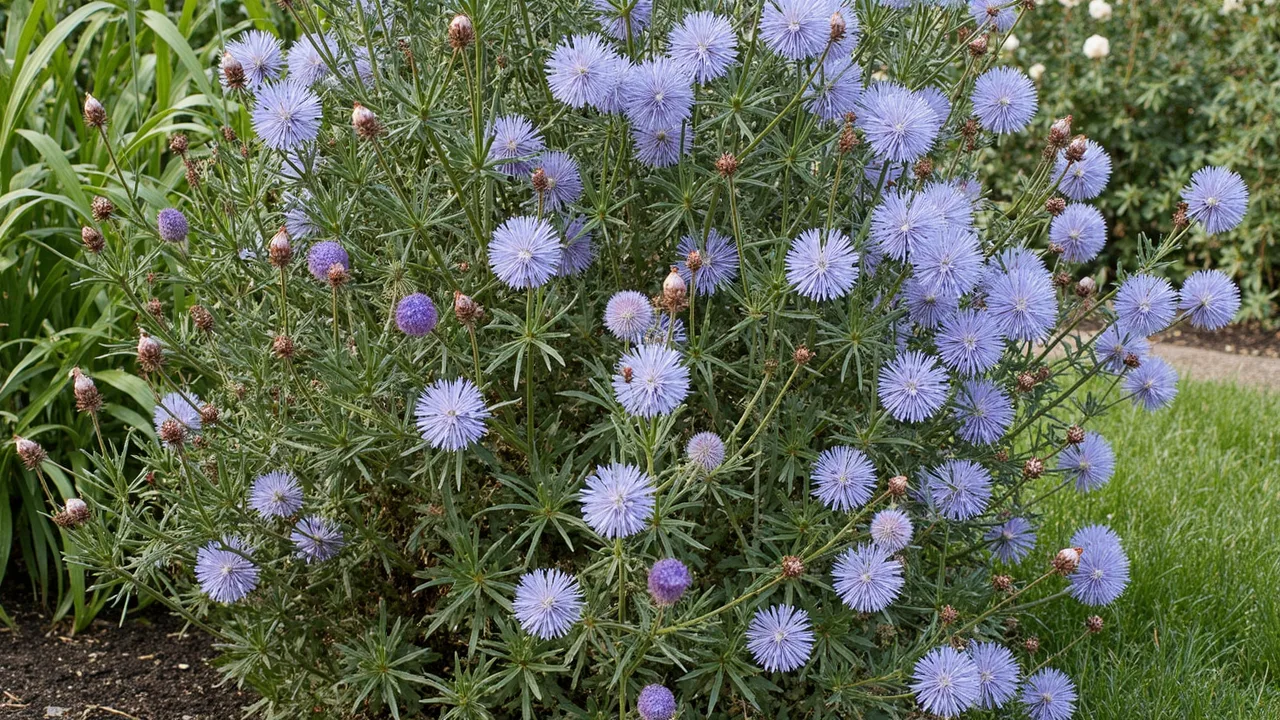
The flowers are the plant's most distinctive feature. Each head is a composite of ray florets only, 2 to 4 cm across, of a vivid sky-blue to lavender-blue that is unusual among British garden plants. There are no disc florets: when the flower is open, it is a flat, ragged-edged star. The flowers open in the morning sun and close again by early afternoon, a habit that gives the species one of its older English names, "blue sailors". Each head lasts only a single day, but the branching stems carry them in such profusion from June through October that the display is continuous for months. The buds, the backs of the rays and the upper stems are often flushed with a paler, almost silvery blue, and the flowers occasionally throw white or pale-pink forms from seed. After flowering, the plant sets small, angular seeds with a tiny pappus; these shed readily and germinate freely in bare soil around the parent.
Below ground, chicory develops a long, thick taproot that can reach 30 to 60 cm in a single season and considerably more in older plants. The root is pale on the outside with a cream-coloured, milky interior that bleeds a bitter latex when cut. This root is the part used for forcing and for the roasted coffee substitute.
Growing Conditions
Chicory succeeds in any reasonably well-drained, sunny site and tolerates a wide range of soils, including the thin, chalky and lime-rich ground where many vegetables struggle. The lower end of its preferred pH range is around 5.5, but it is comfortable in neutral to markedly alkaline soil and is frequently found wild on chalk and limestone in southern England. The one soil condition it will not tolerate is waterlogging; roots left sitting in cold, wet ground through winter are prone to rot, and the crown can collapse in late winter. For this reason heavy clay is best improved with coarse grit and organic matter before sowing, or chicory should be grown on a slightly raised bed. Once established, the deep taproot makes the plant notably drought-tolerant, and it copes well with the dry conditions against warm south- and west-facing walls.
The species is fully hardy across the United Kingdom. Established plants survive winter temperatures well below -15 °C in well-drained soil, and young plants tolerate the milder frosts of lowland Britain without protection. In cold, exposed sites a light, free-draining mulch of coarse grit or straw is preferable to bark or compost, which can hold damp against the crown. Aspect matters more for flower quality than for survival: in full sun the rosette stays compact and the stems branch freely, while in light shade flowering is reduced and the stems tend to lean. Chicory will grow in dappled shade but produces its best display and its best roots in open ground.
Planting and Care
Sow chicory where it is to grow, as the taproot resents disturbance. Direct sow from March to July in drills 1 to 1.5 cm deep, in soil that has been raked to a fine tilth. Thin seedlings to 15 to 20 cm apart for leaf production, or 25 to 30 cm apart if large roots are wanted for forcing. A second sowing in late June or July gives leaves through autumn and roots large enough to lift from October onwards. For an early start, sow one or two seeds per module under cover in March or April and plant out once the soil has warmed.
Watering is seldom needed after germination. Young plants benefit from steady moisture in their first six to eight weeks to build a strong taproot; thereafter rainfall is normally sufficient, with supplementary watering only in prolonged drought on very free-draining ground. Feeding should be modest: a single light dressing of a general-purpose fertiliser at planting time, or a thin top-dressing of garden compost in early spring, is plenty. Over-rich soil produces lush, soft growth and more leaf than root, and may encourage earlier running to flower.
Harvesting depends on the use. Cut-and-come-again leaves can be taken from around 60 days after sowing, picking a few outer leaves from each plant while leaving the central crown intact. Mature heads can be cut whole at the base in late summer. Roots for forcing are lifted after the first sharp frost in October or November, trimmed of foliage to leave 2 to 5 cm of stump, and stored in damp sand in a cool shed. To force chicons, replant the roots close together in deep containers of moist compost and keep them in complete darkness at 10 to 13 °C for three to four weeks; the resulting tightly furled, blanched spears are the classic witloof of winter cookery. Seed for next year's crop is saved by leaving one or two plants uncut; the resulting stems will flower from June and seed ripens in late summer.
Propagation is almost always by seed. Division is not recommended, as the taproot does not split cleanly and replanted pieces usually fail. Self-sown seedlings are common around established plants and are easily transplanted while small; this is the most reliable way to maintain a local strain.
Common Problems
Chicory is generally a low-input crop but is not entirely free of problems. Powdery mildew is the most frequent complaint, producing a white, dusty coating on the leaves in warm, dry weather, particularly on crowded plants late in the season; improve airflow by thinning, water at the base rather than overhead, and remove badly affected leaves. Aphids, particularly the black bean aphid, cluster at shoot tips and on the undersides of leaves in early summer; a strong jet of water or insecticidal soap is usually sufficient. Leaf miners produce pale, meandering tunnels in the leaves and are best dealt with by removing and destroying affected foliage before the larvae complete their cycle. Slugs and snails can be troublesome on seedlings and on the soft young leaves of autumn sowings, and the usual organic controls apply.
Crown rot, caused by Sclerotinia and related fungi, can be a serious problem on heavy or persistently damp soils. Affected plants wilt suddenly, the crown turning soft and grey-white; they should be removed and destroyed, and the site should be kept out of chicory and other Asteraceae for at least three years. Rust can appear as orange-brown pustules on the undersides of leaves in damp seasons but rarely warrants treatment in a garden setting. The most common problem in a well-managed garden, however, is self-seeding: chicory seeds freely, the seedlings are vigorous, and a single neglected plant can produce hundreds of offspring in bare ground nearby. Deadheading spent flowers before they set seed, or cutting back flowering stems as the display fades, keeps the plant where you want it. The species is not considered toxic to humans or to domestic animals.
Popular Varieties
Chicory is grown in a number of distinct forms, and the choice of variety depends on whether the crop is wanted for leaves, for forced chicons or for roots. 'Witloof' (also sold as 'Belgian Endive') is the traditional forcing type, with a thick, pale taproot and a tight, blanched chicon; it is the standard variety for autumn lifting and winter forcing under cover. 'Zoom' is a widely available sugar-loaf type forming a self-blanching, romaine-like head of sweet, pale leaves for autumn harvest without forcing. 'Palla Rossa' types (often sold as 'Radicchio') form the familiar red-and-white hearts and are treated as annuals; 'Palla Rossa 3' is a reliable selection, as is 'Rossa di Treviso', with its longer, more upright leaves. For leaf production cut as cut-and-come-again, 'Italiko Rosso' and the green-leaved 'Catalogna' (sometimes called dandelion chicory) are vigorous, deeply cut, and productive over a long season. 'Magdeburg' is the classic large-rooted variety for coffee substitute, with a particularly thick, fleshy taproot. Growers should note that chicory readily cross-pollinates, so saved seed may not come true to type where more than one variety flowers in the same garden.
Pests and Diseases
| Problem | Symptoms | Management |
|---|---|---|
| Slugs and snails | Irregular holes chewed in leaves, particularly on young seedlings and tender shoots. | Use physical barriers like copper tape or beer traps, and hand-pick at night. |
| Powdery mildew | White, dusty fungal growth appears on the upper surfaces of leaves and stems. | Ensure good air circulation and spray with a fungicide or bicarbonate solution if severe. |
| Rust | Orange or brown pustules develop on the undersides of leaves, causing them to yellow. | Remove affected foliage immediately and avoid overhead watering to reduce humidity. |
| Bolting | Plants send up flower stalks prematurely, resulting in bitter, tough leaves. | Sow at the correct time to avoid cold spells or extreme heat stress. |
For step-by-step help, read Dealing with Slugs and Snails and Treating Powdery Mildew. Or browse the full plant problem solver to diagnose an issue by symptom.
Recommended Products
GardenWizz earns a commission from qualifying purchases made through affiliate links on this page (including links within the article) — as an Amazon Associate, and from Thompson & Morgan via the Awin network. This does not affect the price you pay. See our disclaimer for details.