Basil-Leaved Rockrose
Cistus candidus
The Gardening Year
Best months in UK gardens · full planting calendar →
🖨 Printable care card (PDF)At a Glance
| Botanical name | Cistus candidus |
|---|---|
| Common name(s) | Basil-leaved Rockrose |
| Family | Cistaceae |
| Plant type | shrub |
| Height × Spread | 0.5–2 m × — |
| Position | Full sun |
| Soil | poor, stony, very free-draining |
| Flowering | June–August |
| Toxicity | — |
| Native range | Mediterranean region, from Morocco, Spain, Italy, Greece, through to the Middle East, and also on the Canary Islands |
Overview
Cistus candidus is a compact evergreen rockrose valued for its silvery foliage and succession of white, golden-centred flowers. It is endemic to Gran Canaria, where it occupies dry, sunny volcanic slopes and cliffs. That origin makes it well suited to warmth, lean soil and summer drought, but poorly adapted to wet, cold British winters. Across most of the UK it is best grown in a container that can be moved under glass; permanent outdoor planting is chiefly realistic in exceptionally mild, sheltered coastal gardens.
A member of the Cistaceae, it belongs to a group of Mediterranean shrubs commonly called rockroses or sun roses. Although established rockroses are often drought tolerant, the name can conceal important differences between species: C. candidus needs more winter protection than rockroses commonly planted throughout Britain. Its strengths are heat tolerance, wind resistance and an ability to grow in relatively poor ground. Its central weakness is the combination of cold and moisture around the roots.
The botanical epithet refers to the plant's pale, whitish appearance. It should not be confused with other Cistus species that may be sold under broad rockrose labels. Plants should be obtained from a reputable specialist nursery and kept under their botanical name, especially when winter protection and eventual size are being planned.
Appearance
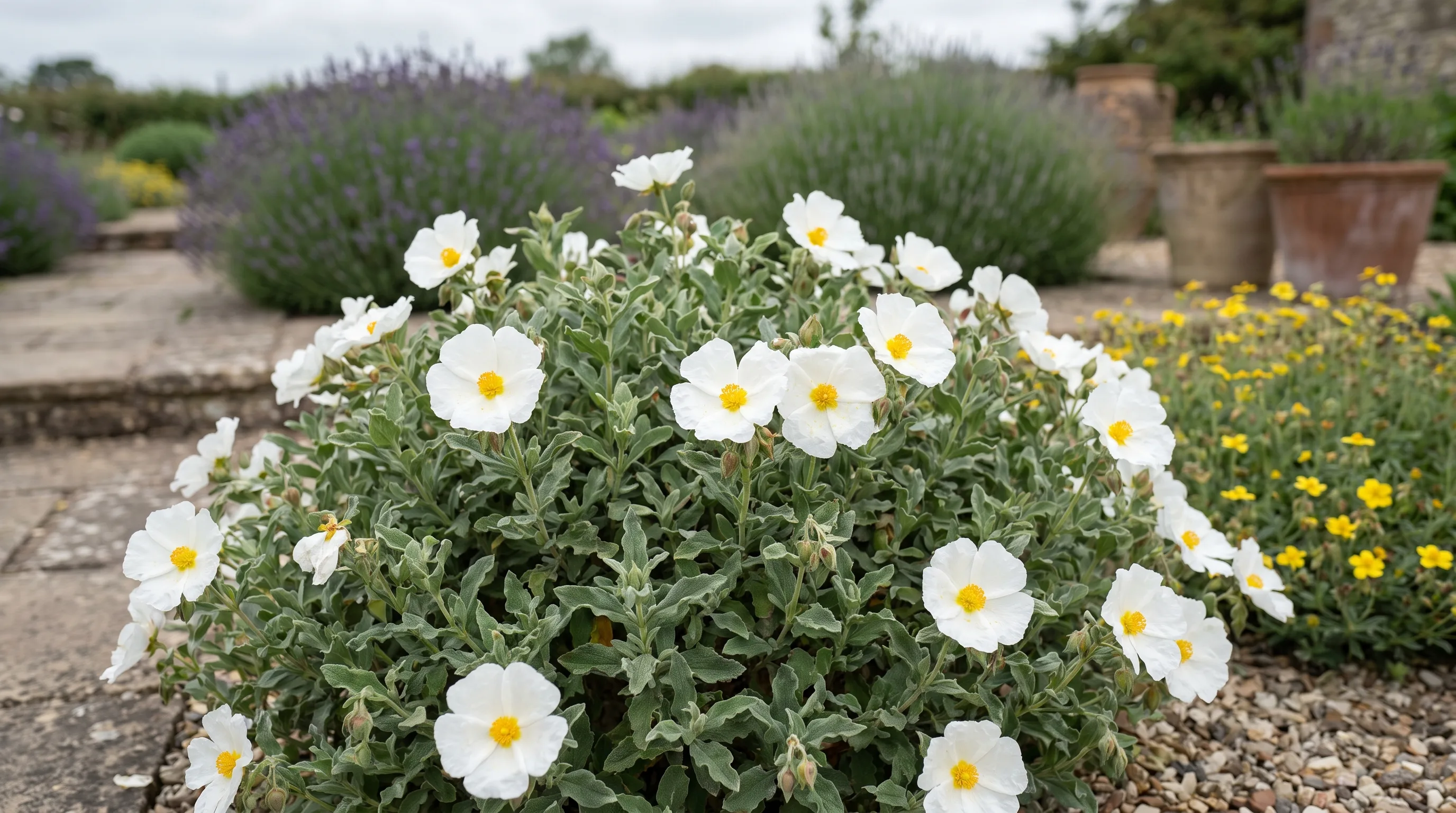
The shrub develops a dense, rounded, many-branched habit, usually reaching 1–1.5 m in height and becoming a little broader as it matures. Young growth contributes to the soft, silver-grey effect. The opposite, simple leaves are ovate to elliptical and generally 2–5 cm long. Their upper surfaces are grey-green to pale and downy when young, while the undersides carry a denser white felt. In strong sunlight this covering gives the whole plant a luminous, almost white cast.
Small stipules are present at the leaf bases. This detail is useful when distinguishing the species from closely related plants, including Cistus symphytifolius, and from many rockroses that lack stipules. It is a feature more readily appreciated at close range than in the overall silhouette, but it helps confirm the identity of correctly labelled material.
Flowers appear at the ends of shoots, either singly or in small clusters. Each is approximately 4–6 cm across, with five thin, crinkled white petals. A yellow mark at the base of each petal frames a prominent mass of golden stamens. Individual blooms are short-lived, often opening for only a day, but fresh buds replace them over a period of several weeks. Under UK cultivation, the main display normally falls in May and June, subject to warmth, light and overwintering conditions.
After pollination, the plant can form small woody capsules containing numerous seeds. The flowers are accessible to bees and other visiting insects. Even outside flowering time, the pale evergreen foliage gives useful year-round structure in a frost-free conservatory, sheltered courtyard or Mediterranean-style container display.
Growing Conditions
Full sun is essential for compact growth and generous flowering. Indoors or under glass, place the plant where it receives the brightest available light without persistent winter condensation. Outdoors in the mildest districts, a south- or west-facing position provides reflected heat and may shelter the shrub from cold easterly winds. Coastal exposure and salt-laden air are generally less troublesome than shade or saturated soil.
The ideal soil is light, stony or sandy, low to moderately fertile and exceptionally free draining. Slightly acidic to neutral conditions are suitable, and mildly alkaline soil may be tolerated, although very chalky conditions can cause chlorosis. Heavy clay should not merely be improved in the base of a deep planting hole, because this can create a sump. Where drainage is marginal, use a raised bed or mound and incorporate mineral grit across a broad area.
Once established, Cistus candidus is drought tolerant. In-ground plants need water during establishment and prolonged dry spells, but routine irrigation is rarely beneficial thereafter. Winter wet poses a much greater danger than summer dryness. Avoid low spots, sites receiving runoff, and wet organic mulches against the crown. A gravel mulch suppresses splashing and helps keep the stem bases dry.
For most UK gardens, container culture offers the safest balance of summer sun and winter protection. Use a substantial pot with unobstructed drainage holes and a loam-based compost opened with coarse grit, approximately three parts loam-based compost to one part grit. Raise the pot on feet so water can escape. Move it into a bright, frost-free greenhouse or conservatory before cold weather arrives, and maintain good air movement.
Planting and Care
Plant or pot Cistus candidus in spring after the risk of frost has passed. Spring planting gives the roots a full warm season to establish before winter. In very mild areas, container-grown plants may be set out into early autumn, but late planting leaves little margin if the first winter is wet. Position the root ball at the same depth at which it was growing and firm gently without compacting the soil.
Water newly planted specimens regularly enough to prevent complete drying during their first growing season, while allowing the surface to dry between waterings. Established plants in open ground should be watered sparingly. Containers dry faster and need moderate watering from spring through summer, but never leave them standing in a saucer of water. During winter protection, keep the compost only just moist; cool, wet roots are highly vulnerable to decay.
Feeding should be restrained. Plants in the ground normally need none where growth is healthy. Potted specimens can receive a light application of balanced, slow-release fertiliser in spring. Rich compost and frequent high-nitrogen feeds encourage soft, sappy stems at the expense of flowers and can make growth more susceptible to winter damage.
Prune lightly after flowering, usually in June or July, by shortening the current season's soft tips enough to maintain a balanced outline. Remove dead or damaged twigs back to healthy young growth. Do not renovate the plant by cutting deeply into bare old wood: rockroses often fail to produce new shoots from such cuts. An elderly, open specimen is usually better replaced than subjected to severe pruning.
Propagation is most reliable from semi-ripe cuttings taken in July or August. Select healthy, non-flowering side shoots and take short cuttings, preferably with a small heel. Remove the lower leaves, insert into a very free-draining cutting medium and maintain humidity without saturating the compost. Gentle bottom heat can improve rooting. Seed may be sown in autumn in a gritty medium, but seedlings can vary and should not be assumed to reproduce the parent exactly.
Move container plants under cover before the first frosts, inspect them for pests and remove fallen leaves from the compost surface. Through winter, provide bright light, ventilation on mild days and minimal water. Return plants outdoors gradually in spring after frost risk has passed, acclimatising the foliage to stronger sunlight over several days. In permanently mild coastal sites, shelter from cold winds and a dry root run remain important even when the shrub stays outside.
Common Problems
Root rot is the principal cultivation problem. A plant may wilt, discolour or collapse suddenly even though the soil appears wet. Waterlogging excludes air from the root zone and favours organisms such as Phytophthora and Pythium. Prevention is more effective than treatment: use clean, free-draining compost, empty standing water, avoid oversized pots and never assume that drought tolerance means a plant should alternate between severe drying and flooding.
Grey mould, caused by Botrytis, can affect leaves, stems and spent flowers in cool, humid, poorly ventilated conditions. Remove affected material promptly, space protected plants so air can circulate, water the compost rather than the foliage, and ventilate glasshouses whenever conditions permit. Dense soft growth encouraged by excess feeding is particularly prone to problems.
Under glass, check leaf undersides and shoot joints for glasshouse red spider mite, whitefly and mealybug. Fine mottling or webbing may indicate mites; clouds of tiny white insects rise from plants disturbed by whitefly; mealybugs appear as white, waxy clusters. Isolate affected plants, improve hygiene and use an appropriate biological or labelled control where necessary. Repeated inspection is important because sheltered winter quarters can allow small populations to build unnoticed.
Outdoor frost injury appears as blackened or browned foliage and dead shoot tips. Delay remedial trimming until the extent of damage is clear, then remove only dead tissue to healthy young growth. Avoid hard cutting into old wood. In most British regions, prevention by moving the pot under frost-free cover is more dependable than wrapping a plant left in saturated ground.
Yellowing between the leaf veins may occur in strongly chalky or persistently alkaline conditions, although root damage from poor drainage can produce similar symptoms. Assess drainage and watering before applying extra feed. Weak flowering is most often linked to inadequate sun, rich soil, excessive nitrogen, hard pruning or insufficient summer warmth. The species is generally trouble-free when its roots remain aerated and its winter environment is bright and dry.
Popular Varieties
Named cultivars of Cistus candidus are not reliably documented in mainstream UK horticulture. Nursery material is generally offered as the species rather than as a selection with an established cultivar name. For accuracy, unverified marketing names should not be treated as cultivars, and plants labelled simply “white rockrose” should not automatically be assumed to be this species.
Related species provide alternatives where a broader choice of rockroses is wanted, but they are not varieties of C. candidus. Cistus ladanifer is a larger, aromatic species whose white flowers commonly carry dark basal blotches. Cistus salviifolius is a lower-growing white-flowered rockrose with sage-like leaves. Cistus creticus generally bears pink, crumpled flowers and is associated with the labdanum-producing rockrose group. Their cultivation and cold tolerance differ, so each should be selected on its own merits rather than used as a direct substitute without checking site requirements.
For a plant true to the description, choose clearly labelled Cistus candidus from a specialist supplier. Look for compact, well-branched growth, pale healthy foliage and roots that are neither congested nor sitting in wet compost. Its botanical character—the white flowers, golden stamens, silver foliage and stipulate leaves—is the reason to grow the species; no invented cultivar name is needed.
Pests and Diseases
| Problem | Symptoms | Management |
|---|---|---|
| Root rot | Leaves turn yellow and drop, stems become soft and mushy at the base. | Ensure planting in sharply draining soil and avoid overwatering. |
| Slugs and snails | Irregular holes chewed into young leaves and shoots, often with slime trails. | Use physical barriers like copper tape or apply iron phosphate pellets. |
| Vine weevil | Notched edges on leaves above ground and wilting due to root damage below. | Apply nematodes to the soil in autumn or use biological controls. |
| Powdery mildew | White, dusty fungal growth appears on leaves and stems in humid conditions. | Improve air circulation and spray with a sulphur-based fungicide if severe. |
| Winter damage | Foliage turns brown and crispy after exposure to frost or cold winds. | Plant in a sheltered, south-facing position away from frost pockets. |
For step-by-step help, read Dealing with Slugs and Snails and Treating Powdery Mildew. Or browse the full plant problem solver to diagnose an issue by symptom.
Recommended Products
GardenWizz earns a commission from qualifying purchases made through affiliate links on this page (including links within the article) — as an Amazon Associate, and from Thompson & Morgan via the Awin network. This does not affect the price you pay. See our disclaimer for details.