Rock Rose
Cistus cyprius
The Gardening Year
Best months in UK gardens · full planting calendar →
🖨 Printable care card (PDF)At a Glance
| Botanical name | Cistus cyprius |
|---|---|
| Common name(s) | Rock rose |
| Family | Cistaceae |
| Plant type | shrub |
| Height × Spread | 100–150 cm × 100–150 cm |
| Position | Full sun |
| Soil | dry or rocky soils |
| Flowering | June–July |
| Toxicity | — |
| Native range | Mediterranean region, from Morocco, Spain, Italy, Greece, through to the Middle East, and also on the Canary Islands |
The "common gum cistus" — a sun-loving, papery-flowered evergreen that delivers one of the most reliable June shows of any Mediterranean shrub suited to British gardens. Most UK stock sold under this name is in fact Cistus × cyprius, a hybrid of C. ladanifer and C. laurifolius; this article treats the hybrid as the principal subject, in line with RHS Plant Finder and the Burncoose and Beth Chatto catalogues, while noting the uncertainty around the species form (see [Overview](#overview)).
Overview
Cistus cyprius belongs to the Cistaceae, the rock-rose family, whose members dominate the sun-baked garrigue and maquis of the Mediterranean basin. The genus Cistus contains around twenty or so species distributed from the Canary Islands and Morocco east to Turkey and the Levant. Almost every species and hybrid in the genus shares the same garden formula: thin, often aromatic leaves; large, papery, five-petalled flowers that open for a single day; and a preference for poor, free-draining ground in full sun.
In the UK it is most commonly encountered as the hybrid Cistus × cyprius, the cross between C. ladanifer (gum cistus) and C. laurifolius, both of which contribute the resinous, sticky foliage that gives the plant its common name. The hybrid is listed in the RHS Plant Finder under "common gum cistus" and is described as a strong-growing small evergreen shrub, reaching roughly 1–1.5 m in height and spread at maturity (Source: rhs.org.uk/plants/92784/cistus-x-cyprius/details, accessed 2026-07-22). The true species Cistus cyprius from Cyprus is a distinct, much less commonly grown plant; most plants sold under this name in British nurseries are in fact the hybrid, and that ambiguity is acknowledged throughout this entry.
Appearance
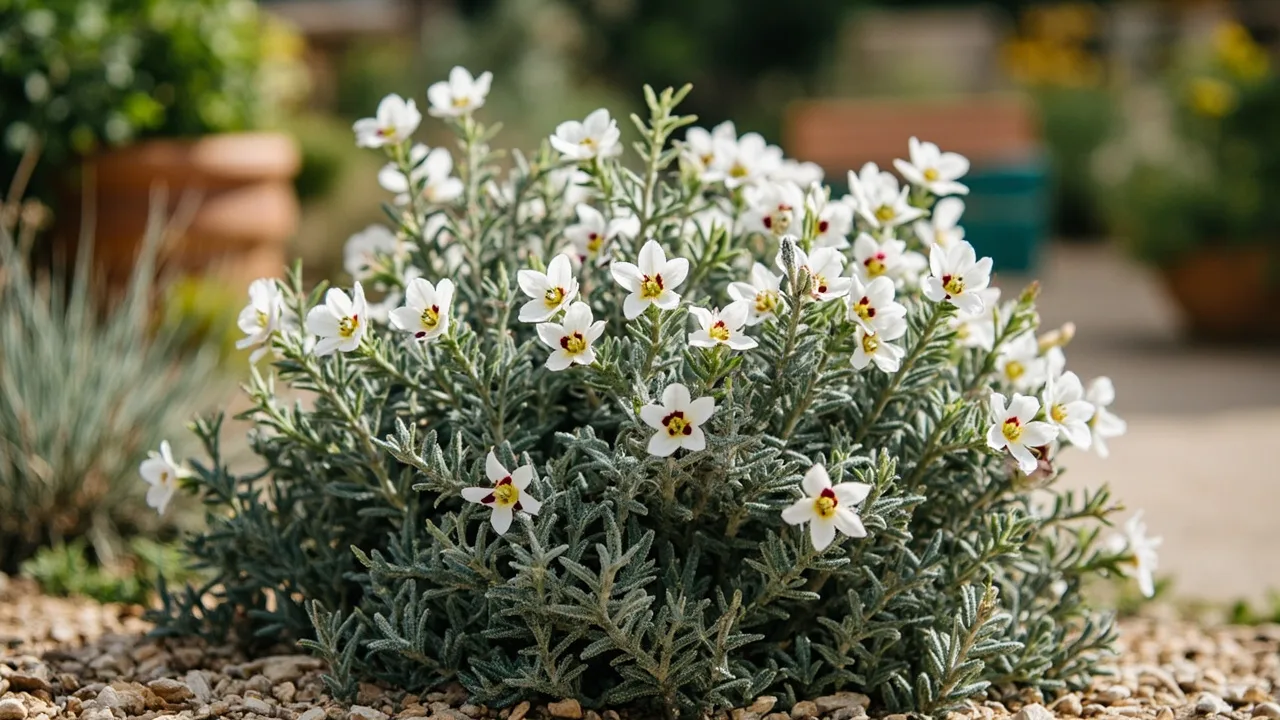
The habit is dense, rounded and bushy, with a slightly irregular outline that improves with light annual pruning rather than hard shaping. Stems are woody at the base and softer higher up; on established plants the lower framework becomes visible in late summer after flowering.
The leaves are arranged in opposite pairs along the stem, simple, lance-shaped to broadly elliptical, and typically 3–8 cm long. On the hybrid they carry a sage- to grey-green tint and feel slightly sticky to the touch in warm weather; that stickiness is the labdanum resin for which C. ladanifer has been gathered since antiquity and which gives the plant its common name.
Flowers are the reason to grow this shrub. Each bloom is roughly 5–8 cm across, with five crinkled, papery petals arranged around a dense boss of bright yellow stamens. In the typical form of C. × cyprius each white petal carries a deep crimson-maroon blotch at its base, producing the classic "rock-rose" look. Individual flowers last only a day, opening in the morning and shedding by evening, but a healthy plant produces a heavy succession over four to six weeks in late May, June and early July. The flowers themselves are unperfumed; the aromatic note comes from the foliage on hot days.
Fruit is a small, many-seeded capsule that is not ornamentally significant. It can be left in place, although seed-grown plants of the hybrid will not come true to type, which is why propagation is almost always by semi-ripe cuttings.
Growing Conditions
Sun is non-negotiable: cistus perform poorly and flower sparsely in any meaningful shade, and a south- or west-facing position with at least six hours of direct summer sun is the minimum. The plant tolerates coastal exposure, including salt spray, and urban pollution, but it fails in two recurring UK scenarios — heavy wet clay and deep shade — both of which shorten its life dramatically.
Soil must be sharply drained. The plant thrives in poor, stony, gritty or sandy ground and is comfortable on alkaline or limy soils where many Mediterranean shrubs struggle. Established plants are notably drought-tolerant; the commonest cause of failure in British gardens is the opposite problem — waterlogging through winter, when roots sit in cold, saturated ground and succumb to rot. A raised bed, a gravel garden, a south-facing bank or a large container in a loam-based (not pure peat) potting mix are all suitable positions.
In colder parts of the UK — inland Scotland, north-eastern England and exposed sites above 150 m — plant in the shelter of a south- or west-facing wall and expect some foliage browning after a hard winter; this is usually cosmetic and recovers in spring. Container-grown plants benefit from a fleece wrap during prolonged hard frost.
Planting and Care
The best planting time in the UK is spring (April to May), so the root system establishes through its first growing season before facing winter; container-grown stock can also go in during early autumn on free-draining ground. Dig a hole twice the width of the pot, tease out congested roots, plant at the same depth as the nursery line, firm in, and water thoroughly. Space plants 1–1.5 m apart.
Watering matters mainly in the first year: water deeply during dry spells to push roots down into the soil profile, then stop routine watering. Once established, the plant is essentially rain-fed across most of the UK.
Feeding is best kept light. On poor soils none is needed; on richer ground a thin spring mulch of well-rotted garden compost is plenty. Avoid high-nitrogen fertilisers, which push soft leafy growth that flowers poorly and is more vulnerable to winter damage.
Pruning is the single most common mistake. Cistus do not regenerate from old, leafless wood, and a hard prune usually kills the plant. Give a light tip-prune immediately after flowering in late July, shortening the current season's growth by 5–10 cm to keep the shrub compact. Plan to replace the plant after roughly six to ten years rather than attempting a renovation prune; many leggy, woody specimens in older gardens are simply at the end of their useful life.
Propagation is straightforward from semi-ripe cuttings taken in July or August. Select non-flowering side shoots 5–10 cm long, trim below a node, remove the lowest leaves, and insert into a 50:50 mix of peat-free multipurpose compost and sharp sand under a propagator lid. Rooting takes four to six weeks; pot on individually and overwinter in a cold frame before planting out the following spring.
Seasonal care is minimal: a light compost top-dressing in mid-spring on poor soil, the post-flowering tip-prune in July, and a thin autumn mulch kept clear of the stems. Watch for prolonged winter wet rather than frost itself — that is the more usual cause of damage in the UK.
Common Problems
Cistus are marketed as trouble-free once planted in the right place, and almost every problem in British gardens traces back to wrong soil, wrong aspect or wrong pruning. The five issues most often recorded for this plant are listed below.
Honey fungus. Wilting, dieback and eventual death, often with white fungal growth at the base of the stem or under the bark. Honey fungus is rare but devastating where it is established. Ensure excellent drainage and avoid replanting cistus in soil known to have carried the disease; lift and destroy affected woody material rather than composting it.
Root rot. Yellowing leaves, stunted growth and collapse caused by waterlogged roots, especially through winter. Plant only in sharply draining soil, on a slope or in raised beds; container specimens need a loam-based mix with added grit and plenty of drainage holes.
Vine weevil. Notched leaf margins on young plants, and root damage that causes wilting in potted specimens. The adult beetles feed at night; the soil-dwelling grubs are the more serious threat. Apply biological nematode treatments in early autumn where pots have a history of infestation, or check rootballs before planting.
Slugs and snails. Irregular holes chewed into tender young leaves and stems, particularly on soft new growth in damp spring weather. Protect young plants with coarse grit around the base, or use ferric-phosphate slug pellets which are approved for use around wildlife.
Winter wet damage. Browning and death of foliage and shoots caused by cold, wet conditions rather than frost alone. The classic symptom is large patches of discoloured foliage on the windward side of the plant after a wet, mild winter. Provide a sheltered position with free-draining soil; for container plants, move under the eaves of the house for the worst of the winter.
Popular Varieties
Stock sold in British nurseries under this name is almost always the hybrid Cistus × cyprius, and several distinct forms are worth seeking out. The varieties below are all listed in the RHS Plant Finder or documented in UK nursery catalogues; no cultivar names have been invented and no hardiness ratings have been quoted, since the structured badge on this page is still to be populated by the platform.
- Cistus × cyprius (common gum cistus, un-named form). The default plant across UK garden centres, with white petals carrying a deep crimson-maroon basal blotch. A vigorous hybrid reaching roughly 1.5 m in both directions on a sunny, free-draining site. Source: RHS Plants 92784.
- Cistus × cyprius var. ellipticus f. bicolor. A botanical variant distinguished by more elliptical leaves and the strongly bicoloured flowers typical of the hybrid. Listed in the RHS Plant Finder and stocked by specialist UK nurseries. Source: rhs.org.uk/plants/193392.
- Cistus × cyprius var. ellipticus 'Elma'. A selected clone of the elliptic-leaved variant, documented in RHS Digital Collections and widely offered by UK nurseries; often described as particularly free-flowering and a touch more compact than the un-named form. Source: rhs.org.uk/Plants/164814.
- Cistus × cyprius 'Troubadour'. A cultivar documented in university cold-hardiness trials and listed by specialist growers. Reported as a vigorous, free-flowering form with the typical crimson-blotched white flowers. Source: mediterraneangardening.fr.
For gardeners considering the wider cistus group rather than the × cyprius hybrid itself, Cistus × purpureus (pink-flowered, widely available in the UK) and Cistus × dansereaui 'Decumbens' (low-growing, also widely available) are well-documented options; these are not cultivars of C. cyprius and are mentioned only for completeness.
Sources & Further Reading
- Royal Horticultural Society, Cistus × cyprius plant details: https://www.rhs.org.uk/plants/92784/cistus-x-cyprius/details (accessed 2026-07-22)
- Royal Horticultural Society, "How to grow cistus": https://www.rhs.org.uk/plants/cistus/growing-guide (accessed 2026-07-22)
- Royal Horticultural Society, Cistus × cyprius var. ellipticus f. bicolor plant details: https://www.rhs.org.uk/plants/193392/cistus-cyprius-var-ellipticus-f-bicolor/details (accessed 2026-07-22)
- Royal Horticultural Society, Cistus × cyprius var. ellipticus 'Elma' plant details: https://www.rhs.org.uk/Plants/164814/Cistus-x-cyprius-var-ellipticus-Elma/Details (accessed 2026-07-22)
- Burncoose Nurseries, Cistus growing guide: https://www.burncoose.co.uk/site/content.cfm?ref=Cistus+-+Growing+Guide (accessed 2026-07-22)
- Beth Chatto Gardens, plant profile — cistus: https://www.bethchatto.co.uk/discover/our-blog/guides/plant-profile-cistus.htm (accessed 2026-07-22)
- Wikipedia, Cistus (genus overview and native range): https://en.wikipedia.org/wiki/Cistus (accessed 2026-07-22)
Pests and Diseases
| Problem | Symptoms | Management |
|---|---|---|
| Honey fungus | Wilting, dieback, and eventual death of the shrub, often with white fungal growth at the base. | Ensure excellent drainage and avoid planting in soil previously infected; remove affected plants completely. |
| Root rot | Yellowing leaves, stunted growth, and collapse of the plant due to waterlogged roots. | Plant only in sharply draining soil or raised beds to prevent waterlogging, especially in winter. |
| Vine weevil | Notched leaf margins on seedlings and root damage causing wilting in potted specimens. | Use nematode treatments in autumn for soil-dwelling larvae or physical barriers for adults. |
| Slugs and snails | Irregular holes chewed into young leaves and stems, particularly on tender new growth. | Apply slug pellets or use beer traps around the base of the plant during damp weather. |
| Winter wet damage | Browning and death of foliage and shoots due to cold, wet conditions rather than frost alone. | Provide a sheltered position with free-draining soil to mitigate exposure to winter moisture. |
For step-by-step help, read Dealing with Slugs and Snails. Or browse the full plant problem solver to diagnose an issue by symptom.
Recommended Products
GardenWizz earns a commission from qualifying purchases made through affiliate links on this page (including links within the article) — as an Amazon Associate, and from Thompson & Morgan via the Awin network. This does not affect the price you pay. See our disclaimer for details.