Darley Dale Heath
Erica x darleyensis
The Gardening Year
Best months in UK gardens · full planting calendar →
🖨 Printable care card (PDF)At a Glance
| Botanical name | Erica x darleyensis |
|---|---|
| Common name(s) | Darley Dale heath |
| Family | Ericaceae |
| Plant type | shrub |
| Height × Spread | 10–60 cm × 50–75 cm |
| Position | Full sun |
| Soil | Moist but well-drained or Well-drained; Chalk, Clay, Loam, Sand; Acid, Alkaline, or Neutral |
| Flowering | January, February, March, April, December |
| Toxicity | — |
| Native range | — |
A carpet of pale-pink bells opening on a frost-bitten January morning is, for many UK gardeners, the moment that justifies a winter heather bed. Erica × darleyensis, sold in garden centres simply as Darley Dale heath or winter heath, is the plant most often chosen to deliver that show. It bridges the lean months between the last snowdrops and the first daffodils without demanding much from the soil beneath it.
Overview
Erica × darleyensis is an inter-specific hybrid between the snow heath Erica carnea (native to the Alps and Dolomites) and the Irish or Mediterranean heath Erica erigena. The original seedling arose at the Darley Dale nurseries in Derbyshire in the early twentieth century, and the cross combines the winter flower power of E. carnea with the taller habit and longer flower stems of E. erigena.
In UK gardens the plant is grown almost exclusively for winter and early spring colour in beds, containers and the fronts of borders. It is one of the few flowering evergreens that will sit happily alongside rhododendrons and camellias on acid ground yet still thrive on the chalk and limestone soils that defeat most heathers. A well-tended clump can keep flowering for two or three months and remain a tidy evergreen mound the rest of the year.
Darley Dale heath succeeds in open, sunny, well-drained positions on any reasonable garden soil and asks only modest maintenance in return. For a gardener wanting year-round structure with a real winter peak of flower, it remains one of the most reliable shrubs available.
Appearance
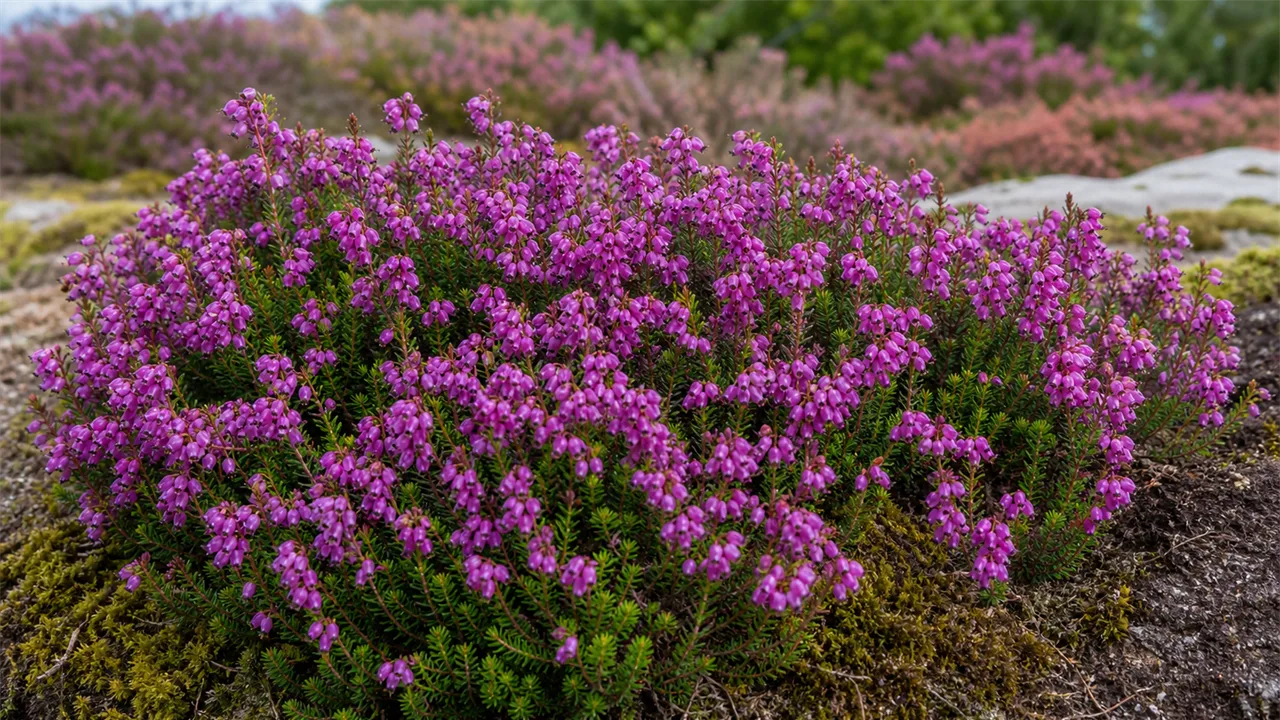
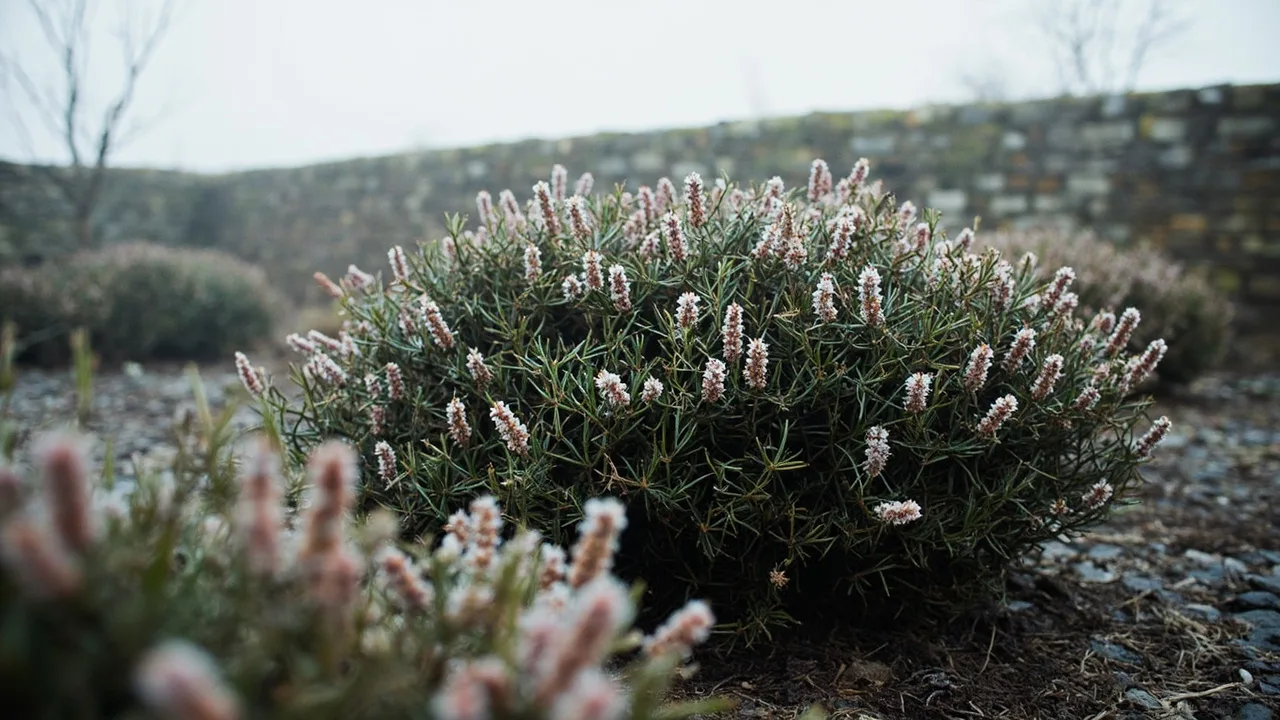
Darley Dale heath is a compact, evergreen, dome-shaped shrub with a slightly looser habit than its E. carnea parent. Mature plants reach about 30-45 cm in height and spread 50-75 cm across, with a tendency to layer their lower branches and root where they touch bare soil.
The foliage is needle-like rather than scaly, arranged in whorls of four along wiry stems. Leaves are typically 4-7 mm long and most often mid- to deep green; a number of cultivars carry bronze, gold or silvery new growth in spring. The young shoots are softly hairy, a feature that distinguishes the hybrid from many other heathers.
Flowers appear in short, leafy racemes clustered towards the tips of the previous year's growth. Each bloom is a small, cylindrical or urn-shaped bell, 4-7 mm long, hanging in rows down the stem. Colour varies from pure white through pale pink, lilac and rose to a deep magenta, with darker anthers often showing at the mouth of the bell. Flowering extends from December (or November in a mild autumn) through to April, with the peak usually between January and March. Bumblebee queens emerging from hibernation visit the flowers on mild days.
Growing Conditions
Sun is the most important ingredient. Erica × darleyensis flowers most generously in full sun, where the foliage also stays tight and the plant keeps its shape. Light dappled shade is acceptable, particularly in the drier east of England, but deep shade under trees produces sparse flower and leggy growth.
Soil drainage matters more than soil pH. The plant tolerates a wider pH range than almost any other erica, growing happily on chalk and limestone soils that would quickly turn rhododendron leaves yellow, provided the ground is not waterlogged in winter. On heavy clay, work in coarse grit and well-rotted organic matter before planting, or set the shrub on a low mound to keep the crown above the wet. Pure, dry sand suits it well.
Wind exposure is generally well tolerated. The low, dense habit means that exposed coastal and hilltop sites are usually fine. The plant is not, however, a candidate for frost pockets or any spot where cold air pools for long periods in still weather. Tolerances include salt-laden coastal air, summer drought once established, and the occasional heavy snow load, which usually bends the pliable stems to the ground without breaking them.
Planting and Care
Plant in autumn or early spring so the roots establish while the soil is moist and warm. Container-grown heathers can go in at almost any time the ground is workable, but October to November and March to April give the best results in the UK. Space plants 45-60 cm apart for a ground-cover effect, or 60-75 cm apart for individual specimens.
Dig a hole roughly twice the width of the rootball and the same depth. On poor soils, work a couple of bucketfuls of well-rotted leafmould or ericaceous compost into the backfill, but avoid burying the plant deeper than it sat in its pot. Water in well, apply a 5 cm mulch of bark or leafmould, and keep the new planting moist through its first growing season. Once established, the plant is drought-tolerant in most summers.
Feeding needs are modest. A light spring top-dressing of a general-purpose fertiliser or a single handful of slow-release pellets around the drip line is plenty. On alkaline soils, an annual top-dressing with leafmould or pine bark helps to keep the upper root zone sweet.
Pruning is the single most useful thing a gardener can do to keep the plant compact and flowering freely. Each year, as the last flowers fade in April or May, trim the previous season's flowered growth back by about a third using shears or secateurs. The aim is to cut just above the leafy part of the stem and never into old wood, which the plant struggles to regrow from. A light annual trim produces a denser bush with more flower buds the following winter; an untrimmed plant becomes woody, gappy and short-lived.
Propagation is easy from semi-ripe cuttings taken in July or August. Pull short sideshoots with a thin heel, dip the base in rooting hormone and set them in a 50:50 mix of peat-free ericaceous compost and perlite. Cover with a clear lid, keep in a shaded frame, and most cuttings will root in 6-10 weeks. Layering is even simpler: peg a low stem into the surrounding soil in spring, sever it once it has rooted, and lift the new plant the following year.
Seasonal care centres on two points: an annual trim after flowering and an annual mulch in late winter. Beyond that, the plant needs little attention.
Common Problems
Phytophthora root rot is the disease to watch for. Plants suddenly collapse, turn pale and fail to recover even after watering; the root system is dark, soft and dead. It is almost always linked to poor drainage or waterlogged ground. Lift and destroy affected plants, improve drainage, and avoid replanting ericas in the same spot for several years.
Honey fungus (Armillaria spp.) occasionally attacks older, stressed plants, producing sheets of white mycelium beneath the bark and clumps of honey-coloured toadstools at the base in autumn. There is no cure once a plant is infected; remove it together with as much of the root system as possible and avoid replanting susceptible shrubs in the same place.
Phytophthora-like die-back can also follow long summer drought on free-draining soil that has been left completely dry for weeks. The foliage yellows, the lower branches die back and the plant fails to flower. The remedy is the opposite of what intuition suggests: soak the root zone thoroughly once or twice in dry spells rather than offering daily sips.
Few pests trouble Darley Dale heath. Vine weevil grubs can attack the roots of container-grown plants, particularly in peat-based composts, and a black vine weevil night patrol in spring or autumn is often enough to keep numbers down. On alkaline soils, an occasional application of a chelated iron treatment prevents the pale, yellowed foliage that signals iron deficiency.
Frost damage is rare on the plant itself, but late-spring frosts on already-opened flowers can scorch the bells and turn them brown. Damage is cosmetic; trim off the spoiled flower stems once the display is over.
Popular Varieties
The original hybrid, raised at the Darley Dale Nurseries in Derbyshire in the early 1900s, is sold simply as Erica × darleyensis and gives a useful, free-flowering pink display.
'Ghost Hills' carries pale pink flowers above grey-green foliage with cream spring tips and is one of the most popular cultivars in UK garden centres. 'Kramer's Rote' is a vigorous, upright selection with deep magenta flowers from January to April and bronze-tinted winter foliage. Both are dependable and well suited to a starter heather bed.
'White Glow' (sometimes listed as f. albiflora 'White Glow') produces pure white flowers over bright green foliage and is the standard white form. 'Lucie' is a more compact white-flowered cultivar, the first heather to receive the Heather Society's Premier Award.
'Furzey' is a widely available pink cultivar with darker foliage, typically flowering from January to April. 'Arthur Johnson' is a tall magenta cultivar with bronze winter foliage, useful towards the back of a heather bed. 'Silberschmelze' carries white flowers over silvery-green foliage and is a classic combination with pink cultivars. 'J. W. Porter' has dark green foliage and rosy-red flowers.
Cultivar availability changes from season to season; specialist heather nurseries such as those listed by the Heather Society offer the widest choice, while general garden centres usually stock only 'Ghost Hills', 'Kramer's Rote' and the white form.
Sources & Further Reading
- Royal Horticultural Society, Erica × darleyensis 'Darley Dale', accessed 2026-07-23.
- Royal Horticultural Society, How to grow erica, accessed 2026-07-23.
- Royal Horticultural Society, Erica × darleyensis 'Kramer's Rote', accessed 2026-07-23.
- Royal Horticultural Society, Vine weevil, accessed 2026-07-23.
- The Heather Society, Erica × darleyensis cultivars, accessed 2026-07-23.
- Wikipedia, Erica × darleyensis, accessed 2026-07-23.
Pests and Diseases
| Problem | Symptoms | Management |
|---|---|---|
| Root rot | Foliage turns brown and drops off while the soil remains persistently wet. | Ensure excellent drainage by planting in gritty, acidic compost and avoid overwatering. |
| Budworm | Flower buds fail to open or turn black and drop before blooming. | Apply a systemic insecticide like dimethoate in early spring if infestation is severe. |
| Powdery mildew | A white, dusty fungal growth appears on the leaves and stems. | Improve air circulation and spray with a fungicide containing myclobutanil if necessary. |
| Spider mites | Fine webbing between leaves and stippled, yellowing foliage during hot, dry weather. | Wash plants with water to dislodge mites or use a horticultural oil spray. |
| Nutrient deficiency | Leaves turn pale green or yellow due to lack of iron or nitrogen. | Apply ericaceous fertiliser in spring and avoid using lime-based soils or water. |
For step-by-step help, read Treating Powdery Mildew. Or browse the full plant problem solver to diagnose an issue by symptom.
Recommended Products
GardenWizz earns a commission from qualifying purchases made through affiliate links on this page (including links within the article) — as an Amazon Associate, and from Thompson & Morgan via the Awin network. This does not affect the price you pay. See our disclaimer for details.