Martin's Spurge
Euphorbia martini
The Gardening Year
Best months in UK gardens · full planting calendar →
🖨 Printable care card (PDF)At a Glance
| Botanical name | Euphorbia martini |
|---|---|
| Common name(s) | Martin's Spurge |
| Family | Euphorbiaceae |
| Plant type | shrub (hybrid between E. amygdaloides and E. characias subsp. characias; dwarf evergreen subshrub) |
| Height × Spread | 30–60 cm × 50–100 cm |
| Position | Full sun, Partial shade |
| Soil | well-drained |
| Flowering | March–August |
| Toxicity | All parts toxic if eaten; milky sap is an irritant to skin and eyes |
| Native range | Mediterranean (found growing wild in southern France) |
Overview
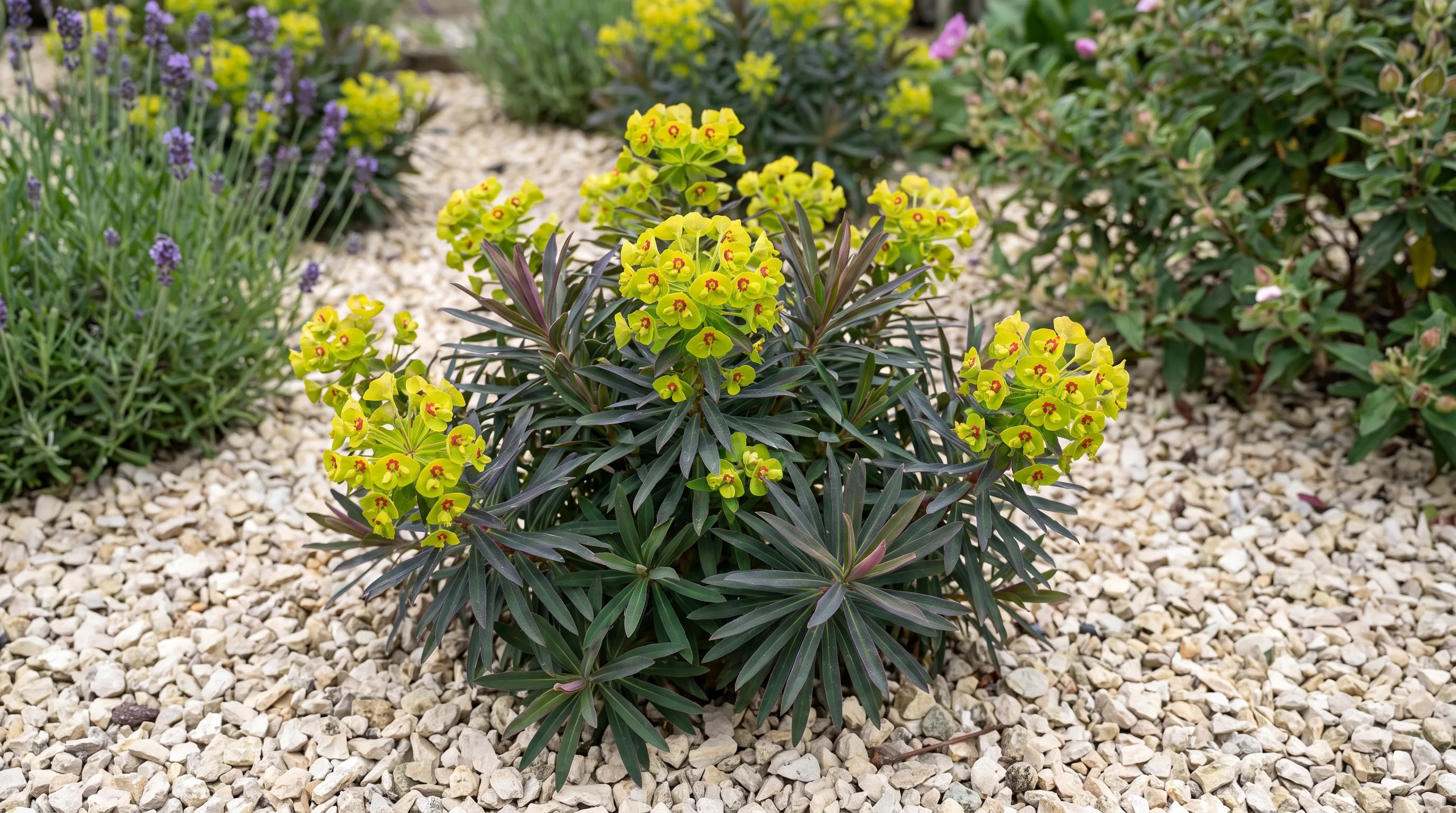
Euphorbia × martini, often sold as Martin's spurge, is a naturally occurring hybrid between Euphorbia characias (Mediterranean spurge) and Euphorbia amygdaloides (wood spurge). It is a small, evergreen, dome-forming sub-shrub grown in British gardens principally for its year-round structure and its spring display of lime-green flower heads, technically cyathia surrounded by showy bracts. It is tougher, more compact, and more reliably hardy than its Mediterranean parent, and it tolerates a wider range of British soils, which explains why it has displaced E. characias in many mixed and gravel borders.
The plant is widely available from British nurseries and is recognised by the Royal Horticultural Society, which lists several cultivars under the name Euphorbia × martini. It is suited to coastal, cottage, gravel, and Mediterranean-style plantings, and to dappled-shade woodland edges where many other euphorbias fail. Like all spurges, every part of the plant exudes a milky, sticky sap when cut that can irritate skin and eyes, so it should be handled with care and sited away from heavily used play areas.
Appearance
Euphorbia × martini forms a tidy, rounded mound roughly 50–80 cm tall and spreading 50–80 cm across at maturity, building a dense framework of upright to slightly arching stems clothed in narrow, oblong leaves. The leaves are dark grey-green, often flushed with a hint of purple-bronze in winter, and are arranged in tight rosettes towards the tips of the stems. In exposed or cold sites the foliage can take on a strong plum tint from late autumn into early spring, then freshen as new growth begins.
The flowering season runs from late April into early June across most of the UK, slightly earlier in the south and slightly later in the north. What passes for flowers are technically cup-shaped structures called cyathia, surrounded by a ring of bright yellow-green bracts. Each flower head sits at the tip of a stem and is backed by an opposite pair of rounder, paler bracts that emerge first and persist for several weeks, giving the spike a two-toned look.
Individual plants are short-lived in the strict botanical sense but are easily renewed from cuttings, so an established clump can be perpetuated indefinitely. Once the flower bracts fade they often turn a soft pinkish-buff and can be left on the plant into summer if seed production is unwanted.
Growing Conditions
Euphorbia × martini grows well throughout most of the UK and tolerates a wide range of soils, including those over chalk, provided drainage is reasonable. It performs best in full sun but is one of the more shade-tolerant evergreen euphorbias and succeeds in light or dappled shade, where it produces slightly looser, more leafy growth. Heavy, waterlogged ground is the main thing to avoid; on stiff clay, plant on a shallow mound or work in grit and well-rotted organic matter before planting to lift the rooting zone.
The plant carries an RHS hardiness rating and is listed as suitable for gardens across most of the British Isles, including coastal and exposed sites. It stands up well to salt-laden winds and is notably drought-tolerant once established, making it a useful choice for dry borders, stony banks, and gravel gardens. In cold inland gardens the foliage may be scorched after severe winters but typically recovers from the base in spring. Gardeners in Scotland, the north of England, and upland parts of Wales should expect flowering to run a couple of weeks later than in the south and to be a little shorter, and will benefit from a thin bark or bracken mulch over the crown in November on the most exposed sites.
In terms of aspect, south-, west-, and east-facing sites all work; a north-facing border is acceptable in lighter soils but flowering will be reduced. Shelter from the coldest winter winds helps preserve the evergreen foliage at its most attractive. The strong UK seasonal signals are the late-April to early-June flower surge, the bronze-purple winter foliage flush that adds colour from November through February, and a short active growth window between March and late June.
Euphorbia × martini fits well into mixed and herbaceous borders as a structural evergreen anchor; it is also at home in gravel, Mediterranean, and coastal plantings and on the dappled edges of woodland gardens where many of its relatives struggle. A single plant provides a useful focal point from autumn through to the following summer, after which it can be renewed from cuttings to keep the planting tight and youthful.
Planting and Care
Plant container-grown specimens from the garden centre at any time between spring and early autumn, avoiding periods when the ground is frozen or waterlogged. The traditional best months for planting are March, April, May, September, and October. Dig a hole roughly twice the width of the pot and the same depth, fork the base, position the plant so the top of the rootball sits flush with the surrounding soil, backfill, firm in, and water thoroughly. A small stake is not needed but a thin mulch of bark or gravel helps conserve moisture in the first season.
Watering through the first summer is worthwhile on free-draining soils; once the plant has put down a deep root system, rainfall is usually sufficient except during prolonged drought. Established plants resent summer irrigation at the crown, particularly in heavy ground, where wet combined with warmth can cause rot. Water in the morning rather than in the evening in late summer, and direct any hose or can onto the soil around the plant rather than over the foliage, which helps keep the crown dry.
Feeding needs are modest. An annual light mulch of well-rotted compost or garden manure in March is normally enough; on poor, hungry soils a single handful of a slow-release, balanced fertiliser at the same time of year will boost both flowering and foliage quality. Overfeeding produces lush, floppy growth that flops in winter winds, and it can encourage the soft, sappy shoots that are most prone to frost damage in cold gardens.
Seasonal care through the year follows a straightforward rhythm. From January to March, leave the foliage alone to carry winter structure and protect the crown from cold; rake off any debris that has fallen into the clump and pull out large weeds by hand rather than hoeing close to the stems. In April and May the new shoots extend and the flower bracts begin to colour up, so any formative shaping should be done by mid-May at the latest. From June through August the spent flower stems are tidied as they fade to keep the clump tidy and to channel energy into the new basal shoots that emerge in late summer. From September to December the plant is best left alone to settle into its winter appearance, which on many cultivars is the most colourful part of the year.
Pruning is essentially a matter of tidying spent flower stems and shaping the crown. Each year, immediately after flowering in June or July, cut back the flowered stems to a healthy pair of leaves near the base. Do not cut into old, leafless wood: Euphorbia × martini does not reliably regenerate from bare stems, in contrast to some shrubby species. Always wear gloves when pruning and rinse any sap off the skin immediately with cold water. In addition, in late March cut back any stems damaged by winter weather to sound growth, cutting just above a pair of healthy leaves rather than shearing the whole plant into a tight dome.
Propagation is straightforward from semi-ripe cuttings taken in late spring or early summer. Pull or cut a non-flowering side shoot about 8–10 cm long, just below a node, let the cut end bleed into a cup of water or rinse briefly under the tap to wash away excess latex, then pot into a 50:50 mix of peat-free compost and sharp grit. Keep the cuttings in a shaded, unheated frame; most will root within six to eight weeks. Pinch out the growing tip once roots are established to encourage a bushy plant. Division of older clumps is possible in early spring but Euphorbia root systems are notionally sensitive to disturbance, so cuttings are the preferred route and produce true-to-type plants for named cultivars. Seed is set freely and will self-sow close to the parent, but named cultivars do not come true from seed and seedlings can be variable, so rogue them out if a uniform planting is wanted.
Common Problems
Euphorbia × martini is largely trouble-free in British gardens and is rarely troubled by pests. The two issues encountered most often are winter leaf scorch and crown rot.
Scorch shows as browning or reddening of the foliage from late January through March, usually after a combination of hard frost and drying easterly winds. The plant usually sheds damaged leaves and pushes fresh growth from the stem tips in April. To reduce scorch, avoid very exposed east-facing sites and resist cutting the plant back in autumn; a full head of foliage helps protect the stems.
Crown rot appears as sudden collapse of one or more stems, often in late summer after a wet period. It is most common on heavy, poorly drained ground or where mulches have been piled against the crown. Improve drainage at planting time, water around the plant rather than over the top, and remove affected stems promptly to a clean base.
Powdery mildew can appear on the foliage of stressed plants in dry late summers but rarely needs treatment. The principal disorder of the genus — the milky, skin-irritating sap — is a human and animal safety issue rather than a plant health problem. Wear gloves when handling cut material, keep cuttings away from children, and avoid planting close to stock paths because all spurges are toxic if ingested and the latex can cause photo-dermatitis on contact with skin.
Popular Varieties
The straight species Euphorbia × martini is the form most commonly sold, and three or four cultivars are widely available in British nurseries.
- Euphorbia × martinii 'Aperitif' – a selection with particularly bright, almost chartreuse-yellow flower bracts held well above a compact, dark-leaved clump; about 50 cm tall.
- Euphorbia × martini 'Ascot Rainbow' – grown mainly for its foliage, which emerges green in spring, then variegates through cream and pink tones, and deepens to red and orange in winter; flowers are modest but the year-round colour makes it a market favourite.
- Euphorbia × martini 'Baby Charm' – a dwarf selection typically reaching around 40 cm, with bronze-tinted young growth and a heavy crop of lime bracts in May.
- Euphorbia × martini 'Red Wing' – selected for the conspicuous purple-red winter colouring of both leaves and stem tips, with the usual green-yellow spring inflorescences.
- Euphorbia × martini 'Tiny Tim' – a particularly compact form, often under 30 cm tall, useful at the front of borders and in containers.
Pests and Diseases
| Problem | Symptoms | Management |
|---|---|---|
| Aphids | Clusters of small green or black insects on new growth causing distorted leaves and sticky honeydew. | Squash by hand, blast off with a hose, or use insecticidal soap for severe infestations. |
| Grey mould (Botrytis) | Fuzzy grey fungal growth on stems and leaves, often following damage or in humid conditions. | Improve air circulation, remove affected material, and avoid wetting foliage when watering. |
| Root rot | Yellowing, wilting foliage and soft, blackened roots due to waterlogged soil. | Ensure well-drained soil and avoid overwatering, especially during winter months. |
| Slugs and snails | Irregular holes chewed in leaves and silvery slime trails on foliage and stems. | Use beer traps, copper tape barriers, or iron phosphate-based pellets to control populations. |
| Sap irritation | Skin redness, itching, or eye irritation after contact with the milky latex sap. | Wear gloves and protective eyewear when pruning or handling cut stems. |
For step-by-step help, read Controlling Aphids Naturally and Dealing with Slugs and Snails. Or browse the full plant problem solver to diagnose an issue by symptom.
Recommended Products
GardenWizz earns a commission from qualifying purchases made through affiliate links on this page (including links within the article) — as an Amazon Associate, and from Thompson & Morgan via the Awin network. This does not affect the price you pay. See our disclaimer for details.