Horned Spurge
Euphorbia cornigera
The Gardening Year
Best months in UK gardens · full planting calendar →
🖨 Printable care card (PDF)At a Glance
| Botanical name | Euphorbia cornigera |
|---|---|
| Common name(s) | horned spurge |
| Family | Euphorbiaceae |
| Plant type | perennial (rhizomatous herbaceous perennial) |
| Height × Spread | 75–100 cm × — |
| Position | Full sun, Partial shade |
| Soil | moist but well-drained |
| Flowering | June–August |
| Toxicity | highly toxic if ingested; sap may cause skin irritation |
| Native range | Bhutan |
Overview
Euphorbia cornigera, widely known as horned spurge, is a hardy herbaceous perennial native to the Himalayas and western China that has become a firm favourite of UK garden designers for its bold architectural presence and long season of interest. It belongs to the spurge family (Euphorbiaceae) and forms tidy, vase-shaped mounds of upright, grey-green stems that carry bright yellow-green flower-heads through the summer months. The species name "cornigera" means "horn-bearing", a reference to the small horn-like projections at the base of each bract that distinguish it from its many relatives.
In British gardens, horned spurge earns its place as both a structural and a seasonal plant: the upright stems give height and rhythm to mixed herbaceous borders from late spring into autumn, the foliage turns warm shades of yellow, orange and red before the stems die back, and the milky sap of every Euphorbia means that any handling should be done with gloves. It is fully hardy across most of the UK, tolerates a wide range of soils and copes well with drier summers once established, making it a low-maintenance choice for gardeners who want a plant that looks deliberate without constant attention.
Like all Euphorbia species, every part of the plant contains a milky latex that is toxic if ingested and a skin irritant, so it is worth thinking about placement where children and pets are present. The same latex, however, has historically been used in folk medicine and the plant has been grown ornamentally in British gardens since at least the early twentieth century.
Appearance
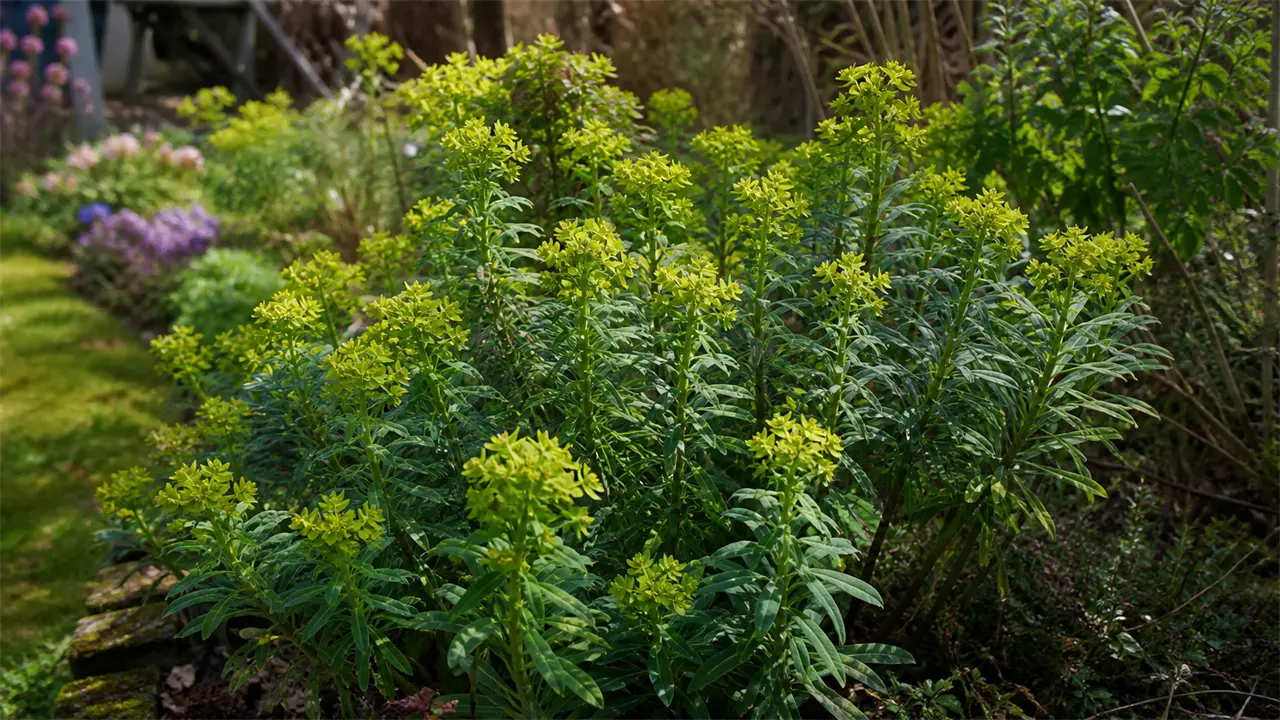
Horned spurge builds a strong, upright clump that reaches roughly 60–90 cm tall and spreads to about 45–60 cm across at full maturity. Growth emerges in spring as fresh pale-green shoots that quickly thicken into upright, lightly ridged, grey-green stems. These stems are the plant's main architectural feature: they hold their form well, rarely needing staking, and branch modestly towards the top to carry the flat-topped flower-heads in summer.
The leaves sit in opposite pairs along the stem and are ovate to lance-shaped, typically 3–8 cm long, with a softly downy underside and a slightly wavy or undulating margin that is characteristic of the species. The colour is a cool grey-green that flatters neighbouring hot-coloured flowers such as crocosmia, kniphofia and helenium. In autumn, the same foliage turns through yellow and orange into rich rusty red before the stems collapse and die back to a woody rootstock at ground level.
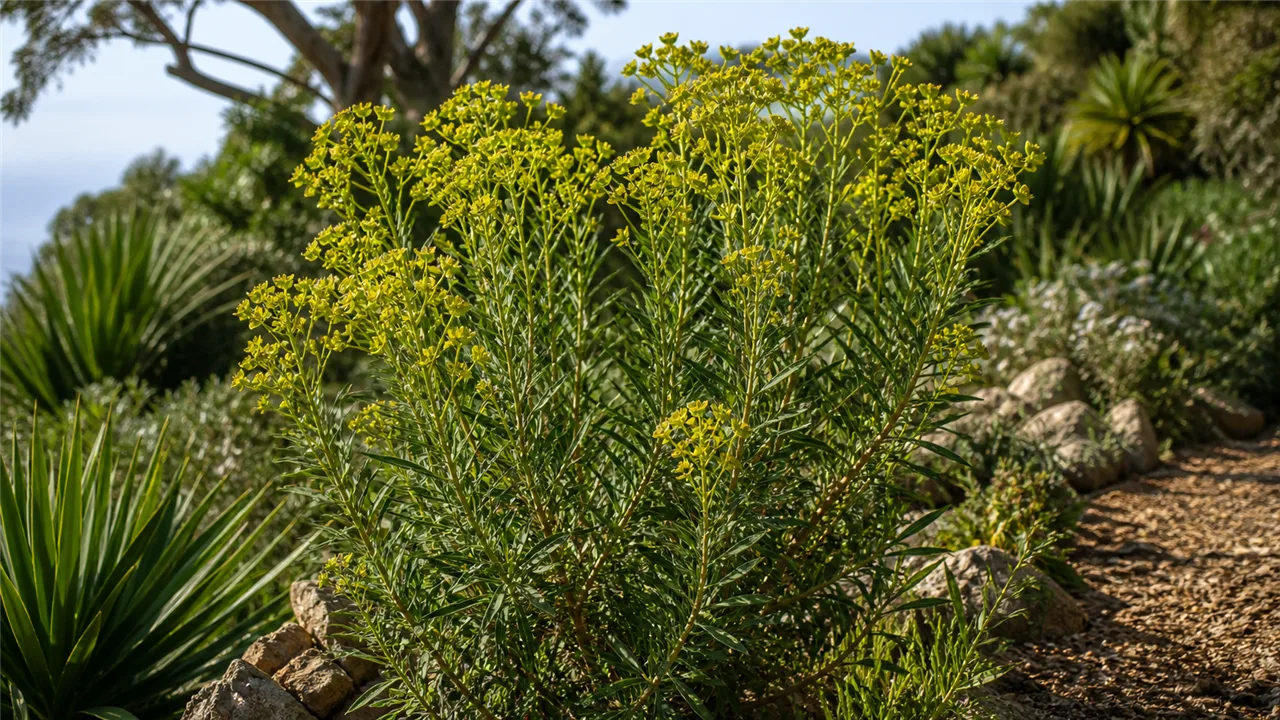
The "flowers" of E. cornigera are technically cyathia — modified cup-shaped inflorescences that the euphorbias have in place of conventional petals. In this species they are carried in broad, branching umbels at the stem tips from early to late summer, and they open a brilliant yellow-green that stands out cleanly against the grey foliage. Each cyathium is backed by a pair of yellow-green bracts, and it is from the small horn-like tips of these bracts that the species takes its botanical name.
Cutting the stems releases a distinctive milky white latex that can be seen seeping from the cut surface within seconds. This latex dries quickly and seals the wound, but it is a known skin irritant and should be washed off promptly if it contacts skin.
Growing Conditions
Horned spurge performs best in a sunny, open position where the stems can develop their full upright habit and the foliage colours up well in autumn. It tolerates light dappled shade, particularly in the warmer south and south-east of England, but flowering is noticeably better in full sun.
Soil requirements are undemanding. Average, well-drained garden soil of any texture suits it, from light loam to chalky ground, provided the site does not become waterlogged over winter. Plants tolerate clay-based soils as long as drainage is reasonable, but on heavy clay it is worth working in coarse organic matter before planting or setting the crown on a slight mound to keep it clear of saturated ground. The preferred pH is neutral to slightly alkaline, and the plant shows no particular sensitivity to chalk.
Once established, E. cornigera is moderately drought-tolerant and copes well with the dry summers that have become more common in the south and east of the UK. It is also fully hardy throughout the British Isles, including most of Scotland and the higher ground of northern England, and it carries a hardiness rating that places it firmly in the "reliable garden perennial" bracket. A deep winter mulch is unnecessary except on the coldest exposed sites.
Good garden positions include the middle or back of a mixed herbaceous border, where the upright stems give height behind lower perennials, and contemporary gravel gardens, where the grey-green foliage and yellow-green flowers harmonise with ornamental grasses and other sun-loving perennials. It also works in cottage-style plantings, pairing comfortably with hardy geraniums, salvias and the softer blues of nepeta.
Planting and Care
The best times to plant horned spurge are spring, once the soil has warmed and the risk of hard frost has passed, and early autumn, when the ground is still workable and the roots can settle in before winter. Container-grown plants from garden centres can go in at any point in the growing season provided they are watered carefully during dry spells in their first summer.
Dig a hole a little wider than the rootball and of equal depth, tease out circling roots if the plant is pot-bound, and set the crown so that it sits at the same level as it was in the pot. Backfill with the excavated soil, firm in gently, and water thoroughly. Space plants roughly 45–60 cm apart so each clump has room to reach its full spread without crowding.
Watering. Water regularly through the first growing season to help the root system establish, particularly during hot, dry spells. After that, supplementary watering is only needed during prolonged drought. Established plants resent waterlogged conditions more than they resent dryness.
Feeding. Horned spurge is not a hungry plant. A single spring mulch of garden compost or well-rotted manure around the base is usually enough to keep it vigorous. On very poor soils, an occasional balanced general fertiliser in spring is helpful but not essential.
Cutting back. The previous season's stems should be cut back to the base in late winter or early spring, just as the new shoots are starting to push through the soil. Wear gloves to protect against the milky latex, and use secateurs rather than shears so the cut is clean and the remaining crown is not bruised. Cut stems can be added to the compost heap.
Propagation. The two reliable methods are division in spring and basal cuttings taken in late spring or early summer. For division, lift an established clump with a fork, split it into smaller pieces each with roots and shoots, and replant immediately. For basal cuttings, pull young non-flowering shoots from the base of the plant, trim them below a node, and root them in a 50:50 mix of peat-free compost and perlite. Always wear gloves when handling cut material, and briefly dip the cut ends of cuttings in water to seal the latex before inserting.
Seasonal care. In summer, little is required beyond checking for aphids on tender shoot tips. In autumn, allow the foliage to colour up before the stems die back naturally. In winter, the dormant rootstock needs no protection in most parts of the UK.
Dividing clumps. Division every three to four years keeps the clump vigorous and provides new plants. It is best carried out in early spring as growth is restarting.
Common Problems
Horned spurge is generally trouble-free, but a small number of issues can occur, particularly in less-than-ideal conditions.
Aphids can cluster on soft young shoot tips in late spring. They are rarely serious enough to weaken the plant but can be disfiguring; a strong jet of water or a spray of insecticidal soap is usually sufficient to keep them in check.
Grey mould (Botrytis) may appear on stems in damp, poorly ventilated conditions, especially after a wet summer. Improving airflow by spacing plants correctly and thinning congested stems in early summer is the best preventative measure; affected material should be cut out and disposed of (not composted) once the season ends.
Crown rot is the most serious threat and is caused by waterlogged soil around the rootstock, particularly over winter. It presents as a sudden collapse of stems and blackening at the base. There is no cure once it has taken hold, so prevention — good drainage and careful siting — is essential.
Powdery mildew can affect foliage in dry, crowded summers where airflow is poor. Thin crowded stems in spring to open up the clump and avoid overhead watering; remove and destroy badly affected leaves.
Toxicity and skin irritation. Every Euphorbia species exudes a milky latex when cut or broken. This latex is toxic if ingested and a skin and eye irritant. Always wear gloves and, ideally, eye protection when cutting, dividing or propagating horned spurge. Wash any sap off the skin promptly with soap and water. Pets and children should be kept away from cut material.
Popular Varieties
Euphorbia cornigera is most often grown as the straight species, which is widely available and entirely satisfactory for most garden uses. A small number of recognised selections and closely related taxa exist, though the named-cultivar range is narrower than for some other widely grown euphorbias, and sourcing through specialist nurseries is often required.
Euphorbia cornigera — the wild-type species, with grey-green wavy-edged leaves and bright yellow-green summer flower-heads on upright stems to 75 cm. The benchmark plant against which the others are judged.
Euphorbia cornigera 'Orange Man' — a selection valued specifically for its stronger and earlier autumn colour, with the foliage turning through orange and red before the stems die back. Otherwise identical in habit to the species. Note that availability of this cultivar varies and it is sometimes listed only by specialist spurge nurseries.
Euphorbia cornigera var. cornigera — the typical variety as described above, distinguished in the literature from regional variants recognised in the wild but not commonly offered separately in British nurseries.
Euphorbia cornigera var. parvifolia — a smaller-leaved form occasionally offered in specialist plant lists. It is reported to have a slightly more compact habit and finer foliage, though nursery descriptions vary and stock can be limited.
Because the cultivar list within E. cornigera itself is small, gardeners looking for greater variety in flower colour, foliage variegation or habit often turn to closely related species such as Euphorbia schillingii (a robust hybrid often sold in place of true E. cornigera), Euphorbia sikkimensis, or Euphorbia polychroma. These are distinct species rather than cultivars of E. cornigera, but they make excellent garden companions and can be planted alongside horned spurge to extend the season of yellow-green flower colour through early and mid summer. Where named cultivars of E. cornigera are offered, they should be bought from a reputable nursery rather than assumed to be correctly identified, as spurge naming in the trade is not always consistent.
Pests and Diseases
| Problem | Symptoms | Management |
|---|---|---|
| Aphids | Clusters of small insects on new growth causing leaf distortion and sticky honeydew. | Squash by hand or spray with a plant-based insecticide like rosehip seed oil. |
| Grey mould (Botrytis) | Fuzzy grey fungal growth on stems and leaves, often in damp, humid conditions. | Improve air circulation and remove affected plant parts to prevent spread. |
| Root rot | Wilting, yellowing foliage and soft, blackened roots due to waterlogged soil. | Ensure soil is moist but well-drained and avoid overwatering, especially in winter. |
| Powdery mildew | White powdery fungal coating on leaves and flowers, potentially causing distortion. | Apply a fungicide or milk spray and ensure good air circulation around the plant. |
| Slugs and snails | Irregular holes chewed in young leaves and silvery slime trails on foliage. | Use beer traps, copper tape barriers, or iron phosphate-based pellets. |
For step-by-step help, read Controlling Aphids Naturally, Dealing with Slugs and Snails and Treating Powdery Mildew. Or browse the full plant problem solver to diagnose an issue by symptom.
Recommended Products
GardenWizz earns a commission from qualifying purchases made through affiliate links on this page (including links within the article) — as an Amazon Associate, and from Thompson & Morgan via the Awin network. This does not affect the price you pay. See our disclaimer for details.