Red Flower Iris
Iris milesii
The Gardening Year
Best months in UK gardens · full planting calendar →
🖨 Printable care card (PDF)At a Glance
| Botanical name | Iris milesii |
|---|---|
| Common name(s) | Red flower iris |
| Family | Iridaceae |
| Plant type | perennial |
| Height × Spread | 50–100 cm × 10–50 cm |
| Position | Full sun, Partial shade |
| Soil | moist but well-drained, fertile, neutral to slightly acid soil |
| Flowering | April–July |
| Toxicity | Harmful if eaten |
| Native range | Himalayas, India and China; temperate Asia (Sichuan, Xizang, Yunnan); tropical Asia (Himachal Pradesh, Uttar Pradesh, Jammu and Kashmir) |
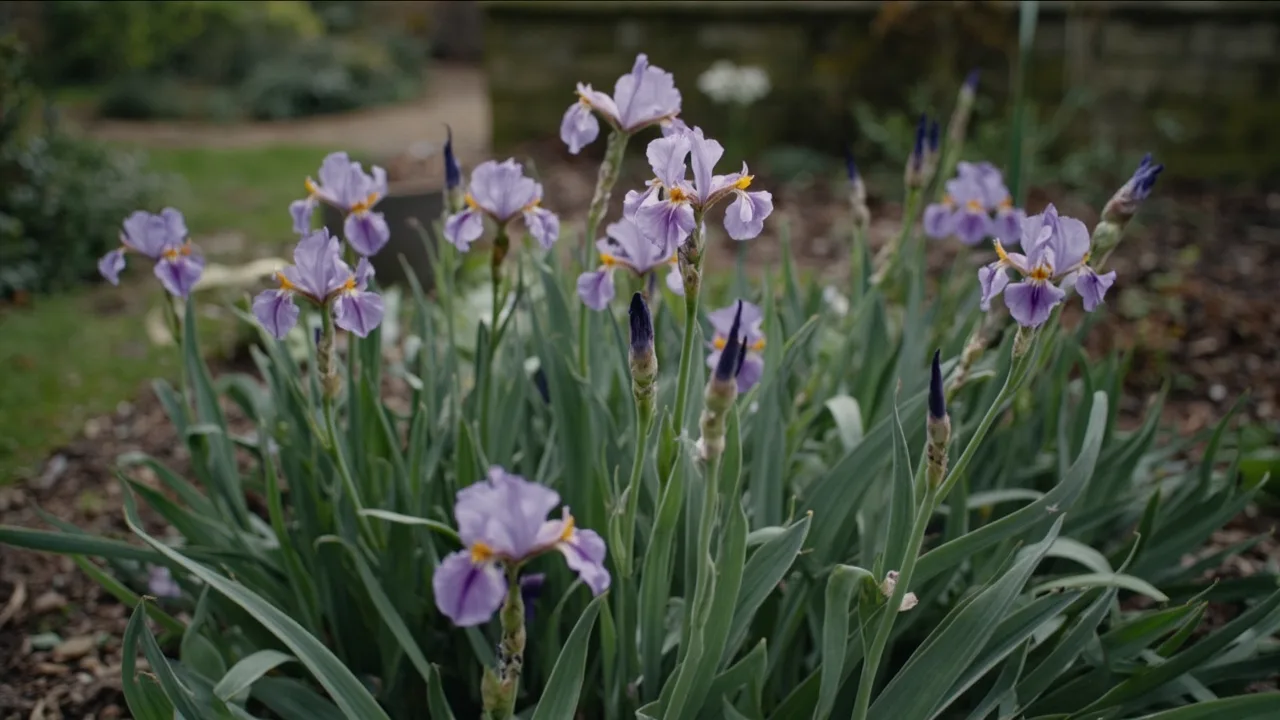
Iris milesii is a beardless rhizomatous iris from the western Himalayas that has been in British cultivation since the late nineteenth century but is still genuinely scarce in UK gardens. A single mature plant forms a spreading clump of broad, glossy, ribbed leaves and, in early summer, sends up slender branching stems hung with lavender-pink flowers marked with darker purple veining and a small orange or yellow crest on each fall. It belongs to the Evansia section of the genus, alongside the better-known Iris japonica and Iris tectorum, and rewards the UK gardener who can give it the cool, partly shaded, humus-rich conditions of its native hillside woods.
Overview
Iris milesii is a member of the family Iridaceae, subgenus Limniris, section Lophiris (the Evansia group), and was described by J.G. Baker in 1883 from specimens collected by Frank Miles in the western Himalayas. Its natural range, according to the Royal Botanic Gardens Kew's Plants of the World Online, covers the western Himalayas, Tibet and south-central China, where it grows in open woodland and grassy hillsides at mid to high altitude. In the UK it is classified by the RHS as a deciduous, clump-forming perennial that is not native to Great Britain or Ireland, and it is listed in the RHS Plant Finder through a small number of specialist nurseries.
For British gardeners it sits between the easier Iris tectorum and the tender Iris japonica in terms of cultivation: hardy enough for most of lowland Britain in a sheltered spot, but not a plant to leave to its own devices in cold, waterlogged clay. Gardeners in the milder counties — Devon, Cornwall, the south coast, the Channel Islands, favoured pockets of central London, and the western fringes of Scotland and Ireland — will have the easiest time with it; further north and east, it performs best at the foot of a warm wall, in a cold greenhouse border, or in a large container that can be moved under cover for the worst of the winter.
Appearance
Iris milesii builds up over several seasons into a slowly spreading clump of fan-shaped leaf tufts. The leaves are bright to mid-green, glossy, strongly ribbed, and noticeably broader than those of I. tectorum, reaching 30–60 cm long and 3–5 cm wide at maturity. Each fan is held semi-erect and arches outwards at the tip, giving the plant an architectural, almost bamboo-like outline in leaf. The rhizome is comparatively thick and fleshy, sitting at or just below the soil surface and throwing out short stolons that, in good conditions, allow a single plant to colonise a 30–60 cm patch over three or four years.
Flowering stems rise from the centre of mature fans in late spring, generally May to mid-June in southern England and a week or two later further north. Each stem is slender, branched, and 45–75 cm tall, well above the foliage. Flowers are 6–8 cm across when fully open, with three broad, slightly ruffled falls in pale pinkish-lavender and three smaller, more upright standards in a similar tone. The most distinctive feature of the bloom is the pattern on the falls: a paler, almost white ground suffused and veined with deep violet-purple, and a raised orange or yellow crest at the throat. Several flowers open in succession along each branched stem, and a well-grown clump carries flowers over a three- to four-week period. Seed pods follow in late summer; they are short, three-celled capsules typical of the genus.
The plant is deciduous in UK cultivation. Leaves yellow and die back in autumn, the rhizome rests through winter, and new fans push through the soil in mid-spring as soon as soil temperatures rise reliably above about 10 °C.
Growing Conditions
Iris milesii is a woodlander by origin and behaves like one in British gardens. The two conditions it will not forgive are deep winter wet around the rhizome and harsh, desiccating midday sun on frozen or droughted foliage. Given a cool root run, leaf mould in the top few centimetres of soil, and a position that catches morning sun and afternoon shade, it grows steadily and flowers freely.
Soil. The single biggest contributor to success is soil that holds summer moisture but never sits waterlogged in winter. A loam enriched with leaf mould or well-rotted garden compost, with a bucket of grit or coarse bark worked into the top 20 cm on heavier ground, replicates the open hillside woodland soils of its native range. pH should sit between roughly 5.5 and 7.0; the plant is tolerant but performs best on the slightly acid to neutral side of neutral. Avoid fresh manure or other high-nitrogen feed at the root — it produces lush leaf at the expense of flower and can rot the rhizome.
Aspect. Light dappled shade under deciduous trees and shrubs, or a north- or east-facing border that catches the morning sun, is ideal. A west-facing site against a wall works well in the wetter west of Britain, where summer drought is rarely a problem; in the drier south-east, give it a position shaded from the hottest part of the day. Avoid deep evergreen shade, where the rhizome stays cold and damp through spring and rarely dries enough to ripen for flowering.
Water. In the open ground, rainfall is usually sufficient once the plant is established, but during dry spells in May and June — the run-up to flowering — a thorough soak every seven to ten days makes a visible difference to flower size and stem count. Container-grown plants need watering roughly twice a week in summer and far less, if at all, between November and March.
Mulch. A 3–5 cm mulch of leaf mould, shredded bark or well-rotted compost applied in early spring does three jobs at once: it keeps the rhizome cool, feeds the soil fungi the plant associates with, and reduces the splash that can mark the glossy leaves in heavy rain. Replenish the mulch in autumn after the foliage has died back.
Hardiness is shown on the plant's badge; do not rely on a single quoted figure, as drainage, exposure and snow cover shift the practical limit by a full zone in either direction.
Planting and Care
Planting. Container-grown plants from specialist nurseries such as RarePlants in Devon or Plant World Seeds in Newton Abbot can go in at any time the ground is workable, but the best windows are mid-spring (April to early May), once the soil has warmed, or early autumn (September), while the soil is still warm enough for new roots to form before winter. Set the rhizome so its top sits at or just below the soil surface — unlike bearded irises, I. milesii does not need to be baked by the sun — and firm the backfill gently. Water in thoroughly and keep the soil just moist until the first new leaves push through. Space clumps 30–45 cm apart; they will fill in over two to three seasons.
Watering in the first season should be steady through dry spells to settle the plant in. After that, supplementary watering in the open ground is only needed during prolonged summer drought; container plants need more regular attention and must never be allowed to stand in a waterlogged saucer through winter.
Feeding is light. A single application of a slow-release organic fertiliser or a top-dressing of garden compost in early spring is sufficient. Avoid high-nitrogen feeds and fresh manure; both produce soft growth prone to rot and weaken flowering.
Pruning and tidying are minimal. Cut away the old flower stems once the last bloom has finished in late June or early July, taking the cut down to the base of the stem but leaving the foliage intact. Do not cut the leaves back while they are still green; the clump needs them to build up the rhizome for next year's flowers. Old leaves can be cleared away in late autumn once they have yellowed and collapsed.
Propagation is straightforward by division of established clumps. Lift a mature clump in early autumn after flowering has finished and the foliage has started to die back, shake off loose soil, and prise the rhizomes apart into pieces each with at least one strong fan of leaves and a healthy section of root. Replant the divisions immediately at the same depth, water in, and label. Division every three to four years keeps the clump flowering strongly and is the most reliable way to bulk up stock. Propagation from seed is also possible; fresh seed sown in autumn and left outdoors in a cold frame germinates the following spring, though seedlings take three to four years to reach flowering size.
Seasonal care in the UK is light. In spring, top-dress with compost, renew the mulch and watch for the first fans pushing through. In early summer, water during dry spells and stake flowering stems if they are in an exposed position. In late summer, deadhead the spent stems and watch for any congested clumps that need lifting. In autumn, clear the yellowing foliage and, in colder inland gardens, apply a dry mulch of bracken or straw over the crown for the worst of the winter.
Common Problems
Winter rot of the rhizome
Symptom: the new fans fail to emerge in spring, or emerge weakly and collapse; the crown feels soft and smells sour when inspected. Cause: prolonged saturation of cold soil around the rhizome, usually on heavy clay or in a low-lying part of the garden. Fix: lift affected plants in early spring, cut back to firm healthy rhizome tissue, dust the cut surfaces with sulphur, and replant on a small mound with added grit. Improve drainage across the bed by working in coarse bark or grit; in cold gardens, treat I. milesii as a container plant and move under cover for the worst of the winter.
Slugs and snails
Symptom: ragged holes in young fans in spring; slime trails across the new leaves. Cause: the soft emerging growth is attractive to common slugs and snails in mild, damp weather. Fix: use pet-safe ferric phosphate pellets around the new growth, thin out dense ground cover that shelters slugs, and pick off offenders after dark. The plant generally grows through minor damage without lasting harm.
Virus (Iris mosaic virus)
Symptom: pale yellow streaks or mottling on the leaves, weaker flowering, and a gradual decline of the clump over several seasons. Cause: a virus spread by aphids and passed on through division of infected plants. Fix: there is no cure. Lift and burn affected plants, control aphids with a winter wash and, if necessary, an insecticidal soap in spring, and only buy or divide from visibly healthy stock.
Lack of flowers
Symptom: a mature, healthy-looking clump that produces strong leaves but few or no flowers in early summer. Cause: usually too much shade, an over-rich nitrogen feed that promotes leaves at the expense of flowers, or a congested clump that has not been divided for several years. Fix: move the plant to a brighter position with at least half a day of sun; switch to a high-potash, low-nitrogen feed in spring; lift and divide congested clumps in early autumn.
Popular Varieties
Iris milesii is grown primarily as the species, and named cultivars are scarce in British trade. The forms most often offered by UK specialist nurseries reflect different wild collections rather than sustained breeding work.
- Iris milesii (species, western Himalayan form) — the standard plant, with branched stems 45–75 cm tall and lavender-pink flowers marked with violet veining. This is the form most commonly sold as bare-root rhizomes in the UK.
- Iris milesii (large-flowered form) — a more vigorous selection with flowers approaching 10 cm across and noticeably broader falls, occasionally offered by specialist bearded-iris growers who also handle beardless species.
- Iris milesii × I. tectorum hybrids — a small number of deliberate crosses between the two species have been raised in British and American collections, combining the harder constitution of I. tectorum with the broader flower of I. milesii. They are rarely listed commercially and tend to circulate between SIGNA (the Species Iris Group of North America) members and British Iris Society growers.
- Iris 'Roy Davidson' — a hybrid of complex Evansia parentage often grouped with I. milesii in nursery catalogues; it carries pale yellow flowers with darker markings and behaves in much the same way in UK cultivation.
Sources & Further Reading
- Source: rhs.org.uk/plants/101241/iris-milesii/details — Royal Horticultural Society plant profile for Iris milesii, with botanical details and a list of UK stockists. Accessed 2026-07-23.
- Source: powo.science.kew.org/taxon/urn:lsid:ipni.org:names:438873-1 — Royal Botanic Gardens Kew, Plants of the World Online entry confirming the species' native range and current taxonomic status. Accessed 2026-07-23.
- Source: rareplants.co.uk/product/iris-milesii — RarePlants (Devon) species profile and bare-root availability, the principal UK supplier of the species. Accessed 2026-07-23.
- Source: plant-world-seeds.com/products/iris-milesii-seeds — Plant World Seeds (Newton Abbot) seed listing for Iris milesii, including sowing notes. Accessed 2026-07-23.
- Source: wiki.irises.org/Spec/SpecMilesii — Species Iris Group of North America wiki entry on I. milesii, with detailed botanical measurements and a colour classification. Accessed 2026-07-23.
- Source: britishirissociety.org.uk/iris-guide — British Iris Society guide to the main iris groups grown in UK gardens. Accessed 2026-07-23.
Pests and Diseases
| Problem | Symptoms | Management |
|---|---|---|
| Bacterial soft rot | The base of the plant and rhizome become soft, mushy, and may emit a foul odour. | Ensure well-drained soil and dispose of severely affected plants to prevent spread. |
| Grey mould (Botrytis) | Fuzzy grey fungal growth appears on flowers, leaves, or stems, often in damp conditions. | Improve air circulation around plants and remove any infected debris promptly. |
| Slugs and snails | Irregular holes are chewed into young leaves, flower buds, and emerging shoots. | Use physical barriers like copper tape or apply iron phosphate pellets to control populations. |
| Thrips | Small insects cause silvering, distortion, or speckling on leaves and damage flower petals. | Monitor regularly and use sticky traps or introduce natural predators like lacewings. |
| Aphid-borne viruses | Young leaves show mottling, streaking, or distortion indicating viral infection. | Remove and destroy infected plants immediately to prevent transmission to healthy irises. |
For step-by-step help, read Controlling Aphids Naturally and Dealing with Slugs and Snails. Or browse the full plant problem solver to diagnose an issue by symptom.
Recommended Products
GardenWizz earns a commission from qualifying purchases made through affiliate links on this page (including links within the article) — as an Amazon Associate, and from Thompson & Morgan via the Awin network. This does not affect the price you pay. See our disclaimer for details.