New England Aster
Symphyotrichum novae-angliae
The Gardening Year
Best months in UK gardens · full planting calendar →
🖨 Printable care card (PDF)At a Glance
| Botanical name | Symphyotrichum novae-angliae |
|---|---|
| Common name(s) | New England aster |
| Family | Asteraceae |
| Plant type | perennial |
| Height × Spread | 0.3–2.4 m × 60–90 cm |
| Position | Full sun, Partial shade |
| Pet safety | Non-toxic to cats and dogs (ASPCA). |
| Soil | moist, well-drained, fertile, humus-rich; avoid very heavy clay or soils that dry out in summer |
| Flowering | August–November |
| Toxicity | Human edibility is not established; not grown as food. |
| Native range | central and eastern North America |
New England aster is one of the most valuable late-season perennials for UK gardens, producing a generous display of daisy-like flowers from late summer well into autumn, just as much of the border is beginning to tire. Native to damp meadows and roadside verges across eastern and central North America, it has settled into British cultivation with little fuss and is widely grown in herbaceous borders, wildlife plantings and naturalistic schemes. Its tolerance of heavy soils, resistance to the colder end of the British climate, and exceptional value to pollinators make it a staple of the autumn garden.
Quick-Care Table
Overview
Symphyotrichum novae-angliae belongs to the daisy family, Asteraceae, and sits within a large genus of North American asters that were reclassified out of the old genus Aster in the late 1990s. The "New England" part of the common name reflects its origins in the north-eastern United States, where it grows in moist prairie, meadow and marsh-edge habitats. In British gardens it is best treated as a back-of-border perennial, where its height can be appreciated and its slightly brittle, late-season stems supported by neighbouring plants. It is one of the last substantial perennials to come into flower in the typical UK border, providing a vital nectar source for bees, hoverflies, butterflies and other late-flying insects as they prepare for winter.
Appearance
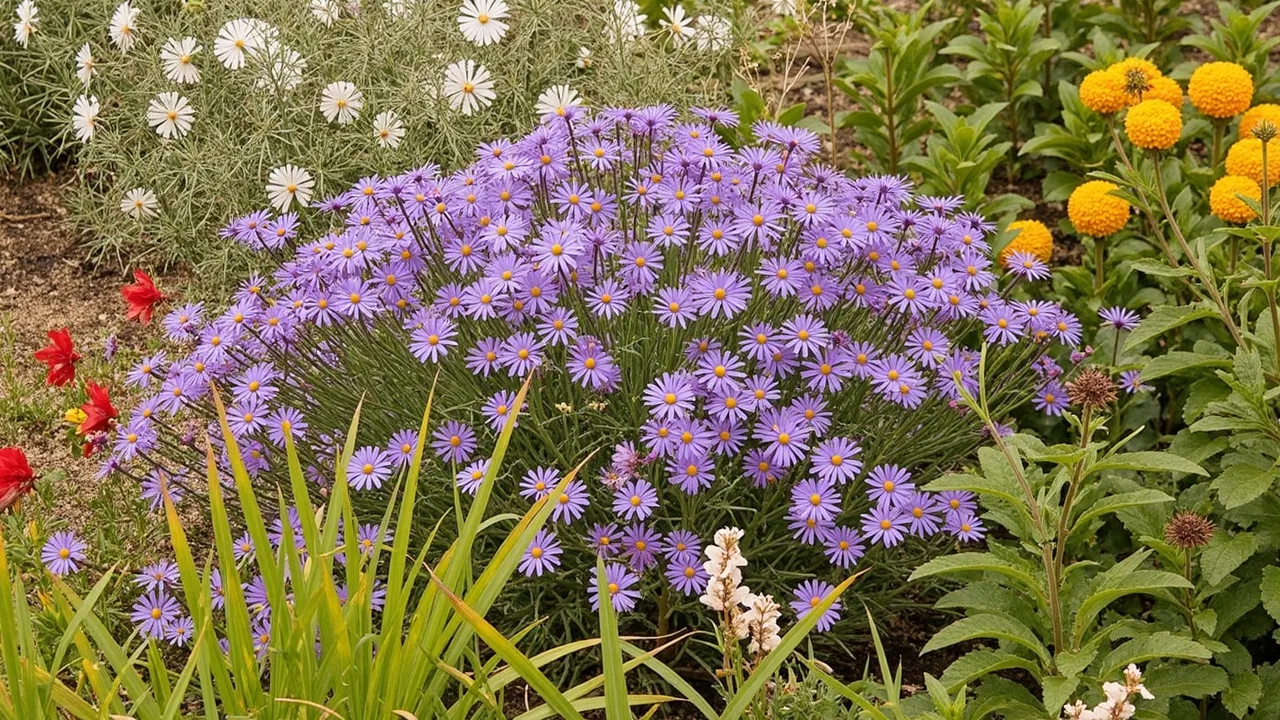
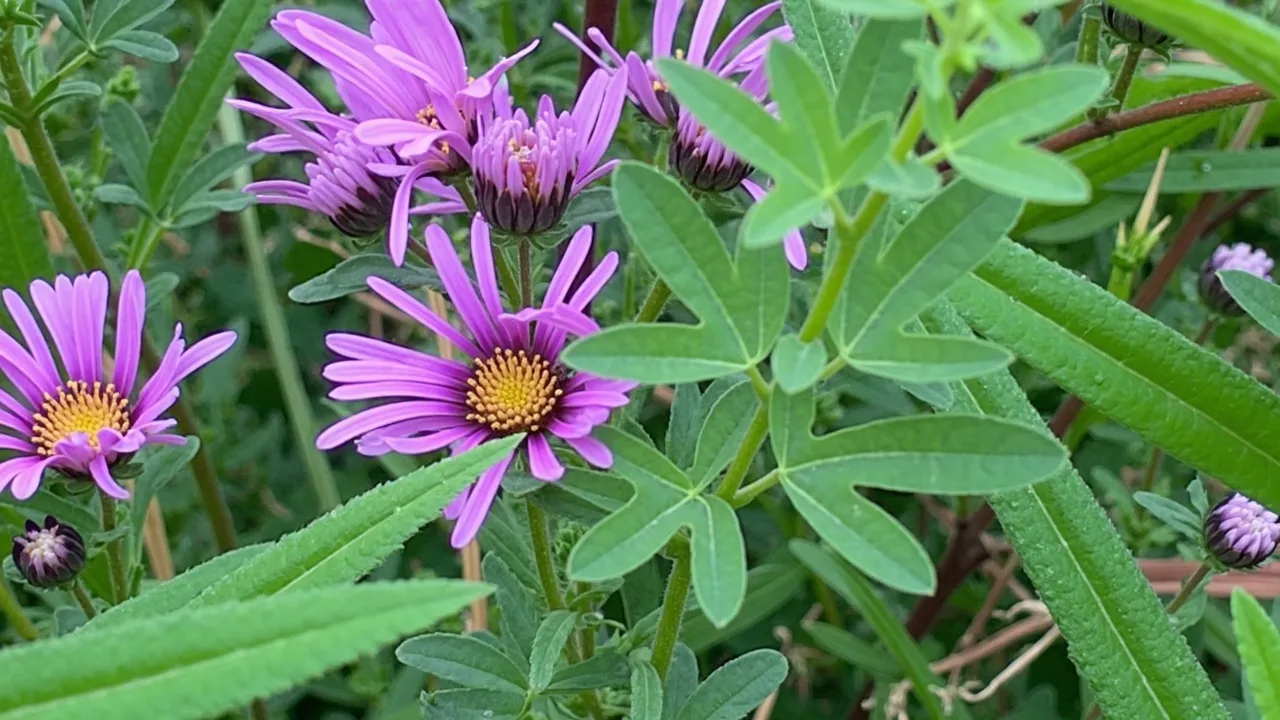
New England aster forms an upright, bushy clump of stiffly erect stems clothed in narrowly lance-shaped, stalkless leaves. The leaves are mid-green, rough to the touch and around 5–12 cm long, clasping the stem with rounded auricles rather than having a stalk. Stems and leaves are clad in fine, bristly hairs, and the foliage carries a faint, slightly resinous scent when crushed — a useful distinguishing feature from the smoother New York aster (S. novi-belgii).
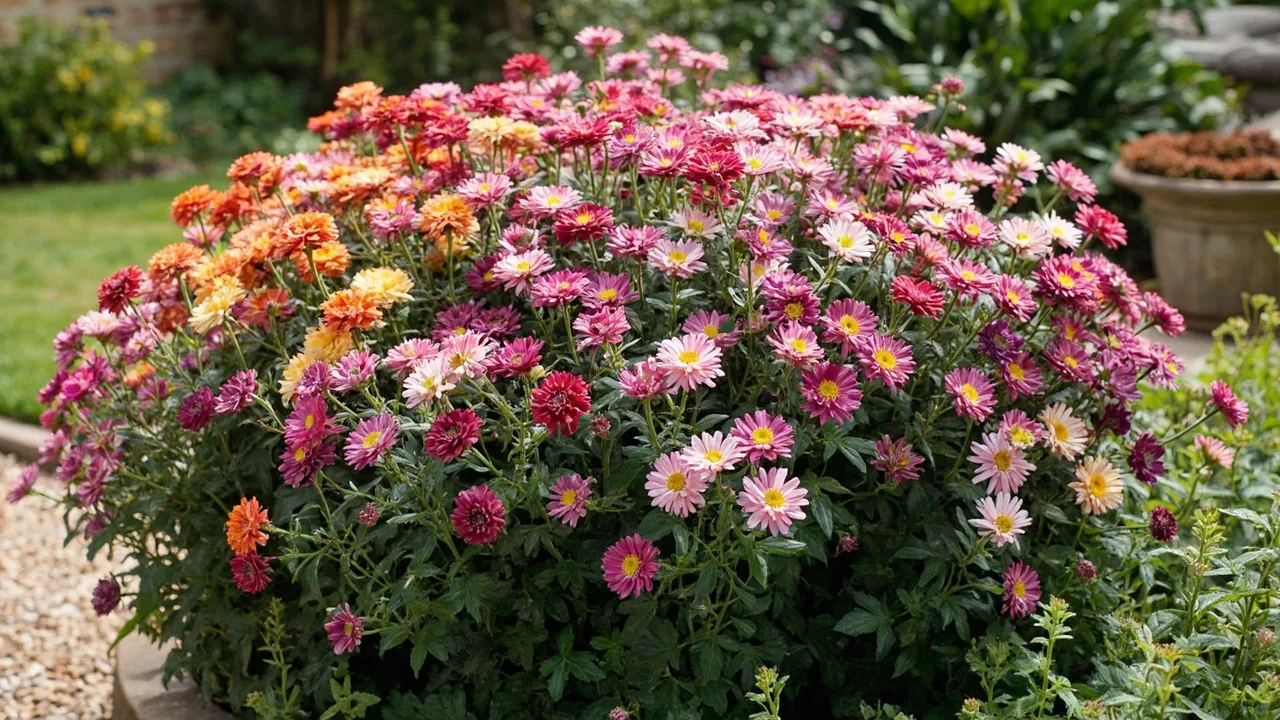
Flowering begins in late summer, typically in August, and continues through September and into October. Each stem terminates in a branched cluster of composite flower heads, each head 3–5 cm across with a central boss of golden-yellow disc florets ringed by slender ray florets. In the wild type these rays are a rich rosy purple, but cultivated selections extend the palette to pinks, magentas, lavenders and pure white. As with all composites, each "flower" is in fact a tight head of many small florets, which is why a single mature plant can support dozens of blooms while remaining in flower for many weeks. The plants die back to ground level after the first hard frost and re-emerge from a compact rhizomatous rootstock in spring.
Growing Conditions
New England aster is fully hardy throughout the United Kingdom and is rated RHS H7, the toughest category on the scale, indicating tolerance of temperatures below −20 °C. It performs best in full sun, where it produces the strongest stems and the most flowers, but it tolerates light, dappled shade for part of the day, particularly in the afternoon.
The ideal soil is one that remains consistently moist through summer but is not waterlogged in winter — a fertile, humus-rich loam suits it perfectly. It will, however, grow well on heavier clay soils provided drainage is reasonable, and established clumps tolerate short periods of dryness better than is often assumed. Soil pH is not critical: a slightly acidic to neutral reading of around pH 6.0 to 7.5 is ideal. Good siting in the open border, away from the dry root-run of large trees and shrubs, is more important than any precise soil amendment.
The plant's natural tolerance of cool, wet winters and warm, damp summers makes it particularly well suited to the temperate maritime climate of Britain. Coastal and upland gardens both grow it successfully, and it is among the more reliable late-season perennials in the colder parts of Scotland and northern England.
Planting and Care
Container-grown plants can be set out at any time the soil is workable, although spring and early autumn are the most reliable windows. Space plants 45–60 cm apart to give each clump room to develop; closer planting increases the risk of mildew. Water in well after planting and keep the soil moist during dry spells for the first growing season while roots establish. A 5–7 cm mulch of garden compost or well-rotted manure applied in spring helps to conserve moisture and feed the plant gently through the summer.
New England aster does not require heavy feeding. A single light top-dressing of a balanced general fertiliser in early spring is sufficient. High-nitrogen feeds should be avoided, as they encourage lush, sappy growth that is prone to flopping and to powdery mildew.
Pruning is the single most useful intervention. The traditional technique, sometimes called the "Chelsea chop" when performed later in the season, is to pinch out or cut back all stems by roughly half in early June. This delays flowering by a couple of weeks but produces shorter, stockier, much more floriferous plants that stand without staking. Left unpruned, taller cultivars can flop badly in autumn rain. Cut the whole plant down to within a few centimetres of the ground after flowering has finished in late autumn, once the stems have begun to yellow.
Propagation is straightforward. Mature clumps benefit from lifting and division every three to four years in spring, which both rejuvenates the plant and yields new stock. Basal cuttings taken in spring root readily in a cold frame, and seed can be sown in spring, although seedlings will not come true to the parent if cultivars are involved.
Common Problems
Powdery mildew is the most frequent complaint, manifesting as a white, dusty coating on leaves from mid-summer onwards. It is worst in dry conditions at the root combined with humid air around the foliage — common during warm British summers. The June pruning described above helps enormously by promoting shorter, better-ventilated growth; overcrowding and overhead watering should be avoided.
Aphids, particularly the large peach-potato aphid, can cluster on young shoots and unopened flower buds in late spring and early summer. They rarely kill established plants but can distort growth; spraying with insecticidal soap or encouraging natural predators such as ladybirds and hoverflies is usually sufficient.
Leaf spot, typically caused by Septoria species, produces brown lesions on the foliage and is most troublesome in wet seasons. Affected leaves should be removed and disposed of (not composted), and air circulation improved by thinning neighbouring plants.
Slugs and snails may attack the soft new shoots in spring, particularly in damp, shaded borders; the usual organic controls — night-time hand-picking, beer traps, and encouragement of natural predators — generally keep damage within acceptable bounds. Rust, appearing as orange-brown pustules on the undersides of leaves, is occasional rather than common but should be dealt with by removing and destroying affected foliage and avoiding waterlogged conditions.
The single most common "problem" is not a pest or disease but a failure to prune in June, leaving plants leggy, sparse, and liable to collapse after autumn rain.
Popular Varieties
A number of well-established cultivars are widely available in British nurseries. Their heights are typically lower than the wild type, making staking less of a concern.
- 'September Ruby' — one of the taller cultivars at around 120–150 cm, with rich ruby-red flowers from late August onwards.
- 'Purple Dome' — a notably compact selection reaching only about 45–60 cm, with vivid violet-purple flowers; one of the most useful cultivars for smaller gardens and the front of the border.
- 'Barr's Pink' — a reliable mid-height cultivar around 90–120 cm, with clear pink blooms and good resistance to mildew.
- 'Alma Pötschke' — bright rose-pink flowers on stems roughly 90–120 cm tall, a long-standing favourite for late-season colour.
- 'Herbstschnee' — a German-raised cultivar producing pure white flowers on 120 cm stems, useful for lifting darker combinations.
Seed-raised mixtures sold simply as New England aster can also be a good, inexpensive option for naturalistic plantings, where slight variation in colour and height is an asset rather than a drawback.
Cultivars and Varieties
| Cultivar | Height | Flower | Notes | AGM |
|---|---|---|---|---|
| 'Andenken an Paul Gerber' | — | — | RHS AGM (H7) | ✓ |
| 'Badsey Pink' | — | — | RHS AGM (H7) | ✓ |
| 'Barr' | — | — | RHS AGM (H7) | ✓ |
| 'Brunswick' | — | — | RHS AGM (H7) | ✓ |
| 'Colwall Century' | — | — | RHS AGM (H7) | ✓ |
| 'Helen Picton' | — | — | RHS AGM (H7) | ✓ |
| 'James' | — | — | RHS AGM (H7) | ✓ |
| 'James Ritchie' | — | — | RHS AGM (H7) | ✓ |
| 'John Davis' | — | — | RHS AGM (H7) | ✓ |
| 'Lachsglut' | — | — | RHS AGM (H7) | ✓ |
| 'Quinton Menzies' | — | — | RHS AGM (H7) | ✓ |
| 'Rosa Sieger' | — | — | RHS AGM (H7) | ✓ |
Pests and Diseases
| Problem | Symptoms | Management |
|---|---|---|
| Slugs and snails | Irregular holes chewed in new growth and leaves, often accompanied by slimy trails. | Use physical barriers like copper tape or organic pellets to protect young shoots. |
| Powdery mildew | White, dusty fungal growth on leaves and stems, potentially causing distortion. | Ensure good air circulation and water at the base to keep foliage dry. |
| Aphids | Clusters of small soft-bodied insects on new growth, often leaving sticky honeydew. | Squash by hand or spray with a strong jet of water; introduce ladybirds if severe. |
| Fusarium wilt | Sudden wilting and yellowing of lower leaves, often on one side of the plant. | Remove affected plants immediately to prevent spread and avoid replanting in same spot. |
| Leaf and bud eelworms | Distorted, swollen buds and leaves with a blistered or crinkled appearance. | Remove and burn infected plant parts; avoid planting asters in infested soil. |
| Grey mould (Botrytis) | Fuzzy grey fungal growth on flowers and stems, especially in damp conditions. | Improve air circulation and remove dead or decaying plant material promptly. |
For step-by-step help, read Controlling Aphids Naturally, Dealing with Slugs and Snails and Treating Powdery Mildew. Or browse the full plant problem solver to diagnose an issue by symptom.
Recommended Products
GardenWizz earns a commission from qualifying purchases made through affiliate links on this page (including links within the article) — as an Amazon Associate, and from Thompson & Morgan via the Awin network. This does not affect the price you pay. See our disclaimer for details.