Kew Primrose
Primula kewensis
The Gardening Year
Best months in UK gardens · full planting calendar →
🖨 Printable care card (PDF)At a Glance
| Botanical name | Primula kewensis |
|---|---|
| Common name(s) | Kew primrose |
| Family | Primulaceae |
| Plant type | perennial (herbaceous or semi-evergreen perennial, forming a basal rosette of simple leaves, with salver-shaped or bell-shaped flowers which may be solitary or carried in an umbel or in whorls on an erect stem) |
| Height × Spread | 10–50 cm × 10–50 cm |
| Position | Partial shade |
| Soil | well-drained, peat-free, loam-based compost with the addition of extra grit |
| Flowering | March–May |
| Toxicity | — |
| Native range | — |
--- calendar_class: herbaceous_perennial sow_months: [] plant_months: [3, 4, 9, 10] flower_months: [4, 5, 6] prune_months: [] cutback_months: [10, 11] divide_months: [9, 10] lift_months: [] harvest_months: [] ---
Primula kewensis (Primula kewensis): Kew primrose growing guide
Primula x kewensis is a fragrant yellow primrose hybrid for a cool greenhouse, alpine house or carefully chosen sheltered position in the UK. Give it bright light without scorching sun, consistently moist but sharply drained compost, and protection from severe winter wet.
Overview
Primula x kewensis, commonly called Kew primrose, is a cultivated hybrid associated with Kew and generally treated as a stable, fertile hybrid. The RHS describes an evergreen perennial reaching about 45 cm, with broadly spoon-shaped leaves and upright stems carrying several whorls of fragrant, bright yellow flowers. In British gardens it is best treated as a specialist primula for a cool, sheltered setting rather than as a universally tough border plant.
Its parentage is usually given as Primula floribunda x Primula verticillata. The Alpine Garden Society describes it as a stabilised, true-breeding polyploid hybrid that arose in cultivation. That history explains both its distinctive tiered flower stems and why plants sold under the name may be encountered through specialist nurseries rather than every garden centre.
Appearance
Primula x kewensis forms a low rosette of light green leaves, sometimes with a mealy, pale coating known as farina. The leaves are broader than those of a typical candelabra primula but retain a neat, primula-like texture and are held close to the crown.
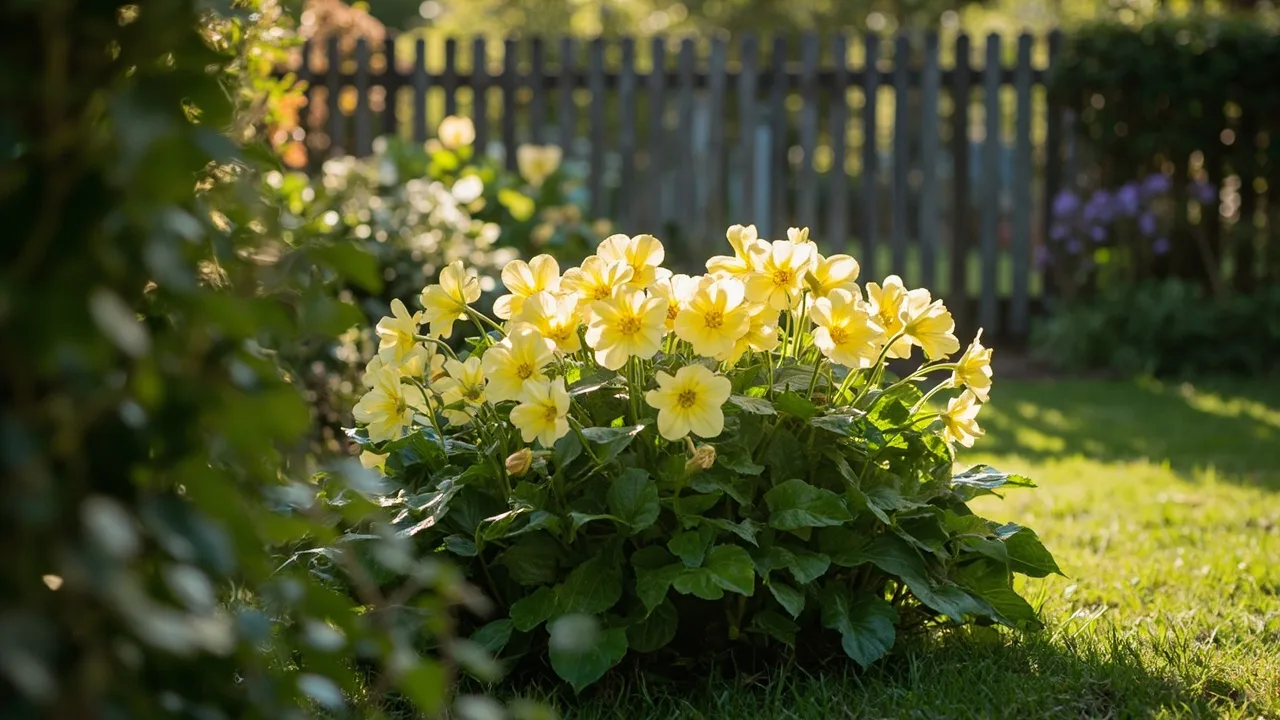
Flower stems rise above the foliage to roughly 45 cm. Each stem carries whorls of lemon-yellow flowers rather than a single flat head; the flowers are notably fragrant, particularly in a cool greenhouse or on a still spring day. The effect is airy and architectural, making it useful in a pot where the tiered stems can be seen at eye level.
The plant is evergreen or semi-evergreen in cultivation, although the amount of foliage retained depends on winter conditions. Old leaves can look tatty after a wet season, while fresh spring growth provides the best display. Avoid burying the crown beneath mulch, as stagnant moisture around the rosette can encourage rot.
Growing Conditions
Primula x kewensis prefers a cool or temperate greenhouse, alpine house or sheltered container in bright filtered light. The RHS recommends a well-drained, peat-free, loam-based compost with extra grit. A site with morning sun and afternoon shade is safer than a hot south-facing position, especially in a dry spell.
Use a compost that holds moisture without becoming waterlogged. A practical container mix is two parts peat-free loam-based compost to one part horticultural grit or fine alpine grit, with a little leaf mould if available. The grit improves drainage; it should not replace organic matter, because the roots still need reliable moisture.
In the open garden, choose a sheltered, free-draining spot with partial shade and protection from cold drying winds. Heavy clay should be improved with organic matter and grit, or the plant should remain in a raised trough or pot. In much of the UK, a container makes it easier to move the plant under cover during prolonged winter wet or a hard freeze.
Keep the compost evenly moist from spring through early autumn. Water at the base rather than repeatedly wetting the crown and leaves. During hot weather, check pots daily; small alpine-house containers can dry faster than a border even when the surrounding soil looks damp.
Planting and Care
Planting is most successful in March to April or September to October, when the soil is workable and neither the plant nor its roots are under summer heat stress. Southern UK gardeners can often plant in early autumn, while gardeners in northern or exposed areas should favour spring or provide winter shelter after autumn planting.
- Choose a pot with generous drainage holes, or prepare a sheltered bed with free-draining soil.
- Mix peat-free loam-based compost with horticultural grit before planting.
- Set the crown level with the surrounding compost or soil; do not bury the growing point.
- Firm the mix around the roots without compacting it.
- Water thoroughly, then allow excess water to drain away.
- Place the container in bright filtered light or partial shade.
- Check moisture every few days in spring and daily during hot, dry weather.
- Remove faded flower stems once flowering finishes to keep the rosette tidy and encourage continued performance.
- Apply a balanced liquid feed at half strength every two to four weeks during active growth if the plant is in a container.
- Stop regular feeding in early autumn and reduce watering slightly while never allowing the compost to become completely dry.
Watering is the main routine task. Rainfall may be sufficient for a plant in the ground during a typical British spring, but containers and plants beneath greenhouse staging still need regular checks. Use rainwater where convenient, particularly in areas with hard tap water, and avoid leaving the pot standing in a saucer of cold water.
Feeding should be modest. A weak, balanced feed during spring and early summer supports foliage and flowering; excessive high-nitrogen fertiliser produces soft growth and can make the plant less resilient. Refresh the top few centimetres of compost in spring rather than repeatedly increasing the feed rate.
Pruning is not appropriate for this herbaceous perennial. Instead, deadhead by cutting spent flower stems down to the rosette and remove yellowing leaves at their base. In October or November, cut back only damaged or collapsing foliage, leaving healthy evergreen leaves in place.
Propagation is most practical by division. Divide established crowns in September or October, separating pieces that each have roots and a visible growing point, then replant immediately into moist, gritty compost. Seed is possible for a fertile, true-breeding form, but specialist propagation is slower and seedlings should be labelled carefully; do not assume every plant sold as a named selection will reproduce identically from seed.
Seasonal care matters more than hard feeding. In February and March, move a protected plant into brighter light and begin checking for new growth. During April to June, maintain steady moisture, feed container plants lightly and deadhead. In July and August, shade glasshouses during strong sun and prevent pots from drying. In September and October, divide if necessary, tidy damaged leaves and move exposed containers to shelter before persistent winter wet arrives.
Link the plant's seasonal jobs with the March gardening calendar, April gardening calendar, September gardening calendar, October gardening calendar, and November gardening calendar. For the growing medium, see the guides to peat-free compost and horticultural grit, and compare its care with Primula vulgaris and Primula veris.
Common Problems
Crown and root rot
Symptom: Leaves collapse at the centre and the crown becomes soft or dark. Cause: Waterlogged compost, poor drainage or water sitting against the crown. Fix: Remove affected tissue, repot into fresh gritty compost and water less frequently. Move the container under cover if persistent rain is keeping it saturated. See the root rot problem solver.
Slugs and snails
Symptom: Ragged holes appear in young leaves or flower stems are chewed overnight. Cause: Slugs and snails shelter in damp, shaded conditions, particularly around pots and greenhouse staging. Fix: Check after dusk, remove hiding places, raise pots and use an approved control according to its label. Do not let dense foliage touch the ground.
Vine weevil
Symptom: Notched leaf edges are followed by sudden wilting, especially in a container. Cause: Adult vine weevils feed at night; their larvae eat roots and can sever the crown's root system. Fix: Inspect compost when repotting and remove larvae. For established container plants, consider biological control nematodes when soil temperatures and label instructions are suitable. Read the vine weevil problem solver.
Aphids
Symptom: New leaves are curled or sticky and small insects cluster around tender growth. Cause: Aphids colonise soft spring growth and may leave honeydew on leaves. Fix: Crush small colonies, wash them off with a gentle jet of water, and encourage natural predators. Avoid broad-spectrum insecticides while flowers are open.
Flowering poorly
Symptom: The plant produces leaves but few flowers. Cause: Too much shade, drought stress, excessive nitrogen or a crown that has become congested. Fix: Increase filtered light, restore even moisture, stop high-nitrogen feeding and divide an overgrown crown in early autumn. Remember that a newly divided plant may need a season to re-establish.
Popular Varieties
The base plant is commonly listed as Primula x kewensis or Primula x kewensis (Sp), rather than as a wide range of consistently available garden cultivars. Confirm the label and growing conditions with a specialist UK nursery before buying, as stock can be seasonal.
- Primula x kewensis 'Sungold': an RHS-listed selection associated with the Kew primrose group and yellow flowers.
- Primula x kewensis 'Mountain Spring': an RHS-listed named selection in the same hybrid group.
- Primula x kewensis (unnamed form): the standard Kew primrose, with fragrant yellow flowers arranged in whorls.
The first two names are recorded by the RHS, while UK availability can change. Do not substitute unrelated yellow primulas if the tiered, fragrant Kew primrose form is the feature you want. Specialist primula nurseries and National Auricula and Primula Society contacts are more reliable places to check than general seasonal bedding displays.
Sources & Further Reading
- Source: RHS: Primula x kewensis (Kew primrose)/details), accessed 21 July 2026.
- Source: RHS: Primula x kewensis 'Sungold'/details), accessed 21 July 2026.
- Source: RHS: Primula x kewensis 'Mountain Spring'/details), accessed 21 July 2026.
- Source: Alpine Garden Society: A Close Look at Primula, accessed 21 July 2026.
- Source: Alpine Garden Society Encyclopaedia: Primula kewensis, accessed 21 July 2026.
- Source: Gardeners' World: How to grow primulas, accessed 21 July 2026.
Pests and Diseases
| Problem | Symptoms | Management |
|---|---|---|
| Primula brown core | Yellow leaf spots with brown centers that may drop out, leaving holes in the leaves. | Remove and destroy infected leaves immediately and ensure good air circulation to prevent spread. |
| Powdery mildew | A white, powdery fungal growth appears on the surface of leaves and stems. | Improve ventilation and avoid wetting foliage when watering; remove severely affected parts. |
| Primula rust | Clusters of tiny, cup-like orange or brown spore-producing structures form on the leaf underside. | Remove infected leaves as soon as symptoms are seen to reduce spore load and reinfection. |
| Slugs and snails | Irregular holes chewed into leaves and silvery slime trails on foliage or nearby surfaces. | Use physical barriers like copper tape or grit, and hand-pick pests at night. |
| Vine weevil | Notched edges on leaves above ground and root damage causing wilting or collapse below. | Apply biological nematodes to the soil in autumn and spring to control larvae. |
For step-by-step help, read Dealing with Slugs and Snails and Treating Powdery Mildew. Or browse the full plant problem solver to diagnose an issue by symptom.
Recommended Products
GardenWizz earns a commission from qualifying purchases made through affiliate links on this page (including links within the article) — as an Amazon Associate, and from Thompson & Morgan via the Awin network. This does not affect the price you pay. See our disclaimer for details.