Blireana Plum
Prunus × blireana
The Gardening Year
Best months in UK gardens · full planting calendar →
🖨 Printable care card (PDF)At a Glance
| Botanical name | Prunus × blireana |
|---|---|
| Common name(s) | Blireana plum |
| Family | Rosaceae |
| Plant type | shrub (deciduous) |
| Height × Spread | 4 m × 4 m |
| Position | Full sun |
| Soil | moist, but well-drained, moderately fertile soil; Chalk, Clay, Loam, Sand; Acid, Alkaline or Neutral |
| Flowering | March–May |
| Toxicity | — |
| Native range | — |
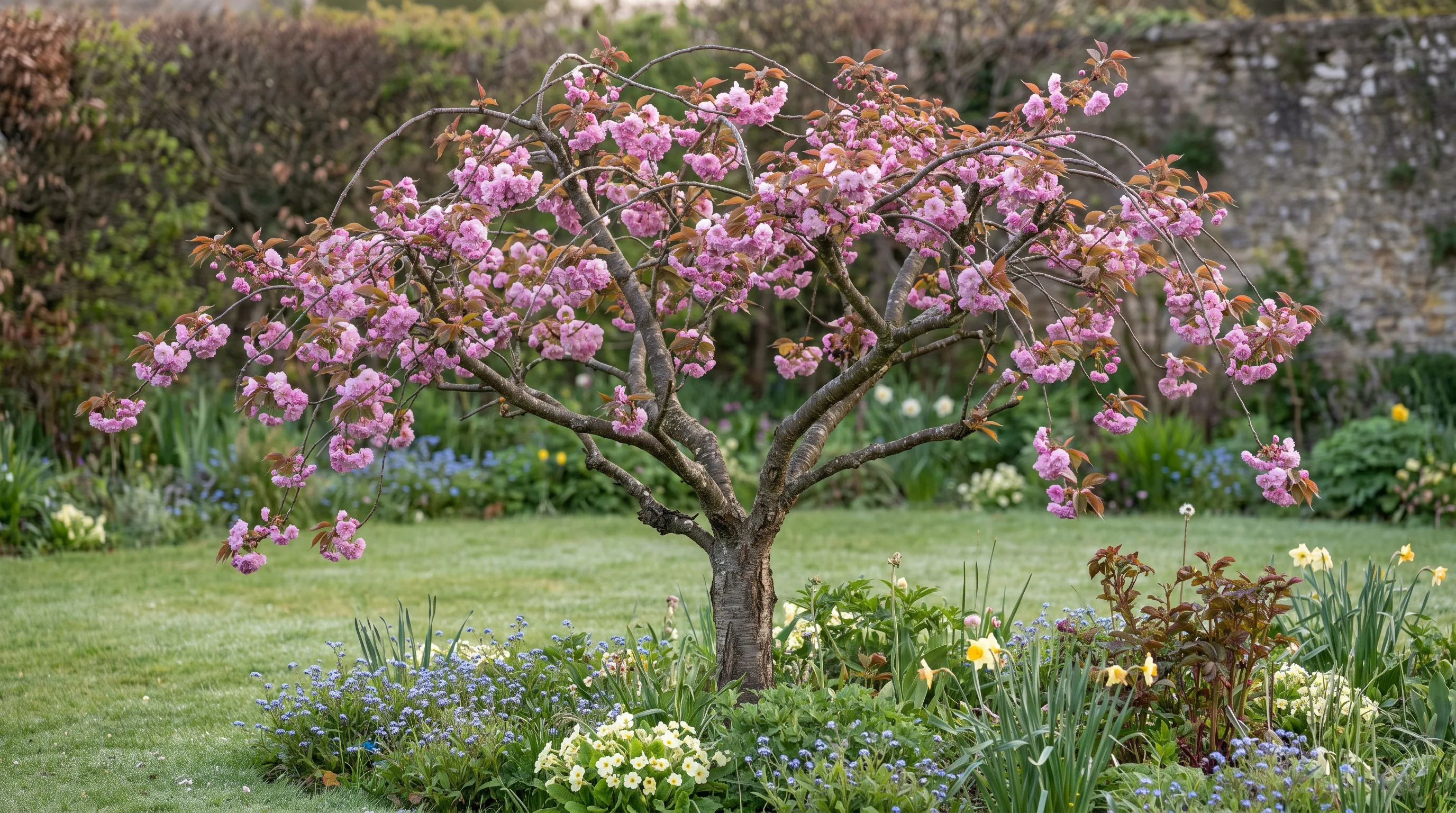
The Blireana plum is a small deciduous flowering tree grown almost entirely for its spring display. Covered in semi-double, rose-pink, lightly fragrant blossom carried on bare branches, it is one of the most reliable early-spring ornamental plums for British gardens, and it combines that flower with the bronze-purple foliage inherited from one of its parents. It is an inter-specific hybrid between the Japanese apricot (Prunus mume) and the purple-leaved cherry plum (Prunus cerasifera 'Atropurpurea'), and was raised in France in the early years of the twentieth century. It is widely planted in temperate gardens across the UK as a specimen tree, a courtyard feature, or a wall-trained fan in cooler districts.
Overview
Prunus × blireana belongs to the rose family (Rosaceae) and sits within the genus Prunus, alongside cherries, almonds, peaches and other ornamental plums. Its exact origin is generally credited to a French hybridiser working in the early 1900s, and the cultivar name 'Blireana' refers to Bléré in the Loire Valley, the town associated with its raising. It has been in British cultivation for the best part of a century and remains a popular choice where a compact, spring-flowering ornamental tree is required.
Its garden value rests on three traits. First, the blossom: semi-double, rose-pink, fragrant, and borne profusely along bare branches in early spring before or with the emerging leaves. Second, the foliage: emerging bronze-purple and holding a dark greenish-bronze tone through summer, a colour inherited from the cherry plum parent. Third, the size and habit: small enough for a courtyard garden, rounded-headed, and tolerant of urban conditions. The small dark plums that sometimes follow the flowers are ornamental rather than culinary, and fruiting is generally sparse in the UK climate.
In UK gardens the tree is best suited to lowland and southern districts. It flowers early enough that severe late frosts can damage open blossom in cold inland pockets and exposed northerly sites, so a sheltered position is worth prioritising in such places. Otherwise it is an undemanding ornamental that asks only for sun, decent drainage, and the basic pruning discipline common to all Prunus.
Appearance
The Blireana plum develops a small, rounded head on a short trunk, reaching roughly 4–6 m in height with a similar spread at maturity. It can also be maintained as a large multi-stemmed shrub if pruned from an early age. The bark on young shoots is smooth and reddish-brown to purplish, darkening with age.
The leaves are ovate to lanceolate, around 5–8 cm long, with finely serrated margins. They emerge bronze-purple in spring, often at the same time as or just after the flowers, and mature to a dark greenish-bronze through summer. This persistent bronze tint is one of the most recognisable features of the plant and distinguishes it from many other ornamental flowering plums, whose foliage reverts to plain green. In a good autumn the leaves may take on a brief yellow or orange flush, although autumn colour on this hybrid is often unreliable and should not be relied upon when siting it.
The flowers are the principal ornamental feature. They are semi-double, around 2–3 cm across, with a soft rose-pink colour and a light, sweet fragrance. They are carried in profusion along the bare branches of the previous year's wood, appearing in early to mid spring — typically March to April across most of the UK, with coastal and southern gardens on the earlier end of that range and colder inland districts a week or two later. The flowers open before or with the emerging bronze foliage, so the early-spring effect is of pink blossom against bare reddish-brown wood.
The fruit, where it sets, is a small dark purple-red plum of around 2–3 cm. It is incidental rather than useful: ornamental, occasionally made into preserves, but generally sparse and not considered a culinary asset in the UK.
Growing Conditions
The Blireana plum performs best in full sun, which both maximises flowering and helps the foliage keep its bronze tone. It tolerates light dappled shade, particularly in warmer southern gardens, but flowering will be reduced and the foliage will read greener in heavier shade.
Soil should be moist but well-drained and reasonably fertile. A loamy garden soil is ideal; the tree tolerates a pH range from acid through neutral into mildly alkaline, which makes it straightforward in most British gardens. It will not thrive in compacted ground or in sites that waterlog in winter, both of which predispose the roots to stress and the tree to canker. Sandy soils are acceptable provided irrigation is kept up during establishment; thin, hungry chalk soils are workable but benefit from organic mulch and a spring feed.
Aspect matters more for blossom protection than for general vigour. A sheltered site facing away from the prevailing north or east wind reduces both bud damage in late winter and the risk of frost-blasted open flowers in a hard spring frost. The tree tolerates urban pollution and is a reasonable choice for town gardens, courtyards and front gardens where space is at a premium.
Hardiness: the plant carries an RHS hardiness rating held in the structured field on this page; refer to the badge for the rating. In practical terms the Blireana plum is considered hardy across most of lowland Britain, though exposed northerly and inland sites may see flower damage in severe late-spring frosts.
Planting and Care
Planting time is autumn through early spring, while the tree is dormant and the ground is workable. Container-grown stock can go in at any time of year provided it is kept well watered through its first summer. Bare-root stock, where available, is best planted between November and March. Allow around 4–6 m of horizontal space for the mature spread; the Blireana plum is not a suitable street tree beneath overhead wires.
After planting, apply a 5–8 cm organic mulch over the rooting area, keeping it clear of the trunk itself. Renew this mulch annually in early spring. A single application of a balanced slow-release fertiliser in spring supports both flowering and the bronze foliage flush; on reasonably fertile garden soils this is rarely needed in subsequent years.
Watering matters most in the first two growing seasons. Keep a newly planted tree watered through dry spells until it is established; an established Blireana plum tolerates short dry periods without complaint. Container-grown specimens on a sunny patio will, of course, need more regular irrigation throughout their life.
Pruning should be kept to a minimum. The objective is to remove any dead, damaged or crossing wood and to maintain a balanced, open crown. If shaping is needed, prune immediately after flowering in late spring or early summer. Two rules are worth keeping in mind across all Prunus: avoid heavy winter pruning, which exposes the tree to silver leaf infection, and disinfect tools between cuts on diseased wood. The Blireana plum is not a plum to be hard-pruned as if for fruit production; light, selective work after flowering is the correct approach.
Propagation is typically by semi-ripe cuttings taken in mid to late summer, or by grafting onto a Prunus rootstock such as P. cerasifera or P. domestica 'St Julien A' for a tree-form specimen. Named clones are usually bought as grafted plants to keep the hybrid true.
Seasonal care is otherwise straightforward. In late winter, check for bullfinch damage on the fattening buds in rural gardens and net small specimens if necessary. In spring, watch for leaf-curling plum aphid on the emerging foliage and treat if infestations are heavy. In high summer, keep watering consistent on young plants and renew mulch as needed.
Common Problems
Silver leaf (Chondrostereum purpureum) is the principal disease risk across the Prunus genus and the Blireana plum is not exempt. The fungus enters through wounds and is most active in cool, damp conditions. The discipline that minimises risk is to prune only in dry summer weather (immediately after flowering), to avoid unnecessary wounds, and to disinfect secateurs between cuts.
Bacterial canker (Pseudomonas syringae) can affect stems and spurs, producing sunken lesions and dieback, particularly on stressed trees or in poorly drained soils. The mitigation is the same set of cultural measures that suit the tree generally: free-draining soil, no winter pruning, and avoidance of wounds during the dormant period.
Blossom wilt (Monilinia laxa) appears as brown, withered flowers that cling to the shoots after bloom, often with gum weeping from the spur. Infected spurs should be cut back promptly into clean wood and removed from the site; again, dry-weather pruning is the cleanest preventative.
Aphids are a regular spring feature. Leaf-curling plum aphid is the most common on this species, attacking the emerging foliage and causing the characteristic twisted, puckered leaves. Heavy infestations can be controlled with a winter wash, by encouraging natural predators, or by targeted treatment in spring.
Bullfinches can be a problem in some rural districts, stripping the fattening flower buds in late winter. Netting small specimens is the cleanest defence where the damage is recurrent.
In well-sited, well-tended plants these problems are uncommon and rarely severe. The Blireana plum is generally a trouble-free ornamental provided the standard Prunus cultural rules are followed.
Popular Varieties
Prunus × blireana is itself a single hybrid clone, almost always sold simply as Prunus × blireana without a cultivar epithet, and most plants in cultivation share the same genetic background. Within that single clone the plant is reasonably uniform in flower colour, habit and foliage tone.
Where a related look in slightly different proportions is wanted, gardeners sometimes turn to the parent species. Prunus mume, the Japanese apricot, is a larger and more vigorous tree with single or semi-double flowers in white, pink or red and a stronger almond-like fragrance; it flowers slightly earlier and is less reliably hardy in cold inland UK districts. Prunus cerasifera 'Atropurpurea', the purple cherry plum, carries single pink-white flowers and the deep bronze-purple foliage that the Blireana plum inherits, and is itself widely grown as a small ornamental tree.
Other ornamental Prunus sometimes considered as alternatives include flowering cherries such as Prunus 'Kanzan' and the early-spring Prunus × subhirtella cultivars, both of which flower later and on a different scale. None reproduces the exact combination of semi-double pink blossom and bronze foliage that the Blireana plum offers, which is why this hybrid has kept its place in British planting lists for over a century.
Note on cultivar naming: the brief for this article did not provide verified cultivar names beyond the hybrid clone itself and its parents, and the writer has not invented any additional cultivar names. If a specific clone is required for a planting scheme, suppliers should be consulted for current availability and naming.
Pests and Diseases
| Problem | Symptoms | Management |
|---|---|---|
| Silver leaf | Leaves develop a silvery sheen and branches may die back due to fungal infection. | Prune out infected wood well below the visible symptoms and burn it immediately. |
| Bacterial canker | Sunken, discoloured lesions on stems with oozing gum and dieback of branches. | Prune out affected wood in dry weather during summer to prevent spread. |
| Powdery mildew | White powdery fungal growth appears on young leaves, shoots, and flowers. | Improve air circulation by thinning the canopy and apply a suitable fungicide if severe. |
| Aphids | Clusters of small soft-bodied insects suck sap from new growth causing leaf distortion. | Encourage natural predators like ladybirds or use a strong jet of water to dislodge them. |
| Verticillium wilt | Sudden wilting and yellowing of leaves on one side of the plant with no external cause. | Remove and destroy infected plants and avoid replanting Prunus in that soil for years. |
For step-by-step help, read Controlling Aphids Naturally and Treating Powdery Mildew. Or browse the full plant problem solver to diagnose an issue by symptom.
Recommended Products
GardenWizz earns a commission from qualifying purchases made through affiliate links on this page (including links within the article) — as an Amazon Associate, and from Thompson & Morgan via the Awin network. This does not affect the price you pay. See our disclaimer for details.