Great White Rhododendron
Rhododendron decorum
The Gardening Year
Best months in UK gardens · full planting calendar →
🖨 Printable care card (PDF)At a Glance
| Botanical name | Rhododendron decorum |
|---|---|
| Common name(s) | Great White Rhododendron |
| Family | Ericaceae |
| Plant type | shrub |
| Height × Spread | 1–6 m × 1.5–2.5 m |
| Position | Partial shade |
| Soil | moist but well-drained, leafy, humus-rich acid soil |
| Flowering | March–May |
| Toxicity | Harmful if eaten |
| Native range | northern Myanmar and Guizhou, Sichuan, Xizang, and Yunnan, China |
Overview
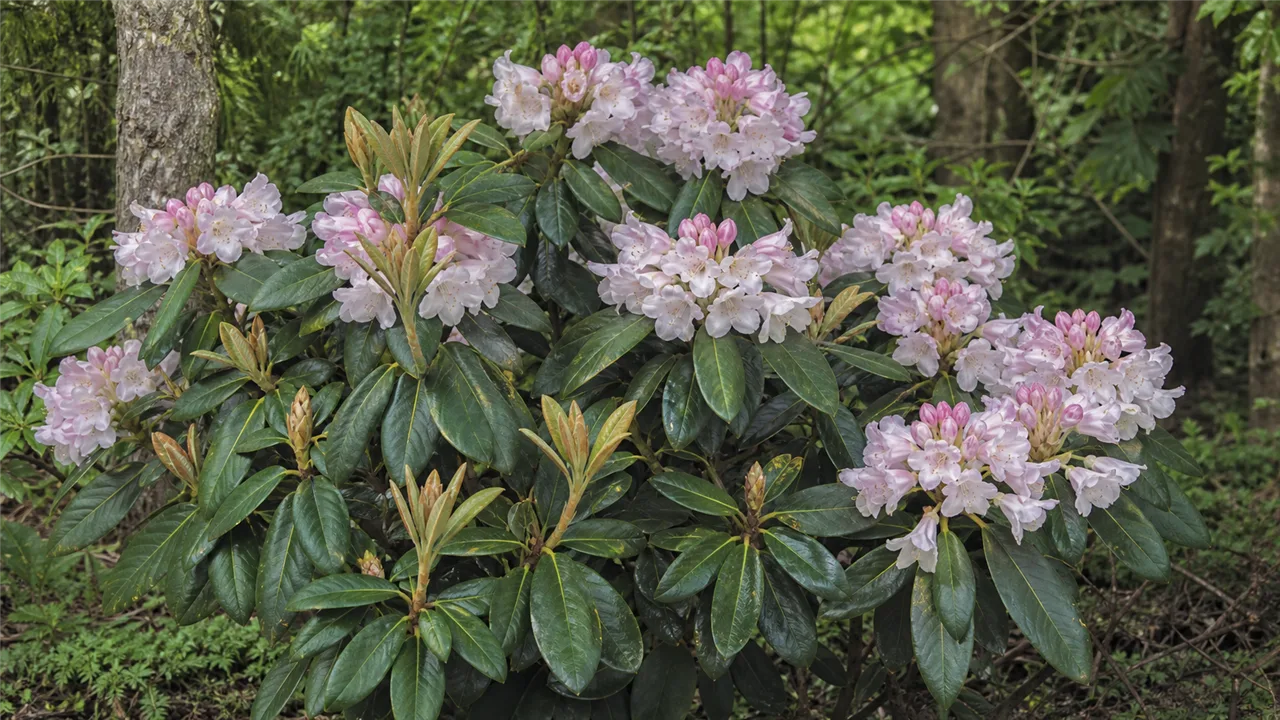
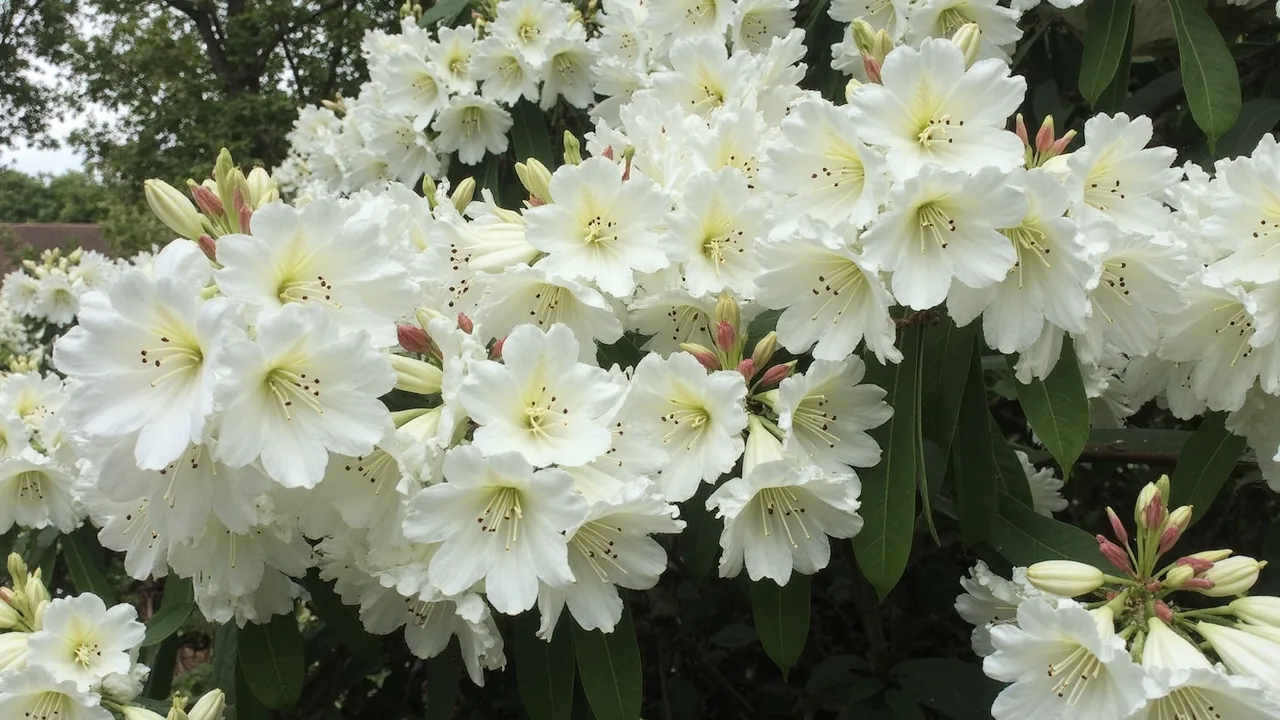
Rhododendron decorum is a large, evergreen rhododendron native to the mountains of south-western China and adjacent north-eastern Myanmar. First described from Yunnan by the French missionary-botanist Jean Marie Delavay in the 1880s and introduced to British gardens by George Forrest in 1906, it has long been valued for two qualities that are unusual among big-leaved rhododendrons: a noticeably sweet scent and a willingness to flower freely as a relatively young plant. In a suitable spot in the United Kingdom it makes a substantial, rounded shrub of around two to five metres, decked in late spring with loose trusses of pink-budded, open-faced white flowers above long, deep-green leaves.
It is a member of subsection Thomsonii within section Ponticum, the group that also includes the well-known R. arboreum and R. campylocarpum. Like its relatives it is an ericaceous plant: in cultivation it needs the same lime-free, humus-rich, moist-but-drained conditions that suit rhododendrons generally. Given that, it is reliably hardy across most of lowland and low-upland Britain, and is one of the better large-leaved species for a sheltered, dappled border in the south and west.
Appearance
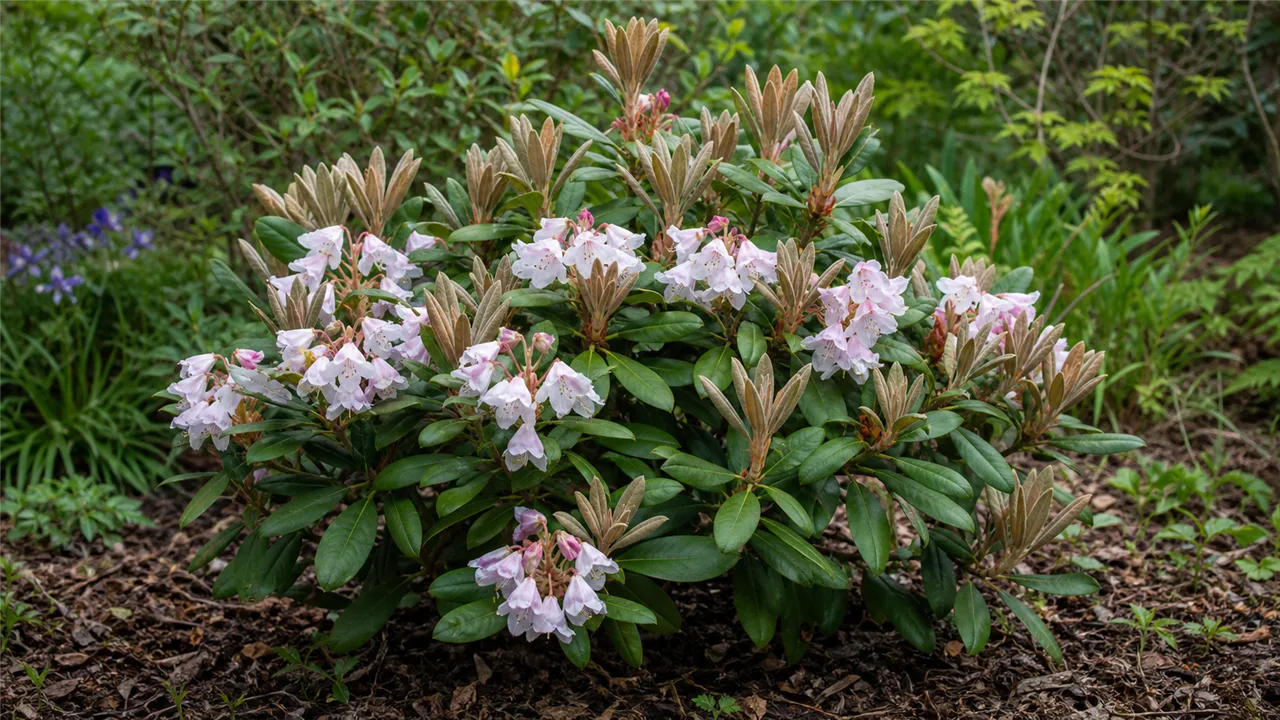
Rhododendron decorum is a broad, rounded evergreen shrub, sometimes developing a short trunk and a more open, small-tree-like habit in older specimens. After fifteen to twenty years in a good British garden a well-grown plant typically reaches three metres in height with a similar spread, and very old plants in mild Cornish or Argyllshire gardens can exceed five metres. The overall outline is denser and more leafy than the rather gaunt, leggy habit of related species such as R. arboreum, which helps it sit more naturally in a mixed border.
The leaves are one of its best features. They are oblong to elliptic, typically eight to fifteen centimetres long and three to five centimetres wide, with a leathery texture and a smooth, slightly glossy dark green upper surface. The underside carries a distinctive pale, powdery blue-grey bloom (a waxy coating called a glaucous indumentum), which flashes silvery when the wind lifts the foliage. This two-tone effect — deep green above, chalky blue-green beneath — is one of the easiest ways to tell R. decorum apart from similar large-leaved species, and it gives the plant year-round interest even when out of flower.
The flowers appear in mid- to late spring, generally from late April through May in southern England and a little later further north or at altitude. They are carried in loose, open trusses of roughly eight to twelve blooms at the shoot tips. Each flower is widely funnel-shaped to almost flat-faced, about six to eight centimetres across, with five to seven gently waved lobes. The buds are a clear, fresh pink; as they open the petals fade to white, often with a faint pink flush on the outside and a small greenish or pinkish speckle on the upper lobe. The most striking feature, however, is the scent: a soft, sweet, lily-like fragrance that carries on a still spring morning. Scent is uncommon in large-leaved rhododendrons, and R. decorum is one of the most reliably fragrant of the whole group.
Growing Conditions
Rhododendron decorum wants the same conditions as any ericaceous shrub: an acid soil, plenty of organic matter, reliable moisture without waterlogging, and protection from the harshest sun and the worst of the wind.
Soil pH is the most important factor. The species performs best in a soil between about pH 4.5 and 6.0, in the same range as camellias, blueberries and heathers. In neutral or alkaline ground the foliage slowly yellows as iron and manganese become unavailable, and the plant steadily declines; on limy or chalky soil it is not a realistic choice even in a large container. Where the garden soil is mildly acidic but heavy, incorporate generous amounts of leaf mould, composted bark or pine needle litter at planting time, which both lowers the local pH and improves the open, free-draining structure that rhododendron roots need.
Light should be dappled or part-shade. R. decorum will tolerate a few hours of direct morning sun, and a little late afternoon sun is fine in the west of the UK, but the leaves scorch readily in prolonged midday exposure, particularly in the south and east. A position on the north or east side of a building, or in the high shade of deciduous trees, suits it well. Shelter matters too: the long leaves are easily tattered by cold easterly winds in late spring, just as the new growth and flowers are at their most vulnerable.
The species is reliably hardy throughout lowland Britain and tolerates winter temperatures down to roughly minus fifteen degrees Celsius in a well-drained site, corresponding to RHS hardiness rating H6. Gardeners in cold inland districts and in much of Scotland can grow it well provided the soil is right and the site is sheltered; the limiting factor is usually spring frost and wind rather than midwinter cold, and a frost pocket should be avoided.
Planting and Care
Planting is best done in autumn or early spring, when the soil is moist and warm and the plant can establish before summer drought or winter cold stress it. Dig a hole at least twice as wide as the rootball and no deeper, and backfill with a mix of the existing soil and generous amounts of ericaceous compost, leaf mould or composted bark. Set the plant so the top of the rootball sits level with — or slightly proud of — the surrounding soil, because rhododendrons are surface-rooters and resent being buried too deep. Water in thoroughly and mulch with a five-centimetre layer of bark or leaf mould, kept clear of the stem.
Watering matters most in the first three or four summers. The species likes a consistently damp but not sodden root run, so water deeply during dry spells rather than little and often. Once established it is reasonably drought-tolerant for a rhododendron, but prolonged dry conditions will check growth and reduce flowering the following year.
Feeding should be light and targeted. A slow-release ericaceous fertiliser applied in late spring, or an annual mulch of well-rotted leaf mould or pine needle litter, is usually sufficient. Avoid high-nitrogen lawn or rose feeds, which push soft leafy growth vulnerable to frost and to rhododendron lace bug.
Pruning is minimal. Deadhead spent trusses carefully as soon as flowering finishes, snapping them off just above the new growth buds without damaging the young shoots beneath; this diverts energy into growth rather than seed and improves the following year's display. If a plant becomes leggy or outgrows its space, it can be cut back hard into old wood after flowering; R. decorum usually responds by sending out new shoots from below the cut, though flowering is sacrificed for a season or two.
Propagation is straightforward from semi-ripe cuttings taken in mid- to late summer. Use current-season wood that has just started to firm at the base, about eight to twelve centimetres long, wound the base lightly, dip in a hormone rooting powder, and root in a 50:50 mix of peat-free ericaceous compost and perlite under a closed propagator with bottom heat. Layering of a low flexible shoot in autumn is slower but reliable without propagation equipment.
Common Problems
Rhododendron decorum shares most of the routine pests and diseases of the wider genus, and is not particularly prone to any one of them.
Phytophthora root rot is the most serious threat on heavy or waterlogged soils. The first symptom is usually a plant that wilts and looks thirsty even in moist ground, followed by sudden collapse. Prevention is far easier than cure: site the plant in free-draining, humus-rich soil and avoid burying the rootball.
Rhododendron lace bug is increasingly common in the south and east of the UK. The pest feeds on the underside of the leaves, leaving a fine pale stippling on the upper surface and dark brown tar-spot droppings below. Mild attacks are largely cosmetic; heavier infestations weaken the plant and can be controlled with a winter wash to the undersides of leaves, encouragement of natural predators, or a systemic insecticide as a last resort.
Powdery mildew can mark the leaves in dry, sheltered summers, particularly on plants under stress. Improving airflow, avoiding drought stress, and clearing fallen leaves in autumn are usually enough to keep it in check.
Yellowing leaves (chlorosis) in a plant otherwise growing in acid soil are usually a sign of waterlogging, root damage, or a shortage of iron and manganese that can be corrected with a chelated ericaceous feed.
Bud blast and flower damage from late frost is largely a site problem rather than a disease. Choosing a sheltered position out of the worst frost pockets, and draping horticultural fleece over the plant on cold nights in April and May, will protect the display in marginal sites.
As with all rhododendrons, the foliage and flowers contain grayanotoxins and should not be eaten; significant quantities can cause stomach upset in pets as well as people.
Popular Varieties
In practice, named cultivars of Rhododendron decorum are few and uncommon in general cultivation; the species itself is what is usually grown.
Rhododendron decorum is most often grown as the straight species, because seedlings tend to be reasonably uniform and the species itself is an attractive garden plant. A handful of forms and hybrids are nevertheless worth seeking out.
The most familiar garden form is the typical pink-budded white-flowered plant raised from Forrest's early twentieth-century introductions, which set the standard for the species in British gardens. Gardeners looking for a particularly robust or free-flowering form should look for plants sold as the Forrest selection, or as large-flowered seedlings from reputable specialist rhododendron nurseries where named mother plants have been chosen over many years.
A more strongly pink-flowered form, sometimes listed as the pink decorum and traded informally among collectors, has deeper rose buds and flowers that retain a noticeable pink flush even when fully open. It is less commonly offered but is a striking plant where it can be obtained from a specialist nursery.
Within subsection Thomsonii, R. decorum has also been used in hybridising. Crosses with related species such as R. arboreum and R. griffithianum appear in the parentage of many older large-flowered hardy hybrids, and where R. decorum is one of the parents the offspring typically inherit its scent, its tolerance of warmer UK summers, and the pale underside to the leaves.
For UK gardeners who want the look of R. decorum in a smaller garden, the species crosses well with R. fortunei, and selections from such crosses — often sold simply as scented large-leaved rhododendron hybrids — give a similar effect in a more compact package. As with any named cultivar, check the label for hardiness and ultimate size, and buy from a specialist nursery that can confirm the plant has been raised from a known parent rather than from open-pollinated seed of uncertain parentage.
Pests and Diseases
| Problem | Symptoms | Management |
|---|---|---|
| Powdery mildew | White powdery fungal growth appears on leaves, buds, and shoots, potentially causing distortion. | Tolerate unless severe; avoid fungicides to protect biodiversity and do not remove leaves. |
| Bud blast | Flower buds turn brown, shrivel, and fail to open before flowering time. | Remove and destroy infected flower buds promptly if practical for the plant size. |
| Vine weevil | Notches on leaf margins above ground and root damage causing wilting below ground. | Use biological nematodes in soil or physical barriers to control larvae and adults. |
| Silver leaf | Leaves develop a silvery sheen underneath and branches may die back. | Prune out infected wood well below the visible symptoms and destroy it immediately. |
| Rhododendron leafhopper | Small white flecks or stippling on the upper surface of leaves. | Encourage natural predators like ladybirds; severe cases may require targeted insecticide. |
For step-by-step help, read Treating Powdery Mildew. Or browse the full plant problem solver to diagnose an issue by symptom.
Recommended Products
GardenWizz earns a commission from qualifying purchases made through affiliate links on this page (including links within the article) — as an Amazon Associate, and from Thompson & Morgan via the Awin network. This does not affect the price you pay. See our disclaimer for details.