
Highbush Blueberry
Vaccinium corymbosum · rabbiteye blueberry
The Gardening Year
Best months in UK gardens · full planting calendar →
🖨 Printable care card (PDF)At a Glance
| Botanical name | Vaccinium corymbosum |
|---|---|
| Common name(s) | highbush blueberry, rabbiteye blueberry |
| Family | Ericaceae |
| Plant type | shrub (deciduous) |
| Height × Spread | 1.8–3.7 m × 1.8–3.7 m |
| Position | Full sun, Partial shade |
| Soil | Well-drained, moisture-retentive, acidic soil (pH 4.5-5.5); organically rich; loam or sand. |
| Flowering | March–June |
| Toxicity | No specific toxicity is listed by the RHS. This is not a guarantee of safety — check with a vet or the ASPCA before pets or children eat any plant. |
| Native range | eastern Canada and the eastern and southern United States |
Overview
Blueberry (Vaccinium corymbosum), the Northern Highbush Blueberry, is the cultivated crop behind the supermarket punnet. It is a deciduous shrub bred from North American stock, hardy across most of the UK, and one of the few fruit crops that genuinely demands acid soil — which is why so many UK plantings struggle on neutral or chalky ground. Grown well, a single bush can crop from year three onwards for twenty years or more, yielding 4–7 kg of fruit per mature plant.
The case for growing your own is partly flavour (shop berries are picked firm for transport) and partly value: established potted plants at garden centres are expensive, and a healthy bush replaces that spend many times over. Blueberries also suit small gardens and patios better than almost any other soft fruit — they crop reliably in 30–40 L containers of ericaceous compost where ground soil is unsuitable.
For UK growers the practical reality is that blueberries need three things right to fruit well: acidic soil (pH 4.5–5.5), consistent moisture, and a sunny or only lightly shaded site. Get those, and the rest is straightforward.
Sowing
Blueberries for fruit are not grown from seed in any practical UK sense. Commercial and amateur fruiting stock is propagated by softwood or semi-ripe cuttings, or by micropropagation, because seed-raised plants take 5–7 years to fruit and don't come true to cultivar. If you want blueberries to eat, plant a potted bush.
When to plant
Container-grown blueberry bushes can go in at almost any time the soil is workable, but two windows are best:
- Autumn (October–November) — the recommended main planting window across most of the UK. Soil is still warm, rainfall is reliable, and the plant establishes roots over winter before pushing strong growth the following spring.
- Early spring (March–April) — a useful second window, especially in colder regions and Scotland where winter heave can lift newly planted stock.
Avoid planting into frozen or waterlogged ground, and avoid mid-summer planting unless you can commit to daily watering for the first two months.
How to plant — ground
- Test your soil pH before doing anything else. A cheap pH meter or kit from a garden centre will do. If pH is above about 5.5, in-ground blueberries are unlikely to thrive without major intervention.
- Where the soil is suitably acidic (pH 4.5–5.5, the typical reading under rhododendrons, heathers and conifers in your area is a useful proxy), plant at the same depth the bush sat in its pot, in a hole roughly twice the width of the rootball.
- Work in well-rotted leaf mould or pine bark fines at planting — both acidify slightly and improve the loose, humus-rich texture blueberries need.
- Space bushes 1.2–1.5 m apart for most highbush cultivars; closer (1 m) if growing as a hedge, wider (1.8 m) for the very vigorous cultivars such as 'Bluecrop'.
- Mulch 5–8 cm deep with pine bark, bark chippings or pine needles. Keep the mulch clear of the stem.
How to plant — containers
For most UK gardeners with neutral or chalky soil, containers are the reliable route. Use a pot at least 40 cm wide and 40 cm deep (40–50 L), filled with ericaceous (acidic) compost — the John Innes ericaceous mix, or a peat-free ericaceous blend. Mix in roughly 20% by volume of pine bark fines for long-term structure. Blueberries in pots dry out fast and need watering almost daily in summer; the trade-off is you control the soil perfectly.
Region-aware notes
- Mild south-west (Cornwall, Devon, Somerset, Dorset, south Wales, the Channel Islands) — soil pH is often naturally low and rainfall high. In-ground plantings of highbush blueberries do well. Plant from October through to early December.
- South-east and East Anglia — generally the hardest UK region for in-ground blueberries: free-draining sandy soils tend to be neutral-to-alkaline, and rainfall is lower. Container cultivation is the safer bet; if planting in ground, dig a 60 cm-wide pit and fill with ericaceous compost.
- Midlands and northern England — workable in-ground if you can confirm pH; otherwise containers. Plant autumn or wait until late March / April.
- Scotland, north-east England, higher ground — late spring planting (mid-April into May) is safer to avoid frost heave. Choose the hardier northern highbush cultivars ('Bluecrop', 'Patriot', 'Northcountry', 'Northblue' — the last two are half-high types bred for cold climates).
Pollination
Most highbush blueberries are at least partly self-fertile, but crops are heavier and earlier with two cultivars flowering at the same time. Plant at least two from the same flowering group within 1.5–2 m of each other for the best yields.
Growing
Watering
Blueberries have shallow, fibrous roots and will not tolerate drought at any stage, especially while fruit is swelling (May–July in the UK). Water deeply rather than little-and-often: in the ground, soak the root zone once or twice a week in dry spells; in containers, water daily in summer, possibly twice in heatwaves. Always use rainwater if your tap water is hard — alkaline tap water gradually raises compost pH and locks out iron, producing the classic yellowing between leaf veins on new growth.
Feeding
Blueberries are light feeders. In early spring, top-dress with an ericaceous feed (a slow-release formulation sold for rhododendrons and camellias works well), or apply a liquid ericaceous feed at half-strength every 2–3 weeks from April to July. Avoid general-purpose fertilisers and any feed containing lime. Mulch annually with fresh pine bark or composted pine needles.
Mulching and weeding
Maintain a 5–8 cm organic mulch year-round. It keeps roots cool, conserves moisture, and slowly acidifies the surface layer. Hand-weed — blueberries' surface roots resent hoeing.
Pruning
Prune in late winter (February–early March), starting from year four. The aim is to remove roughly one in five of the oldest, thickest stems at the base each year, plus any dead, crossing or weak wood. This keeps the bush open, encourages strong new canes that will fruit the following year, and prevents overcropping of small berries. After year eight or nine, a harder renewal prune — taking out two or three old stems — will rejuvenate the plant.
Pests and problems
- Birds are the number one issue. Blackbirds in particular will strip a bush clean. Net with a fruit cage or individual bush netting as the berries start to colour (usually late June in the south).
- Vine weevil can be a problem in containers — the grubs eat roots. Check before planting by tipping the rootball out; treat with nematodes (Steinernema kraussei) in August–September if found.
- Chlorosis (yellow leaves with green veins) is almost always pH or water-quality related in the UK — correct the soil, switch to rainwater.
- Frost damage to flowers — late April and May frosts can scorch open blossom in inland and northern sites. Fleece covers on cold nights are worthwhile in a small planting.
UK climate notes
Highbush blueberries tolerate winter cold to roughly -25 °C once fully dormant, well below anything the UK throws at them, so winter hardiness is rarely the issue. The UK climate challenge is insufficient winter chill in the mildest south-west regions: a few older southern highbush cultivars need only 200–300 hours below 7 °C and crop well anywhere; traditional northern highbush cultivars need 800–1000 hours, which most of inland and northern Britain easily supplies but which the far south-west and Channel Islands sometimes don't. If you're in those milder corners, choose low-chill cultivars such as 'Misty', 'Sunshine Blue' or the early-fruiting 'Duke'.
Harvesting
UK blueberries ripen from mid-July into September, depending on cultivar and region:
- South-west, southern coastal areas and London — first fruit typically from late June into mid-July.
- Most of England and Wales — main picking window is mid-July through mid-August.
- Scotland, north-east England, higher ground — main picking late July through August, sometimes into early September.
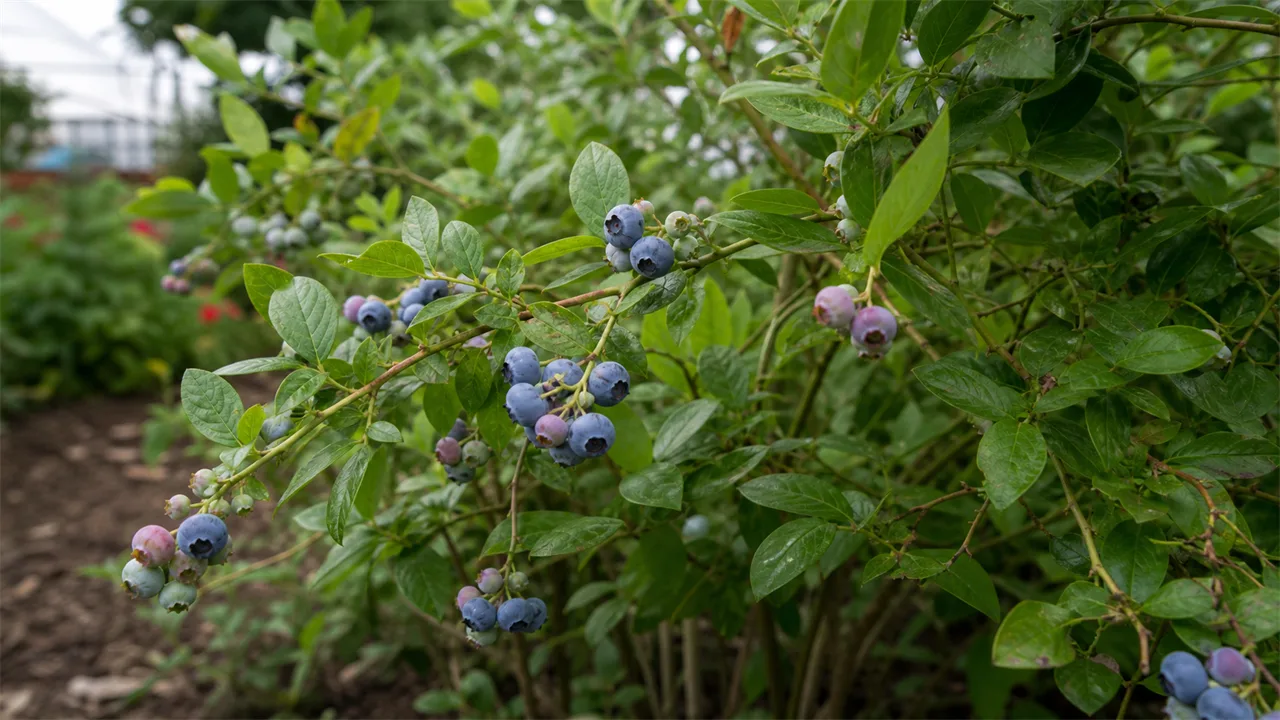
A bush will crop over 3–5 weeks rather than all at once. Pick individual berries rather than clusters. Ripe fruit is fully blue all the way round with no green or red at the stem end, comes away easily with a gentle tug, and has a slight bloom (the pale dusty coating) on the skin. Berries picked slightly under-ripe will not ripen further at home, so leave them on the bush.
In a good year, expect 2–3 kg from a bush in its third year, building to 4–7 kg at full maturity (years five to ten). Net before, not after, the birds find the fruit.
Eating
Fresh-picked blueberries at full ripeness are markedly sweeter and more complex-flavoured than anything shop-bought. They're genuinely one of the crops where the gap between home-grown and bought is largest.
Straight from the bush is the best starting point — at peak ripeness, with the morning still cool, they're excellent raw. Beyond that:
- Yoghurt, porridge and muesli — the obvious use, and one of the better ways to eat them without cooking.
- Baking — blueberries hold their shape better than most soft fruit when baked. They suit muffins, pancakes, simple cakes, crumbles and cobblers. Toss in a teaspoon of flour before folding into batter so they don't sink.
- Jams and compotes — high in natural pectin, so they set cleanly. Combine with a little lemon juice if you want a sharper set.
- Sauces for game and pork — briefly stewed with red wine, shallot and a splash of vinegar makes a sharp, vivid sauce that pairs well with rich meat.
- Frozen — the easiest way to deal with a glut. Spread unwashed berries on a tray, freeze, then tip into a bag. They'll keep a year and can be used from frozen in baking or thawed for yoghurt.
Nutritional note
Blueberries are notably high in anthocyanins (the pigments that give them their colour) and vitamin C. They're one of the better fruit choices for fresh eating in volume.
Storing
Fresh-picked blueberries keep in the fridge for about a week in a covered container — don't wash them until just before use, as moisture shortens storage life significantly. They store longer than raspberries or strawberries but shorter than currants.
For longer keeping:
- Freezing is the easiest method (see Eating). Spread on a tray to freeze individually first so they don't clump, then bag.
- Jam and compote — use within a year for best colour.
- Drying is possible but rarely done domestically; the berries are low in sugar and dry to a leather rather than a raisined fruit.
- Infused in vinegar or spirit — blueberry gin and blueberry vinegar both work well and use up surplus without specialist equipment.
Supporting
Most highbush blueberry bushes are self-supporting and need no staking. In exposed sites (coastal north Scotland, the Pennines, upland Wales) taller cultivars such as 'Bluecrop' or 'Chandler' can lean under a heavy crop — a short post and soft tie at 60 cm is occasionally worthwhile for a mature bush. Bushes in containers on windy patios are best weighted or in a sheltered corner.
Cultivars and Varieties
| Cultivar | Height | Flower | Notes | AGM |
|---|---|---|---|---|
| 'Duke' | — | — | Award of Garden Merit | ✓ |
| 'Spartan' | — | — | Award of Garden Merit | ✓ |
Pests and Diseases
| Problem | Symptoms | Management |
|---|---|---|
| Vine weevil | — | — |
| Honey fungus | — | — |
| Powdery mildews | — | — |
| Root rot | — | — |
| Chlorosis | Due to iron and manganese deficiency | — |
For step-by-step help, read Treating Powdery Mildew. Or browse the full plant problem solver to diagnose an issue by symptom.
GardenWizz earns a commission from qualifying purchases made through affiliate links on this page (including links within the article) — as an Amazon Associate, and from Thompson & Morgan via the Awin network. This does not affect the price you pay. See our disclaimer for details.