Common Camellia
Camellia japonica · Japanese camellia
The Gardening Year
Best months in UK gardens · full planting calendar →
🖨 Printable care card (PDF)At a Glance
| Botanical name | Camellia japonica |
|---|---|
| Common name(s) | common camellia, Japanese camellia |
| Family | Theaceae |
| Plant type | shrub |
| Height × Spread | 1.5–6 m × 4–8 m |
| Position | Full shade, Partial shade |
| Soil | acidic |
| Flowering | March–April |
| Toxicity | No specific toxicity is listed by the RHS. This is not a guarantee of safety — check with a vet or the ASPCA before pets or children eat any plant. |
| Native range | China and Japan |
Overview
Common camellia (Camellia japonica) is a glossy-leaved evergreen shrub native to Japan, Korea and parts of China, and one of the most widely planted ornamental flowering shrubs in British gardens. It belongs to the family Theaceae and is grown primarily for its showy, often long-lasting flowers which open from late winter into spring, providing colour at a time when little else is in bloom. In the UK, C. japonica has been cultivated since the early nineteenth century and forms the backbone of many historic and modern shrub collections, particularly in the milder, wetter south and west.
The species is closely related to the tea plant (Camellia sinensis) and shares its preference for acid, humus-rich soils. It should not be confused with Camellia × williamsii hybrids, which were bred specifically for greater cold tolerance, earlier shedding of dead flowers, and a longer flowering season; C. japonica cultivars tend to hold their spent blooms on the plant, which can look untidy in wet weather. A wide range of japonica cultivars is offered by UK nurseries, with flower forms ranging from simple singles to formal doubles, in colours from pure white through pink and red to deep crimson, often with contrasting golden stamens at the centre.
Appearance
Camellia japonica is a dense, upright to spreading shrub with a naturally tidy, slightly layered habit. In the wild it can eventually reach the size of a small tree, but in cultivation in the UK most plants remain shrub-sized within a normal gardening lifetime. The leaves are one of its most attractive features outside the flowering season: they are leathery, elliptical to broadly oval, 5–10 cm long, with finely serrated margins and a glossy dark green upper surface. The underside is paler and matte. New growth in spring is often a lighter, bronze-tinted green before hardening to deep green.
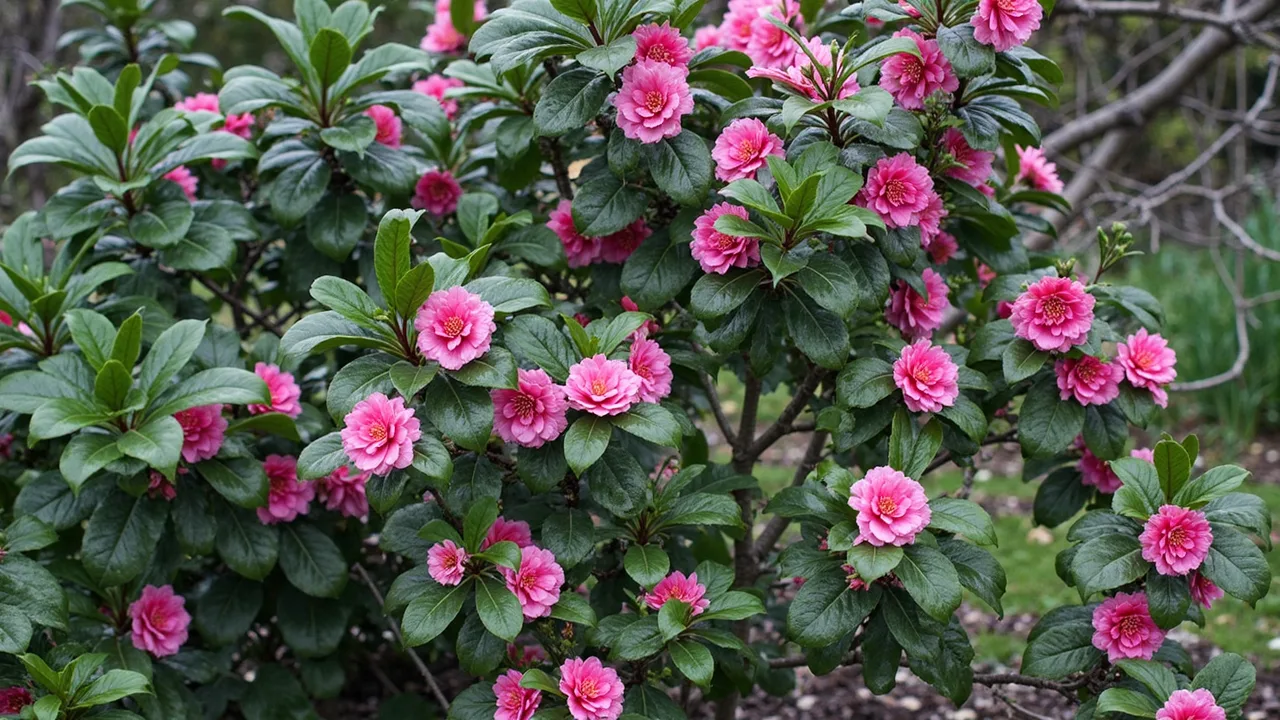
The flowers are the main reason for the plant's popularity. They are typically 7–12 cm across, though this varies noticeably with cultivar. Six main flower forms are recognised by growers: single, semi-double, anemone-form, peony-form, rose-form double, and formal double. Colours range from pure white, through shell-pink and rose, to cherry red, crimson and, in some cultivars, deep wine-purple; bicoloured and striped forms also exist. At the centre of single and semi-double flowers sits a prominent boss of golden-yellow stamens, which are conspicuous against darker petals. The flowers are produced mainly on the previous year's wood and appear at the leaf axils along the branches.
Growing Conditions
Camellia japonica performs best in a sheltered, partially shaded position, ideally with protection from the early morning sun. Buds and open flowers can be damaged by sudden thaws followed by re-freezing, and an east-facing site that catches morning sun on frosted buds is a common cause of browning and bud drop. A west- or north-facing wall, or light overhead canopy from deciduous trees, offers good protection. In the milder south-west, Wales and along the western seaboard, the species can be grown in more open positions, whereas in colder inland or northern gardens a courtyard or walled garden is preferable.
The soil must be acid to neutral, moist but free-draining, and rich in organic matter. Slightly chalky or alkaline ground will cause leaves to yellow through iron and manganese deficiency (lime-induced chlorosis) and the plant will gradually decline. Where soil is unsuitable, C. japonica can be grown successfully in large containers of ericaceous (lime-free) compost. Container culture is, in fact, one of the most reliable ways to grow camellias in much of central and southern England, where garden soil is often over chalk.
The RHS assigns Camellia japonica an H5 hardiness rating, indicating it is hardy in most parts of the UK in a suitably sheltered site, coping with minimum winter temperatures in the range of -10 to -15 °C. In colder pockets — inland Scotland, exposed northern England, and high-altitude gardens — losses in harsh winters are possible, particularly to young or recently planted specimens. Planting against a wall, mulching heavily in autumn, and avoiding east-facing exposure all help to push the plant safely through cold snaps.
Planting and Care
Plant container-grown camellias in autumn or spring, when the soil is moist and warm enough to encourage quick root establishment. Dig a hole at least twice the width of the rootball and incorporate well-rotted leafmould, bark or ericaceous compost into the backfill. After planting, water thoroughly and apply a thick organic mulch of leafmould or bark, keeping it clear of the stem. Container-grown plants should be potted into ericaceous compost in a container comfortably larger than the original, with crocked drainage.
Watering is most critical in the first two or three years and during dry summers. The root system is relatively shallow and the plant shows stress quickly: flower buds may drop, or leaves may curl and turn dull. Water with rainwater rather than tap water where possible, particularly in hard-water areas, to avoid raising soil pH. A regular soak in July and August, when the following year's flower buds are forming, is especially worthwhile.
Feeding should be modest. A slow-release ericaceous fertiliser applied in late spring, or a top-dressing of well-rotted leafmould and a light application of sequestered iron if chlorosis appears, is usually sufficient. Avoid heavy nitrogen feeds, which can promote soft growth prone to frost damage.
Pruning is minimal. The plant has a naturally tidy shape and responds to light formative pruning after flowering in spring. Remove any dead, damaged or crossing branches, and lightly shorten over-long shoots to keep the shrub within bounds. Hard renovation pruning is tolerated by established plants and can be done immediately after flowering, though flowering will be reduced for one or two seasons afterwards.
Propagation is usually by semi-ripe cuttings taken in mid to late summer, or by layering low branches in autumn. Both methods are straightforward for the home gardener, though seed-raised plants are variable and are used mainly by breeders.
Seasonal care centres on three moments: in autumn, apply a mulch and, in exposed gardens, consider fleece protection for young plants; in late winter, clear fallen flowers from beneath the plant if desired (with japonica cultivars they often remain attached); and in spring after flowering, feed lightly and top up the mulch.
Common Problems
The most frequently reported issue on C. japonica in the UK is bud drop, where well-developed buds turn brown and fall before opening. The usual causes are inconsistent watering, particularly drought during bud formation in summer, sudden cold snaps in early spring, or frost-thaw cycles caused by morning sun on frozen buds. Improving soil organic matter, mulching, watering in dry summers, and siting the plant away from morning sun are the main remedies.
Yellowing leaves between green veins, especially on container-grown or pot-bound plants, usually indicate iron or manganese deficiency brought on by alkaline soil or compost. Treatment is by switching to ericaceous compost, watering with rainwater, and applying a chelated iron or ericaceous tonic in spring.
A fungal disease, camellia leaf gall (Exobasidium camelliae), can cause leaves and occasionally buds to become thickened, fleshy and pale. It is unsightly rather than fatal: affected parts should be picked off and destroyed before the white spore bloom is released in late spring. Sooty moulds sometimes appear on leaves beneath aphid colonies and can be washed off once the insects are controlled.
Scale insects and aphids are the most common pests. Neither is usually serious, and a winter wash, encouragement of garden predators, or a careful targeted spray will normally keep them in check.
Toxicity information for C. japonica is limited in the published horticultural literature; the plant is not generally listed among significantly poisonous garden shrubs, but it should not be assumed edible. Pets and children are best kept from chewing the leaves or flowers, and readers should consult a vet or medical professional for any specific concern.
Popular Varieties
A great many named C. japonica cultivars are available in the UK; the following are long-established, widely sold and reliably garden-worthy.
'Adolphe Audusson' is one of the most popular red-flowered cultivars, with large, semi-double, deep red flowers showing a distinct central boss of golden stamens. Vigorous, upright and a reliable performer in many UK gardens.
'Nobilissima' is notable for being one of the earliest camellias to flower, often opening in January or February in mild areas. The flowers are peony-form, creamy white, sometimes flushed with the palest pink at the edges.
'Elegans', often sold as 'Chandleri Elegans', carries large anemone-form flowers in rose-pink, the centre packed with petaloids. It is a slower, more spreading shrub than 'Adolphe Audusson' and has been grown in British gardens since the mid-nineteenth century.
'Alba Plena' is a classic formal double with pure white, symmetrically arranged petals, traditionally planted in many old gardens, though its spent flowers cling to the plant and can look scruffy in wet weather.
'Lady Vansittart' is grown as much for its attractive foliage, which is often variegated with creamy white margins on mature plants, as for its slender, single to semi-double white flowers striped with pink.
'Black Lace' is a more recent cultivar with deep, lustrous red formal-double flowers, frequently listed by UK specialist nurseries and useful where a darker flower colour is wanted.
The exact range offered by a particular nursery will vary year to year, and gardeners wanting an unusual colour or form are well served by specialist camellia growers and RHS plant finder lists.
Cultivars and Varieties
| Cultivar | Height | Flower | Notes | AGM |
|---|---|---|---|---|
| 'Adelina Patti' | — | — | RHS AGM (H5) | ✓ |
| 'Adolphe Audusson' | — | — | RHS AGM (H5) | ✓ |
| 'Akashigata' | — | — | RHS AGM (H5) | ✓ |
| 'Alba Plena' | 76 cm | pure white flowers about 3 to 4 inches across | nicknamed the 'Bourbon Camellia' | |
| 'Alexander Hunter' | — | — | RHS AGM (H5) | ✓ |
| 'Annie Wylam' | — | — | RHS AGM (H5) | ✓ |
| 'Australis' | — | — | RHS AGM (H5) | ✓ |
| 'Ave Maria' | — | — | RHS AGM (H5) | ✓ |
| 'Ballet Dancer' | — | — | RHS AGM (H5) | ✓ |
| 'Berenice Boddy' | — | — | RHS AGM (H5) | ✓ |
| 'Bob' | — | — | RHS AGM (H5) | ✓ |
| 'Bob Hope' | — | — | RHS AGM (H5) | ✓ |
| 'Bokuhan' | — | — | RHS AGM (H5) | ✓ |
| 'Carter' | — | — | RHS AGM (H5) | ✓ |
| 'C.M. Hovey' | — | — | RHS AGM (H5) | ✓ |
| 'Commander Mulroy' | — | — | RHS AGM (H5) | ✓ |
| 'Coquettii' | — | — | RHS AGM (H5) | ✓ |
| 'Deep Secret' | — | — | RHS AGM (H5) | ✓ |
| 'Desire' | — | — | RHS AGM (H5) | ✓ |
| 'Doctor Tinsley' | — | — | RHS AGM (H5) | ✓ |
| 'Drama Girl' | — | — | RHS AGM (H5) | ✓ |
| 'Elegans' | — | large pink flowers with white streaks | — | |
| 'Fire Falls' | — | — | RHS AGM (H5) | ✓ |
| 'Giulio Nuccio' | — | red to pinkish petals and yellow stamens | — | |
| 'Gloire de Nantes' | — | — | RHS AGM (H5) | ✓ |
| 'Grand Prix' | — | — | RHS AGM (H5) | ✓ |
| 'Grand Slam' | — | — | RHS AGM (H5) | ✓ |
| 'Guilio Nuccio' | — | — | RHS AGM (H5) | ✓ |
| 'Hagoromo' | — | — | RHS AGM (H5) | ✓ |
| 'Hakurakuten' | — | — | RHS AGM (H5) | ✓ |
| 'Joseph Pfingstl' | — | — | RHS AGM (H5) | ✓ |
| 'Jupiter' | — | — | RHS AGM (H5) | ✓ |
| 'Konronkoku' | — | — | RHS AGM (H5) | ✓ |
| 'Kramer' | — | — | RHS AGM (H5) | ✓ |
| 'Lavinia Maggi' | — | — | RHS AGM (H5) | ✓ |
| 'Lovelight' | — | — | RHS AGM (H5) | ✓ |
| 'Margaret Davis' | — | — | RHS AGM (H5) | ✓ |
| 'Mars' | — | — | RHS AGM (H5) | ✓ |
| 'Masayoshi' | — | — | RHS AGM (H5) | ✓ |
| 'Mathotiana Alba' | — | pure white flowers | — | |
| 'Mercury' | — | — | RHS AGM (H5) | ✓ |
| 'Nobilissima' | — | — | RHS AGM (H5) | ✓ |
| 'Nuccio' | — | — | RHS AGM (H5) | ✓ |
| 'R.L. Wheeler' | — | — | RHS AGM (H5) | ✓ |
| 'San Dimas' | — | — | RHS AGM (H5) | ✓ |
| 'Scentsation' | — | — | RHS AGM (H5) | ✓ |
| 'Silver Anniversary' | — | — | RHS AGM (H5) | ✓ |
| 'Souvenir de Bahuaud-Litou' | — | — | RHS AGM (H5) | ✓ |
| 'Sylva' | — | — | RHS AGM (H5) | ✓ |
| 'The Czar' | — | light crimson semi-double-flowered | — | |
| 'Tom Thumb' | — | — | RHS AGM (H5) | ✓ |
| 'Tricolor' | — | — | RHS AGM (H5) | ✓ |
| 'Wilamina' | — | — | RHS AGM (H5) | ✓ |
Pests and Diseases
| Problem | Symptoms | Management |
|---|---|---|
| Camellia flower blight | Flowers turn brown, shrivel and drop prematurely during spring bloom. | Rake up fallen petals immediately to remove fungal spores; choose autumn-flowering cultivars to avoid infection. |
| Camellia leaf blight | Leaves develop dark spots with black fruiting bodies, leading to defoliation. | Remove and destroy affected leaves promptly; improve air circulation and keep foliage dry. |
| Cushion scale | Small, light brown scales with white egg sacs appear on leaf undersides, often accompanied by sooty mould. | Control infestations with horticultural oil or systemic insecticides; wash away sooty mould with water. |
| Oedema | Raised, corky spots or patches form on the undersides of leaves due to excess water uptake. | Ensure well-draining soil and avoid overwatering; reduce humidity if grown under glass. |
| Camellia gall | Individual leaves become swollen, distorted and turn white with a fungal bloom. | Pick off affected leaves before spores are released to prevent spread. |
Or browse the full plant problem solver to diagnose an issue by symptom.
Common Camellia in our guides
- Garden Mulch: Why It Matters and How to Apply It
- Planting a Shady Border
- Vine Weevil: How to Spot and Control This Garden Pest
Recommended Products
GardenWizz earns a commission from qualifying purchases made through affiliate links on this page (including links within the article) — as an Amazon Associate, and from Thompson & Morgan via the Awin network. This does not affect the price you pay. See our disclaimer for details.