Many-Branched Rhododendron
Rhododendron polycladum
The Gardening Year
Best months in UK gardens · full planting calendar →
🖨 Printable care card (PDF)At a Glance
| Botanical name | Rhododendron polycladum |
|---|---|
| Common name(s) | Many-branched Rhododendron |
| Family | Ericaceae |
| Plant type | shrub (Evergreen) |
| Height × Spread | 50–120 cm × 50–100 cm |
| Position | Partial shade |
| Soil | Moist but well-drained, humus rich, acidic soil |
| Flowering | April |
| Toxicity | Harmful if eaten |
| Native range | central and northwestern Yunnan in China |
Overview
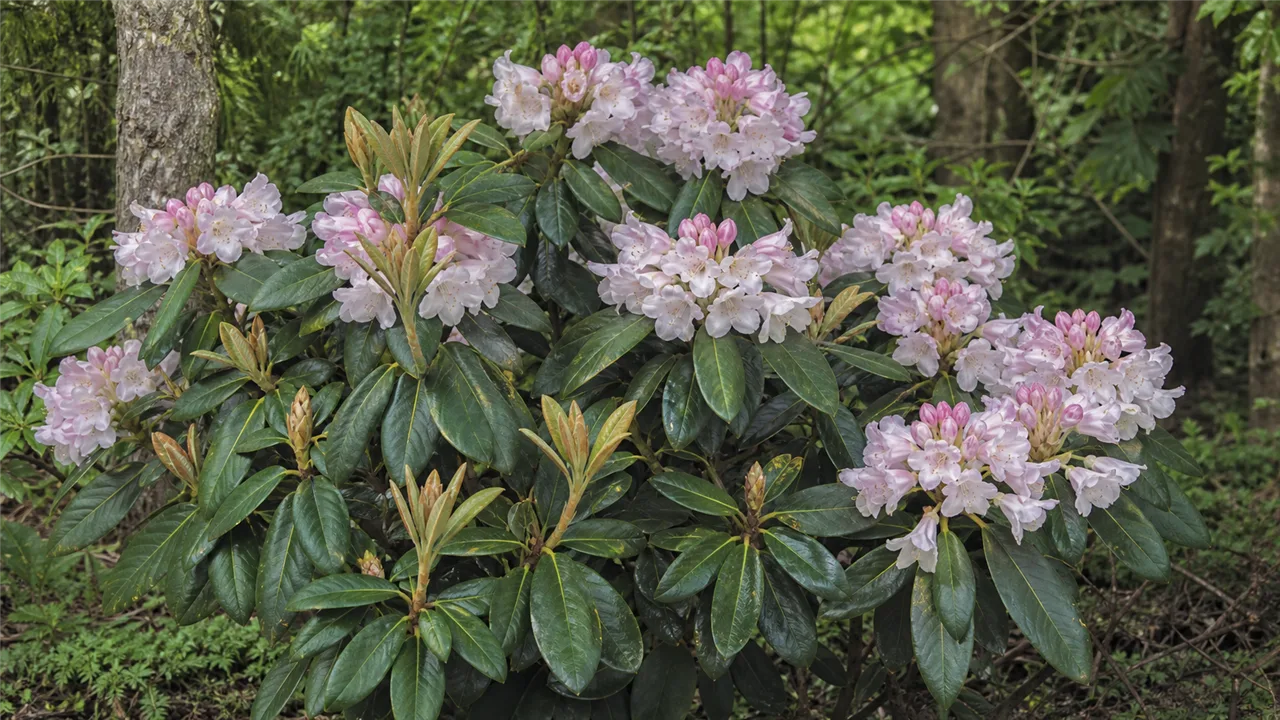
Rhododendron polycladum is a compact, evergreen flowering shrub belonging to the lepidote (scaly) section of the genus — the group of small- to medium-leaved rhododendrons distinguished by the tiny scales scattered across the undersides of their leaves. The species name, polycladum, refers to its many-branched habit, which gives mature plants a notably dense, tidy form. In the wild it occurs in the mountains of north-western Yunnan and northern Burma, where it grows on rocky slopes and in moorland-like scrub at high altitude, often alongside other ericaceous shrubs. It is not widely encountered in British garden centres, but it has long been grown by collectors of dwarf and unusual rhododendrons and is well suited to the cooler, damper parts of the UK.
For British gardeners, the chief appeal of R. polycladum is its compact size, its tolerance of exposed positions relative to many of its larger-leaved relatives, and its reliable late-spring display of small lavender to purple flowers in tight trusses. It is a good choice for an acid border, a peat garden, a woodland edge or a large container of ericaceous compost, where its evergreen foliage provides year-round structure. Like all rhododendrons it demands acidic soil and resent chalk or strongly alkaline ground; given that single condition, it is otherwise an easy and undemanding shrub.
Appearance
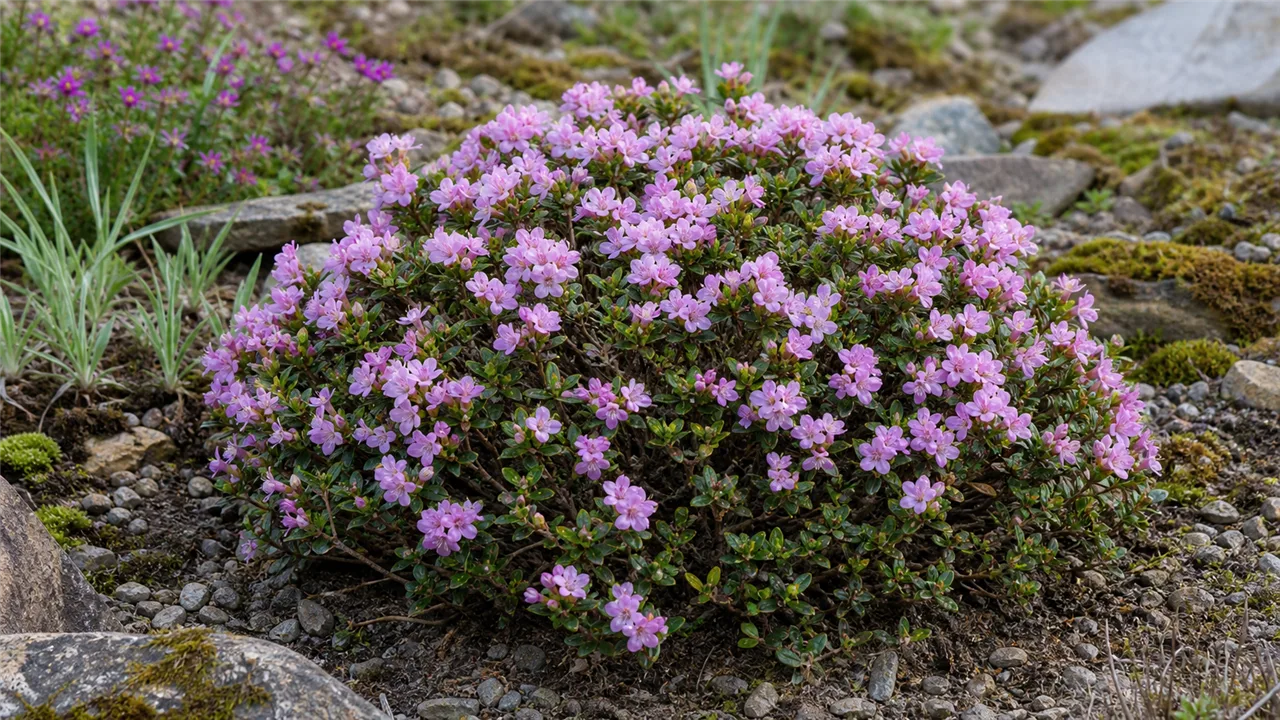
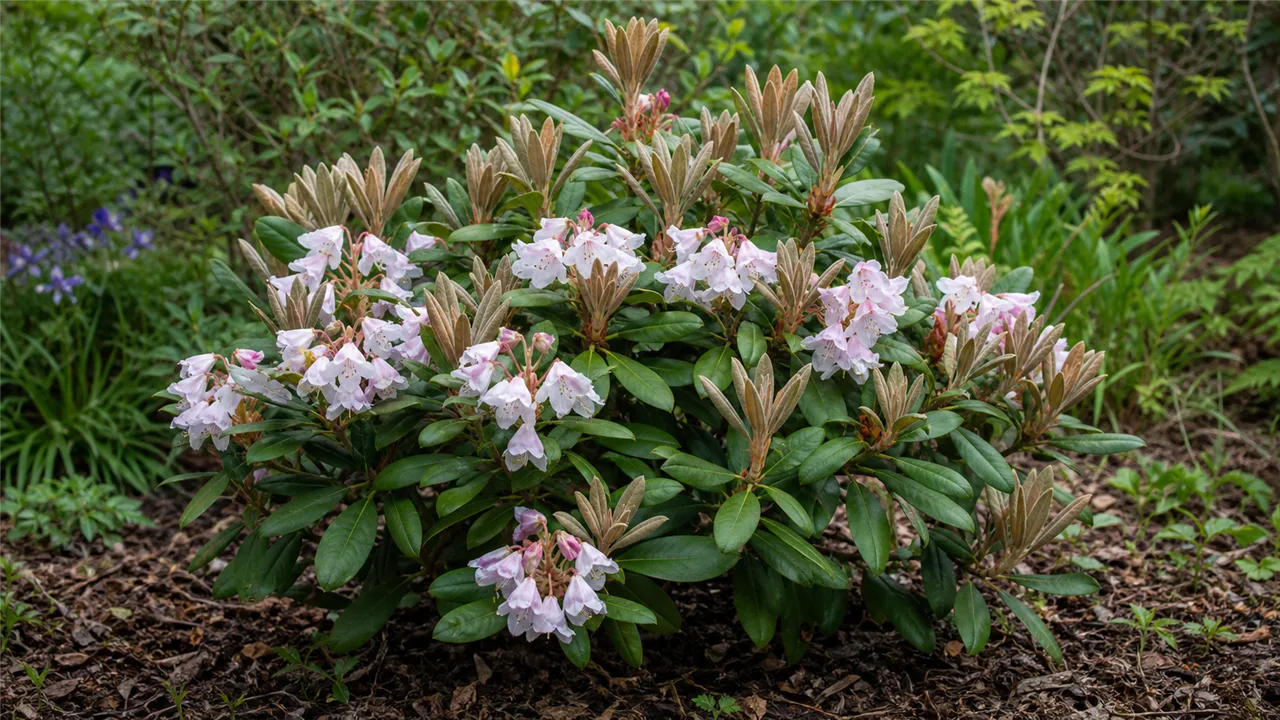
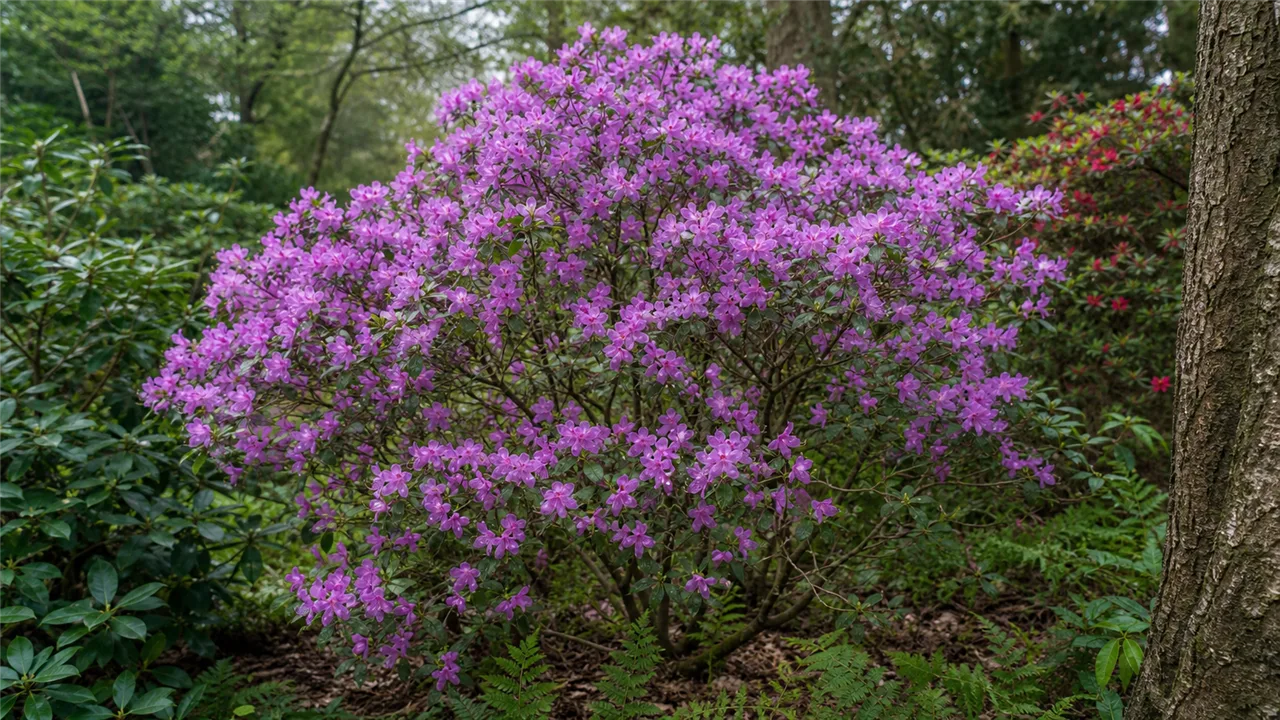
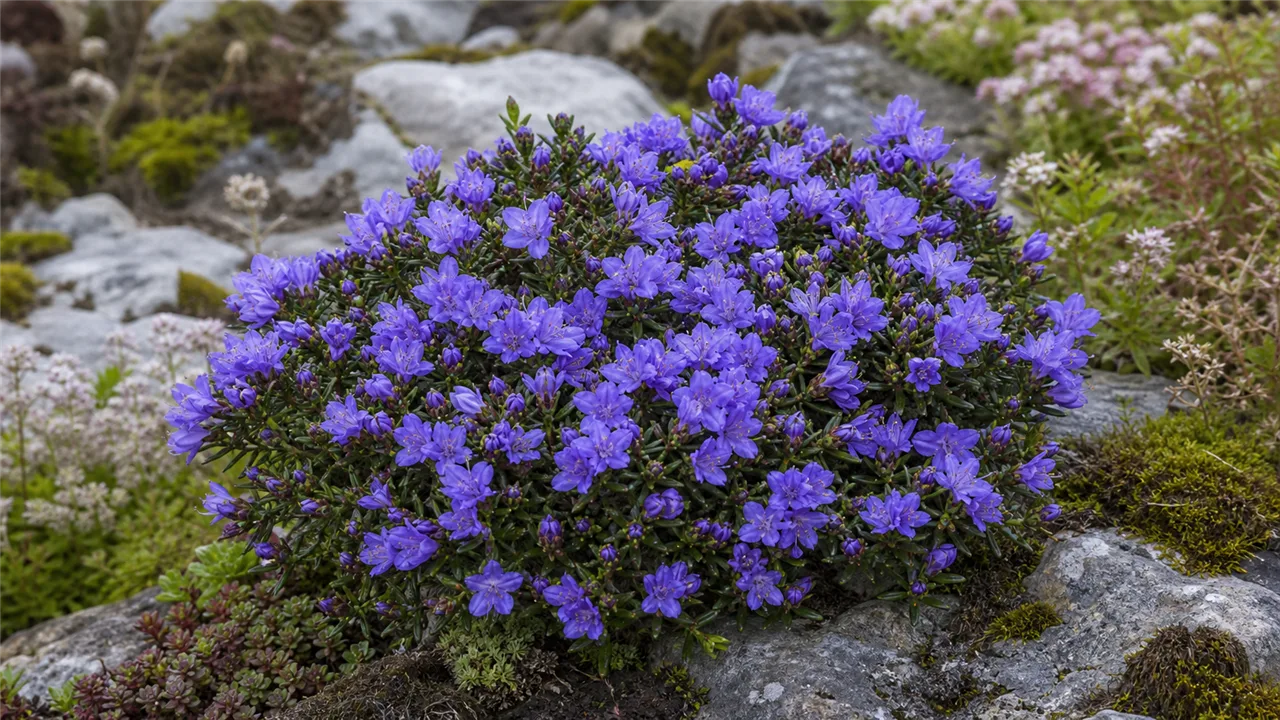
Rhododendron polycladum forms a dense, rounded, evergreen shrub reaching roughly 1 to 1.5 m tall and slightly wider at maturity, with a strongly branched, twiggy framework that gives the plant its characteristic "many-branched" look. The branching is fine and intricate, and the plant retains a neat outline without much shaping.
The leaves are small for a rhododendron — typically 2.5 to 5 cm long — elliptic to narrowly oblong, dark glossy green on the upper surface and noticeably paler beneath, where they are dotted with fine scales (a defining feature of the lepidote section; these scales may glint bronze or silvery when backlit). The leaves are aromatic when crushed, another typical lepidote trait. In cold, exposed sites the foliage may take on a bronze or purplish cast in winter; this is cosmetic and the leaves green up again in spring.
Flowers appear in mid- to late spring, usually from late April into June depending on locality and season. They are carried in small but full trusses of three to eight blooms held just above the foliage at the tips of the previous year's shoots. Individual flowers are broadly funnel-shaped, around 2 to 3 cm across, in shades of lavender, lilac-pink, pale purple or — in some wild forms — near-white, frequently with a scattering of darker spots or flecks on the upper petal. The overall effect is delicate rather than showy, and the flowers last for several weeks in cool weather.
Growing Conditions
Soil. R. polycladum must have moist but well-drained, acidic soil with a pH in the range 4.5 to 6.0. It will not tolerate chalk or limestone soils: on alkaline ground the leaves become yellow (chlorotic) and the plant slowly declines. If your garden soil is neutral or alkaline, grow the plant in a container of ericaceous (lime-free) compost, or in a raised bed filled with an acidic mix of leaf mould, bark and lime-free loam.
Light. Best in dappled shade or partial shade, ideally with morning sun and afternoon shade, or under the high canopy of deciduous trees. It will tolerate a sunnier position provided the soil stays reliably moist, but deep shade reduces flowering and can encourage mildew.
Position. A sheltered site is important, particularly shelter from cold, drying easterly and northerly winds in late winter and spring, which can scorch the evergreen foliage and damage opening flower buds. Avoid frost pockets at the bottom of slopes and avoid exposed coastal or hilltop positions. In the UK this species is happiest in the west, in upland valleys, in coastal districts of Scotland and Wales with reliable rainfall, and in any garden with neutral-to-acid soil and shelter.
Climate. R. polycladum is a high-altitude species in the wild and tolerates cool UK summers well. It should be regarded as hardy across most of the UK once established, though it appreciates a little protection in the coldest inland districts. As with all rhododendrons, hardiness is governed by site and exposure as much as by the plant itself; the GardenWizz hardiness badge displays the formal rating for this species.
Planting and Care
When to plant. The best planting windows in the UK are autumn (October to November) and early spring (March to April), when the soil is workable, warm enough to encourage root growth, and not waterlogged. Container-grown plants can go in at any time of year provided the ground is not frozen and you can water reliably through dry spells.
Planting technique. Dig a hole at least twice the width of the rootball and the same depth. Tease out any circling roots on container-grown plants, set the plant so the top of the rootball sits level with the surrounding soil, and backfill with the original soil — do not add compost or organic matter to the backfill, as this can create a sump that holds water and encourages root rot. Water in thoroughly and apply a 5 to 8 cm mulch of bark chips, leaf mould or other acidic organic matter over the root area, keeping the mulch clear of the stem.
Watering. Keep the plant well watered through its first two growing seasons; consistent moisture is the single biggest factor in successful establishment. Established plants are reasonably drought-tolerant but will flower better and look fresher if given a soak during extended dry spells in summer. Where possible, use rainwater rather than hard tap water — over time, hard water raises the soil pH and undermines the plant.
Feeding. Apply an ericaceous (acid-loving) fertiliser in early spring as growth begins, following the manufacturer's dose. Top-dress the mulch annually with fresh bark or leaf mould; this both feeds the soil and maintains acidity. Avoid general-purpose or lime-based fertilisers.
Deadheading. This is the principal annual task. As the last flowers fade in late May or June, carefully snap off the spent truss at its base, taking care not to damage the small buds clustered just beneath it which will carry next year's display. Deadheading tidies the plant and channels energy into growth rather than seed. Do not shear or hard-prune.
Propagation. Increase from semi-ripe cuttings taken in mid- to late summer, dipped in a rooting hormone and rooted in a 50:50 mix of ericaceous compost and perlite under a propagator lid with bottom heat. Layering of low branches in autumn is also reliable but slow. Seed is possible but slow to germinate and the offspring will not come true to a particularly good flower-colour form.
Seasonal care. In early spring, top up the mulch and apply fertiliser. During dry summer weather, water deeply at the base rather than sprinkling the foliage. In late autumn, clear fallen leaves from around the base to reduce the carry-over of fungal spores. Container-grown plants need repotting every two to three years into fresh ericaceous compost.
Common Problems
Chlorosis (yellowing leaves). The most common problem on UK rhododendrons. Leaves turn pale yellow while the veins stay green, a sign that the plant cannot take up iron and manganese because the soil is too alkaline. Correct by applying chelated iron (Sequestrene is the usual brand) according to the label, mulching with acidic organic matter, and — where possible — switching to rainwater for irrigation. In containers, repot into fresh ericaceous compost.
Bud blast. Caused by the fungus Pycnostysanus azaleae and spread by the rhododendron leafhopper. Affected flower buds turn brown or black, remain closed and develop a bristly appearance; they may carry the small black fruiting bodies of the fungus through winter. Pick off and destroy affected buds (do not compost) and, if leafhoppers are seen in summer, consider a contact insecticide or, in smaller plantings, a physical barrier.
Powdery mildew. A whitish, powdery coating on the leaf surface, most often in dry, stagnant conditions at the end of summer. Improve air circulation by thinning surrounding plants, water at the base rather than overhead, and remove badly affected leaves. Most modern outbreaks are cosmetic and do not need fungicidal treatment.
Phytophthora root rot. The most serious disease of rhododendrons and almost always caused by poor drainage. Plants wilt even when the soil is moist, the roots turn dark brown and the lower foliage yellows and drops. There is no cure once a plant is badly affected. Prevention is everything: plant in well-drained soil, avoid deep planting, and never allow the root area to sit in winter wet.
Vine weevil. A particular problem for container-grown rhododendrons. Adult weevils chew notches out of leaf margins in summer, while the creamy-white grubs eat roots and can quickly kill a pot-grown plant. Treat containers with a biological control (nematodes, applied in late summer) or a systemic insecticide labelled for the purpose. Check pot-grown plants routinely by tipping them out.
Aphids and scale insects. Sap-sucking insects that colonise young shoots and the undersides of leaves, causing stickiness and sooty mould. Wash off with a strong jet of water or treat with insecticidal soap; encourage natural predators such as ladybirds and hoverflies.
Popular Varieties
Rhododendron polycladum is a fairly narrowly distributed wild species, and named clonal selections are few and far between in mainstream UK nursery trade. Most plants sold under this name are raised from wild-collected or garden-raised seed, so individual seedlings vary slightly in flower colour and habit. This is honest background, not an attempt to dress up a thin list; if you are specifically seeking a named cultivar of R. polycladum you will need to go to a specialist rhododendron nursery (such as Glendoick, Millais or Burncoose), and even then availability varies year to year.
For gardeners who want the look and feel of R. polycladum but with a more reliable named cultivar, the closest widely available choices are other dwarf or compact lepidote rhododendrons. Rhododendron `Blue Diamond` is a popular compact, blue-flowered hybrid in the lepidote style, reaching around 1 m tall. Rhododendron `Scarlet Wonder` (a dwarf elepidote hybrid) gives a similar compact habit with vivid red flowers but needs a slightly more sheltered site. Rhododendron impeditum, often sold as a dwarf blue form, gives the same scaly-leaved, twiggy look at smaller scale. None of these are cultivars of R. polycladum; they are alternatives in a similar niche, and you should buy them on their own merits rather than as substitutes.
Two related wild species are also worth knowing for context. Rhododendron tapetiforme (formerly treated as a form of R. polycladum) is very similar but forms an even tighter, mat-like shrub suited to the smallest gardens and troughs. Rhododendron campylogynum shares the lepidote scales and dwarf habit but carries its bell-shaped flowers on longer stalks and tolerates slightly cooler, wetter positions. Both are better suited to specialist collections than to general garden-centre planting.
If you are collecting for a peat garden, woodland edge or container display and want a reliably tidy, late-spring-flowering evergreen with the small leaves and scaly undersides of the lepidote rhododendrons, R. polycladum itself — raised from a reputable seed strain — remains the most authentic choice. Treat named "varieties" with caution, and ask the nursery for the wild provenance of any plant offered as a selected form.
Cultivars and Varieties
| Cultivar | Height | Flower | Notes | AGM |
|---|---|---|---|---|
| 'Policy' | — | — | RHS AGM (H5) | ✓ |
Pests and Diseases
| Problem | Symptoms | Management |
|---|---|---|
| Powdery mildew | White, dusty fungal growth appears on leaves and shoots, potentially causing distortion. | Improve air circulation and apply a suitable fungicide if infection is severe. |
| Bud blast | Flower buds turn brown, shrivel, and fail to open due to frost damage or fungal attack. | Avoid late pruning that encourages tender growth susceptible to frost; ensure good drainage. |
| Slugs and snails | Irregular holes chewed in young leaves and shoots, often accompanied by slimy trails. | Use physical barriers like copper tape or apply iron phosphate-based pellets around the base. |
| Vine weevil | Notched edges on leaves above ground and root damage below, leading to wilting plants. | Apply systemic insecticide granules to the soil in autumn to control larvae. |
| Phytophthora root rot | General decline, yellowing leaves, and sudden collapse due to waterlogged, poorly drained soil. | Plant in well-drained acidic soil and avoid overwatering to prevent root suffocation. |
For step-by-step help, read Dealing with Slugs and Snails and Treating Powdery Mildew. Or browse the full plant problem solver to diagnose an issue by symptom.
Recommended Products
GardenWizz earns a commission from qualifying purchases made through affiliate links on this page (including links within the article) — as an Amazon Associate, and from Thompson & Morgan via the Awin network. This does not affect the price you pay. See our disclaimer for details.