Anise-Scented Sage
Salvia guaranitica
The Gardening Year
Best months in UK gardens · full planting calendar →
🖨 Printable care card (PDF)At a Glance
| Botanical name | Salvia guaranitica |
|---|---|
| Common name(s) | Anise-scented sage |
| Family | Lamiaceae |
| Plant type | perennial |
| Height × Spread | 120–150 cm × 50–100 cm |
| Position | Full sun, Partial shade |
| Soil | light, moderately fertile, humus-rich, moist but well-drained soil |
| Flowering | June–November |
| Toxicity | — |
| Native range | South America |
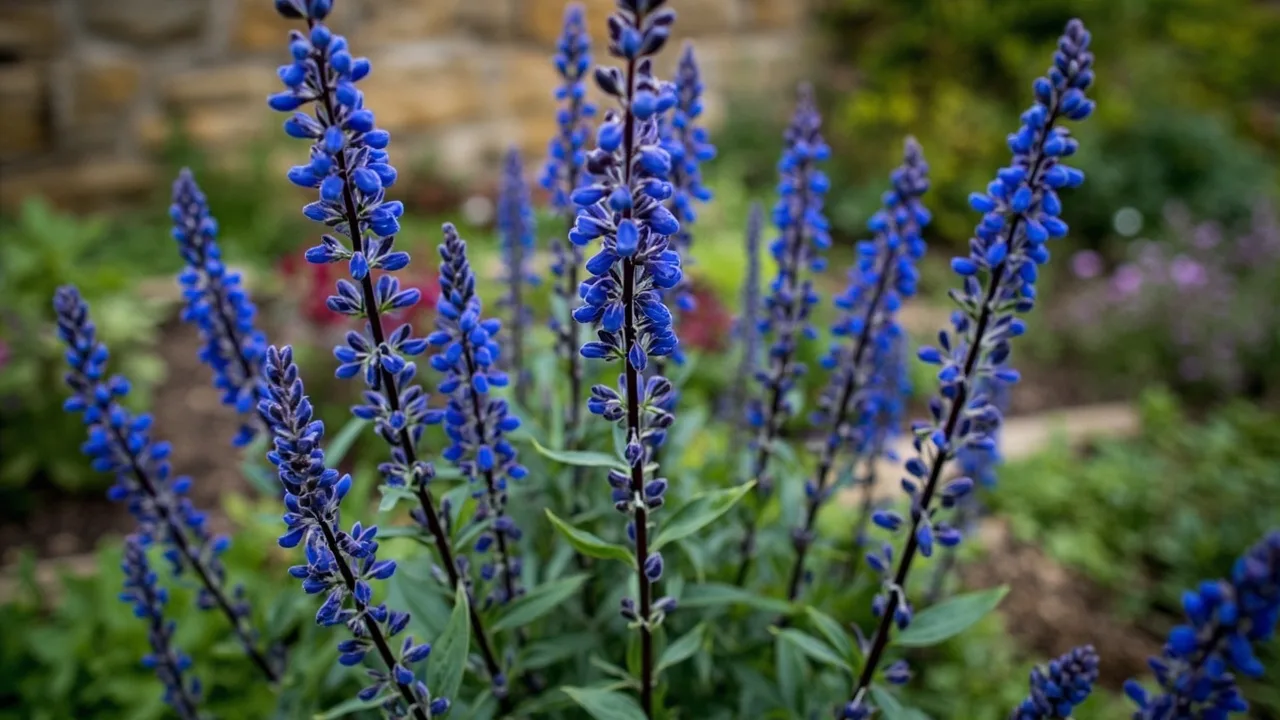
Anise-scented sage, Salvia guaranitica, is a late-flowering blue perennial from South America that has earned a firm place in UK gardens. It carries the season where many earlier salvias have faded, producing tall, deep-blue flower spikes from late July into autumn, and its aromatic foliage pairs with dahlias, rudbeckias and ornamental grasses.
Overview
Salvia guaranitica belongs to the family Lamiaceae and sits within the large Salvia genus. It is native to Brazil, Paraguay, Uruguay and northern Argentina, where it grows in open scrub at forest edges on moisture-retentive but free-draining ground. In UK cultivation it has become a fixture of the late-summer border, valued for the depth of its blue flowers, which is unusual among perennials for this time of year, and for providing nectar through August and September.
The species sits firmly in the half-hardy perennial camp in British conditions. Top growth is reliably cut back by the first hard frost, and the crown itself may be lost in cold, wet districts. In milder regions of southern and coastal England, established clumps can overwinter where drainage is sharp and the crown is mulched; in colder inland and northern gardens, the dahlia-style practice of lifting, potting and overwintering under cover is the safer route. The vertical habit, blue flowers and tolerance of warm, sheltered borders make it a natural partner in exotic-style plantings and pollinator-friendly late-season borders.
Appearance
The habit of Salvia guaranitica is clump-forming and broadly upright. From late spring a single crown pushes out several square, slightly hairy stems that branch modestly as the season progresses. In a typical UK growing season the plant reaches 1.2–2 m in height with a spread of 60–90 cm; in a hot, sheltered border it can exceed 2 m. In mild winters, or on overwintered stock, the basal stems may become lightly woody, but this is not a true shrubby framework and most of the year's growth is herbaceous.
The leaves are opposite, ovate to lance-shaped, 5–13 cm long, and mid-green with a slightly rugose surface. They carry the feature that gives the plant its common name: when crushed or brushed past, the foliage releases a faint sweet scent often described as anise or a hint of blackcurrant. It is a subtle note rather than a powerful aroma, but it is distinctive at close quarters and helps separate the species from many other blue-flowered salvias.
Flowers are carried in whorls along terminal spike-like racemes and have the classic two-lipped Salvia form. The corolla is usually a deep ink-blue, occasionally paler, and the calyx is a darker violet-blue that remains decorative after the corolla drops. The coloured calyces extend the visual season of the spike well after the flowers are shed, and they hold well in arrangements. In UK conditions flowering begins in late July or August, peaks in September, and continues through the first frosts in October or, in a mild year, into November. Fruit is limited to small dry nutlets typical of the mint family and is of little ornamental consequence.
Growing Conditions
Salvia guaranitica flowers most freely in full sun. It will tolerate very light dappled shade, particularly through the hottest part of a UK summer, but heavy shade reduces both the number of spikes and the depth of blue. A warm, sheltered position at the back of a border or against a south- or west-facing wall suits it best.
The soil should be moist but well-drained and reasonably fertile. Garden loam improved with compost or well-rotted manure gives the strongest growth; very dry, impoverished soils lead to shorter plants and an earlier finish. The species tolerates a range of pH but performs best on neutral to slightly alkaline ground. In heavier soils, work in coarse grit and organic matter at planting to keep the crown out of cold, wet conditions, which is the most common cause of winter loss.
Consistent moisture is welcome. In prolonged summer drought, supplementary watering keeps the foliage upright and supports the long flowering display. Once established, Salvia guaranitica tolerates short dry spells, but it is not a plant for a parched rain-shadow border without irrigation. Shelter from cold wind is useful; the tall hollow stems can splay under autumn gales, so a discrete stake ring is worth planning for in exposed sites.
In the UK the plant is borderline rather than reliably hardy. The crown tolerates light frost if drainage is sharp and the position is sheltered, but the top growth is cut back by the first hard frost in most districts. Where winter wet or prolonged cold is expected, treat the plant as a half-hardy perennial: lift, pot up and overwinter under cover as for a dahlia.
Planting and Care
Plant out only after the last UK frosts, usually in late May or early June once the soil has warmed and new shoots are growing strongly. Plants raised under glass should be hardened off for a week or two before planting, as the soft early-season growth is easily checked by cold nights. Space plants 60–90 cm apart at the back of the border, depending on the vigour of the cultivar and the fertility of the soil, and water in well.
Watering matters most in the first season, while the root system establishes. Soak thoroughly rather than sprinkling lightly, and repeat during dry spells. In subsequent years, deep watering every week or two in prolonged drought keeps the foliage in good condition.
For feeding, a general-purpose fertiliser applied in spring, topped up with a mulch of garden compost or well-rotted manure, supports strong basal growth. From July through August a liquid tomato or seaweed feed every two to three weeks helps carry the long flowering season. Avoid heavy nitrogen feeds late in the season, which encourage soft growth that flops and is more easily checked by early autumn frosts.
The annual cutback is the key seasonal task. Leave the spent top growth in place over winter, where it offers a small amount of frost protection to the crown. Cut back hard to near ground level in mid- to late spring, typically April to early May, once the worst frosts have passed and new basal shoots are visible. Cutting back too early risks damaging soft new growth in a late frost; cutting back too late reduces the number of flowers. In colder districts where the crown has been lost, cut back the dead stems and replace with overwintered stock or new rooted cuttings.
Propagation is straightforward. Soft-tip cuttings taken in late spring or early summer root readily in a free-draining compost under cover; this is the standard way to increase named cultivars, which do not come true from seed. Basal cuttings from overwintered plants in spring work equally well. Division of established clumps every three to four years in spring keeps the crown vigorous.
In cold districts, lift and store as for a dahlia. After the first frosts cut back the top growth to within a few centimetres of the crown, lift the rootball, allow it to dry briefly, then pot up into loam-based (John Innes No. 3) compost and overwinter in a frost-free greenhouse, conservatory or shed. Water sparingly through the winter and plant out after the last frosts the following spring.
Common Problems
Salvia guaranitica is generally healthy in UK gardens once established. The few problems that occur are mostly cultural. Slugs and snails can damage fresh spring growth, particularly in damp sites, and are worth monitoring in the first weeks after the cutback. Aphids and capsid bugs colonise the soft shoot tips in early summer; strong jets of water or a soft soap treatment usually keep them in check. Powdery mildew can appear in hot dry summers where the plant has dried out at the root; mulching in spring and watering during drought usually prevent it.
The most serious problem in UK cultivation is winter loss: crowns rot in cold, wet, poorly drained soils, particularly in clay that holds water against the crown through the coldest months. Improving drainage at planting, and lifting for the winter where necessary, is the standard response. The aromatic foliage is generally avoided by deer and rabbits. Routine deadheading of individual spent spikes through August and September helps prolong the display into October.
Popular Varieties
Cultivars frequently encountered in UK nurseries include:
- 'Blue Enigma' — the most widely available form in the UK, with tall, open spikes of clear deep blue and the dark violet calyces characteristic of the species. It reaches close to 2 m in a warm border.
- 'Argentine Skies' — a paler sky-blue selection, useful where a softer blue is wanted in the late border and a good partner to warm orange and yellow daisy flowers.
- 'Purple Majesty' — a deep violet-blue form, sitting between the typical ink-blue and the paler 'Argentine Skies'; reliably tall and free-flowering in a warm border.
- 'Black and Blue' — widely grown, with dark ink-blue corollas and almost black calyces; useful for depth in a mixed planting and a popular cut-flower subject.
- Salvia 'Amistad' — often sold in UK gardens and commonly associated with S. guaranitica, though most plants in trade are a hybrid between S. guaranitica and Salvia gesnerifolia. Worth growing for its hybrid vigour, but it is not a straight S. guaranitica cultivar.
Pests and Diseases
| Problem | Symptoms | Management |
|---|---|---|
| Slugs and snails | Irregular holes in young leaves and stems, often with silky trails visible on foliage. | Use physical barriers like copper tape or apply iron phosphate pellets around the base of plants. |
| Powdery mildew | White, dusty fungal growth appears on leaves and stems, potentially causing distortion. | Ensure good air circulation and water at the base; treat with a sulphur-based fungicide if severe. |
| Root rot | Stems become soft and mushy at the base while foliage wilts despite moist soil. | Plant in well-drained soil and avoid overwatering, especially during winter dormancy. |
| Aphids | Clusters of small green or black insects on new growth, often accompanied by sticky honeydew. | Squash by hand or spray off with a strong jet of water; use insecticidal soap if infestation persists. |
| Capsid bugs | Leaves develop small, pale spots and may curl or distort as the insects suck sap. | Encourage natural predators like ladybirds or apply a horticultural oil spray during peak activity. |
For step-by-step help, read Controlling Aphids Naturally, Dealing with Slugs and Snails and Treating Powdery Mildew. Or browse the full plant problem solver to diagnose an issue by symptom.
Recommended Products
GardenWizz earns a commission from qualifying purchases made through affiliate links on this page (including links within the article) — as an Amazon Associate, and from Thompson & Morgan via the Awin network. This does not affect the price you pay. See our disclaimer for details.