Verbena
Verbena bonariensis
The Gardening Year
Best months in UK gardens · full planting calendar →
🖨 Printable care card (PDF)At a Glance
| Botanical name | Verbena bonariensis |
|---|---|
| Common name(s) | Verbena |
| Family | verbena family |
| Plant type | perennial (cultivated as a flowering annual or herbaceous perennial plant; perennial, hardy in USDA Zones 7-11; can be grown as an annual in areas where it is not winter hardy) |
| Height × Spread | 180 cm × 90 cm |
| Position | Full sun, Partial shade |
| Soil | well-drained soil |
| Flowering | June–November |
| Toxicity | — |
| Native range | tropical South America |
Overview
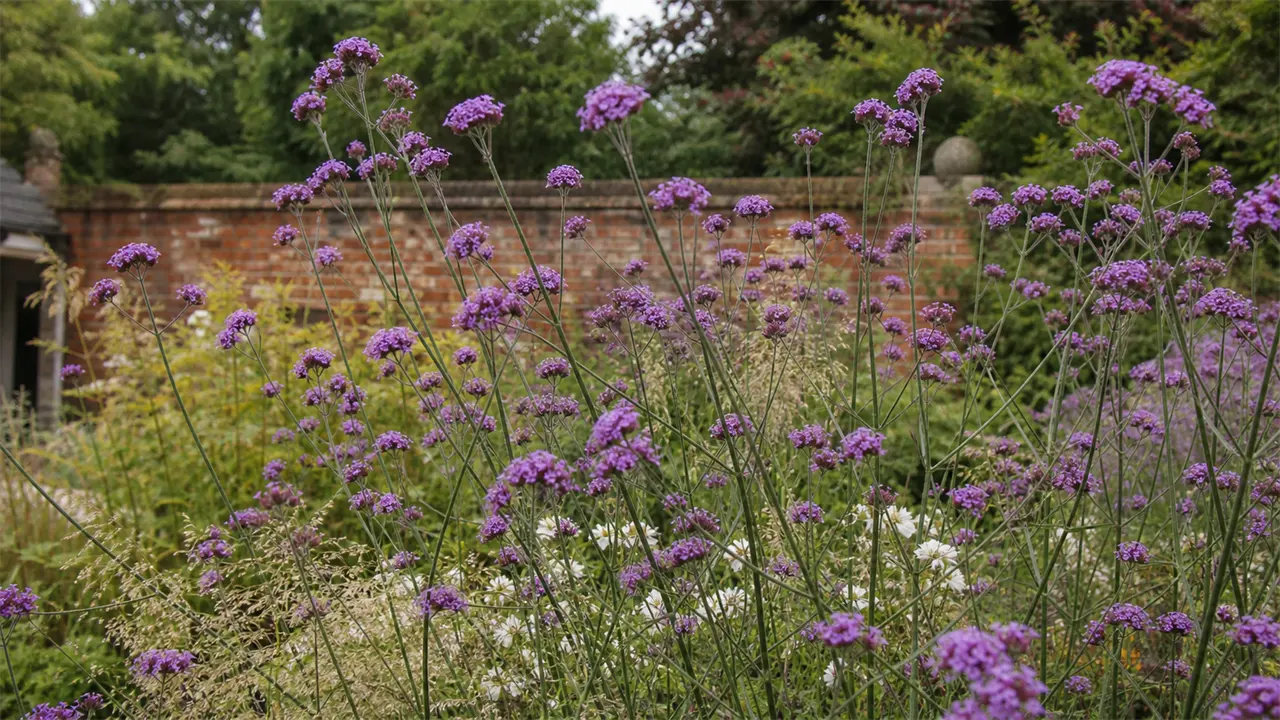
Verbena bonariensis, widely known in British gardens simply as verbena or purpletop vervain, is a tall, airy perennial that has become a mainstay of contemporary UK planting schemes. A native of South America — chiefly southern Brazil, Argentina, Paraguay and Uruguay — it was introduced to European horticulture in the early nineteenth century and has since earned a reputation as one of the most reliable late-summer nectar plants available to British gardeners. Its slender stems and small, vivid violet-purple flower clusters allow it to weave through other plants without smothering them, an attribute that has made it a signature feature of naturalistic and prairie-style borders from Cornwall to the Scottish borders.
In the United Kingdom it is treated as a half-hardy perennial. The Royal Horticultural Society classifies it as H3, meaning it tolerates light frost but top growth is killed back once temperatures drop below roughly minus five degrees Celsius. In milder regions, on free-draining soil and with a protective mulch over the crown, established plants return reliably year after year; in colder districts or on heavy ground it is more often grown as a short-lived perennial or self-seeding annual. The species has received the RHS Award of Garden Merit, a recognition of its consistent garden performance in British conditions.
Verbena bonariensis holds particular value as a pollinator plant and is listed on the RHS Plants for Pollinators scheme. It produces abundant nectar from midsummer through to the first hard frosts, sustaining bees, butterflies, hoverflies and moths at a time when many other garden flowers have finished. Its tolerance of poorer, drier soils, combined with its see-through habit, makes it equally useful in cottage gardens, gravel gardens and modern naturalistic plantings.
Quick-Care
Appearance
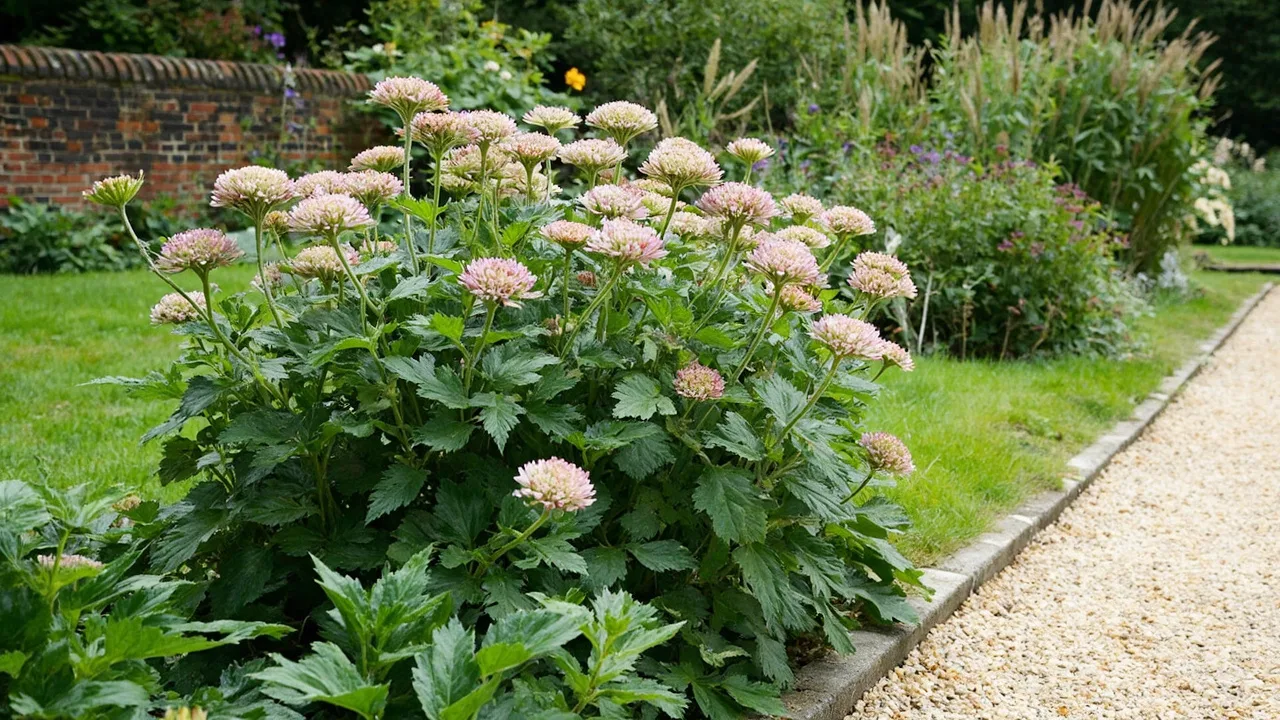
Verbena bonariensis is distinguished by its tall, slender silhouette and small, vivid flower heads held well above surrounding foliage. Mature plants typically reach 120 to 200 cm in height, with a spread of only 40 to 60 cm, giving the species its characteristic transparent, screen-like quality. This slim footprint is one of its chief ornamental virtues: rather than blocking views of neighbouring plants, it allows them to be seen through its framework, softening and connecting the front and back of a border.
The stems are wiry, branched and noticeably square in cross-section, a typical feature of the Verbenaceae family. Stems branch freely from mid-height, producing a candelabra-like structure with multiple flower clusters. The leaves are lance-shaped, mid-green and rough-textured, arranged in opposite pairs along the stem. In the first year, plants form a low basal rosette of leaves close to the ground; only in their second season do they throw up the tall flowering stems.
Flowers are borne in flattened, domed terminal clusters typically 5 to 8 cm across. Individual florets are small, tubular and five-lobed, opening in succession from the outer edge of each cluster inward. Colour is a saturated violet-purple, though paler lilac forms appear in cultivation. Flowering begins in July in most UK gardens and continues without pause until the first hard frosts of October or November.
Seed heads are small, dry and persist through winter, providing structure and food for goldfinches and other seed-eating birds. Self-seeding is vigorous in mild, free-draining gardens, and seedlings can be recognised by their distinctive opposite, rough leaves and upright, square stems.
Growing Conditions
Verbena bonariensis thrives in full sun and well-drained soil. Six hours or more of direct sunlight daily is required for sturdy growth and prolific flowering; in partial shade plants become leggy, flop more readily and flower less freely. Soil fertility is unimportant — the species actually performs better on lean, gravelly or stony ground than on rich, moisture-retentive loam. Damp winter conditions are the single greatest threat, particularly on clay soils where waterlogging can rot the crown.
In UK climate terms, it suits gardens across the south and west, the Midlands, and coastal Wales and Scotland. In colder inland districts of northern England, the East Midlands and much of Scotland, plants benefit from sharp drainage and a thick dry mulch of straw or bracken over the crown in late autumn. Its RHS hardiness rating is H4, indicating tolerance of winter temperatures between approximately −10 °C and −5 °C, although top growth can still be damaged by hard frost.
The species tolerates exposed sites better than many tall perennials, because its flexible stems bend rather than snap in strong winds. However, very windy locations, particularly on open hills or coastal gardens, will still benefit from staking or from planting among stiffer neighbours that offer informal support. Drought tolerance, once established, is excellent, making verbena a sensible choice for hot south-facing borders and gravel gardens where watering is kept to a minimum.
Planting and Care
When to plant. Container-grown plants from garden centres are best planted out in May or early June, once the risk of hard frost has passed. Seed can be sown indoors in March at around 18 to 21 degrees Celsius, pricked out into individual pots and grown on under glass until planting time. Outdoor sowing is also possible from May to June directly into a prepared seedbed.
Spacing. Allow 40 to 60 cm between plants. Although the foliage footprint is small, mature stems need airflow to reduce mildew risk, and overcrowding causes weak, sprawling growth. Groupings of three, five or seven plants are typical in border design.
Watering. During the establishment phase, water regularly for the first six to eight weeks. Once roots have penetrated the surrounding soil, verbena is notably drought-tolerant and supplementary watering is rarely needed except during prolonged dry spells in high summer.
Feeding. Little or no feeding is required. Over-rich soil produces lush foliage at the expense of flowers and weakens stems, increasing the need for staking. A single light mulch of well-rotted garden compost in spring is sufficient on most garden soils.
Pruning and aftercare. No routine deadheading is necessary; spent flowers are followed rapidly by new blooms higher up the same stem. In early spring, cut last year's dead stems back to the base before new growth emerges. In mild regions where the crown survives winter, leave the old stems in place over winter to provide some insulation and seed-head interest, removing them only when new shoots appear at the base.
Propagation. Seed is the easiest method. Collect ripe seed heads in autumn, dry them in a paper bag and sow the following spring. Alternatively, take basal cuttings in spring from new shoots at the crown; these root readily in gritty compost under a propagator lid. Plants also self-seed freely, and seedlings are easily lifted and transplanted in autumn or spring.
Seasonal calendar. March — start seed indoors. April — prick out seedlings. May to June — plant out, sow outdoors. July — first flowers. August to September — peak flowering. October — final blooms before frost. November to February — seed heads and dead stems provide winter structure; cut back in early spring.
Common Problems
Powdery mildew is the most frequent foliage complaint, appearing as a white, dusty coating on leaves in dry, crowded conditions. Improve air circulation by thinning surrounding plants, water at the base rather than overhead, and clear affected foliage in autumn. Resistant varieties are not generally available within Verbena bonariensis itself, but good spacing largely prevents serious outbreaks.
Aphids, particularly greenfly, may cluster on young shoot tips in late spring and early summer. They are usually controlled by natural predators such as ladybirds, lacewings and hoverflies; if populations build up, a firm spray with water or an application of insecticidal soap is effective. Strong, healthy plants generally outgrow aphid attack without lasting damage.
Slugs and snails are the principal threat to young seedlings and the low basal rosettes in early spring. The tall flowering stems are largely ignored once they begin to rise, but emerging shoots benefit from standard slug controls such as nematode applications, beer traps or hand-picking at dusk in damp weather.
Frost damage is to be expected in most British winters. Top growth blackens and collapses at the first hard frost; this is normal and does not indicate crown death. Where the crown survives, new shoots appear from the base in April or May. Where the crown has failed, replacement plants are usually available as self-sown seedlings elsewhere in the garden.
Leggy, floppy growth indicates one or more of: insufficient sunlight, over-rich soil, over-watering, or excessive nitrogen feeding. Remedy by relocating affected plants to sunnier, leaner ground and avoiding supplementary feed.
Lack of flowers in otherwise healthy plants is most often caused by too much shade or too much fertiliser. Both are easily corrected.
Popular Varieties
In practice, named cultivars of Verbena bonariensis are few and uncommon in general cultivation; the species itself is what is usually grown.
Verbena bonariensis itself is usually sold as straight species seed or unnamed container plants, and the cultivar range is modest. A handful of distinct forms are nonetheless widely available in British nurseries and garden centres.
Verbena bonariensis 'Lollipop' is a compact selection reaching roughly 60 cm in height, roughly half the size of the species. It retains the same flower colour and pollinator value but suits smaller borders, patio containers and the front of mixed beds where the taller form would be out of scale. Like the species, it is half-hardy and behaves as a short-lived perennial in most UK gardens.
Verbena bonariensis 'Seabrook's Lavender' is a softer-toned form with lilac-lavender flowers rather than the saturated violet-purple of the species. It reaches a similar height to the type and is useful in pastel colour schemes, particularly in cottage and romantic-style plantings. Availability is more limited than the species.
Verbena bonariensis var. conglomerata is a rarely encountered form with denser, more congested flower heads than the typical species. It is occasionally offered by specialist herbaceous nurseries and is of more interest to collectors than to gardeners seeking a general border perennial.
Beyond these, much of what is sold under cultivar names in the trade is seed-raised and shows considerable natural variation. Gardeners seeking a particular colour or habit should purchase flowering plants in person where possible, rather than relying on seed packets alone. None of these varieties carries an RHS Award of Garden Merit in its own right at the time of writing, although the species as a whole does; specific ratings for individual cultivars should be checked against the current RHS Plant Finder before purchase.
Pests and Diseases
| Problem | Symptoms | Management |
|---|---|---|
| Powdery mildew | White, dusty fungal patches appear on leaves, stems, and flowers, potentially causing distortion. | Ensure good air circulation and avoid overhead watering; treat with a fungicide if severe. |
| Aphids | Clusters of small soft-bodied insects on new growth accompanied by sticky honeydew residue. | Squash infestations by hand or spray with a strong jet of water; use insecticidal soap if needed. |
| Root rot | Stems become soft and mushy at the base while foliage wilts despite moist soil. | Plant in well-drained soil and avoid overwatering to prevent waterlogging around roots. |
| Slugs and snails | Irregular holes chewed into young leaves and silvery slime trails on foliage. | Use physical barriers like copper tape or apply slug pellets sparingly in the evening. |
| Frost damage | Stems turn black and collapse, and foliage wilts rapidly after a hard freeze. | Cut back stems to ground level in autumn and mulch roots for protection in colder areas. |
For step-by-step help, read Controlling Aphids Naturally, Dealing with Slugs and Snails and Treating Powdery Mildew. Or browse the full plant problem solver to diagnose an issue by symptom.
Recommended Products
GardenWizz earns a commission from qualifying purchases made through affiliate links on this page (including links within the article) — as an Amazon Associate, and from Thompson & Morgan via the Awin network. This does not affect the price you pay. See our disclaimer for details.