Fragrant Snowball
Viburnum × carlcephalum
The Gardening Year
Best months in UK gardens · full planting calendar →
🖨 Printable care card (PDF)At a Glance
| Botanical name | Viburnum × carlcephalum |
|---|---|
| Common name(s) | Fragrant snowball |
| Family | Adoxaceae |
| Plant type | shrub (deciduous) |
| Height × Spread | 3 m × 3 m |
| Position | Full sun, Partial shade |
| Soil | Moist but well-drained or well-drained soil; acid, neutral or alkaline |
| Flowering | June–August |
| Toxicity | — |
| Native range | garden origin |
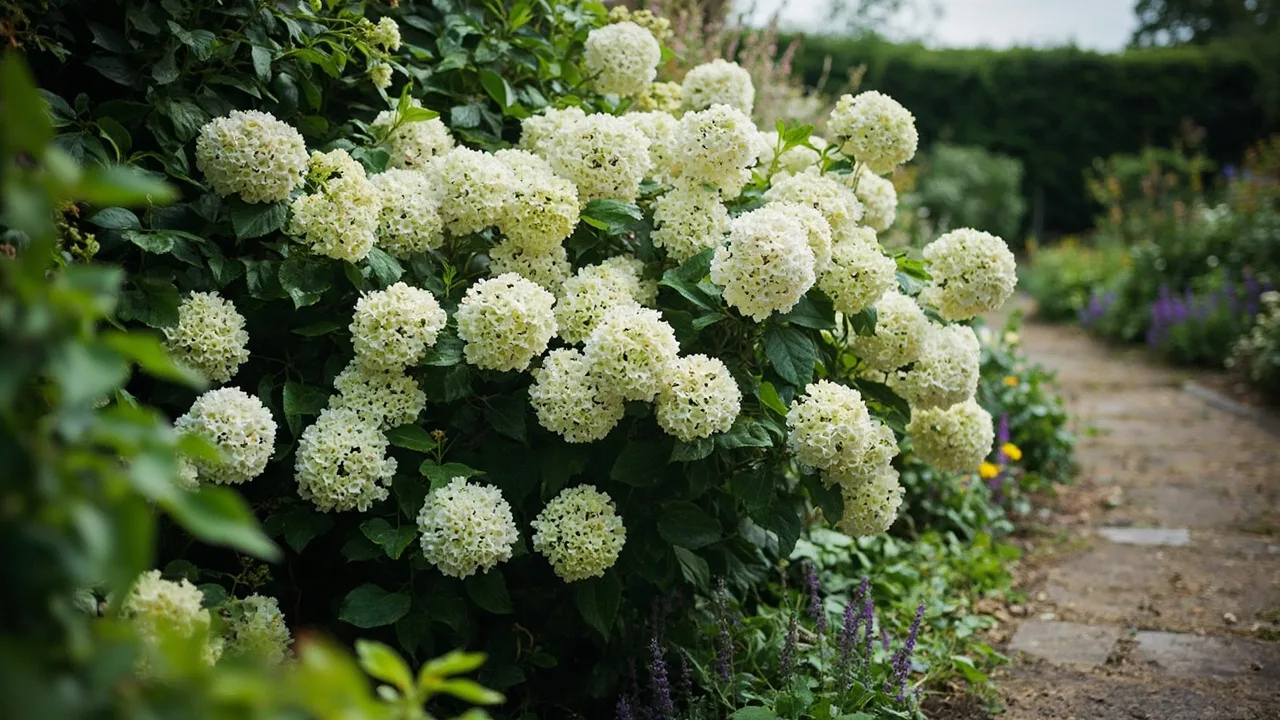
Pink buds opening into white, sweetly scented flower heads make fragrant snowball one of the most distinctive late-spring shrubs for a UK garden. Give this broad, deciduous viburnum enough room, reasonably fertile soil and a position where its perfume can be enjoyed.
Overview
Viburnum × carlcephalum is a garden hybrid between Korean spice viburnum, Viburnum carlesii, and Chinese snowball viburnum, Viburnum macrocephalum. It was raised at RHS Garden Wisley in 1935. The cross combines the powerful fragrance associated with its Korean parent and the substantial rounded flower heads associated with Chinese snowball. It belongs to the Viburnaceae and is not native to Britain or Ireland.
This is a substantial, multi-stemmed shrub rather than a compact border plant. Its rounded outline, scented spring flowers and autumn leaf colour give it interest across several seasons. A position near a path, terrace, entrance or frequently opened window makes best use of the perfume. It also works at the back of a mixed border, at a lightly shaded woodland edge, as an informal screen or as a specimen in a lawn.
The flowers offer nectar to visiting insects in late spring, while the dense framework can provide useful cover. Fruit may occasionally follow, although it is not usually the principal display. The ornamental fruits are not to be eaten, and gloves are sensible when handling the plant. Gardeners with children or pets should place it with this precaution in mind.
Fragrant snowball is generally a low-maintenance choice once established. The main commitments are allowing sufficient space at planting time, watering while the roots establish, maintaining drainage and pruning only when necessary. Its recognised garden merit is reflected by the RHS Award of Garden Merit shown on the current RHS plant profile.
Appearance
The shrub develops into a broad, rounded and often open framework of several stems. A mature plant commonly reaches around 2.5-3 m in height with a comparable or greater spread, so its eventual footprint should be considered before it is put into a narrow bed. Young shoots may be lightly downy; older stems mature to brown and form a sturdy framework.
Leaves are arranged in opposite pairs. They are broadly oval to slightly obovate, dark green and commonly finely toothed at the edges. Their texture and mass provide a calm background to summer perennials after flowering has finished. In autumn, the foliage can colour red or reddish purple before falling, although the strength of the display varies with weather, soil and exposure.
The flower heads are the defining feature. Rounded clusters are densely packed with many small, tubular flowers and can be roughly 8-12 cm across, sometimes larger under favourable conditions. Rosy pink buds gradually reveal pink-tinged white flowers, creating a two-tone effect before each cluster becomes predominantly white. Bloom normally falls from late April into May in much of Britain, with colder districts and exposed gardens tending towards the later end of that period.
Scent is intense, sweet and noticeable from several metres away in still weather. The flowers are carried on wood made during the previous growing season, an important point when deciding when to prune. Cutting healthy shoots in winter or early spring removes the flower buds before they open.
Occasional small, oval fruits may ripen from green through red towards dark blue-black, but fruiting is often sparse and should not be relied upon as an autumn feature. For indoor arrangements, flower stems can be cut when individual blooms are beginning to open, then conditioned in deep water. Removing foliage below the water line helps the rounded heads last more cleanly in a vase.
Growing Conditions
Full sun generally encourages the heaviest flowering and strongest autumn colour, but fragrant snowball also performs in partial shade. Light shade from high-canopied deciduous trees suits it better than the dry, dense shade beneath established evergreens. In a very shaded position the framework may become looser and flowering less generous.
Choose moderately fertile, humus-rich soil that drains freely while retaining some moisture. Loam is ideal, but clay can be suitable where its structure is improved and water does not stand around the roots. Sandy ground benefits from generous organic matter and an annual mulch. The shrub tolerates a useful range of soil conditions, although thin, strongly chalky soil may produce weaker growth and waterlogged ground increases the risk of root disease.
An established plant copes with short dry spells, but reliable moisture from bud development through flowering supports a better display. Avoid treating drought tolerance as a reason to neglect a newly planted shrub: the root system normally needs two growing seasons of attention. A 5-7 cm organic mulch helps maintain more even moisture and improves the soil as it breaks down.
Shelter is valuable even though the shrub is suitable across the UK. A site protected from cold, drying easterly winds helps preserve developing buds and open flowers. In frost pockets, a warm spell can encourage growth that is then browned by a sharp late frost. A west- or south-facing mixed border is often effective, provided summer soil does not become parched.
Allow at least 2.5-3 m between fragrant snowball and another large shrub, wall or path edge. Crowding restricts its natural outline and reduces air movement, while repeated clipping sacrifices flowers. Suitable companions include spring bulbs beneath the outer canopy and shade-tolerant perennials such as hardy geraniums or foxgloves nearby. Keep vigorous climbers away from the framework.
Container cultivation is only a temporary option for a young plant. Its mature size, water demand and broad root system make permanent pot culture impractical. Where garden soil is unsuitable because it remains saturated, improving drainage across the planting area or choosing another position is more reliable than placing the rootball in an isolated pocket of amended soil.
Planting and Care
Plant in October or November where possible, while the ground retains warmth and autumn rain supports establishment. Early spring is the next-best period. Container-grown specimens can technically be planted at other times, but planting during hot, dry weather creates unnecessary watering work. Do not plant into frozen, saturated or baked-hard ground.
Prepare a hole about twice the width of the rootball but no deeper. Loosen circling roots, place the top of the rootball level with the surrounding soil and backfill using the excavated soil. Organic matter is most useful across the wider bed rather than concentrated as a rich sump in the hole. Firm gently, water thoroughly and apply a 5-7 cm mulch, leaving a clear gap around the stems. Stake only if the rootball rocks in wind, and remove the support after establishment.
Water deeply once a week during dry spells in the first two growing seasons, adjusting for rainfall and soil type. A thorough soak that reaches the rootball is more useful than frequent surface sprinkling. Established plants usually need additional water only during prolonged drought, especially in spring as flower heads expand. Renew the mulch each March or April without burying the stem bases.
Feeding should be restrained. On average garden soil, an annual mulch may be all that is required. Where growth is weak, apply a balanced slow-release shrub fertiliser in spring at the labelled rate. Excess nitrogen encourages soft leafy shoots at the expense of flowers and may make aphid problems worse.
Pruning is normally minimal. Immediately after flowering, remove dead, damaged, diseased, rubbing or badly placed stems. To thin an old shrub, take one or two of the oldest stems down to near ground level rather than shearing the entire outside. This retains the natural habit and leaves time for new shoots to mature and form next year's buds. Renovation by harder pruning is possible, but it removes a season's flowers and should be spread over several years where the plant remains healthy.
Propagate with softwood cuttings in summer. Take healthy non-flowering shoot tips, trim below a leaf joint, remove the lower leaves and insert the cuttings into a free-draining propagation compost. Keep them humid, shaded from strong sun and evenly moist until rooted. As this plant is a hybrid, seed would not reliably reproduce the parent plant and vegetative propagation is the appropriate method.
Seasonal care is straightforward: mulch and feed if needed in spring; watch for foliage pests and water young plants through summer; prune after flowering; plant or transplant in autumn; and inspect bare stems for damage in winter. If a severe late frost is forecast while flowers are opening, horticultural fleece can protect a manageable young plant overnight, but it should be removed during the day.
Common Problems
Viburnum beetle is the most characteristic pest. Creamy-yellow larvae marked with dark spots feed between leaf veins in late spring, leaving a lace-like skeleton, while adults make irregular holes later in summer. Inspect leaf undersides from late April and remove larvae by hand where practical. Healthy viburnums usually recover from some defoliation, and encouraging birds, beetles and other predators is preferable to routine spraying.
Aphids gather on tender shoot tips and can cause curled leaves, sticky honeydew and sooty mould. Small colonies seldom justify intervention. Encourage ladybirds and hoverflies, squash accessible colonies or wash them off with water. Avoid overfeeding, which produces the soft growth aphids favour.
Leaf spot and grey mould are more likely during damp seasons or where branches are congested. Symptoms include scattered brown or black marks, dying flower tissue or fuzzy grey growth. Remove badly affected material, clear fallen leaves and thin crossing stems after flowering to improve air movement. Water the ground rather than wetting foliage repeatedly.
Phytophthora root rot can cause poor growth, yellowing, wilting and branch dieback where soil remains wet. Prevention is more dependable than treatment: avoid deep planting, improve broad-scale drainage and do not overwater. A badly affected shrub may need removal, and another susceptible woody plant should not be put directly into the same unimproved site.
Honey fungus may cause progressive dieback, loose bark near the base, white fungal sheets beneath bark or honey-coloured mushrooms in autumn. Diagnosis can be difficult because drought and root damage produce similar symptoms. If it is suspected, check current RHS guidance before removing plants and roots or choosing replacements.
Late frost can brown exposed flower heads without harming the entire shrub. Give the plant a sheltered site and avoid frost hollows. Damaged blooms can be removed after the danger has passed, but healthy shoots should not be cut back unnecessarily. Branch breakage and poor flowering are more often consequences of cramped siting or ill-timed pruning than disease.
Popular Varieties
Named cultivars of Viburnum × carlcephalum are not commonly listed by authoritative UK sources. The standard hybrid is the principal form sold by British nurseries, normally under the botanical name Viburnum × carlcephalum or the common name fragrant snowball. It should not be given an invented cultivar epithet simply to distinguish one nursery's stock from another.
Some references associate the name 'Cayuga' with this hybrid group, but plant databases differ in how they present its parentage and classification. Without a consistent current UK listing, it is safer to treat 'Cayuga' as a separate purchasing choice requiring label verification rather than as a confirmed named cultivar of the standard fragrant snowball described here.
For gardeners comparing genuine alternatives rather than varieties of the same hybrid, Viburnum carlesii offers strongly scented spring flowers on a generally smaller shrub, while Viburnum macrocephalum carries conspicuous snowball-like heads but differs in fragrance and garden performance. Viburnum × burkwoodii is another fragrant spring-flowering hybrid. These are related plants, not cultivars of V. × carlcephalum, and their mature size and cultivation details should be checked separately.
When buying, select the correctly labelled standard hybrid from a reputable UK nursery. Look for balanced branching, healthy buds, an evenly moist rootball and roots that have not formed a dense woody coil. A smaller well-rooted plant often establishes more readily than an oversized specimen that has remained in its container too long.
Sources & Further Reading
- RHS: Viburnum × carlcephalum plant profile, accessed 2026-07-23.
- RHS: How to grow viburnum, accessed 2026-07-23.
- RHS: Viburnum beetle, accessed 2026-07-23.
- Missouri Botanical Garden Plant Finder: Viburnum × carlcephalum, accessed 2026-07-23.
- Bluebell Arboretum and Nursery: Viburnum × carlcephalum, accessed 2026-07-23.
Pests and Diseases
| Problem | Symptoms | Management |
|---|---|---|
| Viburnum beetle | Leaves are skeletonised with only veins remaining, often causing significant defoliation. | Hand-pick adults and larvae; prune out infested shoots or apply systemic insecticides if severe. |
| Aphids | Clusters of small soft-bodied insects on new growth, causing leaf curling and sticky honeydew. | Spray with water jet or use insecticidal soap; encourage natural predators like ladybirds. |
| Powdery mildew | White powdery fungal growth on leaves and stems, potentially causing distortion. | Improve air circulation and avoid overhead watering; treat with sulphur-based fungicide if necessary. |
| Phytophthora root rot | General decline, wilting, and yellowing of foliage due to waterlogged soil conditions. | Ensure well-drained soil; avoid planting in heavy clay or areas prone to waterlogging. |
| Honey fungus | Slow decline with white fungal threads at the base and eventual dieback of branches. | Improve drainage and remove infected roots; avoid replanting viburnums in the same spot. |
For step-by-step help, read Controlling Aphids Naturally and Treating Powdery Mildew. Or browse the full plant problem solver to diagnose an issue by symptom.
Recommended Products
GardenWizz earns a commission from qualifying purchases made through affiliate links on this page (including links within the article) — as an Amazon Associate, and from Thompson & Morgan via the Awin network. This does not affect the price you pay. See our disclaimer for details.