Butterfly-Bush
Buddleja davidii · orange eye · summer lilac
The Gardening Year
Best months in UK gardens · full planting calendar →
🖨 Printable care card (PDF)At a Glance
| Botanical name | Buddleja davidii |
|---|---|
| Common name(s) | butterfly-bush, orange eye, summer lilac |
| Family | Scrophulariaceae |
| Plant type | shrub |
| Height × Spread | 2.5–4 m × 4–8 m |
| Position | Full sun, Partial shade |
| Soil | well-drained soil |
| Flowering | June–August |
| Toxicity | No specific toxicity is listed by the RHS. This is not a guarantee of safety — check with a vet or the ASPCA before pets or children eat any plant. |
| Native range | most of China except for the far northeast |
Overview
Buddleia, almost always referred to in British gardening as the butterfly bush, is Buddleja davidii, a fast-growing deciduous shrub in the family Scrophulariaceae, native to central and western China. First introduced to British horticulture in the 1890s, it has become one of the most familiar large garden shrubs, valued for its long, conical flower spikes, its tolerance of poor conditions, and its exceptional attractiveness to butterflies, bees and hoverflies. The plant has, however, acquired a problematic reputation: it is widely naturalised on waste ground, railway embankments, derelict walls and urban demolition sites, and is listed under Schedule 9 of the Wildlife and Countryside Act, meaning it is an offence to plant it or to allow it to grow in the wild. The following quick-care table summarises the essentials for UK growers; the full article below covers each in detail.
Buddleja davidii is a vigorous, somewhat coarse-textured shrub with arching, wand-like shoots and long, narrow leaves. In the wild Chinese form the flowers are lilac with an orange throat, but the cultivated range now includes white, pink, deep purple, magenta and near-red forms, many of which have received the Royal Horticultural Society's Award of Garden Merit. Mature plants, left unpruned, can reach 4 m in a single season, though most British gardeners cut them back hard each spring to keep the habit compact and the flower size generous. The plant is widely used in late-summer borders, wildlife gardens, on poor dry sites, and as a coloniser of urban rubble. Its flowers are notable for producing abundant nectar at a time of year when few other shrubs are in bloom. Cultivars raised for sterility or reduced vigour are now widely available and are a sensible choice for gardeners concerned about the species' invasive tendency.
Appearance
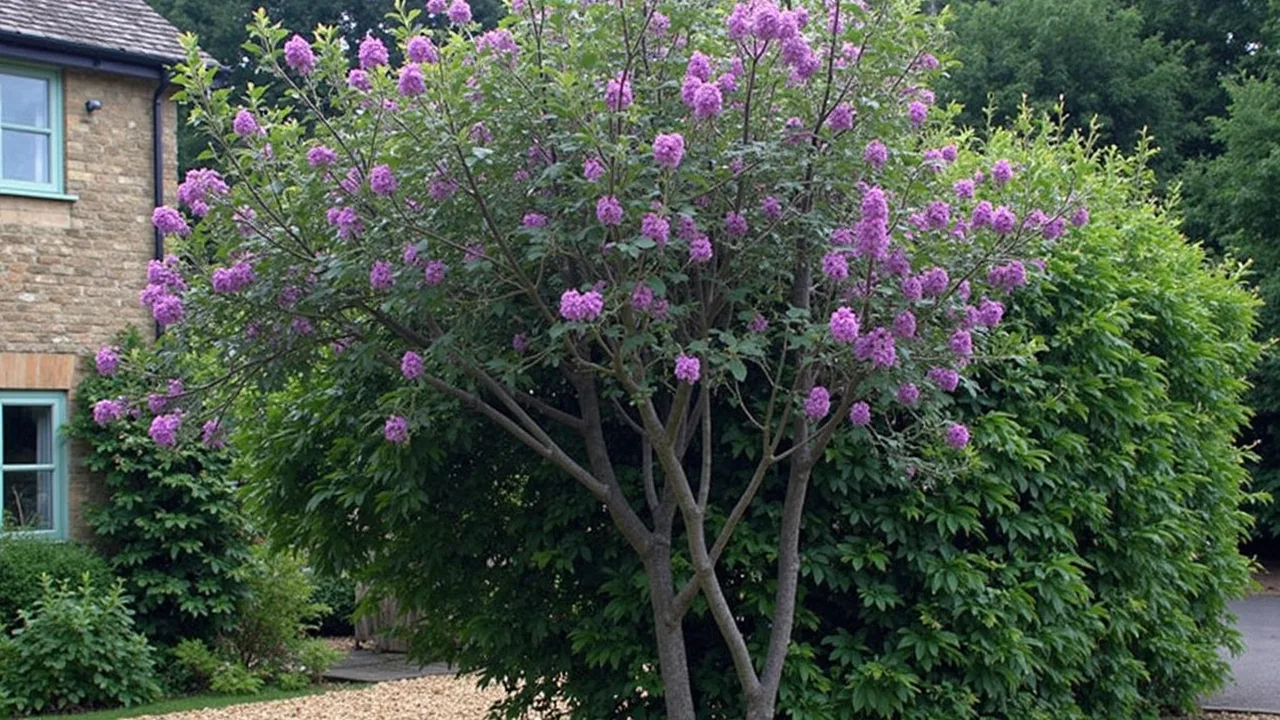
Buddleja davidii is a deciduous shrub of loose, arching habit, with long, slender shoots that lean outwards from the crown as the season progresses. The bark on young stems is downy and pale grey-green, becoming smoother and faintly furrowed on older wood. The leaves are opposite, lance-shaped, 10 to 25 cm long, dark green above and silvery-white with a fine felt of hairs beneath, giving the shrub a two-tone appearance when the wind lifts the foliage. The flowers are borne in dense, tapered panicles, typically 15 to 30 cm long, at the ends of the current season's shoots. Each individual flower is small, tubular and four-lobed, with a flattened orange or yellow throat; the panicles are conical to slightly cylindrical, and in good forms stand roughly upright at the shoot tips. Colour in cultivation ranges from white through pale lilac, lavender-pink, deep violet-purple, magenta and dark plum. The flowers are strongly honey-scented, particularly in still, warm weather, and a single panicle may be visited by dozens of butterflies and bees in high summer. By autumn the panicles dry on the shrub to a soft buff, and the narrow seed capsules split to release small winged seeds — the principal means by which the plant has naturalised across much of central and southern England.
Growing Conditions
Buddleja thrives in full sun and tolerates an unusually wide range of soils, including poor, dry, chalky, stony and slightly alkaline ground. It performs best in well-drained loam of moderate fertility, where it produces the strongest shoots and the largest flower spikes. Heavy, waterlogged or strongly acidic ground is unsuitable and may lead to slow growth and winter die-back. Like most late-summer flowering shrubs, buddleia flowers on the current season's wood, which is why the hard spring pruning described below works so well: the plant throws out vigorous new shoots from near the base and flowers on them the same year. The RHS rates Buddleja davidii as hardy to H6, tolerating winter temperatures down to about -15 to -20 °C, and it can be grown across the whole of the UK with the exception of the very highest and most exposed Scottish sites, where dwarf cultivars are more reliable. The shrub is notably wind-tolerant and stands up well to exposed coastal and hilltop positions. In deep shade it becomes leggy, flowers poorly and is more susceptible to mildew, so a sunny, open site is strongly preferred. Once established, the plant is drought-tolerant and survives on rainfall alone in most parts of Britain, though a thorough soaking in prolonged dry spells during the first year markedly improves establishment.
Planting and Care
Plant container-grown specimens in autumn or spring, at any time the ground is workable. The standard British practice is to cut the entire plant back to within 15 to 30 cm of the ground each March or early April, which keeps the shrub to a manageable 2 to 3 m, produces larger leaves and bigger flower spikes, and prevents the woody, leggy framework that develops in unpruned specimens. Water in well after planting and keep the soil just moist through the first growing season; once established, buddleia needs very little supplementary watering except in severe drought. Feeding is generally unnecessary on reasonably fertile soil; on thin ground, a single light application of a general-purpose fertiliser in spring is sufficient. Overfeeding produces soft, leafy growth and weak flower colour.
Pruning is the single most important task. Each year, in early to mid-spring when the worst of the frost has passed, cut all the previous season's shoots back to a low framework of two or three buds from the base, or to within roughly 30 cm of ground level. Remove any dead, damaged or crossing wood at the same time. This hard annual prune produces the vigorous, straight, flower-bearing shoots that characterise a well-grown buddleia; plants that are never pruned become tall, woody and bare at the base, with small flowers held above an ugly tangle of old growth. Dead-heading the spent panicles during summer keeps the shrub tidy and limits self-seeding, which is the main route by which the plant escapes into the wider environment. No autumn pruning is needed.
Propagation is straightforward from semi-ripe cuttings taken in midsummer: 10 to 15 cm cuttings of healthy current-season wood, trimmed just below a node with the lower leaves removed, root readily in a gritty compost under a cold frame. Hardwood cuttings of well-ripened dormant shoots also root well in winter. Seed germinates freely but produces variable, non-true-to-type offspring, so is used only for the species or naturalising schemes, never for a chosen cultivar. Layering of low shoots is also reliable in autumn.
Seasonal care is light. Spring is for the annual hard prune and, on poor soil, a top-dressing of compost. Summer requires only dead-heading and watering in the first year. Autumn is the time to cut off remaining seed heads on garden specimens to limit self-seeding, and to tidy any straggly growth. In winter the framework is exposed and may suffer tip die-back in colder parts of Britain, which is easily removed at the spring prune.
Common Problems
The principal complaint in British gardens is powdery mildew, a white dusty coating on the leaves in late summer and early autumn, especially after a dry spell followed by warm humid nights. It is largely cosmetic and rarely harms the plant, but can be reduced by full sun, avoiding overhead watering, and choosing the more mildew-resistant modern cultivars. Where it is persistent, cutting the plant back harder at the spring prune helps because the fresh growth is less affected.
Capsid bug and various leaf-sucking insects can produce distorted, tattered leaves in early summer, particularly on plants under stress; damage is rarely serious and natural predators usually build up quickly.
Buddleia is otherwise largely free of serious pest and disease problems in the UK. It is not considered toxic to humans, dogs or cats, and there is no recorded case of poisoning from garden exposure, although, as with most non-food plants, the leaves and flowers are not eaten.
The most significant problem is ecological rather than horticultural. Buddleja davidii is listed under Schedule 9 of the Wildlife and Countryside Act 1981, making it an offence to plant it, or to cause it to grow, in the wild. It has naturalised extensively on waste ground, railway lines, walls and brownfield sites, particularly in the south-east of England, where it can outcompete native flora on thin, dry soils. Gardeners should dead-head spent flowers before they set seed, dispose of seed heads through normal household waste rather than green-waste composting where local guidance recommends it, and consider the newer sterile or low-fertility cultivars described below.
Popular Varieties
'Black Knight' is one of the most widely grown cultivars, with very deep violet-purple flowers and an orange throat, on a vigorous shrub to about 3 m. It holds the RHS Award of Garden Merit and reliably produces the darkest flower colour in the range. 'Royal Red' is similar in habit but bears rich magenta-red panicles, also AGM-rated, and is a strong partner for late-summer plantings of pink and white phlox, sedums and asters. 'White Profusion' carries pure white, orange-throated panicles in profusion, useful for lifting a border at the back end of the season; it is also AGM-rated. 'Nanho Blue' (sometimes sold as 'Mongo') is a more compact cultivar reaching roughly 1.5 m, with narrow leaves and lavender-blue panicles, well suited to smaller gardens. For gardeners concerned about the plant's invasive reputation, the dwarf, largely sterile cultivar 'Blue Chip' (part of the Lo & Behold series) reaches only 60 to 90 cm and sets very little seed, though it still attracts butterflies in the usual way. Other widely available AGM forms include 'Pink Delight', with large pale-pink panicles, and 'Empire Blue', a clear lavender-blue. Cultivars raised specifically for sterility or reduced vigour are now offered by several British nurseries, including the 'Miss' series (such as 'Miss Ruby' and 'Miss Pearl') and 'Flutterby Petite', and these are the most responsible choice for gardens near sensitive semi-natural habitats.
Cultivars and Varieties
| Cultivar | Height | Flower | Notes | AGM |
|---|---|---|---|---|
| 'Black Knight' | — | — | RHS AGM (H6) | ✓ |
| 'Blue Chip' | — | — | — | |
| 'Blue Horizon' | — | — | RHS AGM (H6) | ✓ |
| 'Darent Valley' | — | — | RHS AGM (H6) | ✓ |
| 'Dartmoor' | — | — | RHS AGM (H6) | ✓ |
| 'Pink Delight' | — | — | — | |
| 'Royal Red' | — | — | RHS AGM (H6) | ✓ |
| 'White Profusion' | — | — | RHS AGM (H6) | ✓ |
Pests and Diseases
| Problem | Symptoms | Management |
|---|---|---|
| invasive species | spreads on open land, railway lines, urban areas and in gardens | deadheading blossoms to prevent seeding |
Or browse the full plant problem solver to diagnose an issue by symptom.
Butterfly-Bush in our guides
Recommended Products
GardenWizz earns a commission from qualifying purchases made through affiliate links on this page (including links within the article) — as an Amazon Associate, and from Thompson & Morgan via the Awin network. This does not affect the price you pay. See our disclaimer for details.