Chamomile
Matricaria chamomilla · German chamomile · Hungarian chamomile (kamilla) · wild chamomile
The Gardening Year
Best months in UK gardens · full planting calendar →
🖨 Printable care card (PDF)At a Glance
| Botanical name | Matricaria chamomilla |
|---|---|
| Common name(s) | chamomile, German chamomile, Hungarian chamomile (kamilla), wild chamomile |
| Family | Asteraceae |
| Plant type | annual (Annual, but can be treated as a perennial due to its ability to self-seed.) |
| Height × Spread | 15–60 cm × 10–50 cm |
| Position | Full sun, Partial shade |
| Soil | Well balanced soils with good topsoil; also grows in poor, heavy clay soil. |
| Flowering | June–November |
| Toxicity | May have mild side effects or drug interactions; use with caution around allergies, estrogen-sensitive conditions, and during pregnancy. Can cause allergy symptoms and cross-react with ragweed pollen. Contact dermatitis may occur when touching the plant. |
| Native range | southern and eastern Europe |
Chamomile, Matricaria chamomilla (syn. Chamomilla recutita), is an annual herb in the daisy family (Asteraceae) cultivated across the United Kingdom for its apple-scented foliage and daisy-like flowers. The species is widely grown in cottage gardens, herb gardens, and allotments, and is one of the principal chamomile species used in herbal tea. The closely related perennial Roman chamomile, Chamaemelum nobile, is a separate species with different growth habits; this article covers the annual German or wild chamomile, Matricaria chamomilla.
Overview
Matricaria chamomilla is a slender, much-branched annual native to much of Europe and temperate Asia, including parts of southern and central Britain where it occurs as a casual or naturalised archaeophyte. The plant has a long history of cultivation in British herb gardens, valued both for its use in tisanes and for its presence in informal flower plantings. The hollow conical receptacle at the centre of each flower head is the principal diagnostic feature separating Matricaria chamomilla from the more solid-centred Anthemis and Chamaemelum species.
In UK gardens the species is straightforward to raise from seed in spring and will flower in the same year. It self-sows readily on bare or lightly cultivated soil, and once established in a suitable site a single sowing can persist for several years without further intervention. The plant is attractive to hoverflies, bees, and other pollinating insects, and is commonly included in pollinator-friendly border schemes.
Chamomile is widely available in the UK through mainstream seed catalogues, herb nurseries, and garden centres. Plants are also sold in pots during the summer months. Seed is generally the more economical option for gardeners wanting a substantial drift of the plant.
Appearance
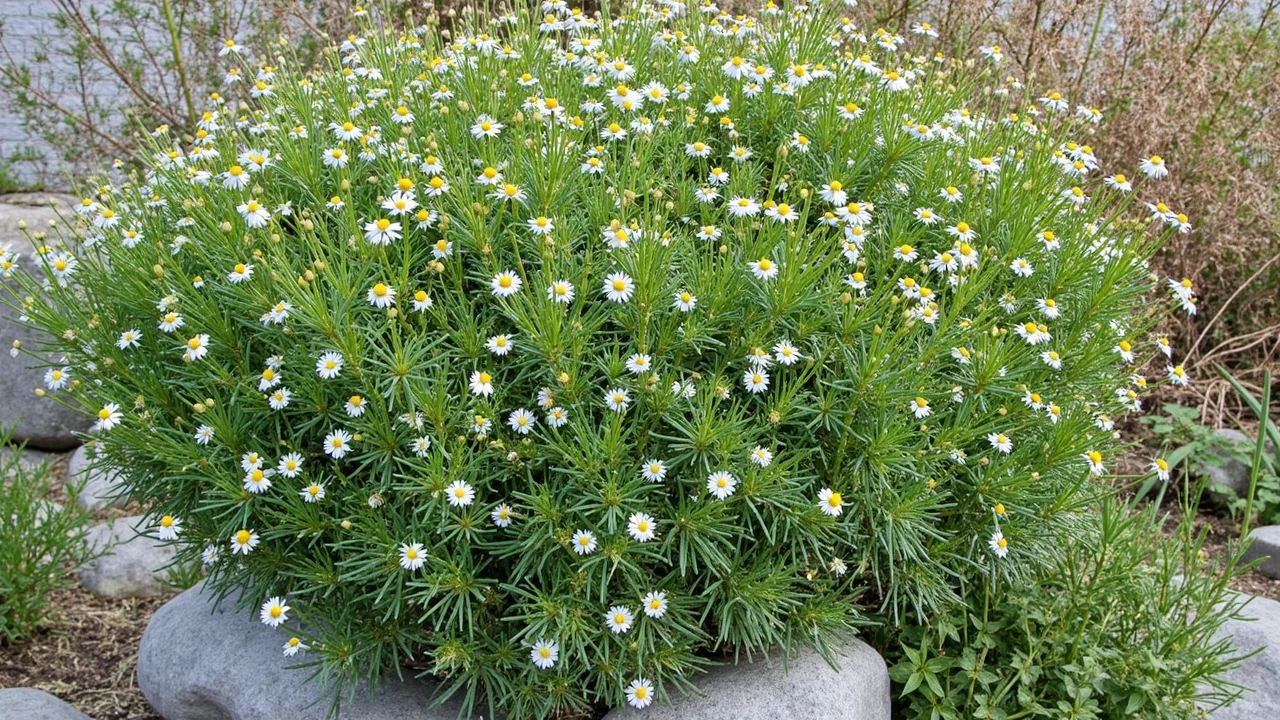
Chamomile is a bushy, erect annual reaching roughly 40–60 cm in height under typical garden conditions, occasionally taller on rich, moist soil. The stems are slender, smooth, and much branched, giving mature plants a feathery, slightly untidy silhouette.
The leaves are finely divided, two- to three-pinnate, and bright green to slightly grey-green. The narrow leaf segments give the foliage a feathery, almost fennel-like appearance, and the leaves are softly aromatic when bruised, releasing the characteristic apple-like scent for which the genus is best known.
The flower heads are borne singly at the tips of the stems and at the ends of the upper branches. Each head is 1.5–2.5 cm across and comprises a ring of white ray florets surrounding a bright yellow, dome-shaped disc. As the disc florets mature the receptacle becomes distinctly conical and hollow, a key feature used to distinguish the species from lookalikes. The flowering season in the UK typically runs from June into September, with peak display in mid-summer.
The roots are shallow and fibrous. The whole plant has a slightly sweet, aromatic fragrance.
Growing Conditions
Chamomile performs best in a sunny, open position but tolerates light dappled shade for part of the day. In the UK, full sun on a south- or west-facing border suits the species well. The plant is relatively tolerant of exposed sites and is often grown successfully in coastal and upland gardens where summers are cool.
Soil should be light, well drained, and reasonably fertile. Chamomile grows happily on loam, sandy loam, and even poor, stony soils provided they do not waterlog. Very rich, heavily manured ground produces lush foliage at the expense of flowers. The species tolerates mildly acidic to mildly alkaline conditions and is not generally considered a fussy plant in the pH range typically found in British gardens.
The plant is hardy as an annual in the British climate and will survive light frost once established, though seedlings are vulnerable to hard late frosts. Gardeners in colder districts of northern England and Scotland sometimes delay sowing until late spring to avoid losses. The Royal Horticultural Society has not published a hardiness rating for Matricaria chamomilla in its commonly cited plant finder data, so specific RHS H-zone ratings for this species should be treated as unverified unless sourced directly from the RHS Plant Finder.
A sheltered but airy site helps reduce the risk of mildew on the foliage in damp summers, which is the most common cause of unsightliness on late-season plants.
Planting and Care
Sowing and planting. In the UK, sow chamomile seed under cover in March or April into modules or small pots, lightly covering the fine seed with compost. Prick out seedlings once they are large enough to handle and harden off before planting out after the last frosts, usually in mid- to late May. Direct sowing in April or early May is also reliable in milder districts; rake the seed bed to a fine tilth, broadcast the seed thinly, and rake in lightly. Thin or transplant seedlings to around 20–30 cm apart. Pot-grown plants from garden centres can be planted at any time during the growing season provided the soil is moist and they are kept watered until established.
Watering. Water young plants regularly during dry spells until they are established. Mature chamomile is moderately drought tolerant and usually copes with typical British summers without irrigation. Container-grown plants need more frequent watering, as the limited root volume dries out quickly.
Feeding. Chamomile does not require heavy feeding. A single light application of a general-purpose fertiliser in spring, or a top-dressing of garden compost, is usually sufficient. Overfeeding produces leafy growth and reduces flower production.
Pruning and deadheading. Deadhead spent flowers regularly through the summer to extend the display and reduce unwanted self-sowing. At the end of the season the whole plant can be cut back to ground level and added to the compost heap. There is no woody framework to manage, as the species is an annual.
Propagation. Chamomile is raised from seed. The species comes reasonably true from saved seed, although plants grown in mixed herb gardens may cross with related genera. For consistent results, buy fresh seed each year or save seed from a stand isolated from other chamomile relatives. Seed remains viable for several years when stored cool and dry.
Seasonal care. Sow under cover in early spring, plant out after the frosts in late May, deadhead through summer, and clear spent plants in autumn. In mild winters, self-sown seedlings may appear in late summer or early autumn and can be left in place to overwinter where they are not in the way.
Common Problems
Chamomile is generally trouble-free in the UK. The most frequently encountered issue is powdery mildew on the foliage in warm, dry late summers, particularly on crowded plants. Improving air circulation by thinning stands and avoiding overhead watering usually keeps it within acceptable bounds.
Aphids can colonise the soft shoot tips in late spring, but damage is rarely severe and natural predators normally bring them under control. Slugs and snails may attack young seedlings, especially in damp conditions; standard control measures such as night-time collection, barriers, or biological controls are effective.
Chamomile is occasionally affected by a fungal root rot in waterlogged soils, which is one reason good drainage is important at the sowing stage. The plant has no significant viral problems commonly reported in UK gardens.
Because chamomile self-sows freely, gardeners may consider the seedlings a weed in other parts of the garden. Hand-pulling or hoeing while small is straightforward.
Popular Varieties
Several named cultivars of Matricaria chamomilla are available in the UK, although seed catalogues also frequently offer the straight species under the name "German chamomile". Real cultivars commonly listed in British seed lists include:
- 'Bodegold' – A tetraploid cultivar with a high essential oil content, selected for commercial and home tisane use. Vigorous and uniform.
- 'Gosal' – A German-bred cultivar noted for uniform plant habit and good flower production; often sold in the UK through herb seed suppliers.
- 'Bona' – A cultivar bred for a high chamazulene content in the essential oil, used in commercial chamomile production in continental Europe and available from specialist UK herb nurseries.
- 'Lutea' – Listed by some UK herb specialists; described as a yellow-flowered variant. Cultivar status and availability are limited, so gardeners should treat it as a curiosity rather than a mainstay.
For most UK gardeners, the straight species is perfectly adequate for garden display and home tisane use, and the cultivars above are of greater interest to growers wanting a particular oil profile or plant habit. Perennial Roman chamomile, Chamaemelum nobile, and its cultivar 'Treneague' (the lawn chamomile) belong to a different species and should not be confused with Matricaria chamomilla.
Pests and Diseases
| Problem | Symptoms | Management |
|---|---|---|
| Slugs and snails | Irregular holes in leaves and damage to soft young shoots. | Use physical barriers like copper tape or organic slug pellets. |
| Aphids | Clusters of small insects on new growth causing leaf curling. | Spray off with water or apply insecticidal soap. |
| Powdery mildew | White powdery fungal growth on leaves and stems. | Ensure good air circulation and avoid overhead watering. |
| Root rot | Yellowing foliage and wilting despite moist soil conditions. | Plant in well-drained soil to prevent waterlogging. |
For step-by-step help, read Controlling Aphids Naturally, Dealing with Slugs and Snails and Treating Powdery Mildew. Or browse the full plant problem solver to diagnose an issue by symptom.
Chamomile in our guides
Recommended Products
GardenWizz earns a commission from qualifying purchases made through affiliate links on this page (including links within the article) — as an Amazon Associate, and from Thompson & Morgan via the Awin network. This does not affect the price you pay. See our disclaimer for details.