Rock Rose
Cistus × aguilarii
The Gardening Year
Best months in UK gardens · full planting calendar →
🖨 Printable care card (PDF)At a Glance
| Botanical name | Cistus × aguilarii |
|---|---|
| Common name(s) | Rock rose |
| Family | Cistaceae |
| Plant type | shrub |
| Height × Spread | 100–150 cm × 100–150 cm |
| Position | Full sun |
| Soil | poor, stony, well-drained; chalk, loam, sand; acid, alkaline or neutral |
| Flowering | June–August |
| Toxicity | — |
| Native range | Mediterranean |
Cistus × aguilarii is an evergreen rock rose grown for its large, pure white summer flowers and neat, rounded framework of bright green leaves. This western Mediterranean hybrid suits sunny, sheltered UK gardens where the soil drains freely, particularly gravel gardens, warm borders, banks and planting beside a south- or west-facing wall.
Overview
The multiplication sign in the botanical name identifies Cistus × aguilarii as a hybrid rather than a wild species. It belongs to the Cistaceae and is associated with the western Mediterranean. Like other rock roses, it combines drought tolerance with a preference for intense light, lean soil and rapid drainage. It is not native to Britain or Ireland, but it grows successfully in many UK gardens when its Mediterranean requirements are respected.
Its most useful landscape qualities are evergreen structure, a long succession of flowers and an ability to perform in dry, stony ground where richer-border shrubs may struggle. A single plant can form a bright summer focal point among silver-leaved herbs, ornamental grasses and other drought-tolerant shrubs. It also works on a sunny bank, in a courtyard, in coastal planting or towards the front of a warm mixed border. Allow it room from the outset: established cistus dislike disturbance and old wood responds poorly to severe cutting back.
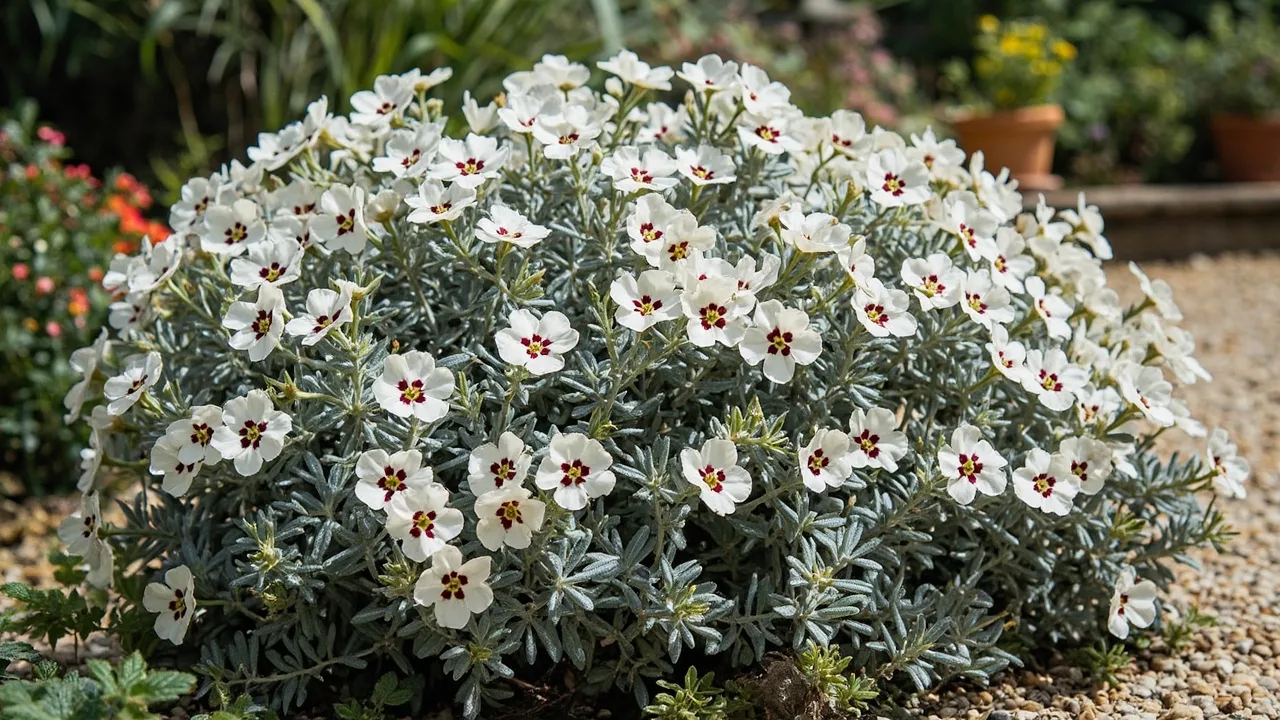
The unselected hybrid bears unmarked white flowers. Plants sold as Cistus × aguilarii ‘Maculatus’ are distinct: they are generally more compact and each petal carries a conspicuous dark maroon blotch. Checking the full label is therefore important when flower pattern and eventual size matter.
Appearance
Cistus × aguilarii develops into a rounded, bushy shrub, typically reaching about 1.2m in height with a similar spread over five to ten years. Its branching becomes woody with age, while the outer shoots retain a lighter, leafy appearance. The evergreen leaves are narrow, bright green and noticeably wavy along the margins, reaching as much as 10cm long. Their texture and close spacing give the plant useful year-round presence without making it look heavy.
The flowers are borne through summer and may reach 8cm across. Five broad, pure white petals surround a small central boss of golden stamens. Their finely crumpled surface gives the familiar tissue-paper effect seen across the genus. Each individual flower is short-lived, often lasting only a day, but new buds open repeatedly so the overall display continues for weeks. Fallen petals beneath the shrub are a normal consequence of this flowering habit, not a sign of ill health.
‘Maculatus’ differs visually as well as in scale. It is usually 0.5–1m high and wide, with sticky, narrowly ovate, wavy-edged leaves. Its white flowers can reach about 10cm across and display a large maroon patch at the base of every petal. Both forms remain naturally informal, making them especially effective in gravel, Mediterranean-style and cottage planting rather than tightly clipped schemes.
Growing Conditions
Full sun is essential for compact growth and generous flowering. A south- or west-facing position is ideal for the typical hybrid; ‘Maculatus’ is also suited to a warm east-facing aspect where it still receives strong light. Shelter from persistent cold wind protects the evergreen canopy, and avoiding a frost pocket reduces the risk of damaged shoot tips. In colder or wetter districts, the warm microclimate beside a wall is preferable to an open lawn or exposed ridge.
Drainage is the decisive soil factor. The shrub accepts chalk, loam and sand, across acid, neutral and alkaline conditions, provided water moves through the root zone quickly. Poor, stony or moderately infertile ground is suitable. Rich soil encourages soft, leafy growth at the expense of flowers and can shorten the useful life of the plant. Although chalk is tolerated, older leaves may become yellow on strongly chalky ground, especially where drainage is also imperfect.
Heavy clay is risky for the typical form because water can remain around the roots during winter. ‘Maculatus’ is listed for clay as well as lighter soils, but it still requires a well-drained site; clay texture does not mean waterlogging is acceptable. On difficult ground, plant on a raised mound or in a raised bed and improve the wider soil structure with organic matter rather than creating a small pocket of radically different compost. A large volume of sharp mineral material is needed to alter clay drainage substantially.
Container growing is possible while the plant is young or where garden soil stays wet. Use a peat-free, loam-based compost with added grit and a pot with generous drainage holes. Containers need more attention to watering than open ground, and the rootball should never stand in a saucer of water. Because cistus resent repeated root disturbance, a permanent position in the ground is usually the better long-term choice where conditions allow.
Planting and Care
Plant in spring, usually from March to May once the soil is workable and the most severe weather has passed. Spring planting gives roots a full growing season to establish before their first winter. Dig a hole no deeper than the rootball and sufficiently wide to spread the outer roots. Set the plant at the same level at which it grew in its pot, firm gently and water thoroughly. Space neighbouring plants so they will not shade its lower branches at maturity; bare shaded wood is unlikely to refill reliably.
Water regularly during the first growing season, checking the rootball rather than wetting only the surface. A thorough soak followed by time for the soil to drain encourages deeper rooting. Once established, Cistus × aguilarii is notably drought tolerant and generally needs water only during prolonged dry spells. Container plants remain dependent on the gardener: water deeply when the upper compost has dried, then let excess water escape.
Routine feeding is unnecessary in open ground. Avoid high-nitrogen fertilisers and thick, nutrient-rich mulches around the crown, as lush growth is less floriferous and more vulnerable to winter damage. A container plant that has remained in the same compost may receive a light, balanced feed in spring, but sparse growth should first prompt checks of light, drainage and root health rather than automatic feeding.
Pruning must remain light. On young plants, pinch or shorten soft leading growth in spring after the immediate risk of damaging weather has passed to encourage branching. Remove dead or damaged tips back to healthy growth at the same time. Established plants need little routine pruning. If a mild, sheltered garden permits a light shaping trim after flowering, cut only into leafy young growth. Never attempt renovation by cutting deeply into old, bare wood: regeneration is unreliable, and replacing an ageing, leggy shrub is usually safer.
Deadheading is optional because new flowers continually replace the spent one-day blooms. Individual shrivelled flowers can be pinched away where appearance matters, but shearing the whole shrub is inappropriate. Seasonal care otherwise centres on keeping the crown open to light, clearing fallen leaves that trap moisture, and checking in autumn that drains and pot feet are unobstructed. Do not wrap foliage in impermeable material, which holds damp air around the leaves.
Propagate the hybrid vegetatively to preserve its characteristics. Take softwood cuttings from healthy, non-flowering shoots from late spring to early summer, commonly May or June. Trim below a node, remove the lower leaves and insert several cuttings around a pot of free-draining propagation compost. Keep them humid but ventilated in bright, indirect light. Semi-ripe cuttings can also be taken from July to September, using current-season shoots that are firm at the base and still flexible at the tip. Overwinter rooted young plants in a cold frame or unheated greenhouse. Seedlings may vary and cannot be expected to reproduce either the typical hybrid or ‘Maculatus’ accurately.
Common Problems
Most failures result from site conditions rather than persistent pest attack. Yellowing leaves can indicate chlorosis on strongly alkaline soil, particularly when poor drainage limits nutrient uptake. Check that the root zone is not saturated before applying trace elements or fertiliser. Where alkalinity is extreme, moving a young container-grown plant to more suitable soil may be more effective than repeatedly treating symptoms.
Root decay and shoot dieback are associated with heavy, waterlogged ground. A plant that wilts while the soil is wet may have damaged roots rather than drought stress, so extra watering can worsen the problem. Improve drainage for nearby planting, remove dead material and avoid replanting another cistus into a persistently wet pocket. Phytophthora root rot may be involved in wet conditions, and honey fungus is also a recorded disease risk; conspicuous white fungal sheets beneath bark, bootlace-like strands or clusters of honey-coloured mushrooms warrant closer investigation.
Cold wind and exposed positions can scorch foliage or kill shoot tips. Wait until spring growth makes the extent of damage clear, then remove only dead tissue. Poor flowering usually follows shade, excessive feeding or overcrowding. Restore light around the plant without exposing old stems through drastic pruning. Cistus are generally pest-free, so distorted or sticky growth should be inspected before any treatment is chosen rather than sprayed routinely.
Ageing plants naturally become open and leggy. This is not safely corrected by hard pruning. Take cuttings while the shrub remains vigorous, then replace it with a young plant in fresh, well-drained ground when its display declines. That planned succession is more reliable than attempting to force dormant old wood to reshoot.
Popular Varieties
Named selection within Cistus × aguilarii is limited, and cultivar names should not be inferred from unlabelled plants. The following includes its documented cultivar and clearly identified alternatives for gardeners comparing white-flowered rock roses:
- Cistus × aguilarii ‘Maculatus’ — the principal named cultivar of this hybrid. It forms a smaller bush, usually 0.5–1m high and wide, with 10cm white flowers marked by five large maroon basal blotches. It is a strong choice where the typical plant's 1.2m framework would be too large.
- Cistus × laxus ‘Snow White’ — a separate hybrid cultivar, not a form of C. × aguilarii. It offers unblotched white flowers on a compact evergreen shrub and suits gardeners seeking a broadly similar light-coloured effect.
- Cistus ‘Snow Fire’ — another distinct cultivar with white petals and prominent dark basal marks. Its broader spread can make it useful on a sunny bank, but labels should be checked for its eventual dimensions.
- Cistus × dansereaui ‘Decumbens’ — a low, spreading white-flowered alternative for the front of a gravel garden or a sunny slope. Its ground-covering outline differs from the rounded habit of C. × aguilarii.
When buying, confirm whether a nursery is offering the unmarked typical hybrid or ‘Maculatus’, as photographs and shortened labels can obscure the difference. Select a compact, well-branched plant rather than an oversized specimen, then establish it in its permanent sunny position.
Pests and Diseases
| Problem | Symptoms | Management |
|---|---|---|
| Honey fungus | Wilting, dieback of branches, and eventual death of the shrub. | Improve drainage and remove infected plants to prevent spread. |
| Root rot | Rapid wilting and collapse of foliage due to waterlogged soil. | Plant in very free-draining soil and avoid heavy, wet conditions. |
| Chlorosis | Yellowing of leaves on acid-loving species grown in alkaline soils. | Choose lime-tolerant species for chalky soils or amend acidity. |
| Frost damage | Blackened, dead shoots and foliage after severe winter cold. | Plant in a sheltered position away from frost pockets. |
| Wind damage | Broken stems and desiccated leaves caused by strong exposure. | Site against a wall or in a protected area to shield roots. |
Or browse the full plant problem solver to diagnose an issue by symptom.
Recommended Products
GardenWizz earns a commission from qualifying purchases made through affiliate links on this page (including links within the article) — as an Amazon Associate, and from Thompson & Morgan via the Awin network. This does not affect the price you pay. See our disclaimer for details.