Dwarf Rock Rose
Cistus dansereaui
The Gardening Year
Best months in UK gardens · full planting calendar →
🖨 Printable care card (PDF)At a Glance
| Botanical name | Cistus dansereaui |
|---|---|
| Common name(s) | Dwarf rock rose |
| Family | Cistaceae |
| Plant type | shrub |
| Height × Spread | 0.5–2 m × — |
| Position | Full sun |
| Soil | very free-draining |
| Flowering | June–August |
| Toxicity | — |
| Native range | Mediterranean region |
Cistus × dansereaui is a hybrid rock rose bred from two Mediterranean parents, and it offers UK gardeners a low-maintenance, drought-tolerant shrub that covers itself in white, papery flowers through early summer. Compact enough for a gravel garden yet generous in flower, it earns its place wherever sun beats down and drainage is sharp.
Overview
Cistus × dansereaui was named by Portuguese botanist P. Silva for the hybrid cross Cistus inflatus × Cistus ladanifer. Kew's Plants of the World Online records it as a south-west European shrub; in UK gardens it behaves as a tidy, sun-loving evergreen that thrives where many other shrubs fail. The most familiar clone, 'Decumbens', is a low, spreading form that has been grown in British gardens since the early twentieth century, and it remains one of the most reliable rock roses for sunny, free-draining sites.
Appearance
The plant forms a dense, mounded shrub of slender, slightly sticky shoots clothed in opposite, oblong-lanceolate leaves. Foliage colour ranges from fresh green to a softer grey-green, and — unlike some other cistus — the leaves lack a dull sheen, giving the canopy a slightly matte finish. Leaves taper to a point and are typically 5–10 cm long, with a faintly wavy edge on established plants.
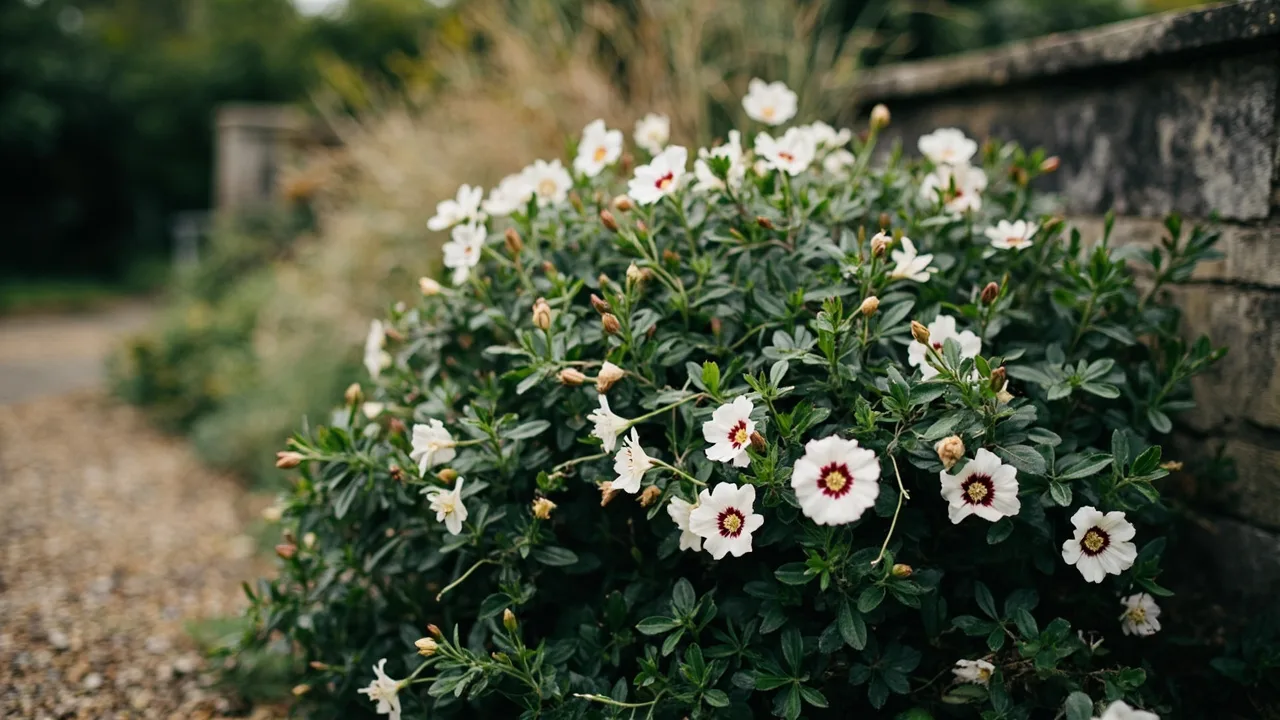
In late spring and early summer the new shoots terminate in clusters of three to six white flowers, each around 7 cm across with five papery petals and a boss of bright yellow stamens at the centre. Selected clones carry a small crimson or burgundy blotch at the base of each petal; in others the flowers are unmarked. Individual blooms last only a day, opening in the morning and shedding by afternoon, but fresh flowers follow in succession over many weeks in warm, sunny weather.
The size depends on the clone. The upright species form reaches about 1 m tall and is recorded by the RHS as a "small, upright, evergreen shrub" with narrow, sticky, dark green leaves up to 10 cm long. The compact 'Decumbens' is shorter and broader, reported at roughly 60–90 cm tall and spreading to about 1.2 m, which makes it particularly useful as low cover along the front of a sunny border.
Growing Conditions
Cistus × dansereaui needs the conditions of its Mediterranean parents translated into a British setting: full sun, sharp drainage, and a sheltered aspect away from cold, drying winds.
Sun. The plant flowers best and stays most compact in full sun for most of the day. Light shade is tolerated but produces a leggier, less floriferous shrub.
Shelter. Position it against a sunny wall, on the lee side of a building, or in the shelter of taller shrubs so that cold easterly and northerly winds do not scorch the evergreen foliage in winter.
Soil. Use poor to moderately fertile, very free-draining soil. Gritty, sandy or stony ground suits it; moisture-retentive loam or clay does not. Where the native soil is heavy, build a raised bed, mound up the planting area, or work plenty of grit into the root zone before planting. Cistus tolerate drought once established and dislike being kept wet, especially through winter.
Climate placement. It is suited to sunny banks, gravel gardens, rock gardens, dry borders, walls and coastal-style planting. In colder inland regions it benefits from a south- or west-facing wall and a gravel mulch that keeps the crown dry through wet winters.
Planting and Care
Plant in spring so the root system has the growing season to anchor itself before its first winter. Dig a hole no deeper than the rootball but two to three times as wide, and loosen the surrounding soil to encourage roots outwards. If drainage is marginal, drop a 5–10 cm layer of coarse grit into the base of the planting hole and mix grit into the backfill rather than enriching it heavily with compost — a rich, nitrogen-heavy planting hole produces soft growth that is more vulnerable to frost.
Watering. Water new plants during dry spells in their first spring and summer, then reduce irrigation as the root system establishes. Once the shrub is in its second season, only prolonged drought requires supplementary watering. Avoid watering in late autumn and winter, when saturated soil is the principal cause of decline.
Feeding. Routine feeding is unnecessary and can be harmful. A single light mulch of well-rotted garden compost in spring, if at all, is plenty. A mineral mulch of gravel or chipped stone is preferable to organic mulches that stay damp around the collar.
Mulching. Mulch with gravel or another free-draining mineral material, keeping it clear of the stem to prevent rot at the crown.
Pruning. Prune lightly, only if needed, immediately after flowering. Trim to shape or to remove winter-damaged growth, cutting back to a healthy pair of leaves. Avoid cutting hard into old, leafless wood: cistus do not reliably reshoot from old stems, and hard pruning can kill an otherwise healthy plant. If the shrub becomes leggy or outgrows its space, it is safer to replace it than to attempt rejuvenation.
Propagation. Take semi-ripe cuttings in mid to late summer: select healthy, non-flowering sideshoots about 8–10 cm long, trim below a node, and root them in a 50:50 mix of grit and peat-free compost under a propagator lid. Named hybrids, including Cistus × dansereaui cultivars, do not come true from seed, so cuttings are the only reliable way to increase a particular clone.
Seasonal care. In colder regions, drape horticultural fleece over the plant during severe winter frosts, particularly if sharp cold follows a wet autumn. In spring, remove any frosted or broken stems and top up the gravel mulch.
Common Problems
Cistus are usually trouble-free when their two essentials — sun and drainage — are right. Problems in UK gardens cluster around a small number of predictable causes.
Winter wet and root decline. Yellowing foliage and dieback in spring are usually the result of waterlogged soil rather than cold itself. Improve drainage, reduce watering, and replant affected specimens on a raised mound of gritty soil if necessary.
Cold wind and frost scorch. Brown, papery patches on the leaves after a cold spell are typical of wind scorch or sudden hard frost. Damaged growth can be trimmed back to healthy wood after the worst weather has passed; the plant will usually recover from the buds lower down.
Aphids. Soft spring growth on young plants can attract aphids, which cluster on shoot tips and cause curling or distorted leaves. A strong jet of water, encouragement of natural predators such as ladybirds and hoverflies, or a fatty-acid-based spray approved for ornamentals are usually sufficient. Avoid broad-spectrum insecticides that will also harm pollinators.
Scale insects. Stems and the undersides of leaves may host scale insects, which appear as small, waxy bumps and produce sticky honeydew on which sooty mould can develop. The RHS records that British gardens contain more than 25 scale species, each with different hosts and life cycles; light infestations can be tolerated as part of the garden's natural balance, while heavier populations respond to a winter wash of plant oil applied when the plant is dormant and frost-free.
Sooty mould. Black, soot-like deposits on the leaves are almost always secondary to honeydew from sap-sucking insects above. Address the insects and the mould weathers away as the leaves turn over.
Popular Varieties
Three named forms of Cistus × dansereaui are widely available in the UK. All are evergreen, white-flowered rock roses with the same sun-loving, drought-tolerant habit; the differences are in size, habit and petal markings.
Cistus × dansereaui 'Decumbens'. The most familiar clone, with a low, spreading habit that makes it useful for the front of a sunny border, gravel gardens and the tops of low walls. White flowers to about 7 cm across, sometimes faintly blotched with crimson or yellow at the petal bases, are carried in clusters from May into July. Mature size around 60–90 cm tall and up to 1.2 m wide. Listed by Burncoose, Ashwood Nurseries, Jackson's Nurseries, Young's Nurseries and Champion Plants among others, with potted plants typically in the £10–£15 range at UK nurseries.
Cistus × dansereaui 'Jenkyn Place'. A perpetual-flowering clone named by the curator of the Cistus & Halimium Website, with white flowers marked by a distinct crimson blotch at the base of each petal (RHS Colour Chart reference 185A). Flowering continues over a long season — the original description notes flowers until the first frosts in UK trials. A useful alternative to 'Decumbens' where a stronger petal marking is wanted.
Cistus × dansereaui 'Portmeirion'. Sometimes sold under the older name 'Albiflorus'. A more upright, vigorous form with larger white flowers and a slightly taller habit than 'Decumbens', recorded in Oregon State University variety trials at around 1 m tall. Worth trying in milder, coastal-style plantings where its vigour can be put to use.
Beyond these named cultivars, the straight species Cistus × dansereaui itself (the un-named cross) is occasionally offered by specialist nurseries and is worth growing where a slightly more upright shrub is needed.
Sources & Further Reading
- Royal Horticultural Society — Cistus growing guide: https://www.rhs.org.uk/plants/cistus/growing-guide, accessed 2026-07-23.
- Royal Horticultural Society — Cistus × dansereaui plant profile: https://www.rhs.org.uk/plants/99333/cistus-x-dansereaui/details, accessed 2026-07-23.
- Royal Horticultural Society — Scale insects in gardens: https://www.rhs.org.uk/biodiversity/scale-insects, accessed 2026-07-23.
- Royal Botanic Gardens, Kew — Plants of the World Online, Cistus × dansereaui: https://powo.science.kew.org/taxon/urn:lsid:ipni.org:names:168237-1, accessed 2026-07-23.
- Trees and Shrubs Online — Cistus × dansereaui: https://www.treesandshrubsonline.org/articles/cistus/cistus-x-dansereaui/, accessed 2026-07-23.
- Shoot Gardening — Cistus × dansereaui 'Portmeirion': https://www.shootgardening.com/plants/cistus-x-dansereaui-portmeirion, accessed 2026-07-23.
- Cistus & Halimium Website — Hybrids & Cultivars: https://cistuspage.org.uk/the-plants/hybrids-cultivars/, accessed 2026-07-23.
Pests and Diseases
| Problem | Symptoms | Management |
|---|---|---|
| Honey fungus | Stems may show white fungal growth at the base and the plant declines or dies back. | Improve drainage and remove infected plants; avoid replanting in the same spot for several years. |
| Root rot | Leaves turn yellow or brown and wilt despite adequate moisture, often due to waterlogged soil. | Ensure planting in well-drained soil and avoid overwatering, especially in winter. |
| Slugs and snails | Irregular holes chewed in leaves and flowers, with slimy trails visible on foliage. | Use physical barriers like copper tape or apply iron phosphate-based slug pellets. |
| Vine weevil | Notched edges on leaves above ground and root damage causing plant collapse below. | Apply nematodes to the soil in autumn or use systemic insecticides as a preventive measure. |
| Powdery mildew | White, powdery fungal growth appears on leaves and stems, potentially stunting growth. | Improve air circulation around the plant and apply a suitable fungicide if necessary. |
For step-by-step help, read Dealing with Slugs and Snails and Treating Powdery Mildew. Or browse the full plant problem solver to diagnose an issue by symptom.
Recommended Products
GardenWizz earns a commission from qualifying purchases made through affiliate links on this page (including links within the article) — as an Amazon Associate, and from Thompson & Morgan via the Awin network. This does not affect the price you pay. See our disclaimer for details.