Field Birch
Betula pubescens
The Gardening Year
Best months in UK gardens · full planting calendar →
🖨 Printable care card (PDF)At a Glance
| Botanical name | Betula pubescens |
|---|---|
| Common name(s) | Field Birch |
| Family | Betulaceae |
| Plant type | tree (deciduous) |
| Height × Spread | 10–27 m × 4–8 m |
| Position | Full sun, Partial shade |
| Soil | moist but well-drained soil, tolerant of poor or wet, acid soils |
| Flowering | March–May |
| Toxicity | No specific toxicity is listed by the RHS. This is not a guarantee of safety — check with a vet or the ASPCA before pets or children eat any plant. |
| Native range | northern Europe and northern Asia |
Quick answer: Betula pubescens (downy birch) is a native UK deciduous tree, typically reaching 15–20 m, thriving on damp, acidic soils where many other trees struggle. It is the birch to choose for wet ground, exposed sites and the colder north and west of Britain, and it supports a rich community of moths, lichens and woodland birds.
Overview
Betula pubescens is one of only two true birches native to the British Isles and the more accommodating of the pair in difficult sites. It is a slender, single-stemmed tree with a conical to slightly oval crown, smooth grey-white bark that stays white at the base, and soft downy shoots that give the species its common name. It is found across the whole of the UK from the Scottish Highlands to the south coast, but it dominates on acidic, nutrient-poor and waterlogged ground — exactly the soils where its close relative, the silver birch (Betula pendula), tends to struggle.
For UK gardeners, downy birch is the practical choice on damp clay, on restored heathland, in new-build gardens with poor subsoil, and in any spot where surface water sits after rain. It establishes quickly from a young whip, grows at a steady 30–60 cm a year in reasonable conditions, and casts only light shade, which makes it useful above acid-loving shrubs such as heathers, rhododendrons and blueberries. It is also the right birch for the colder, windier north and west, where its greater tolerance of wet soil and exposure gives it a clear edge over silver birch.
Appearance
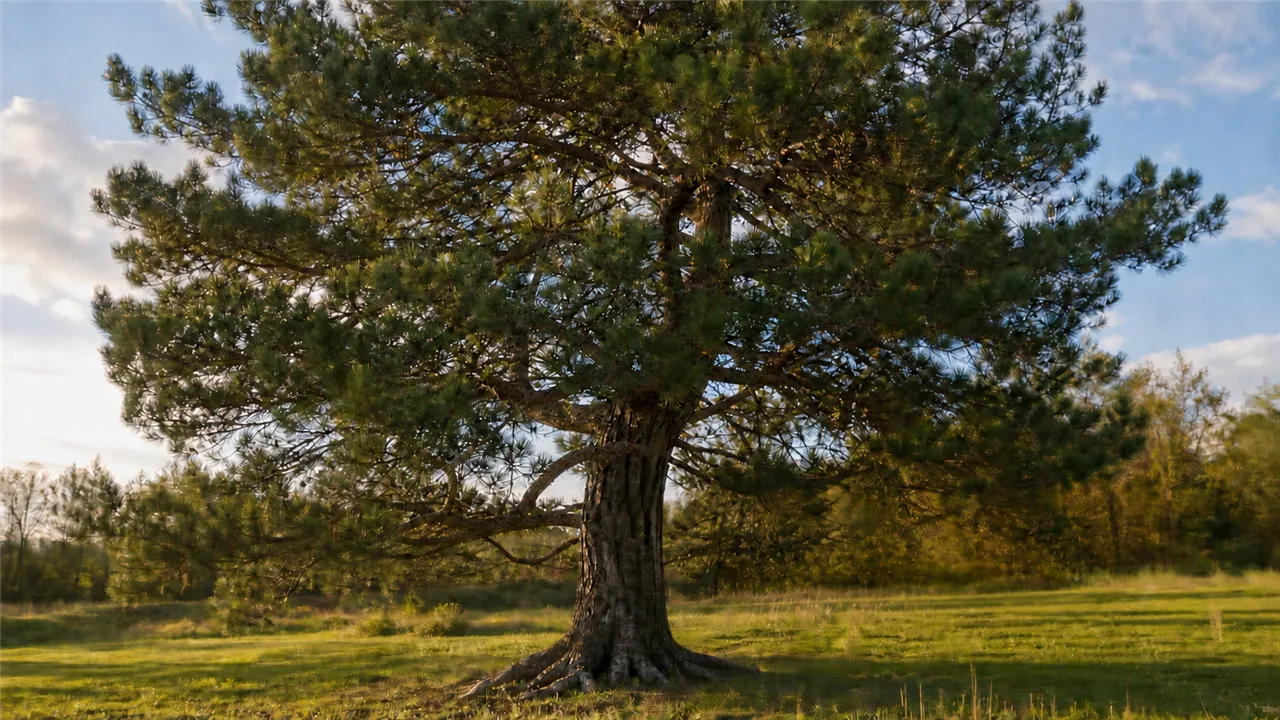
A mature downy birch carries an open, conical crown on a single, usually straight trunk. The bark is a dull grey-white, often with pale grey or pinkish-brown patches in older trees, and peels in thin papery strips without the heavy black diamond markings so characteristic of silver birch. The bark stays notably white right down to the base of the trunk, which is one of the simplest field characters separating the two species at a distance.
The twigs are softly hairy when young and lack the rough, warty gland-dots of silver birch. Buds are small, conical and sticky. The leaves are alternate, broadly ovate to almost round, 3–6 cm long, with a rounded or slightly heart-shaped base, a pointed tip and a single rather than double set of marginal teeth. They emerge fresh green in spring and turn a clear, sometimes buttery yellow in autumn before falling. Young leaves carry a fine down on both surfaces; older leaves become smoother above but usually retain some hair beneath.
Flowering takes place in early spring, often before the leaves have fully expanded. Male catkins are long, yellow-brown and pendulous, shedding pollen in March and April; female catkins are smaller, upright and green, eventually ripening into pendulous clusters of tiny winged seeds (samaras) that disperse in late summer and autumn. The seeds are a major food source for seed-eating birds such as siskins and redpolls, and the catkins support pollinators coming out of winter dormancy.
A fully grown specimen typically reaches 15–20 m on most sites, with a spread of 7–10 m. On deep peat or in a sheltered Scottish glen it can exceed 25 m, but on thin, dry soil it may stay closer to 10–12 m. Downy birch is not a long-lived tree: even healthy specimens often begin to decline after 50–70 years, and many garden trees become untidy in their third or fourth decade.
Growing Conditions
Downy birch succeeds across almost the full range of UK climates, from the Western Isles to the Home Counties, and tolerates exposure far better than most broadleaves. It will grow in full sun or in light, dappled shade, and a young tree copes with a degree of competition from other vegetation while it establishes.
The defining requirement is moisture and acidity. Downy birch thrives on soils with a pH of roughly 3.5 to 5.5 and tolerates peaty ground, gleys and the iron-rich, waterlogged margins of ponds and streams that would kill less tolerant species. It is the birch to plant where silver birch yellows and fails. On thin chalk or limestone soils it survives but grows slowly and often suffers from chlorosis; on neutral loams it grows acceptably but rarely achieves its full stature.
Soils that hold winter wet for weeks on end — heavy clay in low-lying gardens, compacted new-build plots, restored industrial sites with a high water table — suit it well, provided the ground is not actually anaerobic. In very dry, sandy soils it grows but never flourishes and is more susceptible to bronze birch borer stress, although that pest is not currently established in the UK.
Coastal exposure is tolerated better than for most deciduous trees, and mature specimens come through gales that snap less flexible species. Inland, downy birch is reliably hardy throughout mainland Britain and Ireland.
Planting and Care
Plant bare-root whips between November and March, when the soil is workable and not frozen, in any part of the UK. Container-grown stock can be planted at any time of year, but autumn and early spring remain the best windows because watering is easier and the young tree can establish before facing summer drought.
Site preparation is minimal. Dig a hole twice the width of the rootball and the same depth, loosen the base with a fork, and plant the whip at the same depth it stood in the nursery — the soil mark on the stem is a reliable guide. Backfill with the original soil; the species does not need enriched planting compost. Mulch with a 5–8 cm layer of bark or well-rotted leaf mould over a 1 m circle, keeping it clear of the stem. Stake taller specimens with a low stake and a flexible tie for the first two to three years, removing the stake before it begins to constrict the trunk.
Watering matters mainly in the first two growing seasons. Soak thoroughly during dry spells of more than a week, rather than sprinkling lightly every day, to encourage roots to follow moisture downwards. Once established, downy birch in the ground needs no supplementary watering in normal UK summers. Container-grown specimens dry fast and should be kept evenly moist.
Feeding is rarely necessary. A single annual mulch of leaf mould or composted bark in early spring is usually enough on reasonable soils. On very poor ground, a light dressing of a balanced, slow-release fertiliser in March will steady early growth, but heavy feeding produces soft, sappy growth that is more attractive to aphids and more vulnerable to wind damage.
Pruning is best kept to a minimum. Downy birch bleeds sap heavily if cut in late winter or early spring, so any shaping or removal of damaged wood is best done in late summer or early autumn, once growth has slowed but before hard frosts. Remove dead, crossing or badly placed branches in the first five years to build a clean single leader; established trees seldom need routine pruning beyond the occasional removal of dead wood.
Propagation is straightforward from seed. Collect ripe catkins in late summer as they begin to brown, dry them indoors and shake out the tiny winged seeds. Sow immediately on the surface of a peat-based seed compost, press in lightly and leave outdoors through winter — downy birch needs a cold period to germinate. Prick out seedlings once they are large enough to handle and grow on in individual pots for two to three years before planting out. Hardwood cuttings of 20–30 cm taken in late autumn root poorly; grafting onto seedling rootstocks is used for named cultivars but is not required for the species.
Common Problems
Aphids on young growth
Shoots become sticky and sooty mould develops on lower leaves in late spring and early summer. The cause is aphid colonies feeding on soft new growth; downy birch is one of the regular UK hosts. Tolerate low populations — ladybirds, hoverflies and lacewings usually move in within a fortnight — and only intervene with a strong jet of water or insecticidal soap if the infestation is distorting new shoots on a small specimen.
Birch leaf-mining sawfly and other leaf miners
Brown blotches or blotchy tunnels appear in the leaves from late spring onwards, and affected foliage may drop early. Several native sawflies and micro-moths mine birch leaves; the damage looks unsightly but rarely harms a healthy tree. Rake up and bin fallen leaves in autumn to reduce overwintering larvae, and avoid high-nitrogen feeding that promotes the soft growth mines prefer.
Fungal leaf spots and birch rust
Yellow or brown spots on leaves, sometimes with small dark fruiting bodies, are typical of the various Melampsora rusts and leaf-spot fungi that affect birch in damp summers. None is serious in isolation, and the species tolerates considerable defoliation. Improve air circulation by spacing trees appropriately, clear up leaf litter at the end of the season and avoid wetting the foliage when watering.
Bronze birch borer (not yet in the UK)
Wilting shoots, D-shaped exit holes in the bark, and dieback of the upper crown are signs of bronze birch borer (Agrilus anxius). The pest is not currently established in the UK but is a notifiable threat, and all species of birch, including Betula pubescens, are potential hosts. Suspected sightings should be reported through TreeAlert; healthy, well-watered trees are the best defence against any future outbreak.
Short lifespan and windthrow
Older downy birches frequently develop decay in the heartwood, lose upper limbs in gales, or simply become thin and stag-headed after 50–70 years. There is no treatment, and the honest answer is that downy birch is a relatively short-lived tree. Plan for replacement at around the half-century mark, especially if the tree is close to a building or a well-used garden area.
Popular Varieties
The species Betula pubescens is the form most often sold in UK native-mix and hedging schemes, and it is the right choice for damp gardens, rewilding projects and the colder north and west. Named cultivars are few, and several that appear in retail listings are actually forms of silver birch; check the botanical name on the label before buying.
Betula pubescens is sometimes sold as the subspecies or variety Betula pubescens var. glabrata, a smoother, less downy form from the Baltic region that some authorities treat as a separate species (Betula glabrata). It is occasionally offered as a more refined garden tree where the hairy shoots of the type are felt to look untidy in winter. Gardeners in the south and east may also encounter the hybrid Betula × aurata, a naturally occurring cross between B. pendula and B. pubescens, which combines the weeping habit of silver birch with the soil tolerance of downy birch and is useful where identification of the two species is uncertain.
For reliable UK availability, the species Betula pubescens itself remains the safest and most ecologically valuable option, particularly in mixed native hedgerows, on the margins of new ponds, and in any planting scheme intended to support native moths, lichens and the woodland birds that depend on birch catkins and seed.
Sources & Further Reading
- Source: rhs.org.uk/plants/2269/betula-pubescens/details, accessed 2026-07-22 — Royal Horticultural Society plant profile for Betula pubescens, including hardiness, cultivation notes and the RHS Plant Finder listing.
- Source: rhs.org.uk/plants/types/trees/native-tree-shrubs, accessed 2026-07-22 — RHS overview of UK native trees and shrubs, summarising Betula pubescens as a 20 m tree that tolerates poor or wet, acid soil.
- Source: woodlandtrust.org.uk/trees-woods-and-wildlife/british-trees/a-z-of-british-trees/downy-birch/, accessed 2026-07-22 — Woodland Trust species profile for downy birch, covering identification, ecology and UK distribution.
- Source: forestresearch.gov.uk/tools-and-resources/fthr/pest-and-disease-resources/bronze-birch-borer-agrilus-anxius/, accessed 2026-07-22 — Forest Research pest dossier on bronze birch borer, confirming Betula pubescens as a potential UK host and giving reporting guidance via TreeAlert.
- Source: observatree.org.uk/media/2098/hotm-march-26-birch.pdf, accessed 2026-07-22 — Observatree pest-alert briefing on birch pests, confirming that bronze birch borer is not currently known to be present in the UK and is a notifiable pest.
- Source: tdag.org.uk/uploads/4/2/8/0/4280686/tdag_speciesguidev1.4.03.pdf, accessed 2026-07-22 — Trees and Design Action Group species guide for green infrastructure, listing Betula pubescens among recommended native trees for UK planting schemes.
Pests and Diseases
| Problem | Symptoms | Management |
|---|---|---|
| Honey fungus | Wilting foliage and cracked or bleeding bark at the base of the trunk. | Improve drainage and avoid planting susceptible species nearby; infected trees are difficult to cure. |
| Birch leaf miner | Leaves develop brown blotches as larvae tunnel within them, causing premature yellowing and drop. | Rake up fallen leaves in autumn to reduce overwintering populations; severe cases may require systemic insecticide. |
| Powdery mildew | A white, dusty fungal growth appears on young shoots and leaves. | Ensure good air circulation and avoid overhead watering; treat with a suitable fungicide if severe. |
| Birch borers | Small holes in the bark with sawdust-like frass, leading to branch dieback. | Maintain tree health through proper watering and mulching; prune out infested branches promptly. |
| Aphids | Clusters of small soft-bodied insects on new growth, often accompanied by sticky honeydew. | Encourage natural predators like ladybirds or spray with insecticidal soap for heavy infestations. |
For step-by-step help, read Controlling Aphids Naturally and Treating Powdery Mildew. Or browse the full plant problem solver to diagnose an issue by symptom.
Recommended Products
GardenWizz earns a commission from qualifying purchases made through affiliate links on this page (including links within the article) — as an Amazon Associate, and from Thompson & Morgan via the Awin network. This does not affect the price you pay. See our disclaimer for details.