Stinking Iris
Iris foetidissima
The Gardening Year
Best months in UK gardens · full planting calendar →
🖨 Printable care card (PDF)At a Glance
| Botanical name | Iris foetidissima |
|---|---|
| Common name(s) | Stinking Iris |
| Family | Iridaceae |
| Plant type | perennial |
| Height × Spread | 50–100 cm × 10–50 cm |
| Position | Full sun, Partial shade, Full shade |
| Soil | Well-drained, neutral to slightly acidic loam; tolerates most soils |
| Flowering | June–July |
| Toxicity | Harmful if eaten — all parts, especially the berries and seeds, cause stomach upset; the sap may irritate skin. (RHS: harmful if eaten / skin irritant.) |
| Native range | Western Europe, including England (south of Durham) and also Ireland, and from France south and east to N. Africa, Italy and Greece |
The stinking iris is an evergreen perennial of the family Iridaceae, native to western Europe and naturalised across much of southern and western England and Wales. It is grown chiefly for its bold, year-round foliage and its striking scarlet-orange autumn seed display, rather than for its flowers, which are modest by iris standards. Tolerant of dry shade beneath deciduous trees, it is one of the most useful structural plants for difficult shaded areas of UK gardens.
Overview
Iris foetidissima is a clump-forming herbaceous perennial that retains its leaves through winter, providing permanent structure in shaded borders. Its rhizomatous rootstock gradually expands to form broad colonies where conditions suit it. Despite its common name, the plant is not strongly aromatic unless the foliage is bruised or crushed, at which point a distinctly meaty, slightly unpleasant scent is released. This smell, variously likened to roasting beef, has earned the species several colloquial names and is the principal reason it is rarely planted close to paths where foliage might be trodden on.
Its garden value lies in two features that most other irises cannot match: tolerance of dry shade, and a vivid winter seed display. Once established, a clump throws up strong, broad foliage that contrasts well with finer-leaved woodland plants, while in autumn the oblong seed pods split to reveal rows of glossy scarlet-orange seeds that persist well into winter. These seeds are widely used in cut-flower work and dried arrangements.
The species is well documented in the wild flora of southern England and Wales and is fully hardy across the British Isles. It carries the RHS Award of Garden Merit (AGM).
Appearance
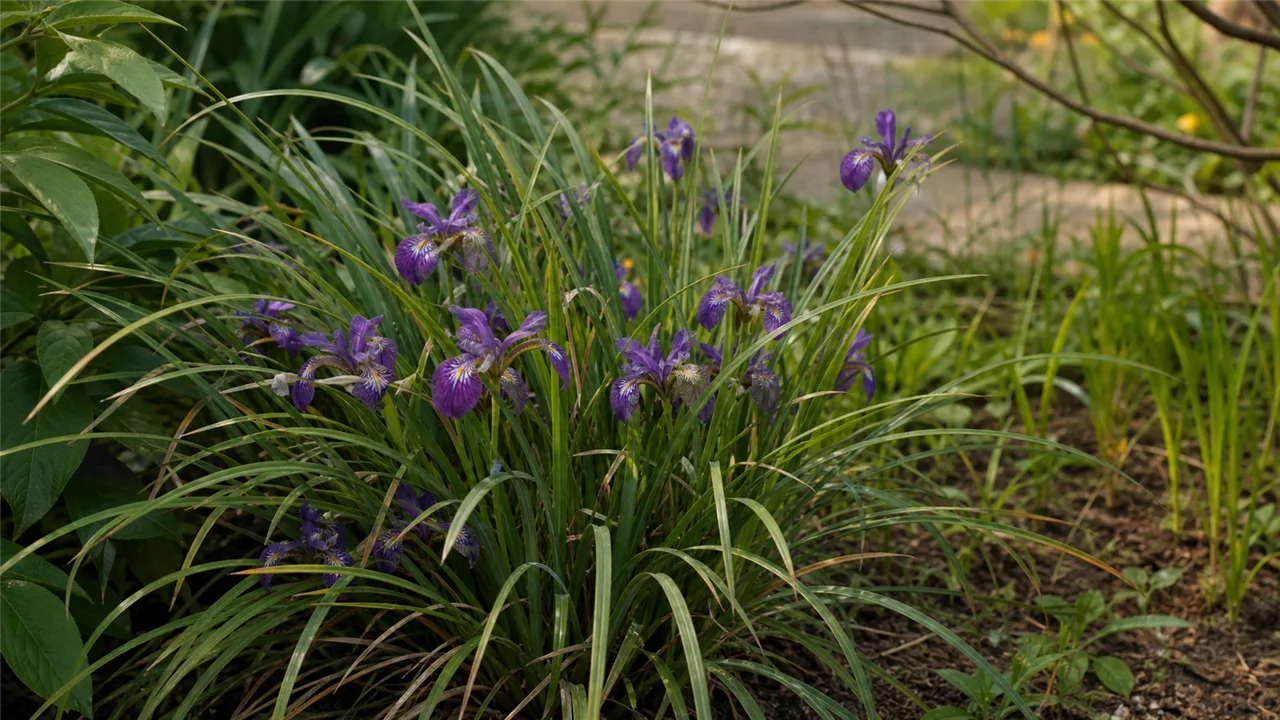
Iris foetidissima forms upright clumps of stiff, sword-shaped leaves that are typically 30–60 cm long and 2–3 cm wide. The leaves are a deep, slightly glaucous grey-green, leathery in texture, with a prominent midrib. They arise in fans from the rhizome and arch outward at the tip, giving established plants a vase-shaped outline that fills out into a broad mass as colonies mature.
Flower stems reach 60–90 cm in height and bear two to three flowers per stem. The blooms are typical of the genus in structure, with three drooping outer falls and three smaller, more erect inner standards, but their colouring is subdued by iris standards. Falls are usually a dull yellowish-green or buff, frequently flushed or veined with dull purple, while the standards are a paler grey-lilac. Flowers appear from late May into June and last only a few days. Their quiet colouring is often remarked upon in literature but is consistent with the species' woodland-edge ecology, where pollinator attraction by colour is less important than by scent.
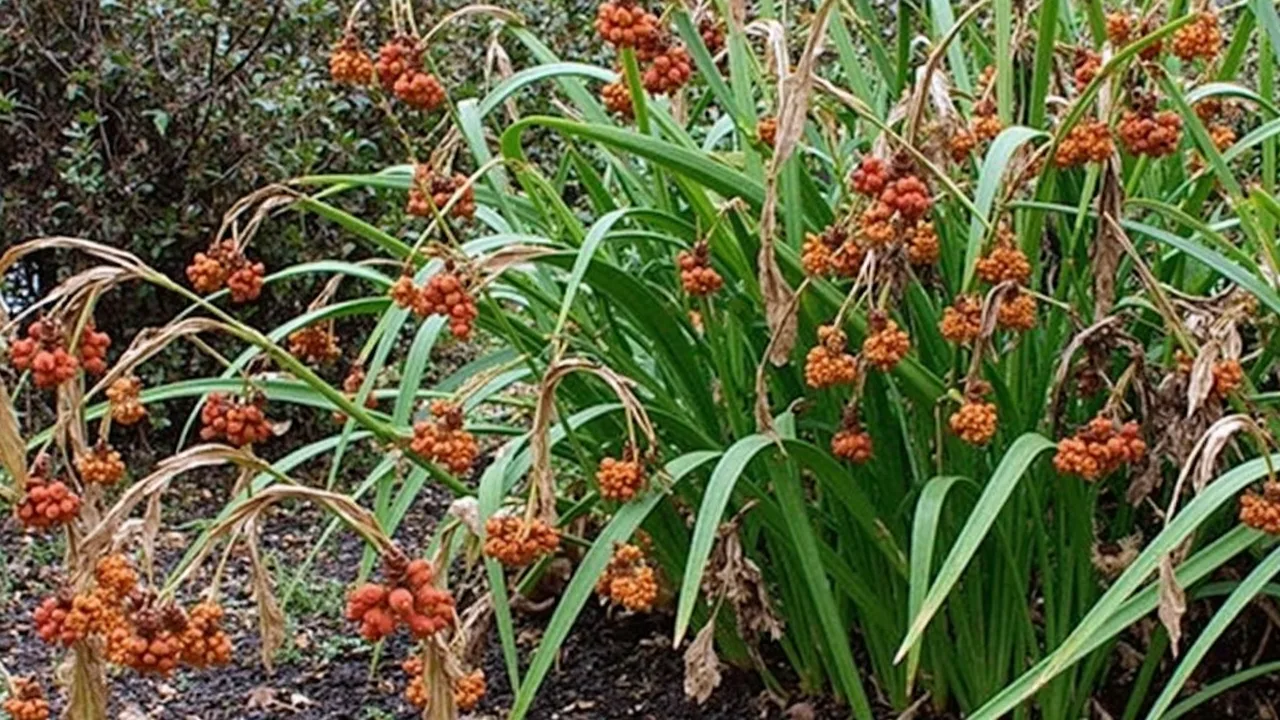
The fruit is the plant's principal ornamental feature. After pollination, the flowers develop into stout, oblong three-celled seed capsules, 5–8 cm long, which ripen from green to brown through summer. In autumn, typically from September into November, the capsules split open along their seams to expose tightly packed, spherical seeds of a brilliant scarlet-orange. The seeds remain glossy and conspicuous through most of winter, especially when frosted, and are frequently cut for indoor decoration.
Growing Conditions
Iris foetidissima is one of the most shade-tolerant members of the genus and performs reliably in conditions that defeat bearded irises and most other rhizomatous kinds. It prefers partial shade but will grow in fairly deep shade beneath deciduous trees, where summer soil moisture is the principal limiting factor. Full sun is tolerated on cool, moisture-retentive sites, but hot, dry south-facing borders should be avoided: leaves scorch and growth is sparse.
Soil should be moist yet well drained. The plant establishes readily on neutral to slightly acidic loam but is notably tolerant of chalk and will accept clay provided it does not waterlog in winter. Once plants have built up a substantial rhizome network they cope well with dry shade, an environment in which surprisingly few flowering perennials thrive.
In UK conditions the species is fully hardy, with an RHS hardiness rating of H6, equivalent to tolerating winter lows of roughly −15 °C to −20 °C. It suffers only in the coldest upland gardens of Scotland and northern England, where exposed sites may damage foliage, though plants usually recover from the base in spring.
Natural habitats of the species include woodland margins, hedgerow banks, and shaded scrub, and these ecological preferences translate directly into garden use: beneath deciduous trees, in shaded mixed borders, or as underplanting in larger woodland schemes.
Planting and Care
Plant container-grown stock at any time of year when soil is workable, though autumn (September to November) and early spring (March to April) are best. Set the rhizome so that its top sits just below the soil surface, firm in well, and water thoroughly. A light mulch of leaf mould or compost helps conserve moisture during the first summer.
Watering is critical in the first growing season. Water deeply once a week during dry spells until plants show signs of active new growth. Established clumps are notably drought-tolerant and need supplementary watering only in prolonged summer drought.
Feeding is straightforward. A single light top-dressing of a balanced general fertiliser in early spring, scratched into the soil around the clump, is sufficient for the year. Over-rich feeding encourages lush soft growth at the expense of flowers and seeds and can make foliage more prone to slug damage.
Pruning is minimal. In late winter, usually February, cut away any leaves that have become battered or discoloured through winter to make room for the new flush of growth that emerges in March. Old flower stems can be cut down once seed pods have developed if a tidier appearance is preferred, or left in place for autumn and winter interest.
Propagation is by two reliable methods. Division of established clumps is straightforward and is best carried out in autumn: lift the clump, cut the rhizomes into sections each bearing at least one fan of leaves and some roots, and replant immediately at the same depth. Seed propagation is also effective. Collect ripe seed in autumn and sow immediately in a cold frame; germination follows in spring, though seedlings may take three to four years to reach flowering size.
Seasonal care in the UK follows the calendar outlined above: light spring feeding, summer watering for young plants, autumn division or seed sowing, and late-winter tidy-up. The species is essentially trouble-free once established.
Common Problems
Iris foetidissima has few serious pest or disease problems in UK gardens, but a handful of issues are worth noting.
Slugs and snails are the most frequent attackers, particularly on soft new spring growth. Damage is usually cosmetic, but in wet seasons young foliage can be holed badly. Organic controls such as nematode applications, beer traps, or hand-removal at dusk are effective; chemical slug pellets should be used only as a last resort and kept out of reach of pets and wildlife.
Fungal leaf spot may appear as small brown or purplish lesions on the leaves during damp summers. It is rarely severe enough to require treatment; affected leaves can be cut out and burnt, and improving air movement around the clump by removing surrounding weeds usually keeps it in check.
Chlorosis, or yellowing of the leaves between the veins, is a sign of iron deficiency and typically appears on very chalky or alkaline soils where iron is locked up. It can be addressed by top-dressing with sequestered iron in spring and, in the longer term, by mulching with leaf mould or composted bark to gradually acidify the surface layer.
Self-seeding can become excessive in favourable conditions, and in smaller gardens deadheading the seed pods before they split, or cutting them for the house, will keep colonies within bounds. Seedlings are easily hoed off or transplanted while young.
The species is generally not browsed by deer or rabbits, an asset in rural gardens, and is not known to be affected by any notifiable plant disease in the UK.
Popular Varieties
Several named cultivars of Iris foetidissima are available in the UK trade, although the straight species remains the most widely planted. The varieties below are established selections whose nomenclature is consistent across reliable horticultural references.
Iris foetidissima var. citrina is a form with pale, clear yellow flowers lacking the usual purple veining. The seed pods and orange seeds are as ornamental as in the type. It is sometimes listed as 'Citrina' and is grown for its quieter, more uniform flower colour in shaded plantings.
Iris foetidissima 'Fructu Albo' is a sought-after white-berried form. The seeds, instead of the usual scarlet-orange, are a pale pearly white and are particularly striking in winter arrangements. It is slower-growing than the type and tends to be offered in smaller pots by specialist nurseries.
Iris foetidissima 'Variegata' has cream-and-green striped leaves and is grown primarily for its foliage effect. It is somewhat less vigorous than the species and benefits from a slightly more sheltered site, where the variegation remains clean through the season.
Where space allows, gardeners often plant a group combining the type with 'Fructu Albo' to extend the seed-colour range in autumn and winter arrangements. All named forms share the species' tolerance of shade, drought, and alkaline soils.
---
Cultivars and Varieties
| Cultivar | Height | Flower | Notes | AGM |
|---|---|---|---|---|
| 'Variegata' | — | — | RHS AGM (H6) | ✓ |
Pests and Diseases
| Problem | Symptoms | Management |
|---|---|---|
| Slugs and snails | Irregular holes chewed in young leaves and seedlings, often with slime trails. | Use physical barriers like copper tape or apply iron phosphate pellets around the base. |
| Root rot | Yellowing, wilting foliage and soft, mushy rhizomes in waterlogged soil. | Ensure well-draining soil and avoid overwatering; remove affected sections if detected. |
| Vine weevil | Notched leaf margins on seedlings and root damage causing sudden collapse. | Apply nematode treatments to the soil in autumn or use systemic insecticides for severe infestations. |
| Powdery mildew | White, powdery fungal growth on leaves and stems, often in humid conditions. | Improve air circulation and spray with a fungicide or milk solution if necessary. |
For step-by-step help, read Dealing with Slugs and Snails and Treating Powdery Mildew. Or browse the full plant problem solver to diagnose an issue by symptom.
Recommended Products
GardenWizz earns a commission from qualifying purchases made through affiliate links on this page (including links within the article) — as an Amazon Associate, and from Thompson & Morgan via the Awin network. This does not affect the price you pay. See our disclaimer for details.