Black Iris
Iris chrysographes
The Gardening Year
Best months in UK gardens · full planting calendar →
🖨 Printable care card (PDF)At a Glance
| Botanical name | Iris chrysographes |
|---|---|
| Common name(s) | Black Iris |
| Family | Iridaceae |
| Plant type | perennial (Dies back to below ground level each year in autumn, then fresh new growth appears again in spring.) |
| Height × Spread | 25–70 cm × — |
| Position | Full sun, Partial shade |
| Soil | Moist but well-drained, neutral to slightly acid loam; can tolerate boggy or poorly-drained conditions. |
| Flowering | May–June |
| Toxicity | Harmful if eaten. All parts can cause indigestion. |
| Native range | Southern China and Myanmar (Burma) |
Iris chrysographes, the black iris, is a rhizomatous beardless iris prized in British gardens for its unusually dark, velvet-textured flowers. Native to alpine meadows and forest margins in south-west China, Tibet and northern Myanmar, it carries the Royal Horticultural Society's Award of Garden Merit and is among the most distinctive of the beardless iris group. Its narrow tolerance for moist but well-drained loam makes it a specialist's plant in the UK, but where conditions suit it forms elegant, long-lived clumps that return reliably each late spring.
Overview
Iris chrysographes belongs to the beardless iris series Sibiricae, sitting alongside the better-known I. sibirica and I. clarkei. Despite the dramatic common name "black iris", the flowers are technically an extremely deep violet-blue that reads as black at a distance and under most garden light conditions. The species name chrysographes derives from the Greek for "gold writing", a reference to the bright golden veining and signal patch on the falls that gives each bloom an almost calligraphic centre.
The species was introduced to British horticulture in the early twentieth century and has remained a connoisseur's plant rather than a mainstream perennial, partly because its cultivation requirements are more particular than those of its Siberian iris cousins. Gardeners who can supply reliably moist but free-draining soil in a sunny or lightly shaded position are rewarded with one of the most arresting flower colours available in the late-spring border. As an AGM plant, it has been assessed by the RHS as reliable for garden use in typical British conditions.
Appearance
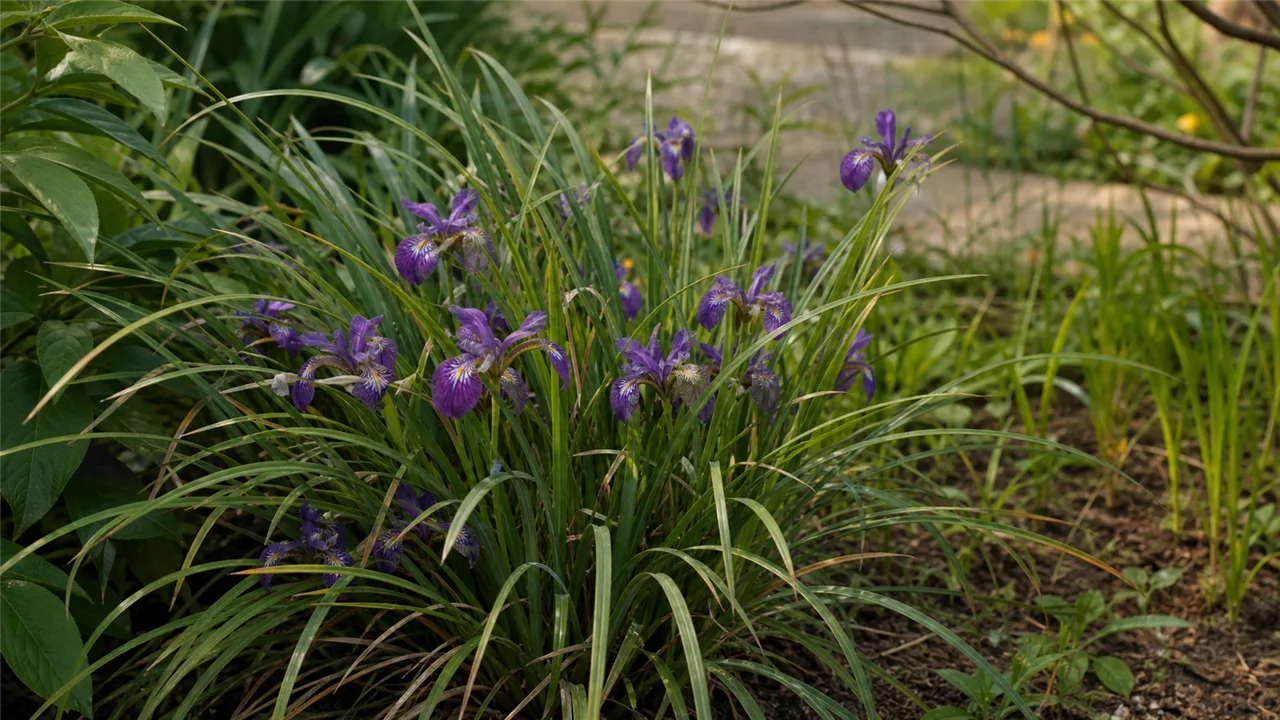
Iris chrysographes forms a clump of slender, strap-shaped, mid-green leaves arranged in a fan-like pattern from a shallow rhizome. The foliage reaches 40–60 cm at flowering and tends to arch gracefully outwards as the season progresses. Unlike the broader, glaucous leaves of bearded irises, the leaves are narrow, slightly ribbed and of a fresh, grassy green that frames the dark flowers effectively.
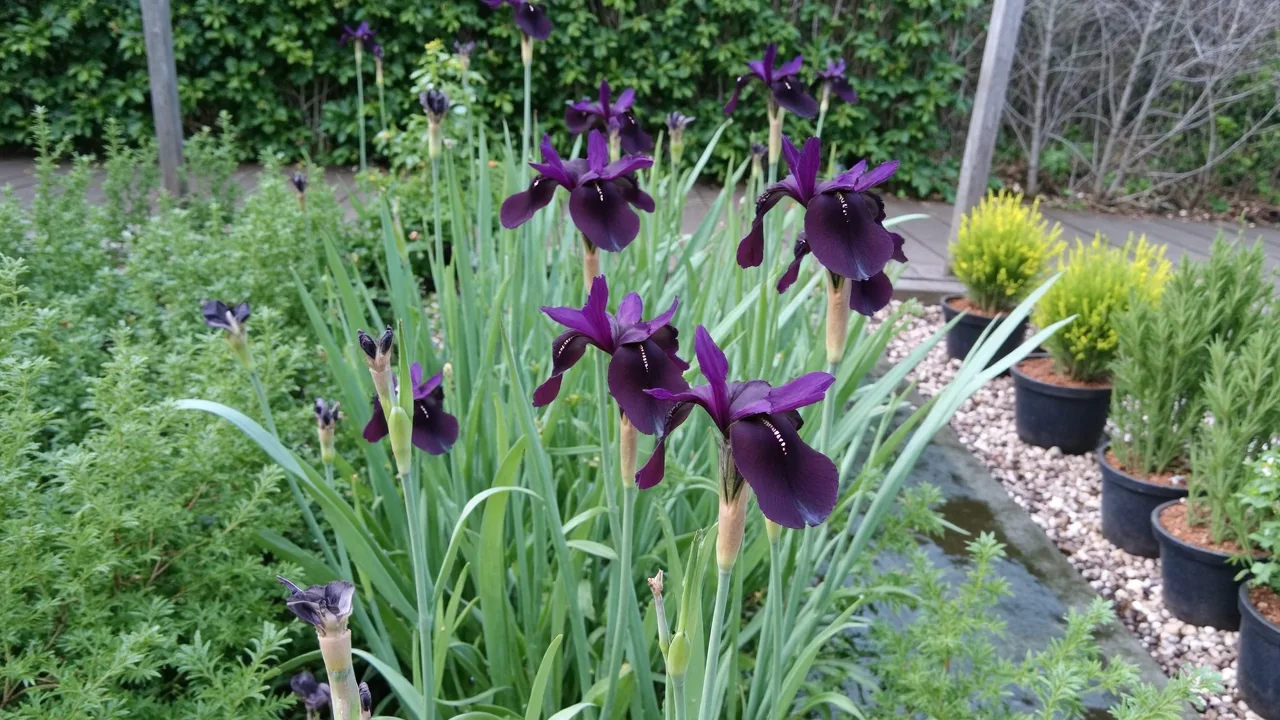
The flowering stems rise just above the foliage and usually carry two, occasionally three, blooms per stem. Each flower has the classic iris structure: three upright "standards" (inner petals) and three broader "falls" (outer petals) that drape downwards. In I. chrysographes the falls are the dramatic element — a deep, saturated violet-blue so dark that it reads as black, especially in low or oblique light. A bright golden-yellow signal runs along the centre of each fall, with fine gold lines radiating outwards across the velvet surface, giving the bloom its distinctive illuminated centre. The standards are typically a fraction lighter, often a dusky violet, and add height to the flower without distracting from the falls.
Bloom size is modest by bearded-iris standards — falls reach 5–7 cm across — but the depth of colour compensates. Flowering in the UK is reliably late May into June, with individual blooms lasting three to four days, though a well-grown clump will carry successive stems over a fortnight or more.
Growing Conditions
Iris chrysographes is hardy across the United Kingdom, rated H6 by the Royal Horticultural Society, meaning it tolerates winter temperatures down to roughly –20 °C. It performs reliably from the Scottish lowlands southwards and tolerates exposed sites better than many beardless irises, though some shelter from the strongest winds helps prevent the slender stems from being flattened in heavy rain.
The single most important condition is soil moisture consistency. The species naturally grows in damp alpine meadows that drain freely but never dry out completely. In British gardens this translates to a loamy soil enriched with organic matter, ideally with a deep root run that retains moisture through summer. Waterlogged soils cause rhizome rot; bone-dry sandy soils lead to stunted growth and poor flowering.
Aspect is flexible. Full sun produces the strongest flowering and the deepest flower colour, but in southern England the foliage can scorch during hot, dry spells, so light dappled shade — particularly afternoon shade — is helpful. The species tolerates a slightly acidic to neutral pH (around 6.0 to 7.0) and resents very alkaline ground, where leaves often yellow and flowering is sparse.
Planting and Care
Planting time. Late summer through early autumn — August and September in most of the UK — is the ideal planting window. This gives the rhizome time to produce fresh roots before winter without the stress of summer heat. Container-grown plants from garden centres can be set out at any time the ground is workable, though spring planting requires careful watering through the first summer.
Planting depth. Unlike bearded irises, which prefer their rhizomes baked at the surface, I. chrysographes rhizomes should be planted shallowly — roughly 2–3 cm below the soil surface, with the top of the rhizome just covered. Planting too deeply is the most common cause of failure.
Spacing. Set plants 30–45 cm apart. The species spreads slowly by rhizome and will fill its space over three to four seasons.
Watering. Maintain steady moisture from late spring through summer. A soak rather than a sprinkle once or twice a week in dry weather is far more effective than daily light watering. Once established, mature clumps tolerate short dry spells but flower poorly if allowed to desiccate.
Feeding. Apply a balanced organic fertiliser such as blood, fish and bone, or a general-purpose Growmore, in early spring as new growth emerges. A second, lighter application after flowering supports rhizome replenishment for the following year. Avoid high-nitrogen feeds, which produce lush foliage at the expense of flowers.
Pruning and tidying. Cut back flowered stems to the base once blooms have finished. In autumn, allow foliage to die back naturally rather than cutting it early — the leaves continue to feed the rhizome well into autumn. Clear dead leaves only once they have fully withered.
Propagation. Lift and divide established clumps every three to four years in late summer, immediately after flowering. Tease the rhizomes apart, retaining healthy outer sections with a fan of leaves, and replant at once at the correct shallow depth. Discard old, woody centre growth. Division is the only reliable vegetative method; seed is viable but slow, requiring a cold period and often taking two to three years to reach flowering size.
Winter care. In most of the UK no special protection is needed. In colder inland or northern gardens, a light mulch of well-rotted leaf mould around (but not over) the rhizomes is helpful and should be removed in early spring.
Common Problems
Rhizome rot. The most serious problem, almost always caused by waterlogged soil or by rhizomes planted too deeply. Affected rhizomes turn soft and brown, and the foliage yellows and collapses. Lift, remove rotten tissue, and replant sound rhizomes at the correct depth in better-drained soil.
Iris leaf spot (Mycosphaerella macrospora). Brown elliptical spots with yellow halos on the leaves, typically appearing in damp summers. Remove and destroy affected foliage in autumn (do not compost) and improve air circulation around the clump. The species is generally less affected than bearded irises.
Slugs and snails. Will attack young growth in spring and may disfigure flower buds. Copper rings, organic ferric-phosphate pellets or hand-removal at dusk are the usual controls.
Aphids. Occasional colonies on young shoots in late spring. A jet of water or insecticidal soap is usually sufficient; the species is otherwise largely free of significant pest pressure.
Poor flowering. Almost always traceable to one of three causes: insufficient sunlight, prolonged drought at flowering time, or clumps that have become overcrowded and need division. Very alkaline soil will also suppress flowering.
The species is not considered toxic to humans or pets, though, as with most irises, it may cause mild gastric upset if ingested in quantity and can be a skin irritant to sensitive individuals when handled fresh.
Popular Varieties
Named cultivars of Iris chrysographes are few, and most garden availability centres on a small number of well-established selections.
'Black Form' is the most widely grown and the form to which most garden centres and nurseries default. It is selected for particularly dark falls and a strong gold signal, and it is the cultivar most commonly associated with the species in British plant catalogues. It holds the AGM in its own right.
'Kew Black' is a notably dark selection, sometimes listed as originating from Royal Botanic Gardens, Kew material, and prized for the depth and uniformity of its near-black flowers.
I. chrysographes dykesii (sometimes sold as I. dykesii) is a closely related taxon, occasionally treated as a separate species but commonly grouped with I. chrysographes in cultivation. It has slightly broader falls and similar dark colouring, and it appears in many Plant Finder listings alongside the type species.
Beyond these, the species crosses readily with its Siberian iris relatives, and several named hybrids in the Iris × chrysographes group appear in specialist catalogues; gardeners seeking particular shades or larger blooms should look to these rather than to further I. chrysographes cultivars, which are genuinely limited in number. As always with specialist irises, sourcing from a reputable British nursery with named, propagated stock is preferable to unnamed "dark iris" seedlings of uncertain parentage.
Pests and Diseases
| Problem | Symptoms | Management |
|---|---|---|
| Bacterial soft rot | Rhizomes become mushy, blackened and emit a foul odour, causing the plant to collapse. | Ensure well-drained soil with rhizomes partially exposed; cut away infected tissue and disinfect tools. |
| Iris leaf spot | Small purple or brown spots appear on leaves, often merging to cause yellowing and dieback. | Remove and dispose of all leaf debris at the end of the year to reduce overwintering spores. |
| Iris rust | Orange or brown pustules form on leaves, accompanied by yellowing and premature leaf death. | Pick off lightly infected leaves to slow spread, but avoid removing too much foliage. |
| Ink disease | Black, inky patches appear on bulb scales or rhizomes, leading to rot and plant failure. | Dispose of affected plants immediately and rest the soil from irises for several years. |
| Virus infection | Young leaves show mottling, streaking, or distortion, reducing vigour and flower quality. | Dispose of severely affected plants to prevent transmission to neighbouring healthy irises. |
Or browse the full plant problem solver to diagnose an issue by symptom.
Recommended Products
GardenWizz earns a commission from qualifying purchases made through affiliate links on this page (including links within the article) — as an Amazon Associate, and from Thompson & Morgan via the Awin network. This does not affect the price you pay. See our disclaimer for details.