Yellow Crocus Iris
Iris crocea
The Gardening Year
Best months in UK gardens · full planting calendar →
🖨 Printable care card (PDF)At a Glance
| Botanical name | Iris crocea |
|---|---|
| Common name(s) | Yellow Crocus Iris |
| Family | Iridaceae |
| Plant type | perennial |
| Height × Spread | 95–180 cm × 50–100 cm |
| Position | Full sun, Partial shade |
| Soil | fertile, moist but well-drained soil; tolerant of clay, loam, sand; pH acid, alkaline, neutral |
| Flowering | April–July |
| Toxicity | Harmful if eaten. Wear gloves and other protective equipment when handling. |
| Native range | Kashmir, Jammu (India), Bhutan, Pakistan, China; West Himalayas |
A bright, architectural beardless iris for damp British borders. Iris crocea carries large, sunshine-yellow blooms on tall stems in early summer and asks for little more than sun, moisture and a clump that is divided every few years.
Overview
Iris crocea is a vigorous, herbaceous perennial in the family Iridaceae and one of the showiest yellow-flowered irises available to UK gardeners. It is sometimes listed in older nursery catalogues and reference works as Iris orientalis, a name now generally treated as a synonym. Native to damp meadows, marshes and river margins across Turkey, the Caucasus and northern Iran, it has settled into British cultivation as a reliable border perennial for retentive but well-drained soils. The Royal Horticultural Society recognises its garden worth with an Award of Garden Merit (AGM), and the plant is rated H6 under the RHS hardiness scheme, indicating it tolerates temperatures down to roughly –20 °C across most of the UK.
The species is classed as a beardless iris in the subgenus Limniris, sharing its section with the familiar native yellow flag iris (Iris pseudacorus) but offering larger flowers, a tidier clump habit and none of the thuggish seeding of that plant. It is grown primarily for its bold June and July flowers, but its upright, sword-shaped foliage gives vertical structure from spring through to the first hard frosts. In a UK setting it sits comfortably in a damp border, a wildlife garden, a cottage-style planting or the margins of an informal pond.
Appearance
Iris crocea forms an upright, slowly expanding clump of slender, sword-shaped leaves that are bright, slightly greyish green and around 40–70 cm long. The foliage emerges in early spring and remains present and tidy through the growing season, gradually yellowing in late autumn as the plant enters winter dormancy.
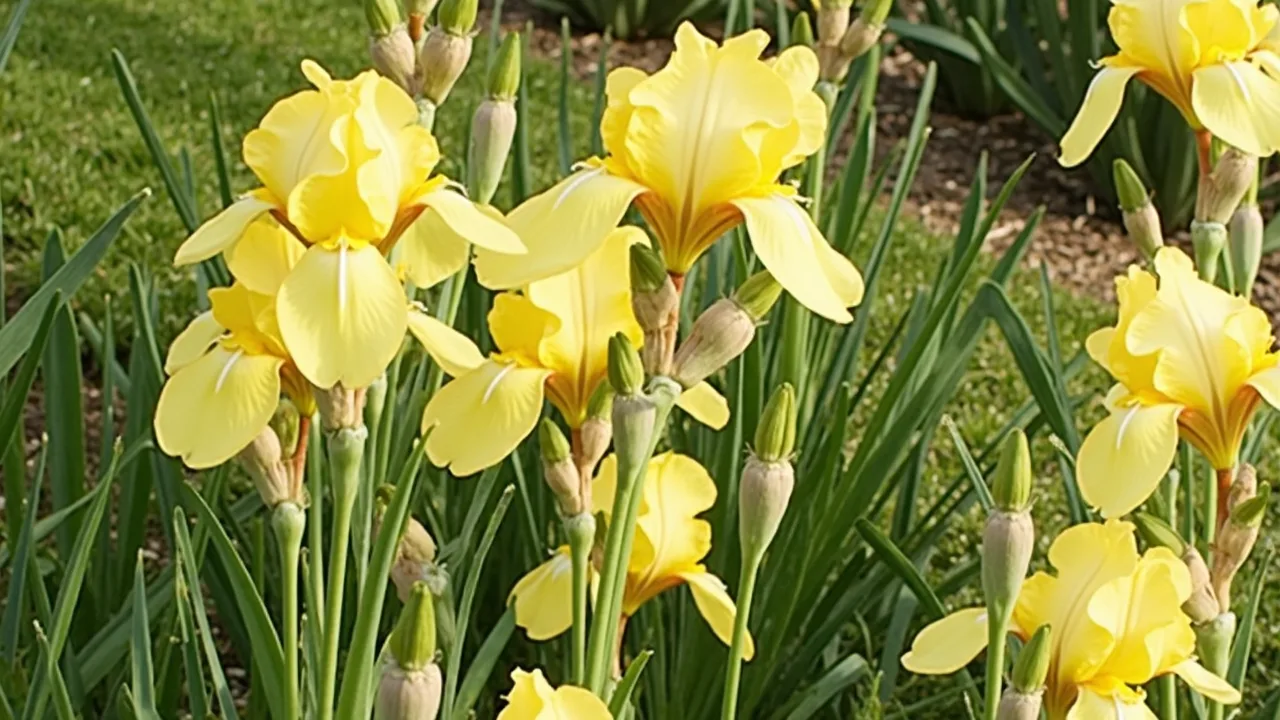
Flower stems rise from the centre of each clump in late spring and early summer, typically reaching 60–100 cm in height in good British conditions, with the strongest stems produced on well-fed, established plants. Each stem carries two to three large, bright yellow flowers, each 10–15 cm across. The falls (the three outer, drooping petals) are broad and rounded, a saturated golden yellow, often lightly veined with orange or brownish markings at the throat. The standards (the three inner, upright petals) are a slightly paler yellow and tend to recurve gently, giving each flower an open, relaxed silhouette rather than the tight, rounded form of many bearded irises. There is no fuzzy "beard" on the falls, as is characteristic of this group.
Flowering in the UK normally falls between early June and mid-July, depending on district and season, with later blooms possible on plants grown in cooler, north-facing positions. After flowering, three-sided seed capsules develop along the stem; these can be left in place for their architectural interest or removed to redirect energy back into the rhizome.
Growing Conditions
Iris crocea is a moisture-loving plant, but it is not an aquatic. The most common reason for disappointment is planting it into a thin, sharply drained border that bakes dry in summer; in such positions it sulks, flowers poorly and is prone to scorch. The ideal is a moisture-retentive but free-draining loam that stays cool and damp through the growing season. Soils enriched with garden compost or well-rotted leaf mould, and a site where the water table is naturally within about 30–60 cm of the surface, suit it well.
Aspect should be open and sunny for the best flower production, although the species tolerates very light, dappled shade, particularly in the warmer south and east of England where afternoon sun can be intense. Avoid deep shade under trees or at the foot of evergreen hedges, both of which reduce flowering and encourage thin, drawn growth.
Soil pH is not a serious constraint: Iris crocea grows successfully in mildly acidic, neutral and mildly alkaline soils, roughly pH 5.5 to 7.5. Heavier clay loams are tolerated as long as the rhizome itself is not planted into a waterlogged hollow that will rot it out in winter; conversely, very sandy soils can be improved for this species by working in substantial organic matter before planting.
UK growers should note the RHS hardiness rating of H6, which places Iris crocea comfortably within the range of a normal British winter, including most of Scotland, northern England and the colder inland microclimates of the Midlands. Some late spring frost damage is possible on emerging foliage in exposed situations but this is generally outgrown.
Planting and Care
Plant bare-root rhizomes in autumn, between September and early November, or in early spring as soon as the soil is workable. Set the rhizome so that it sits just at, or very slightly below, the soil surface, with the leaf fans and any emerging roots pointing in the direction you want the clump to develop. Space plants 30–45 cm apart, allowing room for each clump to expand. Water in well at planting and keep the soil consistently moist through the first growing season.
Once established, Iris crocea is largely self-sufficient. Watering should focus on maintaining even moisture during the growing season, especially from late April through July when the plant is in active growth and flower; mature clumps tolerate short dry spells but flower more freely where moisture is steady. Feeding is best kept light: a single application of a balanced, slow-release general-purpose fertiliser in early spring as the new leaves emerge is sufficient, supplemented by a 5–8 cm mulch of garden compost or well-rotted leaf mould laid over the root area. The mulch both feeds the soil and helps to retain moisture through summer.
Pruning in the strict sense is not required. Tidying consists of removing spent flower stems down to the base after the last bloom has finished, and cutting away any leaves that have become damaged, scorched or heavily marked by leaf spot in late autumn. Leave healthy foliage standing through autumn so that the plant can continue to photosynthesise and build up its rhizome for the following year.
Propagation is straightforward by division. Lift congested clumps every three to five years in late summer, after flowering has finished and the plants have begun to slip into semi-dormancy. Wash the rhizomes so that you can see them clearly, cut or break the younger, vigorous outer pieces away from the woody centre, and replant these at the same depth as the original plants, discarding the spent oldest growth. Each new section should have at least one healthy leaf fan and a good root plate. Seed can be sown fresh in autumn, but named cultivars, where available, will not come true from seed and should always be propagated by division.
Common Problems
Iris crocea is generally healthy in British gardens, but a small number of issues recur on damp sites or in crowded plantings. Iris leaf spot, caused by the fungus Mycosphaerella macrospora, is the most familiar: small, brown, often rectangular spots appear on the leaves during wet summers. Remove and destroy affected foliage in autumn, water at the base of the plant rather than overhead, and improve air circulation by thinning congested clumps.
Slugs and snails are occasional pests of the soft new shoots and of the petals in damp springs. In most years their damage is cosmetic, but on heavily infested sites a control programme using ferric phosphate slug pellets, beer traps or biological nematodes may be needed to protect the developing flower stems. Iris borer, a caterpillar that tunnels into rhizomes, is a more serious problem where it occurs: it is still uncommon in the UK but worth inspecting for at division time, and any rhizome showing soft, foul-smelling tunnels should be destroyed rather than replanted.
Powdery mildew can appear as a white, dusty coating on the leaves in dry, still, crowded conditions. It rarely does serious damage but is best controlled by improving air movement around the clump and watering consistently rather than letting the plant cycle through drought and rehydration. Root and rhizome rots, sometimes associated with bacterial soft rot, occur almost exclusively in waterlogged soils; prevention is straightforward, and it consists of planting into free-draining ground and avoiding the temptation to bury the rhizome deeply.
Popular Varieties
Iris crocea is, in strict terms, a species rather than a cultivar, and named selections of this particular species remain scarce in UK commerce. Most plants sold as Iris crocea or under its older synonym Iris orientalis represent the wild type. A small number of selected forms have been offered by specialist nurseries over the years, but availability is inconsistent and named cultivars should be verified directly with the supplier before purchase.
Where gardeners want a named yellow-flowered beardless iris with an AGM and reliable British garden performance, the closely related Iris pseudacorus offers a wider range of selected forms. The species itself, Iris pseudacorus, is a vigorous native for pond margins and wet meadows. Iris pseudacorus 'Variegata' carries cream-and-green striped foliage in spring that greens up as the season progresses. Iris pseudacorus 'Roy Davidson' is a more restrained selection with broader, glossier leaves and larger, paler yellow flowers than the type. For gardeners wanting a smaller, less spreading clump in a similar colour range, Iris forrestii is a slender yellow-flowered beardless iris from Yunnan and is sometimes offered by specialist alpine and iris nurseries.
For most gardeners the best approach is to source plants of Iris crocea as a species from a reputable British iris specialist and propagate from a single, vigorous, well-flowering clump by division, building up stock over the years rather than relying on scarce named cultivars.
Pests and Diseases
| Problem | Symptoms | Management |
|---|---|---|
| Vine weevil | Irregular notches on leaf margins from adults, or sudden wilting and death caused by larvae eating roots. | Apply biological nematodes to the soil in late summer or hand-pick adult weevils at night. |
| Slugs and snails | Irregular holes chewed in leaves and flowers, often accompanied by slimy trails. | Use physical barriers like copper tape or organic pellets containing iron phosphate to protect foliage. |
| Bacterial soft rot | The base of the plant and rhizome become soft, mushy, and collapse, often with a foul smell. | Ensure well-drained soil and avoid waterlogging; cut away affected tissue and disinfect tools. |
| Iris leaf spot | Small, pale or yellow spots appear on the leaves, which may enlarge and cause foliage to wither. | Remove and dispose of infected leaves and clear all leaf debris at the end of the year. |
| Iris rust | Orange or brown spore pustules form on leaves, leading to associated yellowing and defoliation. | Pick off lightly infected leaves to slow spread and maintain good air circulation around plants. |
For step-by-step help, read Dealing with Slugs and Snails. Or browse the full plant problem solver to diagnose an issue by symptom.
Recommended Products
GardenWizz earns a commission from qualifying purchases made through affiliate links on this page (including links within the article) — as an Amazon Associate, and from Thompson & Morgan via the Awin network. This does not affect the price you pay. See our disclaimer for details.