Bamboo Iris
Iris confusa
The Gardening Year
Best months in UK gardens · full planting calendar →
🖨 Printable care card (PDF)At a Glance
| Botanical name | Iris confusa |
|---|---|
| Common name(s) | Bamboo Iris |
| Family | Iridaceae |
| Plant type | perennial (Evergreen, rhizomatous perennial with creeping habit forming thick clumps.) |
| Height × Spread | 25–120 cm × 50–150 cm |
| Position | Full sun, Partial shade |
| Soil | well-drained, fertile, neutral to slightly acid soil |
| Flowering | April–May |
| Toxicity | Harmful if eaten. Wear gloves and other protective equipment when handling. |
| Native range | Western China |
Overview
Iris confusa is a beardless, rhizomatous species iris native to the mountains of southwestern China, where it grows on shady, rocky slopes and in light woodland. It belongs to the Iris subgenus Limniris, section Lophiris (the crested irises), and is most often grown in British gardens for its tall, bamboolike fans of glossy evergreen foliage and its delicate, late-spring sprays of pale blue to white flowers. In UK cultivation it is sometimes sold under the common name "Bamboo Iris" in reference to the cane-like flower stems that can reach 90 cm or more.
Although Iris confusa is less widely planted than its better-known crested cousins such as Iris cristata and Iris tectorum, it has earned a quiet following among UK gardeners looking for an architectural, shade-tolerant iris that performs reliably in milder parts of the country. It holds the Royal Horticultural Society hardiness rating H4, meaning it is hardy across most of the UK down to around -10 °C, although in colder inland districts and exposed northern gardens the foliage may be cut back by hard frost and the rhizomes benefit from a dry winter mulch. It is not, however, awarded the RHS Award of Garden Merit.
Within the British climate Iris confusa is best treated as a foliage-and-flower plant for a sheltered, partially shaded border, a woodland edge or a large patio container. It dislikes cold, wet winters far more than it dislikes dry summers, and the most frequent cause of failure in UK gardens is waterlogged soil during the dormant period rather than winter cold per se.
Appearance
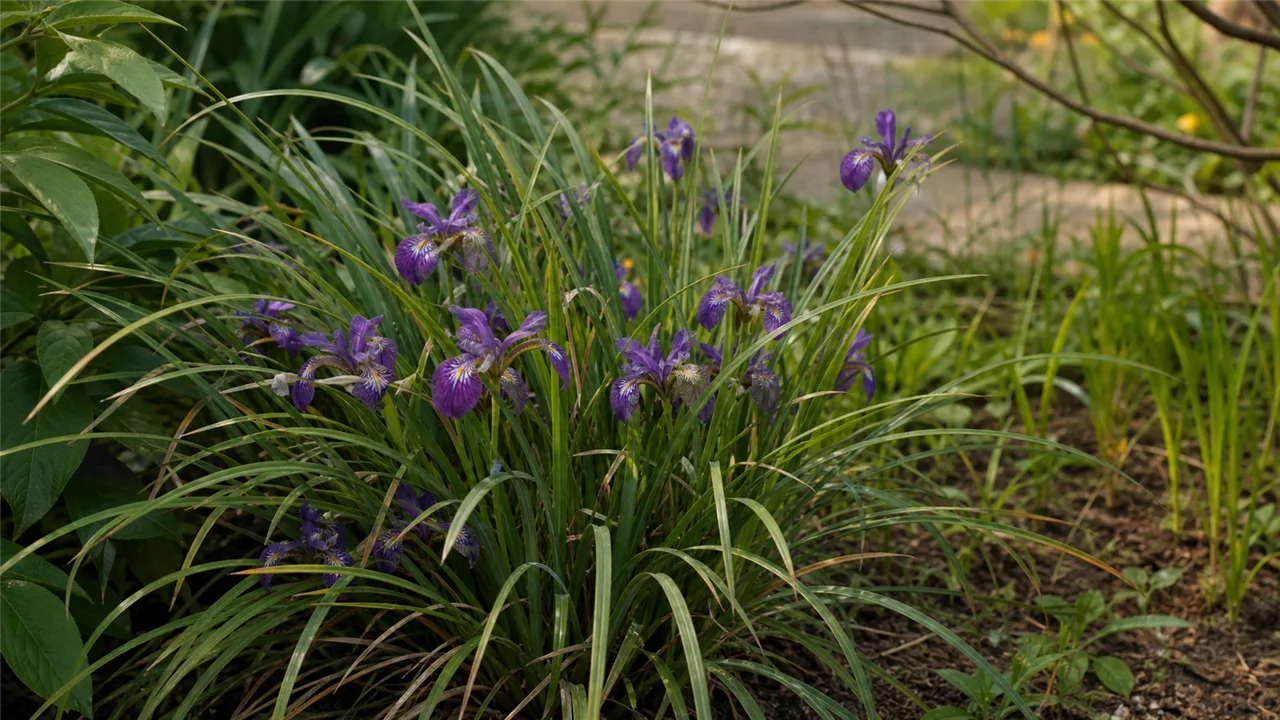
Iris confusa forms a slowly expanding clump from a surface-rooting rhizome. The leaves are the plant's most distinctive feature in the garden: glossy, mid-green, strap-shaped, and held in upright, gently arching fans that can reach 60-90 cm tall and 3-5 cm wide. The fans are supported on stout, canelike bases that give the whole plant a bamboolike silhouette, hence the common name.
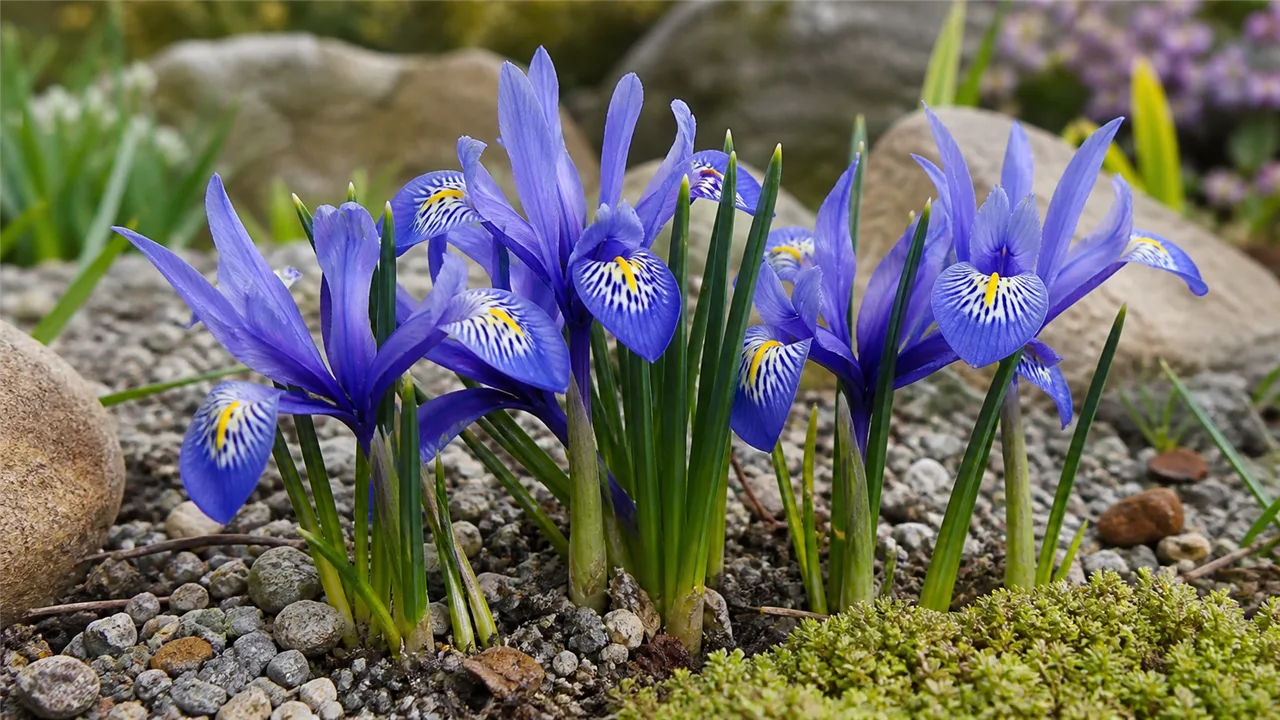
Flowers are borne in late spring, typically from late May into June in southern England and slightly later further north. Each branched stem carries a loose spray of six to twelve blooms held above the foliage. Individual flowers are around 5-6 cm across, with three small, more or less erect standards and three broader falls. The falls carry the crested ridge (the "crest" that gives section Lophiris its name) — a frilled, comb-like ridge down the centre of each fall rather than the beard seen in bearded irises. Colour is variable but typically a soft lavender-blue to pale sky-blue, often with yellow or white markings around the crest; white-flowered forms also occur. Flowers last two to three weeks and are followed by plump, ovoid seed capsules.
At maturity a well-grown clump can spread to 60-90 cm across, with flowering stems pushing up to 90-120 cm. The seed capsules are decorative in their own right but are best removed before they exhaust the plant.
Growing Conditions
Iris confusa thrives in conditions that mimic its native Chinese woodland-edge habitat: dappled shade or morning sun with afternoon shade, a humus-rich but sharply drained soil, and a position sheltered from cold drying winds. Full sun is tolerated where the soil remains reliably moist through the growing season, but the foliage tends to scorch and the flowers fade faster in hot, exposed sites — a particular concern in the south and east of England during dry summers.
Soil pH is not critical; the plant grows well in slightly acidic to neutral ground (roughly pH 5.5-7.0) and tolerates mildly alkaline conditions. The single most important soil requirement is drainage. The rhizome is shallow-rooting and prone to rot where water sits through the winter, so heavy clay should be improved with coarse grit and well-rotted leaf mould before planting. In lighter, sandier soils a generous mulch of organic matter each spring is usually enough to keep the plant happy.
Container cultivation works well, particularly in colder districts where the planter can be moved to the lee of a house wall for winter. Use a loam-based compost such as John Innes No. 3 with added grit (around 1 part grit to 4 parts compost by volume), and pot only one division per 25-30 cm container. Under glass the plant can be grown year-round in a cold or frost-free greenhouse, although flowering tends to be poorer than outdoors.
The RHS hardiness rating of H4 places Iris confusa in the same bracket as many reliably hardy perennials: it will tolerate lows of around -10 °C to -5 °C across most of southern and central England, but in exposed northern gardens, in cold inland valleys, and above roughly 150 m in Scotland and upland Wales a thick winter mulch and a sheltered aspect are advisable.
Planting and Care
Plant container-grown Iris confusa at any time the ground is workable, although spring (April-May) and early autumn (September) give the best establishment. Set the rhizome so that it sits at, or very slightly below, the soil surface — deep planting is a common cause of rot. Space plants 45-60 cm apart; clumps expand steadily and will fill the gap within two to three seasons.
Watering is most important in the first growing season. Keep the soil just moist, not saturated, until new foliage growth confirms establishment. Established plants are remarkably drought-tolerant during the summer dormant period but appreciate a soak during prolonged dry spells in late spring when flower stems are extending.
Feeding needs are modest. A single application of a slow-release, general-purpose fertiliser in early spring, or a top-dressing of well-rotted garden compost, is sufficient. Avoid high-nitrogen feeds, which produce lush soft growth prone to frost damage and rot.
Pruning is largely a matter of tidying. In late winter or very early spring, before new growth emerges, cut away any leaves that have been blackened or torn by winter weather. Do not cut healthy evergreen foliage back hard: the plant depends on it for photosynthesis through the winter months. After flowering, deadhead spent stems at the base to prevent seed set unless you want to collect seed or allow self-sown seedlings.
Propagation is straightforward by division of established clumps in autumn or immediately after flowering. Lift the clump, shake off loose soil, and separate the rhizomes by hand or with a sharp knife, retaining three to five fans of foliage per division. Replant immediately at the same depth and water in well. Seed can be sown fresh in autumn, but named cultivars will not come true and seed-raised plants typically take three to four years to reach flowering size.
Seasonal care in the UK centres on protecting the rhizome from winter wet. In heavy or badly drained soils apply a 5-8 cm mulch of coarse bark or leaf mould over the clump in late autumn, taking care to pull it back from the immediate crown in spring so that new growth is not smothered. In containers, raise pots on pot feet over winter to keep the drainage holes clear.
Common Problems
The most serious complaint is rhizome rot, almost always caused by waterlogged soil or deep planting. Affected plants produce yellowed, wilting foliage in spring and the rhizome, when lifted, is soft, dark and foul-smelling. Prevention — sharp drainage and shallow planting — is far more effective than cure.
Leaf spot, caused by various fungal pathogens including Didymellina and Mycosphaerella species, produces small brown spots with yellow haloes on the foliage, typically during damp springs. It is rarely fatal but disfigures the plant; remove and bin affected leaves and avoid overhead watering.
In mild, damp summers, slugs and snails may graze young foliage and flower buds, particularly on plants grown in heavy shade. Standard control measures — beer traps, ferrous-phosphate pellets, night-time hand-picking — are effective.
Iris confusa is occasionally affected by aphid colonies on the flower stems in late spring; these can be washed off with a strong jet of water or treated with insecticidal soap if persistent.
In colder districts the foliage can be blackened by hard frost, particularly after a spell of mild weather that has encouraged soft late growth. This is rarely fatal — fresh foliage follows from the rhizome in spring — but indicates that the plant would benefit from a more sheltered site.
Toxicity: Iris species in general are considered mildly toxic if ingested, with the rhizomes containing irritant compounds (iridins) that can cause gastric upset. There is no specific, widely-cited toxicity rating for Iris confusa in UK horticultural literature; in the absence of clearer guidance, gardeners should treat the rhizome as potentially irritant and keep it away from children and pets.
Popular Varieties
Named cultivars of Iris confusa are relatively few in UK commerce and many plants are sold simply as the species. The following are the forms most commonly encountered in British nurseries and are reasonably well-established in cultivation; growers should note that availability varies year to year.
- Iris confusa 'Martyn Rix' — a particularly vigorous selection with broad, lustrous foliage and tall stems bearing pale lavender-blue flowers; widely considered one of the most reliable forms for UK gardens.
- Iris confusa 'Border Mist' — a softer, slightly glaucous-leaved form with white to very pale blue flowers; valued for its luminous quality in shaded plantings.
- Iris confusa 'Chengdu' — a form introduced from wild-collected seed near the type locality in Sichuan; intermediate in colour between the lavender and white extremes, and useful for seed-raised stock where genetic diversity is desired.
The RHS has not published an Award of Garden Merit recommendation for Iris confusa or for any of the cultivars listed above; the ratings mentioned here are general UK hardiness assessments only. Gardeners seeking AGM-rated crested irises for similar conditions should consider Iris tectorum or Iris cristata instead, both of which have been assessed by the Society.
Pests and Diseases
| Problem | Symptoms | Management |
|---|---|---|
| Slugs and snails | Irregular holes chewed in leaves or young shoots damaged. | Use physical barriers, hand-pick at night, or apply iron phosphate pellets. |
| Thrips | Silvering or bronzing of leaves with small black specks of frass. | Monitor with blue sticky traps and remove heavily infested foliage. |
| Grey mould (Botrytis) | Fuzzy grey fungal growth on dying flower heads or wet foliage. | Improve air circulation and remove dead flowers promptly to prevent spread. |
| Bacterial soft rot | Rhizomes become mushy, blackened, and emit a foul odor. | Ensure well-drained soil and dispose of infected plants immediately. |
| Aphid-borne viruses | Mottled, distorted, or stunted new growth on young leaves. | Control aphids early and remove severely infected plants to prevent spread. |
For step-by-step help, read Controlling Aphids Naturally and Dealing with Slugs and Snails. Or browse the full plant problem solver to diagnose an issue by symptom.
Recommended Products
GardenWizz earns a commission from qualifying purchases made through affiliate links on this page (including links within the article) — as an Amazon Associate, and from Thompson & Morgan via the Awin network. This does not affect the price you pay. See our disclaimer for details.