Japanese Maple
Acer palmatum · palmate maple · smooth Japanese maple
The Gardening Year
Best months in UK gardens · full planting calendar →
🖨 Printable care card (PDF)At a Glance
| Botanical name | Acer palmatum |
|---|---|
| Common name(s) | Japanese maple, palmate maple, smooth Japanese maple |
| Family | Sapindaceae |
| Plant type | shrub (deciduous) |
| Height × Spread | 4–8 m × 4–8 m |
| Position | Full sun, Partial shade |
| Soil | well-drained, fertile soil; sandy, slightly acidic soil preferred; contains plenty of organic matter |
| Flowering | April–May |
| Toxicity | No specific toxicity is listed by the RHS. This is not a guarantee of safety — check with a vet or the ASPCA before pets or children eat any plant. |
| Native range | Korea, Japan, China, eastern Mongolia, and southeast Russia |
A graceful deciduous shrub or small tree native to Japan, South Korea, eastern China, Taiwan and parts of south-eastern Russia, Japanese Maple is prized in British gardens for its delicate, hand-shaped foliage and its spectacular autumn colour. It performs reliably across most of the UK, tolerating partial shade and well-drained loam, and is small enough to suit courtyard, woodland and urban plots where a larger tree would be out of scale.
Overview
Acer palmatum belongs to the Sapindaceae family and is the species most widely grown in the UK, in a range of cultivars selected for leaf colour, leaf shape and growth habit. It is generally slow-growing, and many of the most popular garden forms stay considerably smaller than the wild type. It is best treated as a specimen plant, where its form, foliage and seasonal colour can be properly appreciated, and it sits comfortably in Japanese-style gardens, mixed woodland borders and large patio containers.
In UK conditions, Japanese Maples are reliably hardy across England, Wales and most of lowland Scotland, though the very youngest plants and the most delicate cut-leaf cultivars benefit from a sheltered position. They prefer a site out of cold east winds, which can scorch new spring growth.
Appearance
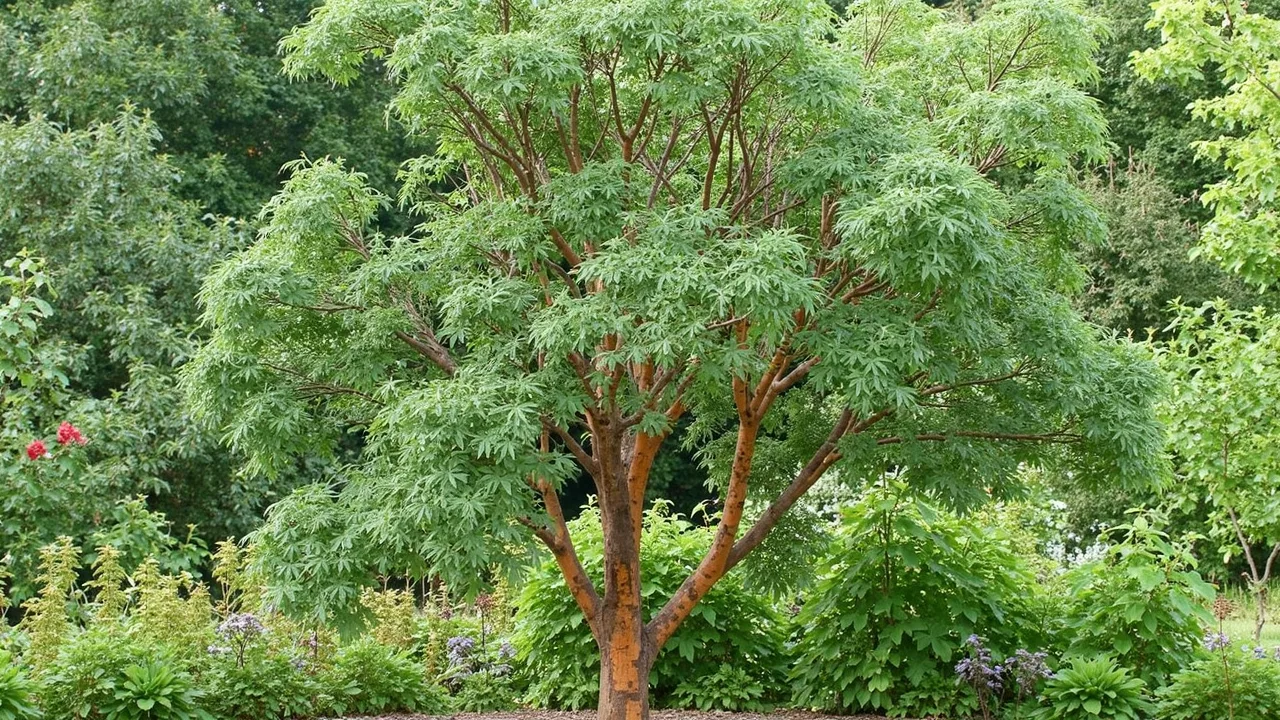
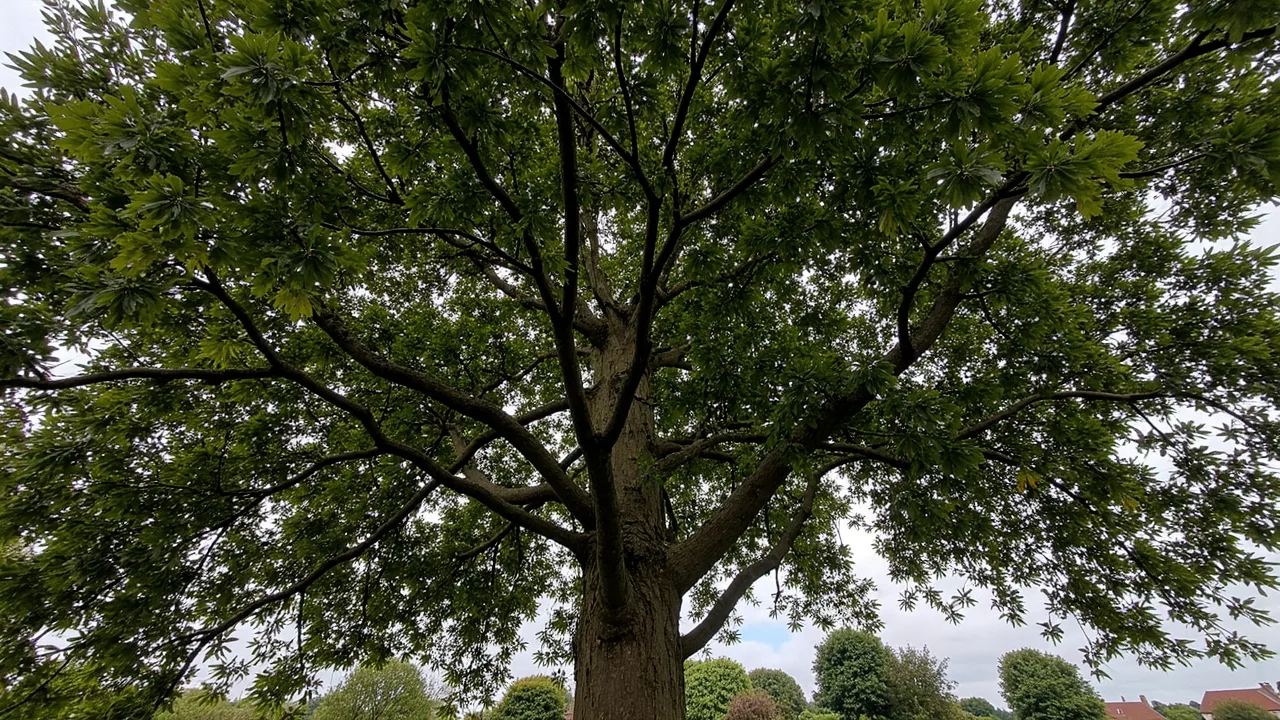
Japanese Maple forms a broad, rounded crown with finely branched, often twisting stems that give the plant an architectural quality even in winter. Mature trees reach 6–10 m in height over many decades, while most cultivated forms stay between 2 and 5 m.
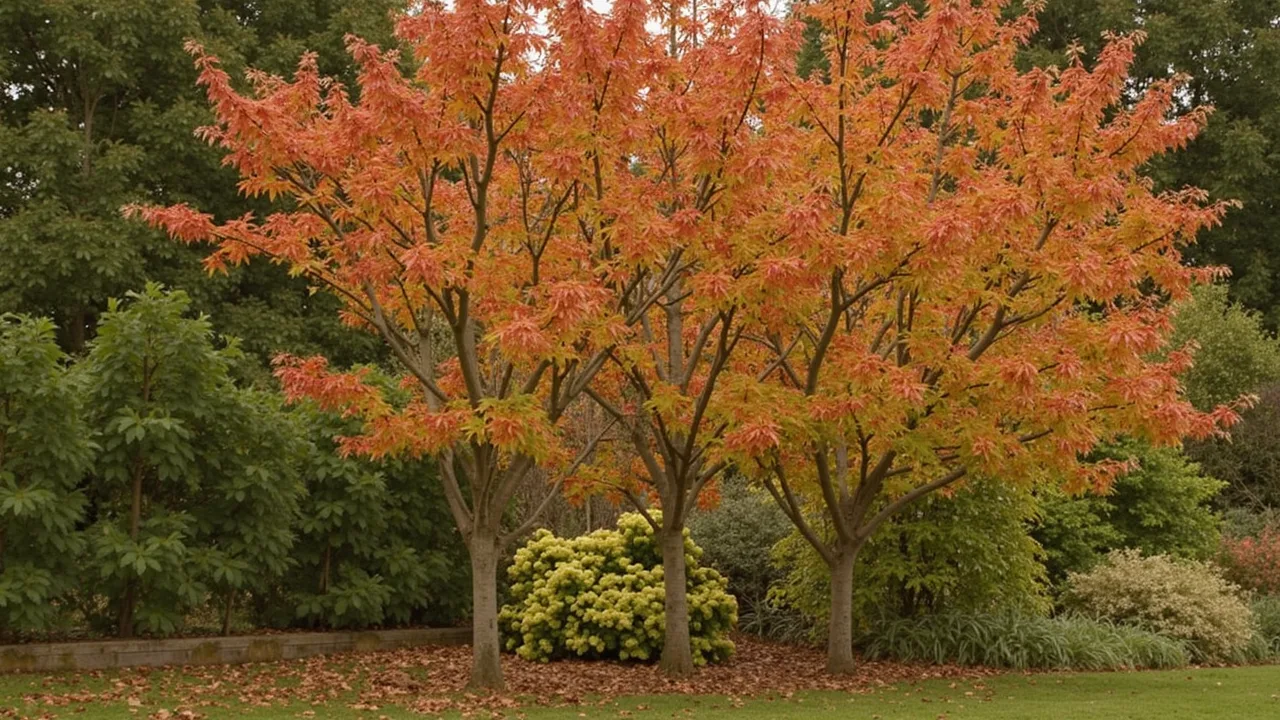
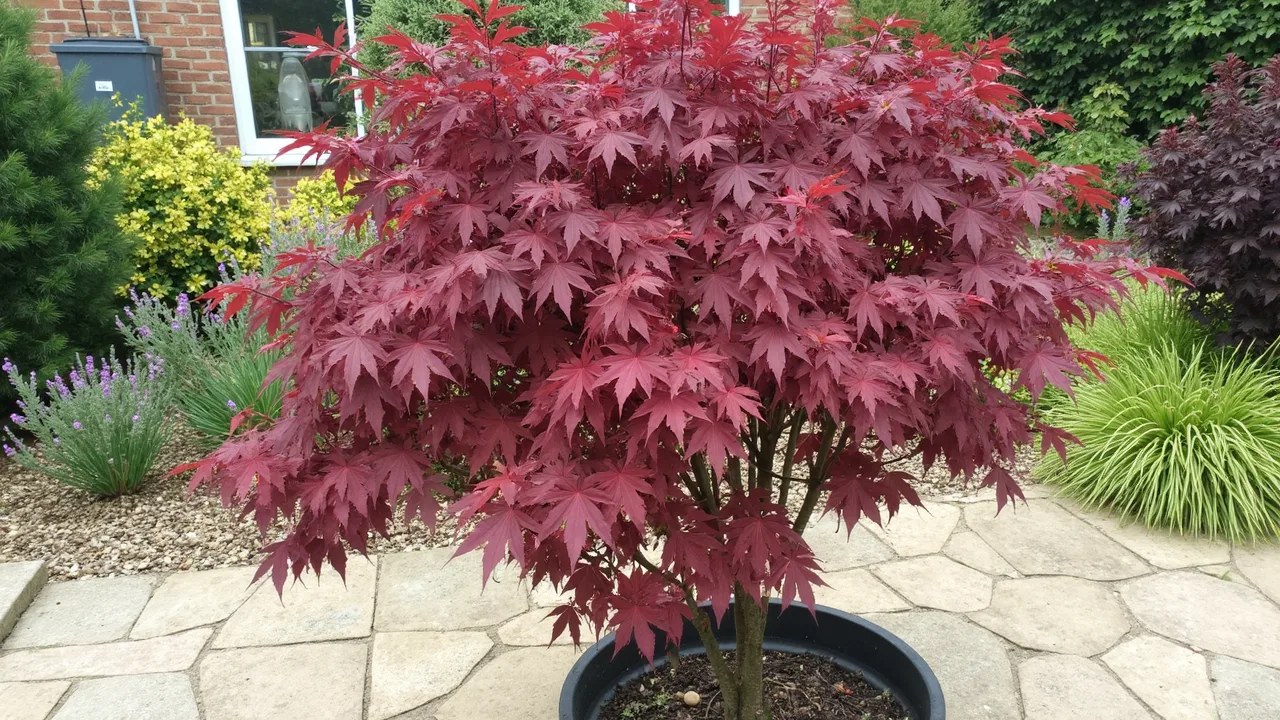
The leaves are the principal ornamental feature. They are palmate, 4–12 cm across, and divided into five, seven or nine deeply cut, serrated lobes. Leaf colour varies widely by cultivar: mid-green, deep purple-red, burgundy, golden-yellow, orange, and forms with white or pink variegation are all available. In autumn, foliage turns vivid shades of red, orange, scarlet and yellow, often with several colours present on the same plant.
In spring, small purple-red flowers appear in pendulous clusters, followed by winged fruits (samaras, often called "keys") 2–3 cm long, frequently flushed red. The bark is grey and smooth on young wood, becoming lightly fissured with age. In many cultivars, the young stems themselves carry colour, from bright green to deep red, adding winter interest.
Growing Conditions
Japanese Maples prefer a sheltered site with consistent moisture and good drainage. Cold winds, late frosts and intensely dry soils are the main causes of poor performance in UK gardens.
Soil should be moist but free-draining, with a slightly acidic to neutral pH of around 5.5 to 7.0. Avoid planting on shallow chalk, which causes leaf chlorosis (yellowing between the veins), and on heavy, waterlogged clay, which encourages root rots. On borderline soils, improve the planting area generously with well-rotted leaf mould or ericaceous compost.
Light requirements are flexible. In most of the UK, Japanese Maples grow best in dappled shade or with morning sun and afternoon shade, particularly in the south and east of England. Deep shade reduces autumn colour, while full sun combined with dry soil and wind causes leaf scorch. Thin, light shade from taller trees is ideal and mimics the plant's natural woodland-edge habitat.
Hardiness is rated RHS H6, indicating tolerance of winter temperatures between approximately −20 °C and −15 °C. Some delicate cut-leaf and variegated cultivars benefit from a more sheltered position, particularly in the north of the UK. Mulching helps insulate roots against both winter cold and summer drying.
Planting and Care
Plant Japanese Maples in autumn or early spring, when the soil is workable and moisture levels are reliable. Container-grown plants establish well at almost any time of year provided the ground is not frozen or waterlogged, but autumn planting gives roots a chance to settle before the following summer.
Dig a planting hole at least twice the width of the root ball and the same depth. Loosen the base and sides of the hole, and backfill with a mix of the original soil and well-rotted leaf mould, garden compost or ericaceous compost. Position the root flare level with the surrounding soil, water in thoroughly, and apply a 5–8 cm mulch of bark chips or leaf mould over the root area, keeping the mulch clear of the stem.
Watering is the most important aspect of aftercare. For the first three growing seasons, water deeply during any dry spell, particularly in late spring and early summer when new growth is most vulnerable. Established plants tolerate short dry periods but produce better autumn colour with consistent moisture.
Feeding is light. A single annual application of a balanced, slow-release fertiliser in spring, or a top-dressing of compost or well-rotted manure, is sufficient. Avoid high-nitrogen feeds, which produce soft growth prone to scorch.
Pruning is rarely necessary and is best kept to the removal of dead, damaged or crossing branches, carried out in late summer or early autumn. Japanese Maples bleed sap if cut in late winter or spring, which weakens the plant and is unsightly. If shaping is required, work gradually over several years.
Propagation is usually by softwood cuttings in early summer, or by grafting for named cultivars. Seed-raised plants are variable and do not come true to type, so cultivars are almost always propagated vegetatively.
Seasonal care centres on mulching in early spring, watering during dry spells in summer, and avoiding unnecessary disturbance to the root area. Container-grown plants need winter protection for the pot, either by wrapping the container in hessian or bubble insulation, or by moving it to a sheltered corner of the garden, as frozen roots are a common cause of losses.
Common Problems
Japanese Maples are generally trouble-free, but a handful of issues recur in UK gardens.
Aphids colonise the soft new growth in late spring, leaving sticky honeydew on the leaves below. Light infestations can be washed off with a strong jet of water; heavier outbreaks respond to insecticidal soap or biological control with lacewing larvae.
Verticillium wilt, caused by the soil-borne fungus Verticillium dahliae, produces sudden wilting and die-back of individual branches. There is no cure, and affected plants should be removed along with as much of the root system as possible. Avoid replanting susceptible species in the same spot.
Leaf scorch is the most frequently reported problem. Browning at the leaf edges is caused by a combination of intense sun, dry wind, dry soil or late frost. The remedy is cultural: improve soil moisture with mulching, water in dry spells, and, where possible, move container specimens to a more sheltered position.
Scale insects occasionally appear as small brown discs on the stems. Treat with horticultural oil applied in summer, following the manufacturer's instructions.
Bark damage is preventable. The bark is thin and easily wounded by lawn mowers and strimmers, which can lead to die-back or infection. Maintain a clear, mulched area around the base of the plant and avoid mechanical weeding close to the stem.
Root rot, caused by Phytophthora species, occurs in poorly drained soils. Symptoms include poor growth, small yellowing leaves and branch die-back. The best prevention is correct site selection and good drainage at planting.
Popular Varieties
Several hundred cultivars of Acer palmatum are grown worldwide, but a small number dominate UK availability. The following are widely planted and reliably available from British nurseries.
Acer palmatum 'Bloodgood' is one of the best-known large purple-leaved forms, growing to around 5 m, with deep burgundy foliage that holds its colour well through summer and turns bright red in autumn.
Acer palmatum 'Sango-kaku' is grown primarily for its coral-red winter stems, which are most vivid on young wood. Spring and summer foliage is pale green, turning yellow in autumn.
Acer palmatum 'Osakazuki' is regarded as one of the finest forms for autumn colour, with green summer leaves turning brilliant scarlet. It has an upright habit and reaches 4–5 m.
Acer palmatum 'Shaina' is a compact, densely branched form to about 2 m, with deep red spring and summer foliage. It is well suited to smaller gardens and large containers.
Acer palmatum 'Dissectum' group includes the thread-leaf and cut-leaf forms, such as 'Garnet' and 'Crimson Queen'. These are low-growing, mound-forming plants with finely divided purple or green foliage, ideal for containers and the edges of ponds, but they are slower-growing and more demanding of shelter than the upright forms.
Acer palmatum 'Beni-shitatsu' is a small, slow-growing form with finely cut purple-red leaves, popular in Japanese-style gardens and bonsai cultivation.
Mature size and ultimate hardiness vary between cultivars, and where specific information is limited, growers should consult the supplier, as the wild species is more vigorous and hardy than many of its cultivated forms.
Cultivars and Varieties
| Cultivar | Height | Flower | Notes | AGM |
|---|---|---|---|---|
| 'Aka shigitatsu sawa' | — | pinkish-white leaves with green veins | — | |
| 'Ao ba jo' | — | — | dwarf with bronze-green summer foliage | |
| 'Arakawa' | — | — | Upright vigorous growth with an exceptional rough bark that makes it very sought after for bonsai | |
| 'Ariadne' | — | — | RHS AGM (H6) | ✓ |
| 'Beni-maiko' | — | — | RHS AGM (H6) | ✓ |
| 'Beni-tsukasa' | — | — | RHS AGM (H6) | ✓ |
| 'Bloodgood' | — | — | RHS AGM (H6) | ✓ |
| 'Burgundy Lace' | — | — | RHS AGM (H6) | ✓ |
| 'Chitose-yama' | — | — | RHS AGM (H6) | ✓ |
| 'Corallinum' | — | — | RHS AGM (H5) | ✓ |
| 'Crimson Queen' | — | — | RHS AGM (H6) | ✓ |
| 'Eddisbury' | — | — | RHS AGM (H6) | ✓ |
| 'Elegans' | — | — | RHS AGM (H6) | ✓ |
| 'Emerald Lace' | — | — | RHS AGM (H6) | ✓ |
| 'Garnet' | — | — | RHS AGM (H6) | ✓ |
| 'Inaba-shidare' | — | — | RHS AGM (H6) | ✓ |
| 'Katsura' | — | — | RHS AGM (H6) | ✓ |
| 'Kinshi' | — | — | RHS AGM (H6) | ✓ |
| 'Kiyohime' | — | — | RHS AGM (H6) | ✓ |
| 'Orange Dream' | — | — | RHS AGM (H6) | ✓ |
| 'Orangeola' | — | — | RHS AGM (H6) | ✓ |
| 'Ornatum' | — | — | RHS AGM (H6) | ✓ |
| 'Ōsakazuki' | — | — | RHS AGM (H6) | ✓ |
| 'Red Pygmy' | — | — | RHS AGM (H6) | ✓ |
| 'Sango-kaku' | — | — | RHS AGM (H6) | ✓ |
| 'Seiryū' | — | — | RHS AGM (H6) | ✓ |
| 'Shin-deshōjō' | — | — | RHS AGM (H5) | ✓ |
| 'Shishi-gashira' | — | — | RHS AGM (H6) | ✓ |
| 'Trompenburg' | — | — | RHS AGM (H6) | ✓ |
| 'Villa Taranto' | — | — | RHS AGM (H6) | ✓ |
Pests and Diseases
| Problem | Symptoms | Management |
|---|---|---|
| Leaf scorch | Leaves turn brown and crispy at the edges or tips, often due to drought stress or excessive sun exposure. | Ensure consistent soil moisture in summer and provide partial shade to protect foliage from harsh sunlight. |
| Verticillium wilt | Sudden wilting, yellowing, and browning of leaves on one side or branch, potentially leading to dieback. | Remove and destroy infected plants immediately; avoid replanting maples in the same soil for several years. |
| Aphids | Clusters of small green or black insects on new growth, causing distorted leaves and sticky honeydew. | Spray off with a strong jet of water or treat with insecticidal soap or natural predators like ladybirds. |
| Honey fungus | General decline, wilting foliage, and white fungal growth under the bark at the base of the trunk. | Improve drainage and avoid deep mulching near the stem; severe cases may require removal of the tree. |
| Acer gall mite | Small, blister-like galls or distortions on the underside of leaves, often appearing in spring. | Prune out affected branches if severe; generally cosmetic and rarely requires chemical intervention. |
For step-by-step help, read Controlling Aphids Naturally. Or browse the full plant problem solver to diagnose an issue by symptom.
Recommended Products
GardenWizz earns a commission from qualifying purchases made through affiliate links on this page (including links within the article) — as an Amazon Associate, and from Thompson & Morgan via the Awin network. This does not affect the price you pay. See our disclaimer for details.