White Dead-Nettle
Lamium album
The Gardening Year
Best months in UK gardens · full planting calendar →
🖨 Printable care card (PDF)At a Glance
| Botanical name | Lamium album |
|---|---|
| Common name(s) | White Dead-nettle |
| Family | Lamiaceae |
| Plant type | perennial (rhizomatous herbaceous perennial) |
| Height × Spread | 10–70 cm × 10–50 cm |
| Position | Full sun, Partial shade |
| Soil | moist, fertile soils |
| Flowering | March–November |
| Toxicity | No specific toxicity is listed by the RHS. This is not a guarantee of safety — check with a vet or the ASPCA before pets or children eat any plant. |
| Native range | Europe and Asia |
White dead-nettle brings a long succession of white, hooded flowers to informal UK gardens, wildlife borders and lightly shaded ground. Its nettle-like leaves do not sting, but its spreading stems need room and occasional control.
Overview
Lamium album is a perennial member of the mint family, Lamiaceae, native across temperate Eurasia and long established throughout much of Britain. It commonly occurs on hedge banks, verges, field margins, waste ground and other fertile, disturbed places. In a garden it is best treated as a robust native wildflower rather than a restrained ornamental: valuable where naturalistic cover is wanted, but unsuitable for a small bed containing delicate plants.
The plant spreads through branching rhizomes and stolon-like stems, producing colonies when conditions suit it. This habit makes it useful beneath an open hedge, beside a wildlife pond, along a boundary or in a meadow edge where bare, fertile soil would otherwise be colonised by less useful weeds. It combines particularly well with other vigorous native plants rather than small alpines or slow-growing woodland treasures.
White dead-nettle has an unusually long flowering period. The RHS records flowers from March into late autumn, while regional timing varies with exposure and weather. Its tubular, two-lipped flowers provide nectar for long-tongued bumblebees; The Wildlife Trusts specifically includes the plant in advice on attracting bumblebees. Early and late flowers are especially useful when fewer other sources are open.
Despite the common name, it is not a true nettle and carries no stinging hairs. The resemblance lies mainly in the paired, toothed leaves. This distinction makes it a useful plant for a wildlife garden close to paths, although its vigorous spread still warrants deliberate siting.
Appearance
Upright, four-angled stems arise from a spreading perennial rootstock. They are generally green and softly hairy, with opposite leaves arranged in pairs at each node. The leaves are broadly oval to heart-shaped, sharply toothed and pointed, with a slightly wrinkled surface. Their resemblance to stinging nettle is convincing from a distance, but white dead-nettle foliage is softer and non-stinging.
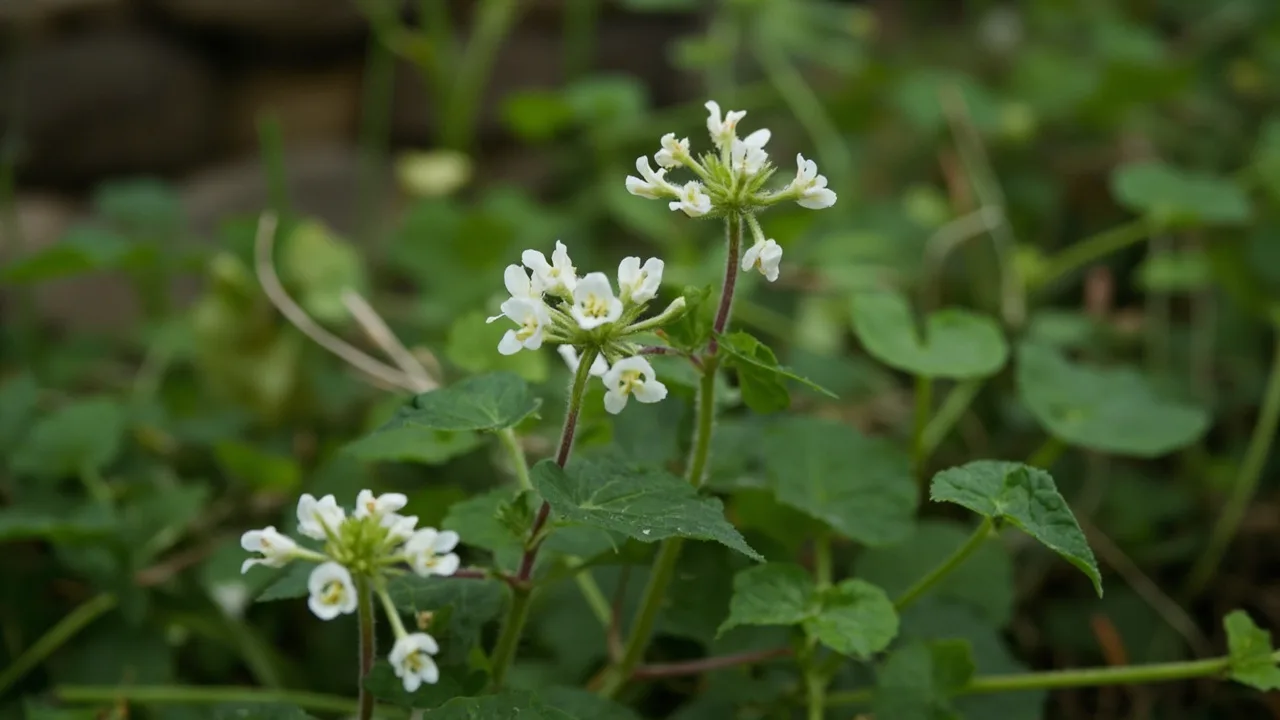
Flowers form in dense whorls around the upper stem, emerging from the leaf axils. Each flower is white or faintly creamy and shaped like a small hood above a three-lobed lower lip. Fine hairs on the upper hood and lower lip add texture when viewed closely. The flowers face outwards around the stem, creating distinct white tiers among the green leaves rather than a single terminal flower spike.
Typical garden plants reach about 30-60cm, although specimens on rich, sheltered ground can grow taller; The Wildlife Trusts records a maximum of up to 80cm. Growth is often lower where plants are cut, exposed or competing with grass. The spread is potentially indefinite because rooted stems and rhizomes can extend beyond the original clump.
The foliage may remain present through much of a mild UK winter, while harder weather checks top growth. Fresh stems then rise in spring. After flowering, small nutlets develop within the persistent calyx. Seed contributes to spread, but vegetative growth is normally the more obvious cause of an expanding garden patch.
Growing Conditions
White dead-nettle grows well across the UK and asks for little protection. The most productive position has reasonably fertile soil that remains fresh in spring and does not stay waterlogged in winter. Moist but well-drained loam is ideal, but established plants also tolerate clay and chalk where roots have air. Very dry, impoverished soil produces shorter, sparser growth, while stagnant ground encourages decline and fungal damage.
Full sun encourages plentiful flowers where the soil retains moisture. Partial shade is equally suitable and often keeps foliage in better condition during dry summers. Under a dense evergreen canopy, however, the combination of deep shade and root competition can reduce flowering. A bright hedge bottom, open woodland edge or east- or west-facing boundary usually gives a better balance.
Allow at least 30-45cm between young plants if establishing a deliberate patch. This space soon closes as stems travel. In rich soil, placing an edging barrier or growing the plant inside a defined wildlife area makes later control easier. It should not be introduced close to a boundary where its spread into neighbouring land would be unwelcome.
Spring or early autumn is the best planting period in most UK districts. March to April suits colder or wetter gardens once soil is workable; September to early October allows roots to settle while soil remains warm in milder areas. Avoid planting into frozen, saturated or drought-baked ground. Container-grown plants can be set out at other times if watered reliably.
The plant is compatible with informal wildlife planting but can overwhelm small companions. Suitable neighbours include sturdy meadow cranesbills, red campion and robust grasses in situations where all can compete. Avoid combining it with slow bulbs, miniature perennials or recently planted seedlings until their roots are well established.
Planting and Care
Prepare a weed-free patch wider than the root ball because creeping weeds become difficult to remove once dead-nettle stems knit together. Loosen compacted soil, incorporate a modest amount of garden compost only on poor ground, and plant at the same depth as in the pot. Firm gently and water thoroughly. Over-enrichment is unnecessary and can produce tall, soft growth at the expense of a balanced habit.
Water new plants during dry spells through their first growing season. A thorough weekly soaking is more useful than frequent surface sprinkling, though rainfall and soil type should guide the interval. Once established, plants generally manage normal UK rainfall; water only during prolonged drought, particularly in exposed sites or beneath hedges. Do not leave pots standing permanently wet.
Feeding is seldom needed in open ground. A thin spring mulch of leaf mould or garden compost is adequate on poor soil, kept clear of congested crowns. High-nitrogen fertiliser encourages excessive leafy spread and lodging. Container-grown specimens can receive a balanced liquid feed sparingly during active growth, but this species is usually better in the ground than confined indefinitely to a small pot.
As an herbaceous perennial, white dead-nettle requires cutting back rather than woody pruning. Shear untidy flowering stems after the main summer flush to encourage compact regrowth and reduce self-seeding. Leave some late flowers where wildlife value is the priority. Cut remaining collapsed growth to near ground level between late autumn and early spring, removing diseased material but allowing sound hollow or leafy cover to remain over winter where invertebrate habitat is wanted.
Divide established colonies in March-April or September. Lift rooted outer sections with a spade, separate vigorous pieces carrying both roots and shoots, and replant promptly into prepared soil. Water divisions until growth resumes. Soft basal shoots can also be rooted in spring, and naturally rooted runners are easily detached. Seed may be sown when ripe, but seedlings vary and division is quicker for establishing a dependable patch.
Check the boundary of the colony two or three times during the growing season. Pull or dig out wandering rooted stems before they enter neighbouring crowns. Do not place live rhizome fragments in home compost unless the heap reliably becomes hot enough to destroy them; repeated regrowth is otherwise possible. Seasonal control is easier than reclaiming an overrun bed after several years.
Common Problems
White dead-nettle is generally healthy, and excessive vigour is more commonly troublesome than pests. Its main garden problem is unwanted spread by rhizomes and stems that root where they touch moist soil. Define its area from the outset, inspect edges in spring and again after summer rain, and remove complete rooted sections. Cutting tops alone will not stop underground spread.
Slugs and snails may rasp holes in soft spring foliage, particularly around new divisions in damp shade. Damage is usually cosmetic on established colonies. Reduce hiding places beside vulnerable plants, water in the morning rather than at night, and use wildlife-conscious controls where intervention is necessary. Strong plants normally outgrow minor feeding.
Dense growth in still, humid conditions can develop grey mould or other fungal spotting. Leaves and stems become brown, soft or coated with greyish growth. Thin congested patches, remove affected material, improve airflow and avoid wetting foliage late in the day. Persistently waterlogged soil should be improved or the planting moved; fungicide is rarely justified for this robust wildflower.
Yellowing or weak, stretched stems usually indicate unsuitable conditions rather than a named disease. Deep shade reduces flowering and creates lax growth, while drought beneath mature hedges causes premature leaf loss. Increase light where possible, water deeply during establishment and use leaf mould to improve moisture retention without creating a wet crown.
Seedlings or young shoots can sometimes be confused with stinging nettle. White dead-nettle has paired leaves, square stems and no sting, but positive identification should be made before weeding or handling unfamiliar plants. Gloves remain sensible in mixed patches because true nettles may grow through the colony.
Popular Varieties
Named cultivars of Lamium album are not commonly offered by UK nurseries. For this species, the meaningful choices are accepted botanical subspecies rather than garden cultivars, and their geographic origins matter more than ornamental variation.
- Lamium album subsp. album is the temperate Eurasian subspecies associated with British plants and the appropriate choice for a UK native or wildlife-style garden. Nursery material sold simply as Lamium album will normally be this form, though provenance should be checked if ecological restoration is intended.
- Lamium album subsp. barbatum is accepted by Kew and occurs from Siberia to Japan and China. It is botanically valid but is not the usual British garden or wild form, and UK retail availability appears limited.
- Lamium album subsp. crinitum is another accepted subspecies, associated with south-western Asian parts of the species' range. It is chiefly of botanical interest and should not be presented as a readily available UK cultivar.
Garden-centre plants labelled Lamium maculatum cultivars or Lamium orvala 'Album' are different taxa and should not be substituted when the aim is to grow white dead-nettle. For wildlife planting, source correctly identified, responsibly propagated British material and avoid collecting plants from the wild without the landowner's permission.
Sources & Further Reading
- Royal Horticultural Society: Lamium album plant profile, accessed 22 July 2026.
- Royal Botanic Gardens, Kew, Plants of the World Online: Lamium album, accessed 22 July 2026.
- The Wildlife Trusts: White dead-nettle, accessed 22 July 2026.
- The Wildlife Trusts: How to attract bumblebees to your garden, accessed 22 July 2026.
- BSBI Online Plant Atlas 2020: Lamium album, accessed 22 July 2026.
- BBC Gardeners' World: Complete guide to dead-nettles, accessed 22 July 2026.
🌿 Wild species. Grown as the true native plant, not as named garden cultivars — so there is no cultivar list here by design, not for want of data.
Pests and Diseases
| Problem | Symptoms | Management |
|---|---|---|
| Powdery mildew | White powdery fungal growth appears on leaves and stems, often causing distortion or yellowing. | Improve air circulation around plants and apply a sulphur-based fungicide if infection is severe. |
| Slugs and snails | Irregular holes chewed in leaves and silvery slime trails visible on foliage and soil. | Use iron phosphate pellets, beer traps, or hand-pick at night to reduce populations. |
| Root rot | Leaves turn yellow and wilt despite moist soil, with stems becoming soft and brown near the base. | Ensure soil is well-drained and avoid overwatering; remove affected plants to prevent spread. |
| Aphids | Clusters of small green or black insects on new growth, accompanied by sticky honeydew residue. | Spray off with a strong jet of water or introduce natural predators like ladybirds. |
| Leaf spot | Small brown or black spots appear on leaves, sometimes surrounded by yellow halos. | Remove affected leaves and avoid wetting foliage when watering to reduce humidity. |
For step-by-step help, read Controlling Aphids Naturally, Dealing with Slugs and Snails, Treating Powdery Mildew and Tackling Black Spot on Roses. Or browse the full plant problem solver to diagnose an issue by symptom.
Recommended Products
GardenWizz earns a commission from qualifying purchases made through affiliate links on this page (including links within the article) — as an Amazon Associate, and from Thompson & Morgan via the Awin network. This does not affect the price you pay. See our disclaimer for details.