Buttonhead Primrose
Primula capitata
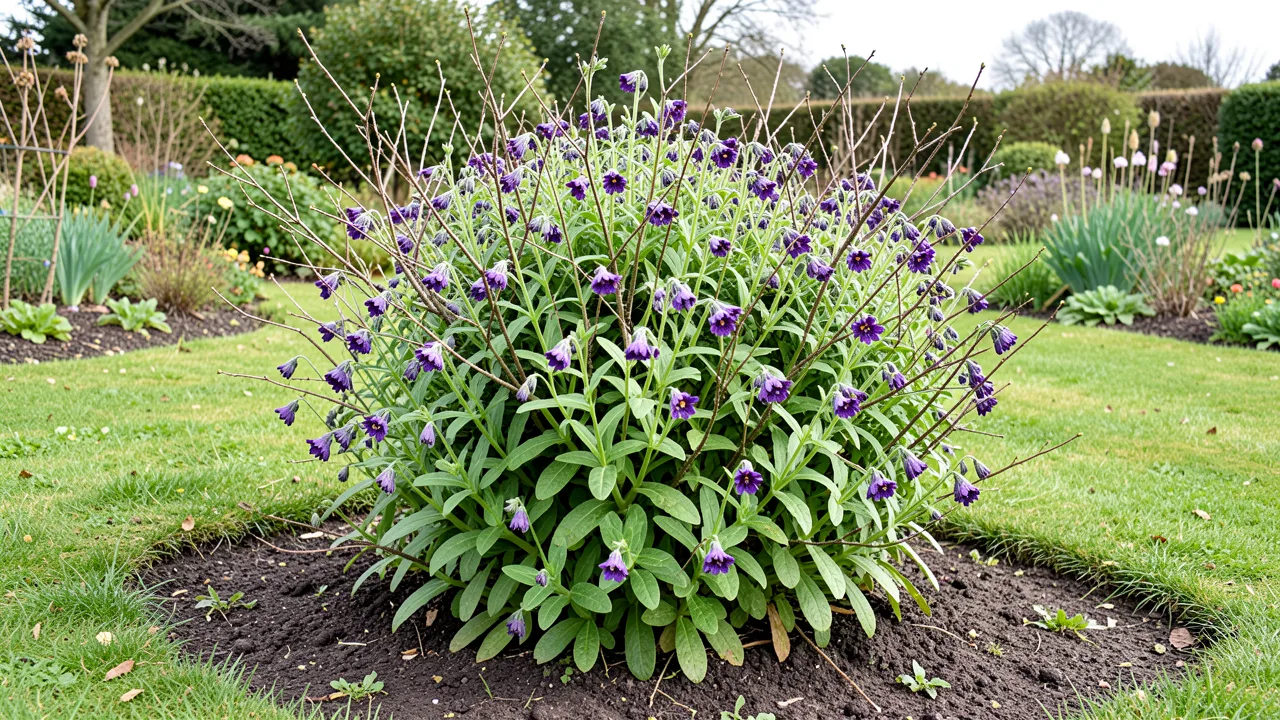
The Gardening Year
Best months in UK gardens · full planting calendar →
🖨 Printable care card (PDF)At a Glance
| Botanical name | Primula capitata |
|---|---|
| Common name(s) | Buttonhead primrose |
| Family | Primulaceae |
| Plant type | perennial (short-lived perennial) |
| Height × Spread | 40 cm × 10–50 cm |
| Position | Partial shade |
| Soil | deep, moist, neutral to acid, humus-rich soil |
| Flowering | May–September |
| Toxicity | — |
| Native range | alpine areas of Bhutan, Tibet, and Sikkim state in India |
Primula capitata is a short-lived herbaceous perennial from the alpine meadows of the eastern Himalayas, grown in UK gardens for its flattened, pincushion-like heads of small, deep violet-purple flowers and the fine mealy farina that dusts its stems and calyces. It belongs to the Primulaceae family and sits within the Asiatic section of the genus alongside other candelabra-type primulas. Although less commonly seen than its candelabra relatives such as Primula japonica and Primula pulverulenta, it is valued by collectors for its compact form, late-flowering habit and the silver-white meal that coats its upper stem — a feature absent from many of its near relatives.
Overview
Primula capitata was introduced to British horticulture from the alpine regions of Bhutan, Tibet and Sikkim, where it grows in damp, organic-rich turf and on the margins of mountain streams. In cultivation it behaves as a hardy perennial that flowers freely in its first or second year from seed, but it is genuinely short-lived: established clumps often dwindle after three or four seasons and benefit from regular renewal. The Royal Horticultural Society has awarded it the Award of Garden Merit, recognising its reliability in suitable UK conditions. It is most often planted in groups of three or more at the edge of a border, beside a pond, or in a damp, partially shaded rock garden, where the late-summer flowers extend the candelabra-primula display well beyond the early-summer peak of related species.
Appearance
The plant forms a flat, evergreen-to-semi-evergreen basal rosette of oblanceolate, slightly wrinkled leaves 8–20 cm long. The leaves are mid-green, narrowing gradually to a winged stalk, and are usually held close to the soil until the flowering stems elongate.
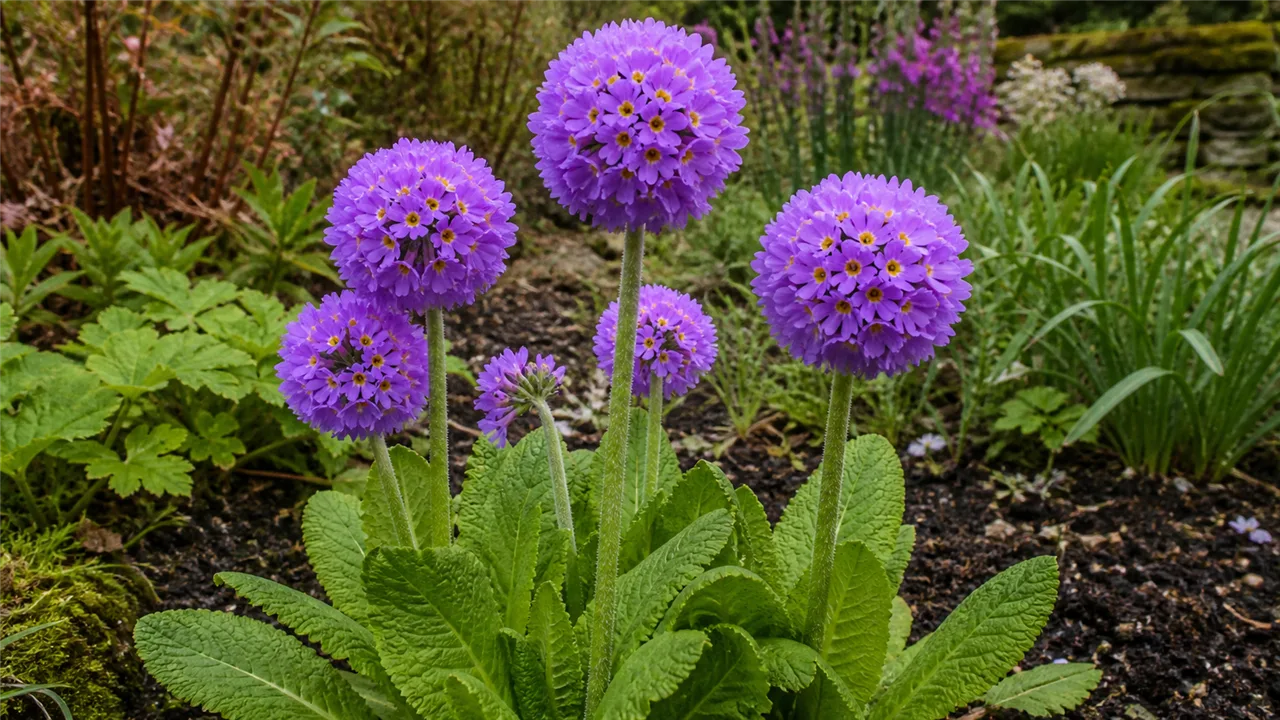
From late spring, upright stems rise 25–40 cm above the rosette. These stems, together with the tightly packed flower buds beneath each inflorescence, are thickly dusted with a white or pale lilac mealy farina that rubs off on the fingers and is one of the plant's most distinctive ornamental features.
The flowers themselves are carried in a dense, rounded, terminal head (the source of both the species name capitata and the common name round-headed Himalayan primrose). Each head comprises dozens of small, salver-shaped blooms with a tubular base and a flat, five-lobed face, opening in succession from the base of the head upwards. The colour is a deep violet-blue to purple, with a darker eye at the throat, and the calyces are conspicuously mealy. Flowering continues intermittently from late May through to September in cool, moist summers.
The plant is at its best planted in drifts or colonies; a single specimen is easily lost among bolder border plants, but groups of five or more produce a visible late-season colour block.
Growing Conditions
Primula capitata demands cool, consistently moist conditions and fails quickly in dry or hot sites. In the UK this usually translates to a position in light dappled shade, or full sun only where the soil remains damp through the summer. South-facing borders at the base of a wall are unsuitable unless irrigation is reliable.
The ideal soil is deep, humus-rich and moisture-retentive but not waterlogged. It favours a neutral to acid pH and tolerates peaty ground; thin, alkaline or free-draining soils should be heavily improved with leaf mould, well-rotted garden compost or similar organic matter before planting. A heavy clay can be made suitable provided drainage is adequate and the surface does not crack in summer — a 5–8 cm organic mulch after the autumn cutback helps with both.
It is hardy throughout the UK, withstanding the winters of all but the most exposed upland gardens, and is grown successfully from the Highlands of Scotland to the south coast. The species is, however, sensitive to summer drought rather than winter cold, and the most common cause of loss in British gardens is desiccation in July and August rather than hard frost. Water at the base of the plant during prolonged dry spells.
Planting and Care
Plant container-grown specimens in autumn or early spring, setting the rosette at the same depth as in the pot and teasing out any congested roots from the rootball. Space plants 25–30 cm apart and water in well. A mulch of leaf mould or composted bark applied after planting conserves moisture and keeps the crowns cool.
Watering is the single most important aspect of cultivation. Plants in moisture-retentive soil in partial shade should not need supplementary watering once established, but those in sunnier or freer-draining positions should be soaked deeply during dry weather. Overhead watering should be avoided where possible, as it can mark the mealy coating on the flower stems.
Feeding is light: a single application of a general-purpose fertiliser in early spring as growth resumes, followed by a top-dressing of well-rotted compost, is sufficient. Overfeeding produces lush foliage at the expense of flower and shortens the plant's already brief life.
Pruning is minimal. The plant has no woody framework to manage; remove damaged or dead leaves by hand as they appear, and clear away debris from the crown in late autumn to reduce overwintering pests and disease.
Propagation is by seed, division or root cuttings. Seed is the most reliable method: sow fresh seed in autumn or early spring in trays of peat-free seed compost, surface-sown and kept cool and shaded; germination is often slow and irregular but usually generous. Prick out seedlings while small and grow on in pots until they are large enough to plant out. Division of established clumps is straightforward and is best carried out in early autumn as the plants re-establish quickly in cool, moist soil; this is also a useful way to maintain stock of named forms, which do not come true from seed. Large, fleshy roots can also be detached in late winter and laid horizontally on a tray of compost, where they will produce young plantlets along their length.
Seasonal care centres on moisture. In dry springs, water to support the first flush of growth and flowering; in dry summers, continue to water to keep plants in active growth; in autumn, reduce watering as growth slows and clear decaying foliage from around the crown.
Common Problems
Primula capitata shares the pest and disease profile of the broader Asiatic primula group, and most problems relate to growing conditions rather than the plant itself.
Aphids are the most frequent pest, congregating on the new spring growth and inside the developing flower heads. They are easily controlled by squashing, by a strong jet of water, or by encouraging natural predators in mixed borders.
Vine weevil can be a serious problem in container-grown plants and in light, dry soils, where the grubs attack the roots; plants wilt and collapse suddenly. Inspection of the rootball and the use of biological nematode control in late summer is the standard treatment.
Slugs and snails disfigure the foliage in damp springs, particularly on young growth. Standard controls (barriers, hand-picking, iron-based slug pellets) are effective.
Leaf and bud eelworms can distort and blacken the foliage and flower buds; affected plants should be removed and destroyed, and the site rested from primulas for several years.
Leaf-mining flies produce characteristic pale blotches or tunnels in the leaves; the affected foliage should be picked off and disposed of before the larvae complete their development.
Glasshouse red spider mite is principally a problem under glass, where it causes fine mottling and a general loss of vigour; it is rarely an issue on plants grown outdoors in the open garden.
Primula leaf spot (a fungal disease) produces brown spots, often with a yellow halo, on the foliage; it is best managed by removing affected leaves, improving air circulation and avoiding overhead watering.
Primula brown core, a soil-borne problem, causes the crown and roots to turn brown and rot; affected plants should be removed and the soil improved with fresh organic matter before replanting.
Plants grown in well-drained, humus-rich soil with adequate moisture rarely suffer serious problems.
Popular Varieties
Named cultivars of Primula capitata are scarce in general nursery trade in the UK, and most plants are sold as the species or as seedlings raised from a single AGM form. This is an area where named selections are limited and where cultivars should be approached cautiously.
Primula capitata subsp. sphaerocephala is the principal recognised subdivision within the species, differing from the type in its more spherical flower head and slightly later flowering period; it holds an Award of Garden Merit and is the form most commonly listed by specialist alpine and primula nurseries.
The cultivar 'Salvana' is occasionally listed by specialist growers as a selected, vigorous form with particularly dense flower heads; availability is variable and plants sold under this name in some outlets should be checked against the original Salvana introduction, which traces to a continental European selection rather than a UK-raised plant.
Where named cultivars cannot be sourced, raising a colony from a packet of seed collected from a reliable AGM form is the standard way to obtain a uniform display, and will produce flowering plants within two seasons under good conditions.
Note on cultivar names: reliable, widely-available named cultivars of Primula capitata beyond subsp. sphaerocephala are genuinely few. Gardeners seeking particular colour breaks or larger heads are advised to seek out specialist primula societies, which maintain a wider range of forms than the general trade.
Pests and Diseases
| Problem | Symptoms | Management |
|---|---|---|
| Powdery mildew | White powdery fungal growth appears on leaves and flower heads, often causing distortion. | Improve air circulation and apply a fungicide or bicarbonate spray at first sign of infection. |
| Slugs and snails | Irregular holes chewed in leaves and flower buds, accompanied by slimy trails. | Use physical barriers like copper tape or apply iron phosphate-based slug pellets around the base. |
| Root rot | Leaves turn yellow and wilt despite moisture, with a mushy, darkened root system. | Ensure well-draining soil and avoid overwatering; remove affected plants to prevent spread. |
| Aphids | Clusters of small soft-bodied insects on new growth, often accompanied by sticky honeydew. | Spray off with a strong jet of water or treat with insecticidal soap or natural predators like ladybirds. |
| Leaf spot | Circular brown or black spots develop on foliage, potentially leading to leaf drop. | Remove infected leaves and avoid wetting foliage when watering to reduce humidity around the plant. |
For step-by-step help, read Controlling Aphids Naturally, Dealing with Slugs and Snails, Treating Powdery Mildew and Tackling Black Spot on Roses. Or browse the full plant problem solver to diagnose an issue by symptom.
Recommended Products
GardenWizz earns a commission from qualifying purchases made through affiliate links on this page (including links within the article) — as an Amazon Associate, and from Thompson & Morgan via the Awin network. This does not affect the price you pay. See our disclaimer for details.