
Cowslip
Primula veris
The Gardening Year
Best months in UK gardens · full planting calendar →
🖨 Printable care card (PDF)At a Glance
| Botanical name | Primula veris |
|---|---|
| Common name(s) | Cowslip |
| Family | Primulaceae |
| Plant type | perennial (Grow as biennials for bedding and in a container or rock garden.) |
| Height × Spread | 20–25 cm × 25–30 cm |
| Position | Full sun, Partial shade |
| Soil | Moist but well-drained; Acid, Alkaline, Neutral; Chalk, Clay, Loam, Sand; Rich or poor soil. |
| Flowering | March–May |
| Toxicity | No specific toxicity is listed by the RHS. This is not a guarantee of safety — check with a vet or the ASPCA before pets or children eat any plant. |
| Native range | Temperate Europe and western Asia |
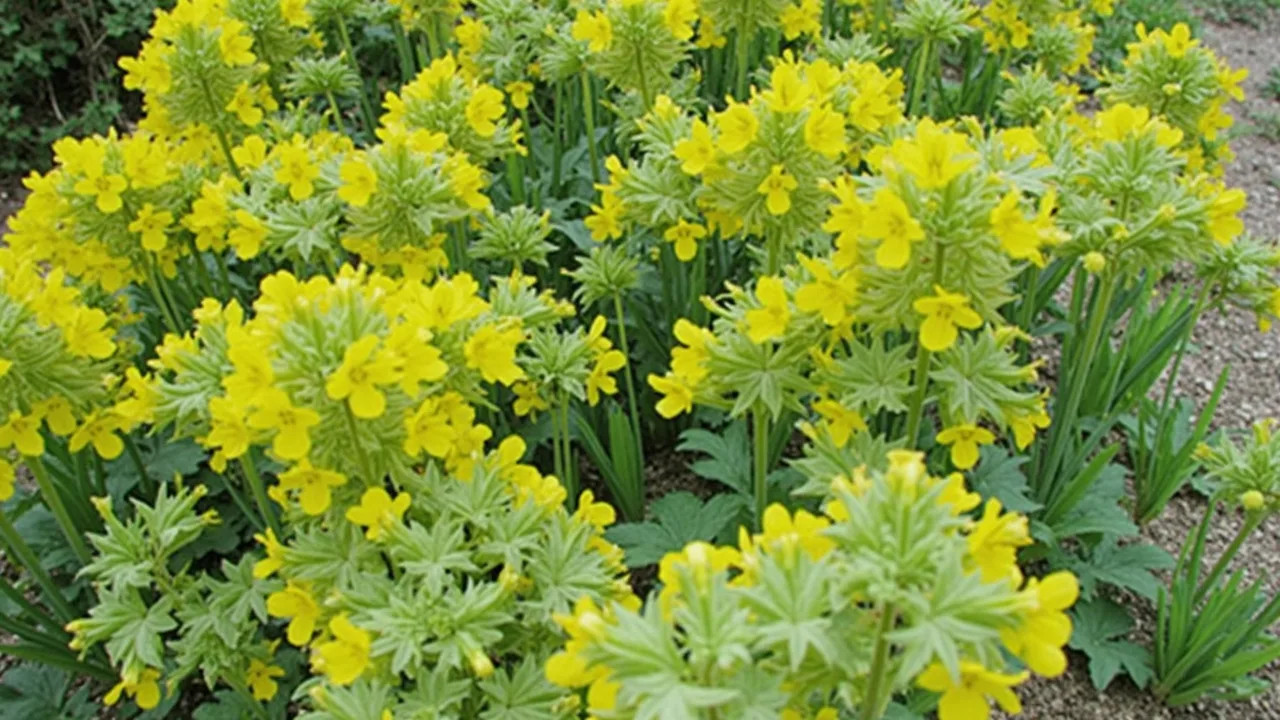
Cowslip (Primula veris) is a spring-flowering herbaceous perennial of the family Primulaceae, native across most of Europe including the British Isles, where it has long been a characteristic plant of meadows, roadside banks and chalk downland. Its clusters of nodding, deep yellow, bell-shaped flowers on hairy stems above a rosette of crinkled leaves are among the most recognisable signs of an English spring, and the species remains a firm favourite for wildlife gardens, wildflower meadows and informal cottage plantings.
Overview
Primula veris belongs to the genus Primula within the family Primulaceae. The plant is a rosette-forming perennial that, in the wild, colonises unimproved grassland, hedge banks and the edges of open woodland, particularly on chalk and limestone soils. Across the British Isles it has historically been so abundant that it gave its name to "cowslip meadows" and was once gathered in great quantities for May Day garlands and for traditional wines and cordials; modern agricultural intensification has reduced many wild populations, and the species is now valued as much for conservation as for ornament.
In cultivation cowslip is undemanding, hardy throughout the UK, and an excellent early-season nectar source for bees, hoverflies and butterflies. It is suitable for naturalising in grass, for the front of a mixed border, for wildlife plantings on thin chalk soils, and for containers where its compact size can be appreciated at close quarters. It is also a parent — alongside the common primrose (Primula vulgaris) — of the popular hybrid Primula × polyantha, the polyanthus primula widely sold as winter and spring bedding.
Appearance
Cowslip grows from a short, stout rootstock that produces a basal rosette of leaves and, in spring, one or more upright, softly hairy flower stalks. Whole mature plants typically reach 10–30 cm in height, with a similar spread once established.
The leaves are arranged in a flat rosette pressed close to the ground. Each leaf is broadly lanceolate to oblong, 5–20 cm long, with a crinkled, somewhat wrinkled surface and a softly downy texture. The leaf blade tapers gradually into a winged stalk — a useful diagnostic that helps separate cowslip from the very similar-looking but unrelated false oxlip (Primula × variabilis) and from the true oxlip (Primula elatior). Leaf margins are entire or only faintly toothed.
The flowers are the species' chief ornament. They are pendent, narrowly bell-shaped and 9–15 mm long, with five broad, notched petals of a deep, warm yellow that occasionally flushes towards orange at the base. They are carried in a one-sided umbel of two to fifteen blooms held above the leaves on a single, stout, hairy stem. The calyx beneath each flower is pale green and distinctly inflated or bulging at the base, another reliable field character. Flowers are fragrant, with a sweet, slightly apricot scent that is most pronounced in warm, still air. Flowering in the UK generally runs from early April through to late May, with stragglers into June in cool seasons.
The fruit is a small, dry, non-showy capsule containing numerous seeds. It is of little ornamental interest but is valuable to seed-collecting gardeners and to small ground-feeding birds.
Growing Conditions
Cowslip is a plant of open, often unimproved ground. In the UK it is most abundant on chalk and limestone grassland, in old hay meadows and along roadside verges that have escaped chemical treatment, but it grows happily on any calcareous to neutral soil that does not dry out completely in summer or lie waterlogged in winter. Heavily acid soils should be improved with garden lime and organic matter before planting.
The ideal site is in full sun or, in the south of England, in light dappled shade cast by deciduous shrubs or open woodland edge. Flowering is reduced in deeper shade, and the rosettes can become drawn and prone to mildew under trees that cast dense summer shade.
A moist but free-draining, moderately fertile loam suits cowslip best. The species tolerates thin, stony soils over chalk far better than it tolerates heavy clay or boggy ground; on clay it is worth working in coarse grit and well-rotted organic matter to improve drainage before planting. Once established, mature plants are notably drought-tolerant for a Primula, surviving the average English summer without supplementary watering except on the very lightest soils.
Across the UK cowslip is fully hardy. The Royal Horticultural Society rates it H7, the hardiest category, indicating survival down to at least −20 °C and tolerance of exposure in all but the most severe upland gardens. Plants tolerate frost, snow and cold wet winters without protection, and the leaves remain semi-evergreen through mild winters.
Planting and Care
Seed is the most economical way to raise cowslip and is also the route to greatest variety. Sow fresh seed in autumn or store seed in the fridge and sow in late winter; germination can be slow and erratic, and a period of cold stratification noticeably improves the take. Surface-sow on a fine, moist seed compost, press the seed in lightly without covering, and keep the pots in a cold frame or shaded corner outdoors. Seedlings transplant easily once they have produced their first true leaves and can be moved to their final positions in autumn or the following spring.
Nursery-grown plants in 9 cm pots or larger can be put out at any time of year when the soil is workable, with autumn and early spring the preferred windows. Space plants 15–20 cm apart in groups of three, five or more for the best display; isolated single plants tend to look thin and flower sparsely. Water in well and keep moist until established, usually within a single growing season.
Once settled, cowslip needs little routine care. Water only during prolonged dry spells in summer; overwatering, particularly on heavy soil, encourages root rot. Feed sparingly — a light mulch of well-rotted compost or leaf mould in early spring is sufficient on most garden soils, and artificial fertiliser is rarely required. Avoid high-nitrogen feeds, which produce leafy growth at the expense of flowers.
Pruning is minimal. Cut back the old flower stems once the blooms have faded to prevent excessive self-sowing where naturalising is not wanted, and tidy away any winter-damaged leaves in early spring to make way for the new rosette. Divide congested clumps every three to four years, immediately after flowering, lifting the whole plant, teasing apart the rosettes and replanting the most vigorous sections into fresh ground.
Propagation is straightforward from seed, as above, or by division of established clumps. Mature plants self-seed freely where conditions suit, and seedlings can be lifted and potted in autumn for planting out the following spring.
Common Problems
Cowslip is generally a healthy, low-maintenance plant when grown in appropriate conditions, but a handful of problems are worth watching for in the UK garden.
Slugs and snails are the principal spring pest, attacking the young leaves and flower stems as they emerge in March and April. Damage is usually cosmetic on established plants but can check the growth of seedlings; control with wildlife-friendly pellets, beer traps or hand-picking at dusk.
Aphids may cluster on developing buds and on the undersides of leaves in late spring. They are usually kept in check by hoverflies, ladybirds and lacewings, and treatment is rarely necessary; a strong jet of water or an insecticidal soap will deal with heavy infestations.
Grey mould (Botrytis cinerea) can affect plants in wet seasons or in crowded, poorly ventilated plantings, causing a fuzzy grey-brown rot on leaves and flowers. Remove affected material promptly, improve air circulation by thinning surrounding growth, and avoid overhead watering.
Powdery mildew occasionally appears in late summer on plants that are dry at the root or crowded by neighbouring vegetation. A light mulch in spring and adequate spacing are usually enough to prevent it; mildew-affected plants can be cut back hard after flowering and will usually regrow clean foliage.
Leaf spot, caused by the fungus Ramularia primulae, produces brownish spots on the leaves and is generally cosmetic rather than damaging. Remove and destroy affected leaves in autumn to reduce carry-over of the fungus.
Vine weevil grubs can damage roots, particularly of container-grown plants, in late summer and autumn. Biological control with pathogenic nematodes (Steinernema kraussei) applied in September is the standard treatment and is effective in most situations.
Popular Varieties
Named cultivars of Primula veris are relatively few, as the species is most often grown in its wild form or as part of mixed meadow mixes. The following are reliably available in the UK trade and offer genuine variety in colour, flower form or habit; none has an Award of Garden Merit from the Royal Horticultural Society.
Primula veris itself, the species, is the form most gardeners grow and the only one that comes true from saved seed. It is vigorous, easy and the best choice for naturalising.
'Katy McSparron' is a double-flowered cultivar bred in Scotland and selected for its densely packed, rosette-like yellow flowers held on short, sturdy stems. It is sterile and therefore does not self-seed, which makes it useful in more formal plantings where seedlings would be unwelcome. Around 15–20 cm tall.
'Sunshine Susie' is a seed-raised strain offering a slightly broader colour range from clear lemon-yellow to a warmer, almost orange gold. Plants are uniform, compact and free-flowering, typically reaching 20–25 cm.
The closely related Primula veris subsp. columnae (sometimes sold as the red-stemmed cowslip) is distinguished by its strongly flushed red stems and slightly broader, paler yellow flowers. It is native to parts of southern and central Europe and is hardy in the UK given a well-drained position.
For gardeners wanting more variety in the wider cowslip-relative group, the hybrid Primula × polyantha (polyanthus) and Primula elatior (oxlip) make excellent companions in the same border, flowering at slightly different times and offering colours from cream to deep mahogany.
---
Pests and Diseases
| Problem | Symptoms | Management |
|---|---|---|
| Primula rust (Puccinia primulae) | Clusters of tiny, cup-like orange or brown spore-producing structures appear on the undersides of leaves. | Remove and destroy infected leaves immediately; avoid fungicides to protect biodiversity. |
| Slugs and snails | Irregular holes chewed in young leaves and flower buds, often accompanied by slimy trails. | Use physical barriers like copper tape or beer traps, and hand-pick at night. |
| Powdery mildew | A white, dusty fungal growth covers the upper surfaces of leaves and stems. | Improve air circulation around plants and avoid overhead watering to keep foliage dry. |
| Vine weevil | Notched edges on leaves above ground, while grubs feed on roots underground causing wilting. | Check pots for grubs before planting and use nematode treatments in late summer. |
| Root rot | Leaves turn yellow and wilt despite adequate moisture, often due to waterlogged soil. | Ensure well-drained soil and avoid overwatering, especially in winter. |
For step-by-step help, read Dealing with Slugs and Snails and Treating Powdery Mildew. Or browse the full plant problem solver to diagnose an issue by symptom.
As an Amazon Associate, GardenWizz earns from qualifying purchases made through links on this page (including links within the article). This does not affect the price you pay. See our disclaimer for details.